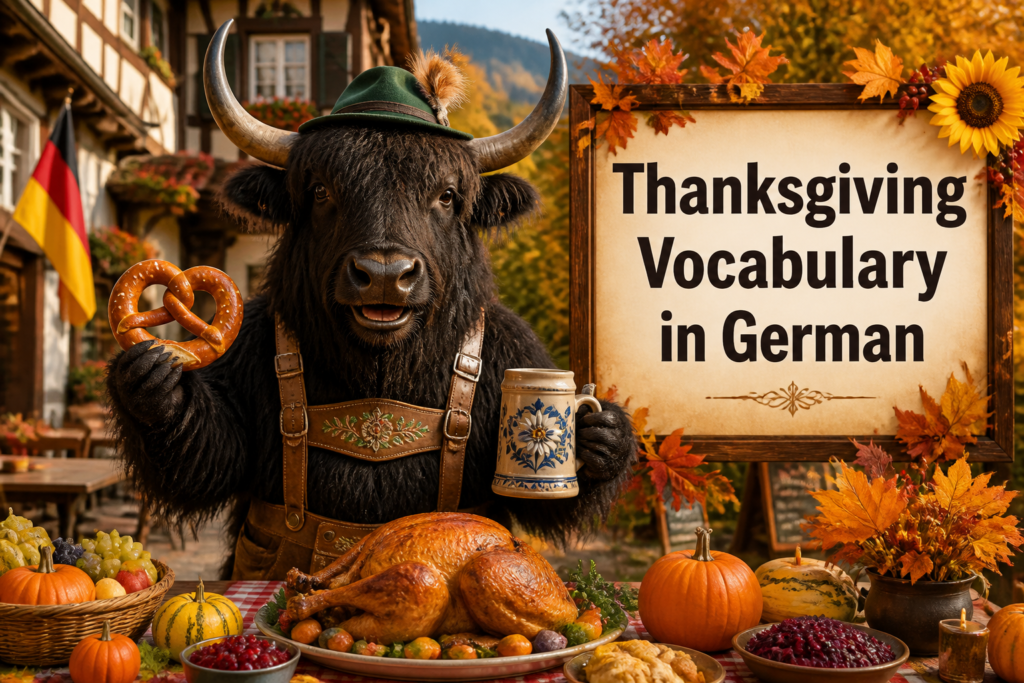
Thanksgiving is not a big traditional holiday in Germany the way it is in the United States or Canada, but the vocabulary is still useful. People travel, eat, host dinners, talk about being thankful, and borrow the whole cozy autumn mood anyway. Language does not care much about borders. It just wants a table and a plate of food.
In this guide, you will learn practical German words and phrases for Thanksgiving-style conversations: food, gratitude, family gatherings, and a few holiday expressions that show up in real life. You will also see where German speakers might use different wording than English speakers expect, because German loves being just a little more specific than necessary. Classic.
For a quick related holiday comparison, you can also check Christmas Vocabulary in German later. Same cozy energy, more candles, fewer turkeys.
Top Thanksgiving Words And Phrases
Here are the most useful words first. Some are direct Thanksgiving words, and some are the everyday German phrases you will actually need when talking about a holiday meal.
| German | Pronunciation | Meaning | Example Sentence | Translation | Learner Note |
|---|---|---|---|---|---|
| das Erntedankfest | airn-tuh-dahng-fest | Thanksgiving / harvest festival | In Deutschland feiert man eher das Erntedankfest als Thanksgiving. | In Germany, people celebrate the harvest festival more than Thanksgiving. | Long compound noun. Capitalize it. It sounds formal and cultural, not like a casual dinner invite. |
| dankbar | dahngk-bahr | thankful, grateful | Ich bin dir sehr dankbar. | I am very grateful to you. | Common and useful all year round. |
| die Dankbarkeit | dahngk-bahr-kite | gratitude | Dankbarkeit ist ein schönes Gefühl. | Gratitude is a nice feeling. | Noun form of dankbar. Feminine: die. |
| danken | dahn-ken | to thank | Wir danken euch für das Essen. | We thank you for the food. | More formal or written than danke. |
| Danke schön | DAHN-kuh shurn | thank you very much | Danke schön für die Einladung. | Thank you very much for the invitation. | Polite and very common. You can also just say Danke. |
| die Einladung | INE-lohng | invitation | Vielen Dank für die Einladung zum Abendessen. | Many thanks for the invitation to dinner. | Useful for holiday gatherings, dinner parties, and family events. |
| das Abendessen | AH-bent-eh-sen | dinner, evening meal | Das Abendessen ist um sechs Uhr. | Dinner is at six o’clock. | Very common in Germany. The main meal may be called Mittagessen or Abendessen depending on context. |
| das Festessen | FEST-eh-sen | feast meal, banquet meal | Zu Thanksgiving gibt es ein großes Festessen. | There is a big feast meal on Thanksgiving. | Great for holiday meals. Slightly formal, but natural. |
| das Familienessen | fa-MEE-lee-en-eh-sen | family meal | Das Familienessen dauert lange. | The family meal lasts a long time. | Good for gatherings that are more family than party. |
| die Familie | fa-MEE-lee-uh | family | Die Familie kommt aus verschiedenen Städten. | The family comes from different cities. | Very common in holiday talk. |
| das Essen | ESS-en | food, meal | Das Essen schmeckt fantastisch. | The food tastes fantastic. | One of the first words you need at any holiday table. |
| lecker | LEH-ker | tasty, delicious | Der Kürbiskuchen ist wirklich lecker. | The pumpkin pie is really delicious. | Very common and friendly. Works well in casual speech. |
| zu lecker | tsu LEH-ker | too tasty? usually “so tasty” | Der Braten ist zu lecker, um ihn nicht zu essen. | The roast is too tasty not to eat. | Usually the context is playful. More natural would be so lecker. |
| der Kürbis | KOOR-bis | pumpkin, squash | Ich mag Kürbis im Herbst. | I like pumpkin in autumn. | Very useful for Thanksgiving-style food. |
| der Kürbiskuchen | KOOR-bis-koo-khen | pumpkin cake / pumpkin pie | Der Kürbiskuchen steht schon auf dem Tisch. | The pumpkin pie is already on the table. | German speakers may say Kürbiskuchen even when English would say pumpkin pie. |
| der Truthahn | TROOT-hahn | turkey | Der Truthahn ist im Ofen. | The turkey is in the oven. | Helpful, even if the turkey is mostly an imported star of the show. |
| der Braten | BRAH-ten | roast | Es gibt einen Braten mit Gemüse. | There is a roast with vegetables. | Very natural for festive meals. |
| die Füllung | FOO-loong | stuffing, filling | Die Füllung schmeckt nach Kräutern. | The stuffing tastes like herbs. | Can mean filling in food generally, not only stuffing. |
| die Soße | SOH-suh | sauce, gravy | Ich nehme noch etwas Soße. | I’ll take a little more gravy. | In Germany, Soße is the standard spelling. In Switzerland, often Sauce. |
| die Beilage | BYE-lah-guh | side dish, accompaniment | Kartoffeln sind eine typische Beilage. | Potatoes are a typical side dish. | Great word for holiday menus. |
One small language note: English speakers often want one perfect German word for “Thanksgiving,” but German usually prefers the wider idea of a harvest festival. So Erntedankfest is the closest standard term, while in everyday conversation people may just talk about ein Festessen, ein Familienessen, or ein Dankesessen if they mean a Thanksgiving-style meal. Languages do enjoy making simple things a little fussy.
Mini rule: German nouns are capitalized, so der Truthahn, die Familie, and das Essen all get a big first letter. The sentence may be having a nice relaxed holiday; the nouns are still dressed formally.
More Useful Holiday And Dinner Phrases
These are the phrases you might actually say at the table, in a message, or when helping with dinner.
| German | Pronunciation | Meaning | Example Sentence | Translation | Learner Note |
|---|---|---|---|---|---|
| Guten Appetit! | GOO-ten ap-peh-TEET | Enjoy your meal! | Guten Appetit und frohes Fest! | Enjoy your meal and happy holiday! | Very common before eating. Works at any meal, not only holiday food. |
| Frohes Fest! | FROH-es fest | Happy holiday! | Ich wünsche euch ein frohes Fest. | I wish you a happy holiday. | Broad holiday phrase, often used in December too. |
| Viel Spaß! | feel shpahs | Have fun! | Viel Spaß beim Abendessen mit der Familie! | Have fun at dinner with the family! | Very common and friendly. |
| Es riecht gut. | ess ree-kht gooht | It smells good. | Es riecht gut in der Küche. | It smells good in the kitchen. | Great for holiday cooking. Watch the ch sound in riecht. |
| Ich bin satt. | ikh bin zat | I am full. | Danke, ich bin satt. | Thanks, I’m full. | Use this after eating. Not ich bin voll unless you want to sound like a container. |
| Ich nehme noch etwas. | ikh NAY-muh nokh ET-was | I’ll take a little more. | Ja, ich nehme noch etwas von der Soße. | Yes, I’ll take a little more of the gravy. | Very natural at the table. |
| Kannst du mir bitte den Kürbis reichen? | kahnst doo meer BIT-tuh den KOOR-bis RY-khen | Can you please pass me the pumpkin? | Kannst du mir bitte die Soße reichen? | Can you please pass me the sauce? | reichen means “pass” in this context. |
| Wir sind eingeladen. | veer zint EYE-n-ge-lah-dən | We are invited. | Wir sind zum Abendessen eingeladen. | We are invited to dinner. | Useful for RSVPs and holiday plans. |
| Was bringe ich mit? | vahs BRING-uh ikh mit | What should I bring? | Was bringe ich zum Festessen mit? | What should I bring to the feast? | Excellent phrase for potlucks and family dinners. |
| Ich bringe einen Salat mit. | ikh BRING-uh EYE-nen zah-LAHT mit | I’m bringing a salad. | Ich bringe einen Salat und Brot mit. | I’m bringing a salad and bread. | mitbringen is separable: ich bringe … mit. |
| Mach es dir gemütlich. | makh ess deer guh-MOOT-likh | Make yourself comfortable. | Mach es dir gemütlich, das Essen kommt gleich. | Make yourself comfortable, the food is coming soon. | Very natural in homes and at relaxed gatherings. |
| Setz dich. | zets ikh | Take a seat. | Setz dich an den Tisch. | Take a seat at the table. | Casual imperative, often used with friends or family. |
| Der Tisch ist gedeckt. | dehr tish ist guh-DEKT | The table is set. | Der Tisch ist schon gedeckt. | The table is already set. | Handy phrase for hosts and dinner prep. |
| Es gibt viel zu essen. | ess geeft feel tsoo ESS-en | There is lots of food. | Zu Thanksgiving gibt es immer viel zu essen. | At Thanksgiving there is always lots of food. | Very useful and very true. |
| Ich freue mich auf das Essen. | ikh FROY-uh mikh oof das ESS-en | I’m looking forward to the meal. | Ich freue mich auf das Essen mit der Familie. | I’m looking forward to the meal with the family. | sich freuen auf takes the accusative: auf das Essen. |
| Vielen Dank für alles. | FEE-len dahngk fir AH-les | Thank you for everything. | Vielen Dank für alles heute Abend. | Thank you for everything this evening. | Warm and useful when leaving or thanking the host. |
The phrase Guten Appetit is especially handy because it works before a holiday meal, a normal lunch, or even a random plate of pasta. German likes practical phrases. No dramatic speeches required before the first bite.
Food Vocabulary For A Thanksgiving Table
Here is a bigger food list with the kinds of dishes and ingredients you might hear around an autumn holiday meal. Some are classic Thanksgiving foods; some are the German words you need to describe them.
| German | Pronunciation | Meaning | Example Sentence | Translation | Learner Note |
|---|---|---|---|---|---|
| der Apfel | AHP-fel | apple | Der Apfelkuchen ist noch warm. | The apple cake is still warm. | Common autumn fruit word. |
| der Apfelkuchen | AHP-fel-koo-khen | apple cake / apple pie | Zum Dessert gibt es Apfelkuchen. | There is apple cake for dessert. | German often says Kuchen where English says pie. |
| der Zimt | tsimt | cinnamon | Der Zimt riecht wunderbar. | The cinnamon smells wonderful. | Great for autumn baking. |
| die Nelke | NEL-kuh | clove | Manchmal kommt Nelke in Gewürzkuchen vor. | Sometimes clove appears in spiced cake. | Useful for spice vocabulary. |
| das Gewürz | guh-VOORTS | spice, seasoning | Die Suppe braucht mehr Gewürz. | The soup needs more seasoning. | Singular. Plural: die Gewürze. |
| die Kräuter | KROI-ter | herbs | Die Füllung hat viele Kräuter. | The stuffing has many herbs. | Plural noun. No singular use here in this sense. |
| die Kartoffel | kar-TOF-fel | potato | Wir essen Kartoffeln mit der Soße. | We eat potatoes with the gravy. | Plural is often used in meals. |
| das Gemüse | guh-MOO-zuh | vegetables | Zum Braten gibt es Gemüse. | There are vegetables with the roast. | Plural-like noun. Usually no article change in plural sense. |
| der Mais | mice | corn | Mais ist eine beliebte Beilage. | Corn is a popular side dish. | Useful for North American-style meals. |
| das Brot | broht | bread | Frisches Brot passt immer gut dazu. | Fresh bread always goes well with it. | Germany has a strong bread culture. No surprise there. |
| die Butter | BOO-ter | butter | Bitte reich mir die Butter. | Please pass me the butter. | Common table word. |
| die Brötchen | BROIT-chen | bread rolls | Zum Frühstück gibt es Brötchen. | There are rolls for breakfast. | Not Thanksgiving-specific, but very German table vocabulary. |
| der Salat | za-LAHT | salad | Der Salat ist frisch und knackig. | The salad is fresh and crisp. | Common side dish. |
| die Kürbissuppe | KOOR-bis-ZOO-puh | pumpkin soup | Im Herbst essen viele Leute Kürbissuppe. | In autumn many people eat pumpkin soup. | Very natural seasonal word in German-speaking countries. |
| der Nachtisch | NAHKH-tish | dessert | Zum Nachtisch gibt es Kuchen. | There is cake for dessert. | Very common everyday word. |
| das Dessert | deh-SERRT | dessert | Wir servieren das Dessert später. | We’ll serve dessert later. | More formal or restaurant-like than Nachtisch. |
| der Kuchen | KOO-khen | cake | Der Kuchen ist selbst gebacken. | The cake is homemade. | Very important. German Kuchen can cover many baked dessert ideas. |
| backen | BAK-en | to bake | Meine Tante backt den Kuchen. | My aunt is baking the cake. | Strong verb. Past tense changes in a fun, unfair way, as verbs do. |
| der Honig | HOH-nig | honey | Der Honig passt gut zu warmem Brot. | Honey goes well with warm bread. | Useful for breads, glazes, and sauces. |
| die Sahne | ZAH-nuh | cream, whipping cream | Bitte mit Sahne. | Please with cream. | Very common for desserts. |
If you are wondering about Kürbiskuchen versus pumpkin pie, German does not always split dessert categories the same way English does. The word Kuchen can cover a wide range of baked sweet things. German, being German, happily keeps the exact mental boundaries slightly messy and then acts surprised when learners ask questions.
Helpful Verbs For Talking About A Holiday Meal
Verbs matter because holiday talk is full of actions: cooking, inviting, thanking, serving, and eating way too much.
| German | Pronunciation | Meaning | Example Sentence | Translation | Learner Note |
|---|---|---|---|---|---|
| essen | ESS-en | to eat | Wir essen zusammen um sieben. | We eat together at seven. | Very common. Remember the vowel change in some forms: ich esse, du isst. |
| trinken | TRINK-en | to drink | Trinkst du Wasser oder Saft? | Do you drink water or juice? | Useful with dinner and toasts. |
| kochen | KOKH-en | to cook | Meine Mutter kocht das Festessen. | My mother is cooking the feast. | Useful in homes and recipes. |
| backen | BAK-en | to bake | Wir backen einen Apfelkuchen. | We are baking an apple cake. | Common for desserts and bread. |
| servieren | zehr-vee-REEN | to serve | Das Dessert wird gleich serviert. | The dessert will be served soon. | Often used in formal contexts or restaurants. |
| bringen | BRING-en | to bring | Ich bringe einen Salat mit. | I’m bringing a salad. | Very common in invitation conversations. |
| einladen | INE-lah-den | to invite | Wir laden die Nachbarn ein. | We are inviting the neighbors. | Separable verb: laden … ein. |
| danken | dahn-ken | to thank | Ich danke dir für das Essen. | I thank you for the meal. | More formal than danke, but still useful. |
| sich freuen auf | zikh FROY-en oof | to look forward to | Wir freuen uns auf den Abend. | We are looking forward to the evening. | Reflexive verb. Needs the right pronoun: ich freue mich, wir freuen uns. |
| reichen | RY-khen | to pass, hand over | Kannst du mir bitte die Kartoffeln reichen? | Can you please pass me the potatoes? | Useful at the table. Often sounds a bit more polite than plain geben. |
Quick Phrases For Gratitude And Hosting
Thanksgiving is really about two things in language: appreciating people and surviving the meal without unbuttoning your pants in public. Here are the best phrases for gratitude and hospitality.
- Danke für die Einladung. — Thank you for the invitation.
- Vielen Dank für das leckere Essen. — Thank you very much for the delicious food.
- Ich bin sehr dankbar für meine Familie. — I am very grateful for my family.
- Wir sind froh, hier zu sein. — We are happy to be here.
- Es war ein wunderschöner Abend. — It was a wonderful evening.
- Alles war sehr lecker. — Everything was very tasty.
- Das war ein tolles Festessen. — That was a great feast.
- Ich habe mich sehr wohlgefühlt. — I felt very comfortable / at home.
- Schön, dass ihr da seid. — Nice that you are here.
- Schön, dass Sie da sind. — Nice that you are here.
Notice the difference between ihr and Sie. ihr is casual “you all” or “you guys,” while Sie is the polite form. If you are at a family Thanksgiving-style meal, ihr is normal. If you are at a more formal dinner, Sie may be safer. German politeness loves making you choose. Charming, really.
Useful Small Talk Around The Table
These phrases help when the meal is not the whole point and people are just chatting before the food arrives.
| German | Pronunciation | Meaning | Example Sentence | Translation | Learner Note |
|---|---|---|---|---|---|
| Wie war dein Tag? | vee vahr dyne tahk | How was your day? | Wie war dein Tag vor dem Festessen? | How was your day before the feast? | Casual dein form. |
| Wie war Ihr Tag? | vee vahr eer tahk | How was your day? | Wie war Ihr Tag heute? | How was your day today? | Polite Ihr form. |
| Was gibt es Neues? | vahs geeft ess NOY-es | What’s new? | Was gibt es Neues in der Familie? | What’s new in the family? | Easy small-talk opener. |
| Wie schmeckt es? | vee shmeckt ess | How does it taste? | Wie schmeckt der Kuchen? | How does the cake taste? | Good when asking about food. |
| Es schmeckt wunderbar. | ess shmeckt VOON-der-bahr | It tastes wonderful. | Der Braten schmeckt wunderbar. | The roast tastes wonderful. | Strong positive compliment. |
| Das ist sehr gemütlich. | das ist zair guh-MOOT-likh | That is very cozy. | Das Abendessen ist sehr gemütlich. | The dinner is very cozy. | gemütlich is a lovely word for warm, comfy, relaxed vibes. |
| Ich mag den Herbst. | ikh mahk den herbst | I like autumn. | Ich mag den Herbst mit seinen Farben. | I like autumn with its colors. | Nice seasonal sentence. |
| Die Blätter sind bunt. | dee BLEH-ter zint boont | The leaves are colorful. | Die Blätter sind im Herbst bunt. | The leaves are colorful in autumn. | Great for seasonal talk before the meal. |
| Ich habe Hunger. | ikh HAH-buh HOONG-er | I’m hungry. | Ich habe nach dem Spaziergang Hunger. | I’m hungry after the walk. | Very common. The opposite is Ich bin satt. |
| Ich bin pappsatt. | ikh bin PAP-zat | I’m completely stuffed. | Nach dem Festessen war ich pappsatt. | After the feast I was completely stuffed. | Casual and slightly funny. Very useful after a huge meal. |
Duden is a boring but reliable place to check word meanings and spelling if you want to dig deeper. Yes, “boring but reliable” is a compliment.
Germany, Austria, And Switzerland: Small Thanksgiving Vocabulary Differences
Thanksgiving itself is not a major holiday in the German-speaking world, but the food vocabulary can still show regional differences. Most everyday words are shared, yet a few terms shift depending on the country.
| English Idea | Germany | Austria | Switzerland | Learner Note |
|---|---|---|---|---|
| gravy / sauce | die Soße | die Soße or die Sauce | die Sauce | Spelling changes more than meaning. Swiss German often keeps the French-looking spelling. |
| Thanksgiving-style meal | das Erntedankfest | das Erntedankfest | das Erntedankfest | Standard term across the region, though the holiday is not equally prominent everywhere. |
| dessert | der Nachtisch / das Dessert | der Nachtisch / das Dessert | das Dessert | Nachtisch sounds especially everyday. |
| small bread rolls | die Brötchen | die Semmeln | die Brötchen / regional forms vary | Very useful if rolls appear at the table. Austrians often say Semmeln. |
| cake / pie | der Kuchen | der Kuchen | der Kuchen | Stable across regions, but desserts may be named differently in practice. |
If a learner sees Semmel in Austria instead of Brötchen, that is not a mystery and not a trap. It is just regional vocabulary doing its little regional dance.
Common Confusion Points
These are the spots where English speakers often stumble. Nothing dramatic. Just the usual language gremlins.
- Thanksgiving is not a standard public holiday in Germany. The closest general term is Erntedankfest, but many people will simply talk about a festive meal.
- “Pie” is often translated loosely as Kuchen. German does not always divide desserts the same way English does.
- “Stuffing” can be Füllung. But German also uses it more generally for “filling.”
- “Gravy” is usually Soße. Do not overcomplicate it.
- German word order changes after time expressions. Example: Am Donnerstag essen wir zusammen. — On Thursday we eat together.
- Separable verbs split apart. Example: Wir laden die Gäste ein. — We invite the guests.
- Don’t forget noun capitalization. der Herbst, die Familie, das Festessen.
Need a broader seasonal vocabulary path after this? The main German learning hub is here: Learn German. Useful when one holiday word leads to twenty more, which is exactly how language learning sneaks up on people.
Quick Practice
Try these mini drills. Short, simple, and far less annoying than pretending you only need “some vocabulary” and not actual practice.
| Prompt | Answer | Translation | Learner Note |
|---|---|---|---|
| Say “Thank you for the invitation.” | Danke für die Einladung. | Thank you for the invitation. | Good basic gratitude phrase. |
| Say “The table is set.” | Der Tisch ist gedeckt. | The table is set. | Useful before dinner. |
| Say “I’m looking forward to the meal.” | Ich freue mich auf das Essen. | I’m looking forward to the meal. | Remember auf + accusative. |
| Say “Can you please pass the sauce?” | Kannst du mir bitte die Soße reichen? | Can you please pass me the sauce? | Great table phrase. |
| Say “I’m completely stuffed.” | Ich bin pappsatt. | I’m completely stuffed. | Casual and very natural. |
| Say “We are invited to dinner.” | Wir sind zum Abendessen eingeladen. | We are invited to dinner. | Passive-style construction, very useful. |
| Say “Everything was very delicious.” | Alles war sehr lecker. | Everything was very delicious. | Easy compliment. |
| Say “What should I bring?” | Was bringe ich mit? | What should I bring? | Perfect for potlucks and family meals. |
Extra Pronunciation Tip: The German ch Sound
The ch in words like ich, weich, and reich is usually a soft sound, kind of like a light hiss from the back of the mouth. In Kuchen and kochen, it is harsher and deeper. Do not panic. German uses one spelling and two moods.
Extra Note: ß Versus ss
In standard German, ß appears after a long vowel or diphthong, while ss often follows a short vowel. For this topic, you will mostly see groß, Fuß, or heiß in related seasonal writing, but the main Thanksgiving words here are more about food than spelling drama.
Next-Step Words To Learn After Thanksgiving Vocabulary
If this topic feels useful, the next logical step is learning holiday and winter food language more broadly. That gives you more words for invitations, recipes, greetings, and family gatherings without repeating the same turkey sentence forever.
- Autumn vocabulary for weather, colors, and seasonal activities
- Christmas vocabulary for winter markets, gifts, and holiday greetings
- Cooking verbs like schneiden, braten, and rühren
- Restaurant phrases for ordering, thanking, and paying
- Family vocabulary for gatherings, relatives, and celebrations
Thanksgiving vocabulary in German is really a mix of holiday words, food words, and polite table phrases. Learn those, and you can survive the feast with style, gratitude, and maybe one extra helping of Kürbiskuchen. Yak takeaway: when in doubt, say Danke, ask Was bringe ich mit?, and never underestimate the power of Guten Appetit!