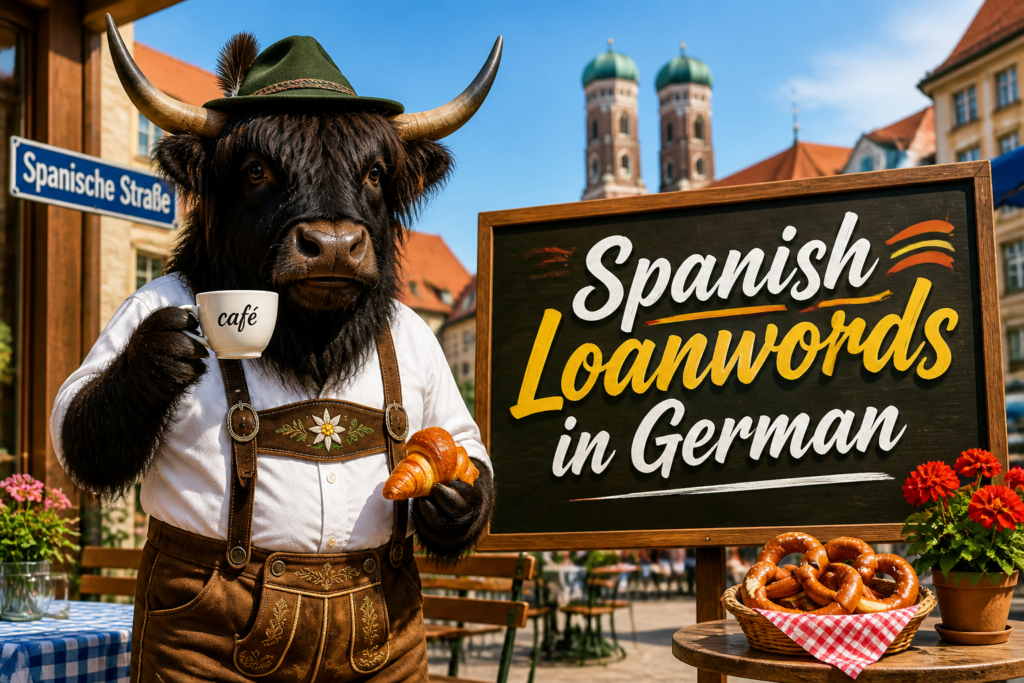
Spanische Lehnwörter im Deutschen are the little language souvenirs German picked up from Spanish over time. Some are obvious, some are sneaky, and some have been wandering around German so long that nobody really notices they arrived with a passport. If you already know a bit of German, these words are fun because they often feel familiar but still behave in very German ways.
For the broader learning path, visit our parent guide.
German borrowed Spanish words mostly through travel, trade, food, music, and culture. And yes, food does a lot of the heavy lifting here. As usual. By the end of this article, you’ll recognize common Spanish loanwords in German, know what they mean, and use them in real sentences without making the vocabulary equivalent of a badly folded napkin.
For a broader look at borrowed vocabulary, you can also compare this topic with French words used in German and English words used in German loanwords. If you like regional flavor, regional words in German is another good rabbit hole.
One quick note: a word may look Spanish, but in German it can have a slightly different meaning, pronunciation, or register. That is not a bug. That is German being German.
Why German Has Spanish Loanwords
Spanish did not flood German with thousands of words the way English has in modern times, but it left a noticeable footprint. Many Spanish words entered German through food culture, colonial history, arts, and international trade. Some came directly from Spanish, while others arrived through French or Italian first and only later settled into German. Linguists love that kind of relay race.
Most of these loanwords are nouns. A few are adjectives or interjections. And some are so naturalized in German spelling and pronunciation that learners do not even realize they come from Spanish.
Yak note: If a German word looks a bit too sunny, spicy, or musical, it may have Spanish roots hiding in plain sight.
Common Spanish Loanwords In German
The table below gives you the most useful and recognizable Spanish-origin words you may meet in German. Pronunciation help is kept simple on purpose, because nobody needs a phonetics lecture wearing a tiny sombrero.
| German | Pronunciation | Meaning | Example Sentence | Translation | Learner Note |
|---|---|---|---|---|---|
| der Tomate / die Tomate | toh-MAH-teh | tomato | Ich kaufe heute Tomaten für den Salat. | I’m buying tomatoes for the salad today. | From Spanish tomate. In German, the singular is die Tomate; the plural is die Tomaten. |
| die Kartoffel / die Kartoffeln | kar-TOF-fel | potato | Wir essen Kartoffeln mit Gemüse. | We’re eating potatoes with vegetables. | Originally from the Americas via Spanish. Not a direct everyday Spanish word in form, but historically tied to Spanish contact. |
| die Fiesta | fee-ES-tah | party, festival | Das Sommerfest war eine echte Fiesta. | The summer festival was a real fiesta. | Used in a festive, playful sense. Not the default word for a normal party. |
| die Siesta | see-ES-tah | afternoon nap, rest | Nach dem Essen machen wir eine kurze Siesta. | After lunch, we take a short siesta. | Often used when talking about a nap or a relaxed break. |
| der Macho / die Machos | MAH-cho | macho man | Er spielt gern den Macho, aber das wirkt eher peinlich. | He likes to play the macho man, but it comes off as kind of embarrassing. | Usually negative or critical. Very common in German commentary. |
| die Plaza | PLAH-tsah | square, plaza | Wir treffen uns auf der Plaza im Stadtzentrum. | We’re meeting at the plaza in the city center. | More likely in travel or cultural contexts than in everyday local German. |
| das Patio | PAH-tee-oh | courtyard, patio | Das Hotel hat einen schönen Patio. | The hotel has a nice courtyard. | Common in architecture, tourism, and descriptions of houses. |
| der Tornado / die Tornados | tor-NAH-doh | tornado | Ein Tornado hat in der Region Schäden verursacht. | A tornado caused damage in the region. | Same shape in English and German, but the German plural is usually Tornados. |
| die Cigarre / die Zigarre | tsee-GA-rə | cigar | Er raucht nur selten eine Zigarre. | He only rarely smokes a cigar. | The modern spelling is usually Zigarre. The older form Cigarre is historical. |
| der Cacao / der Kakao | kah-KOW | cocoa | Ich trinke gern Kakao im Winter. | I like drinking cocoa in winter. | The German standard spelling is Kakao, but the word ultimately comes via Spanish-related contact history. |
Some of these words are everyday German now, especially food terms. Others are more stylistic, colorful, or context-specific. Either way, they are worth knowing because they pop up in reading, menus, travel writing, and casual speech.
More Spanish-Related Words You May See
This next table gives you more vocabulary that is less universal but still very handy. Some items are direct loanwords, while others are Spanish-flavored cultural words used in German.
| German | Pronunciation | Meaning | Example Sentence | Translation | Learner Note |
|---|---|---|---|---|---|
| der Sombrero / die Sombreros | som-BREH-roh | wide-brimmed hat | Der Mann trägt einen Sombrero im Karneval. | The man is wearing a sombrero at carnival. | Often used in cultural or costume contexts, sometimes humorously. |
| der Elch? | — | not Spanish; false trail | — | — | This is here as a reminder: not every exotic-looking word is Spanish. German loves a decoy. |
| die Hacienda / die Haciendas | ha-syen-DAH | estate, large ranch, plantation house | Die Hacienda liegt außerhalb der Stadt. | The hacienda is outside the city. | Used for Latin American settings, history, or architecture. |
| die Guerrilla / die Guerilla | geh-RIL-yah | guerrilla warfare, guerrilla group | Die Guerilla war in den Nachrichten ein großes Thema. | The guerrilla movement was a big topic in the news. | In German, the spelling often appears as Guerilla. |
| der Amigos | ah-MEE-gos | friends, buddies | Er nennt seine Freunde oft seine Amigos. | He often calls his friends his amigos. | Usually playful, joking, or in a pop-culture style. |
| die Ranch | rench | ranch | Sie arbeitet auf einer Ranch in Kanada. | She works on a ranch in Canada. | Borrowed from English via international usage, but often tied to Spanish-speaking imagery. |
| die Matadorin / der Matador | mah-tah-DOHR | bullfighter, winner, star performer | Er ist der Matador des Teams. | He is the star performer of the team. | Figurative use is common in German journalism and sports. |
| die Armada | ar-MAH-dah | fleet, large force | Eine Armada von Fahrrädern blockierte die Straße. | A fleet of bicycles blocked the street. | Often used figuratively for large groups. |
| der Ketchup | KECH-up | ketchup | Kann ich bitte Ketchup dazu haben? | Could I have ketchup with that, please? | Not Spanish in origin, but useful in the same everyday food vocabulary space. |
| die Salsa | SAL-sah | sauce; salsa dance/music | Wir tanzen gern Salsa am Wochenende. | We like dancing salsa on the weekend. | In German, Salsa can mean sauce or the dance/music style depending on context. |
If you are noticing that some of these are more “Spanish-world” than strictly Spanish-origin, good. That is a helpful distinction. German often uses words from Spanish culture, Latin America, or international media even when the borrowing route is a little messy.
Useful Phrases With Spanish Loanwords
Now let’s use these words in real-life German phrases. That is the part that actually sticks in your brain, unlike random vocabulary lists that vanish five minutes later like a cheap pastry in a train station.
- eine Siesta machen — “to take a nap / rest” — Wir machen nach dem Mittagessen eine Siesta. — “We take a siesta after lunch.”
- eine Fiesta feiern — “to celebrate a party/festival” — Im Sommer feiert die Stadt eine große Fiesta. — “In summer, the city celebrates a big fiesta.”
- wie ein Macho auftreten — “to act like a macho man” — Er tritt oft wie ein Macho auf. — “He often acts like a macho man.”
- Kakao trinken — “to drink cocoa” — Die Kinder trinken Kakao am Abend. — “The children drink cocoa in the evening.”
- auf der Plaza sitzen — “to sit at the plaza” — Wir sitzen auf der Plaza und schauen den Leuten zu. — “We sit at the plaza and watch people.”
- ein Sombrero tragen — “to wear a sombrero” — Er trägt bei der Party einen Sombrero. — “He wears a sombrero at the party.”
- eine Zigarre rauchen — “to smoke a cigar” — Mein Onkel raucht manchmal eine Zigarre. — “My uncle sometimes smokes a cigar.”
- eine Armada von … — “a fleet/large number of …” — Eine Armada von Autos stand im Stau. — “A fleet of cars was stuck in traffic.”
- mit der Guerilla kämpfen — “to fight with the guerrilla movement” — Das Land kämpfte jahrelang mit der Guerilla. — “The country fought with guerrilla forces for years.”
- wie auf einer Hacienda wohnen — “to live like on a hacienda” — Das Haus sieht aus, als würde man auf einer Hacienda wohnen. — “The house looks like you’d live on a hacienda.”
Some phrases are literal, while others are idiomatic. Eine Armada von … is a good example: in German it often means “a huge number of something,” not just ships. Nice little semantic upgrade. Very German of it.
Pronunciation Tips For Spanish Loanwords In German
German speakers usually adapt Spanish-looking words to German sound patterns. That means the pronunciation is often close, but not identical to Spanish. Here are the main things to listen for.
| Sound | German-Friendly Tip | Example | What To Notice |
|---|---|---|---|
| j in Spanish-looking words | Often sounds like y or a soft German ch depending on the word and origin | Fiesta, Siesta | The vowel rhythm matters more than perfect Spanish sound imitation. |
| z | In German, z is usually pronounced like ts | Zigarre | Do not say English z here. |
| sch | Sounds like English sh | Sombrero in some accents may soften nearby sounds, but the word itself does not use sch | German spelling is very regular here. |
| r | Often a soft, throaty German r | Armada, Tomate | Do not stress the r too hard. |
| Final consonants | German often devoices them | Tornado, Macho | Final sounds may be a bit crisper than in English. |
If you want a boring but useful pronunciation reference for individual words, the Duden is still one of the most reliable places to check standard German spelling and usage. Not glamorous, but solid. Like a sensible raincoat.
Spelling And Grammar Notes
Spanish loanwords in German often behave like normal German nouns. That means they take German articles, plural forms, and capitalization. Because of course they do. German is a country where every noun wants a title.
| Word | Gender | Plural | Learner Note |
|---|---|---|---|
| die Tomate | feminine | die Tomaten | Very common and important in food vocabulary. |
| die Fiesta | feminine | die Fiestas | Uses regular German plural -s for many foreign words. |
| die Siesta | feminine | die Siestas | Also commonly pluralized with -s. |
| der Macho | masculine | die Machos | Many borrowed masculine nouns take -s in the plural. |
| die Zigarre | feminine | die Zigarren | Here the plural is fully Germanized with -n. |
| das Patio | neuter | die Patios | Neuter foreign nouns often take -s. |
One thing that helps: do not assume the gender from Spanish. German gender is its own little kingdom, and it does not always send a newsletter.
Quick memory trick: Foreign nouns in German often like -s in the plural, especially when they sound international.
Common Confusions And False Friends
Some words look Spanish or feel Spanish but are used differently in German. Others sound familiar because they entered German through international culture, not because German and Spanish are secretly sharing a vocabulary spreadsheet.
| German Word | Not To Assume | Better Understanding | Example |
|---|---|---|---|
| die Fiesta | Not just any party | Usually a festive, colorful event | Das Straßenfest war eine echte Fiesta. |
| der Macho | Not a compliment in many contexts | Usually implies exaggerated masculinity | Er verhält sich wie ein Macho. |
| die Salsa | Not always just “sauce” | Can mean sauce or the dance style | Wir essen Salsa oder tanzen Salsa. |
| das Patio | Not the same as English “patio” in every case | Often a courtyard or inner yard | Im Hotel gibt es ein offenes Patio. |
| die Armada | Not always a literal navy | Often used figuratively for a large crowd or mass | Eine Armada von Fans wartete vor der Halle. |
If you are curious about how German treats borrowed words from other languages in general, the standard reference pages on loanwords are useful for background. For German-specific study, vocabulary lists from Goethe-Institut and DW Learn German are usually reliable and pleasantly unexciting, which is exactly what you want from a language source.
Germany, Austria, And Switzerland: Any Differences?
For many Spanish loanwords, the usage is broadly similar across standard German. But everyday vocabulary can still shift a bit by region, especially in travel, food, and cultural contexts.
- Germany: standard German will usually use words like Tomate, Zigarre, Fiesta, and Siesta in the same way you’d expect from dictionaries and media.
- Austria: many of the same borrowings appear, but some cultural terms may be used a bit more warmly or in tourism contexts.
- Switzerland: standard written German still uses the same forms, though spoken Swiss German may prefer local everyday alternatives in casual speech.
If you want a closer look at how German vocabulary changes by region, the guide to regional words in German is a helpful companion piece. Vocabulary is never as tidy as grammar books pretend it is.
Mini Practice
Try these quick exercises. The answers are simple, but simple is not the same thing as easy. Annoying, yes. But useful.
| Task | Prompt | Possible Answer | Why It Helps |
|---|---|---|---|
| 1 | Translate: “I’m drinking cocoa.” | Ich trinke Kakao. | Practices a common everyday loanword. |
| 2 | Translate: “We are at the plaza.” | Wir sind auf der Plaza. | Practices location with auf. |
| 3 | Choose the correct plural: die Tomate / die Tomaten | die Tomaten | Shows regular plural formation. |
| 4 | Translate: “He acts like a macho.” | Er verhält sich wie ein Macho. | Practices a figurative use. |
| 5 | Translate: “They are having a short siesta.” | Sie machen eine kurze Siesta. | Useful for natural German phrasing. |
Extra challenge: make one sentence with Fiesta and one with Armada in a figurative way. German loves dramatic vocabulary when it can get away with it.
Quick Answer Check
Fiesta: Die Straßenparty war eine echte Fiesta. — “The street party was a real fiesta.”
Armada: Eine Armada von Radfahrern fuhr durch die Stadt. — “A fleet of cyclists rode through the city.”
Quick Reference Summary
- Spanish loanwords in German are mostly nouns tied to food, culture, travel, and colorful description.
- Common examples include Tomate, Fiesta, Siesta, Macho, Plaza, and Zigarre.
- German usually applies its own grammar: articles, plural forms, and capitalization.
- Many borrowed words keep a slightly exotic or stylistic feeling, even when they are well established.
- Some words are more cultural than strictly Spanish in origin, so context matters.
- Pronunciation usually follows German patterns, not Spanish ones.
Spanish loanwords in German are a small but lively part of the language. They add flavor, they show history, and they make German feel a little more international without trying too hard. In other words: useful, stylish, and not remotely boring, which is rare enough to deserve respect.
Yak takeaway: when German borrows a Spanish word, it usually keeps the fun and changes the grammar. Classic German move.