
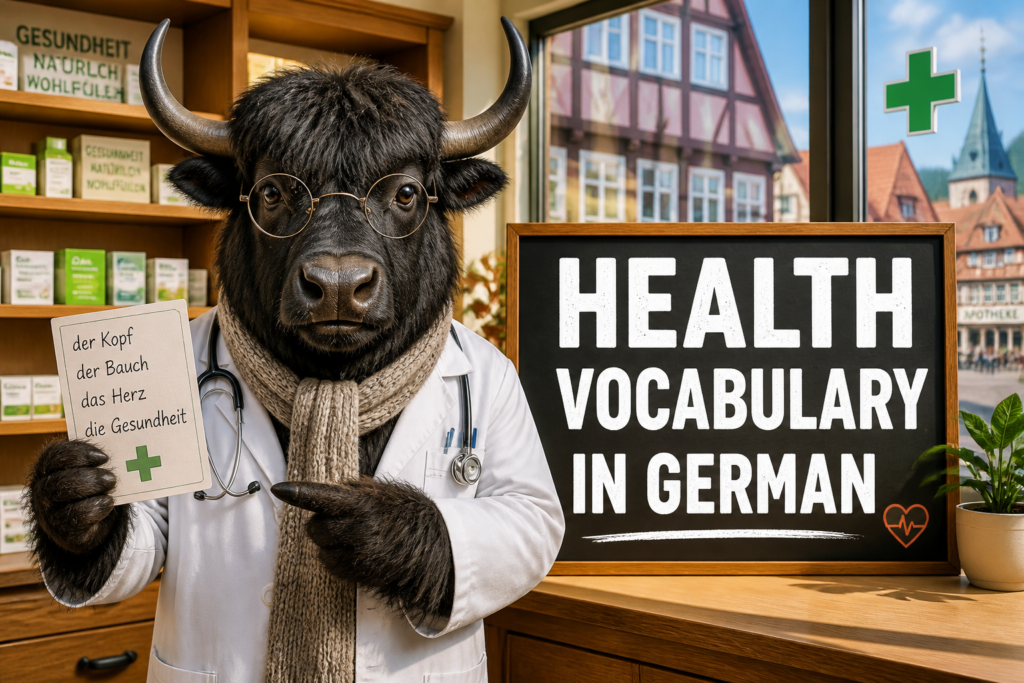
Getting sick in another language is never charming, glamorous, or educational in the fun way. But it is useful. If you know a few solid German health words, you can explain what hurts, ask for help, and survive a pharmacy visit without silently panicking into your jacket.
This guide gives you practical Health Vocabulary in German for real-life situations: symptoms, body parts, doctor visits, medicine, emergencies, and a few handy phrases for when your body decides to be dramatic. Standard German is the default here, with a few regional notes where they actually matter.
You will also see a couple of common expressions that show up in everyday life, because German speakers do not always say things the way a textbook would. Shocking, really.
Learn German | Health Vocabulary in German | Bathroom Vocabulary in German | Feelings Vocabulary in German
Quick Health Basics
If you remember only a few phrases, start here. These are the words and sentences most likely to save you from confusion, awkwardness, or an unnecessary mime performance.
| German | Pronunciation | Meaning | Example Sentence | Translation | Learner Note |
|---|---|---|---|---|---|
| die Gesundheit | dee geh-ZOONT-hait | health | Gesundheit ist wichtig. | Health is important. | Noun, feminine: die. |
| krank | krahnk | sick, ill | Ich bin heute krank. | I am sick today. | Very common and useful. |
| es geht mir schlecht | es gayt meer shlekt | I feel bad / I’m not well | Heute geht es mir schlecht. | Today I feel bad. | Natural and polite enough for many situations. |
| Ich habe Schmerzen. | ikh hah-buh shmahrt-sen | I have pain. | Ich habe Schmerzen im Rücken. | I have pain in my back. | “Schmerzen” is plural in German. |
| Mir ist übel. | meer ist OO-bel | I feel nauseous / sick to my stomach | Mir ist übel nach der Fahrt. | I feel nauseous after the ride. | Common when travel turns mean. |
Common Symptoms
These are the words people actually use when describing how they feel. You do not need medical jargon to say your throat hurts or your head feels like a drum solo.
| German | Pronunciation | Meaning | Example Sentence | Translation | Learner Note |
|---|---|---|---|---|---|
| der Husten | dehr HOO-sten | cough | Ich habe starken Husten. | I have a bad cough. | Masculine noun: der. |
| der Schnupfen | dehr SHNOOP-fen | runny nose, cold | Er hat Schnupfen. | He has a cold. | Often means a common cold symptom. |
| das Fieber | dahs FEE-ber | fever | Das Kind hat Fieber. | The child has a fever. | Neutral noun: das. |
| die Kopfschmerzen | dee KOPF-shmahrt-sen | headache | Ich habe Kopfschmerzen. | I have a headache. | Plural only in normal use. |
| die Halsschmerzen | dee HAHLS-shmahrt-sen | sore throat | Sie hat Halsschmerzen. | She has a sore throat. | Also plural only. |
| die Bauchschmerzen | dee BOWKH-shmahrt-sen | stomach ache | Das Baby hat Bauchschmerzen. | The baby has a stomach ache. | Useful for children and adults alike. |
| der Schwindel | dehr SHVIN-del | dizziness | Ich habe Schwindel. | I feel dizzy. | Also used for vertigo. |
| die Übelkeit | dee OO-bel-kite | nausea | Nach dem Essen habe ich Übelkeit. | After eating, I feel nauseous. | Noun, feminine: die. |
| die Allergie | dee al-er-GEE | allergy | Er hat eine Allergie gegen Nüsse. | He has an allergy to nuts. | Use gegen for “against/to” here. |
| der Ausschlag | dehr OW-shlahk | rash | Ich habe einen Ausschlag. | I have a rash. | Needs accusative: einen. |
Note the pattern Ich habe … for many symptoms. English often uses “I feel” or “I have,” and German does the same in many health situations. Convenient for once.
Ich habe Kopfschmerzen is much more natural than trying to translate word-for-word from English. German likes direct symptom phrases. No unnecessary poetry while you are miserable.
Body Parts You Will Actually Need
If you need to point to where it hurts, body words matter. A lot. Here are the most useful ones, with article notes because German insists on making everything a little more grammatical than necessary.
| German | Pronunciation | Meaning | Example Sentence | Translation | Learner Note |
|---|---|---|---|---|---|
| der Kopf | dehr kopf | head | Mein Kopf tut weh. | My head hurts. | Common with wehtun. |
| der Hals | dehr hahls | throat, neck | Mein Hals tut weh. | My throat hurts. | Context decides throat or neck. |
| der Bauch | dehr bowkh | stomach, belly | Mein Bauch tut weh. | My stomach hurts. | Very common in everyday speech. |
| der Rücken | dehr RUEK-en | back | Mein Rücken tut weh. | My back hurts. | The ü sound is rounded; do not flatten it to “oo.” |
| der Arm | dehr arm | arm | Mein linker Arm tut weh. | My left arm hurts. | Often used with side words like links. |
| das Bein | dahs bine | leg | Mein Bein ist geschwollen. | My leg is swollen. | Pronounced like “bine,” not “bean.” |
| die Hand | dee hahnt | hand | Meine Hand tut weh. | My hand hurts. | Useful in injuries and doctor visits. |
| der Fuß | dehr foos | foot | Mein Fuß ist verletzt. | My foot is injured. | Watch ß: long vowel before ß. |
| das Ohr | dahs or | ear | Mein Ohr tut weh. | My ear hurts. | Neutral noun: das. |
| das Auge | dahs OW-guh | eye | Mein Auge ist rot. | My eye is red. | Plural: die Augen. |
| die Nase | dee NAH-zuh | nose | Meine Nase läuft. | My nose is running. | “Laufen” here means run, not sprint. |
Weh tun is a very handy phrase. The structure is usually: Mein Kopf tut weh. Literally: “My head does pain.” English is more polite to grammar. German is more direct.
Useful Doctor and Clinic Phrases
These phrases help in a medical office, at reception, or when explaining symptoms clearly. Keep them simple. In health situations, simple is beautiful.
| German | Pronunciation | Meaning | Example Sentence | Translation | Learner Note |
|---|---|---|---|---|---|
| Ich brauche einen Arzt / eine Ärztin. | ikh BROW-khuh ayn-en arts / ayn-uh airts-tin | I need a doctor. | Ich brauche einen Arzt. | I need a doctor. | Accusative after brauchen: einen/eine. |
| Ich möchte einen Termin. | ikh MEHKH-tuh ayn-en ter-MEEN | I would like an appointment. | Ich möchte einen Termin am Freitag. | I would like an appointment on Friday. | Polite and very useful. |
| Wo tut es weh? | voh toot es vay | Where does it hurt? | Wo tut es weh? fragte die Ärztin. | Where does it hurt? asked the doctor. | Great question to recognize. |
| Es tut hier weh. | es toot heer vay | It hurts here. | Es tut hier weh. | It hurts here. | Point while saying it. |
| Seit wann haben Sie das? | zite vahn hah-bən zee dahs | Since when have you had that? | Seit wann haben Sie das? | Since when have you had that? | Formal Sie with doctors is common. |
| Ich habe Fieber. | ikh hah-buh FEE-ber | I have a fever. | Ich habe Fieber seit gestern. | I have had a fever since yesterday. | Use with temperatures and infections. |
| Ich bin allergisch gegen … | ikh bin al-ER-gish gay-gen | I am allergic to … | Ich bin allergisch gegen Penicillin. | I am allergic to penicillin. | Very important phrase. Keep it ready. |
| Ich nehme Medikamente. | ikh NAY-muh meh-dee-kah-MEN-tuh | I take medication. | Ich nehme Medikamente. | I take medication. | Medikamente is plural. |
| Haben Sie etwas gegen Schmerzen? | hah-ben zee ET-vahs geh-gen shmahrt-sen | Do you have something for pain? | Haben Sie etwas gegen Schmerzen? | Do you have something for pain? | Very useful at a pharmacy. |
| Ich brauche einen Krankenwagen. | ikh BROW-khuh ayn-en krank-en-vah-gen | I need an ambulance. | Ich brauche einen Krankenwagen. | I need an ambulance. | Emergency phrase. Say it clearly. |
Sie is the formal “you” form. In medical settings, German speakers often use it by default with doctors, nurses, reception staff, and pharmacists. That is normal. You are not being cold; you are being appropriately civilized.
Pharmacy Vocabulary
Pharmacies are one of those places where a little German goes a long way. Here are the words for medicine, packaging, and the kind of questions you are likely to hear.
| German | Pronunciation | Meaning | Example Sentence | Translation | Learner Note |
|---|---|---|---|---|---|
| die Apotheke | dee ah-po-TAY-kuh | pharmacy | Die Apotheke ist um die Ecke. | The pharmacy is around the corner. | In Germany, pharmacies are serious places. Quietly serious. |
| das Medikament | dahs meh-dee-kah-MENT | medication, medicine | Dieses Medikament hilft. | This medicine helps. | Singular is das Medikament; plural is die Medikamente. |
| die Tablette | dee tah-BLET-teh | tablet, pill | Nehmen Sie bitte eine Tablette. | Please take one tablet. | Common in pharmacy instructions. |
| der Saft | dehr sahft | liquid medicine / syrup | Das Kind bekommt einen Saft. | The child gets a syrup. | Can mean juice too, so context matters. |
| die Salbe | dee ZAHL-buh | ointment, cream | Die Salbe hilft gegen den Ausschlag. | The ointment helps against the rash. | Useful for skin problems. |
| das Rezept | dahs reh-TSEPT | prescription | Ich brauche ein Rezept. | I need a prescription. | Don’t confuse with a cooking recipe. |
| frei verkäuflich | fry fer-KOYF-likh | available without prescription | Ist das frei verkäuflich? | Is that available without prescription? | Useful question at the pharmacy. |
| die Nebenwirkung | dee NAY-ben-veer-koong | side effect | Hat das Medikament Nebenwirkungen? | Does the medicine have side effects? | Plural: Nebenwirkungen. |
| die Dosis | dee DOH-ziss | dose | Welche Dosis soll ich nehmen? | What dose should I take? | Very useful when asking instructions. |
| der Beipackzettel | dehr BY-pak-TSET-tel | package insert | Ich lese den Beipackzettel. | I am reading the package insert. | A wonderfully German word. A compound noun doing compound noun things. |
If you want a boring but reliable reference for medical vocabulary and usage, Duden is a good place to check standard spelling and meaning. Boring is a compliment in this case.
At The Pharmacy: Small Conversations
Here are some natural mini exchanges that help you sound less like a textbook robot and more like a person asking for cold medicine.
| German | Pronunciation | Meaning | Example Sentence | Translation | Learner Note |
|---|---|---|---|---|---|
| Ich suche etwas gegen Husten. | ikh ZOO-khuh ET-vahs geh-gen HOO-sten | I’m looking for something for a cough. | Ich suche etwas gegen Husten. | I’m looking for something for a cough. | Very natural pharmacy phrase. |
| Haben Sie etwas ohne Zucker? | hah-ben zee ET-vahs OH-nuh tsoo-ker | Do you have something without sugar? | Haben Sie etwas ohne Zucker? | Do you have something without sugar? | Useful for syrups and medicines. |
| Wie oft soll ich das nehmen? | vee oft zoll ikh dahs NAY-men | How often should I take this? | Wie oft soll ich das nehmen? | How often should I take this? | Classic instruction question. |
| Vor oder nach dem Essen? | for oh-der nakh daym ES-sen | Before or after food? | Vor oder nach dem Essen? | Before or after food? | Very common with medication. |
| Kann ich das zusammen nehmen? | kahn ikh dahs tsoo-ZAM-men NAY-men | Can I take that together? | Kann ich das zusammen nehmen? | Can I take that together? | Helpful if you take more than one medicine. |
nehmen means “to take.” In medical contexts, it often means “to take medicine.” The separation of zusammen nehmen is not a new horror story; it is just normal German word order doing its thing.
Emergency And Serious Situation Words
Most health vocabulary is for mild annoyance. A few words, though, are for genuine emergencies. Learn them early. They are not glamorous, but they are useful.
| German | Pronunciation | Meaning | Example Sentence | Translation | Learner Note |
|---|---|---|---|---|---|
| der Notfall | dehr NOHT-fall | emergency | Das ist ein Notfall. | This is an emergency. | Very important word. |
| die Notaufnahme | dee NOHT-owf-nah-muh | emergency room, ER | Wir gehen in die Notaufnahme. | We are going to the emergency room. | Literal meaning: emergency intake. |
| der Rettungswagen | dehr RET-toongs-vah-gen | ambulance | Rufen Sie den Rettungswagen. | Call the ambulance. | Long compound noun, very standard German. |
| bewusstlos | beh-VOOST-lohs | unconscious | Er ist bewusstlos. | He is unconscious. | Serious word; use carefully and clearly. |
| bluten | BLOO-ten | to bleed | Sie blutet stark. | She is bleeding heavily. | Verb, with -en infinitive. |
| verletzt | fer-LETSST | injured | Mein Arm ist verletzt. | My arm is injured. | Useful for accidents and sports injuries. |
| giftig | GIF-tikh | poisonous, toxic | Ist das giftig? | Is that poisonous? | Important for accidents and safety. |
| Vergiftung | fer-GIF-toong | poisoning | Es könnte eine Vergiftung sein. | It could be poisoning. | Serious. Use only if relevant. |
Notaufnahme is the word many learners hear in hospitals and TV dramas. It refers to the emergency department. If you are using this word in real life, the situation is already annoying enough.
Useful Verbs For Health Problems
German health talk often relies on a few core verbs. Learn these, and the rest gets much easier.
| German | Pronunciation | Meaning | Example Sentence | Translation | Learner Note |
|---|---|---|---|---|---|
| wehtun | VAY-toon | to hurt | Mein Knie tut weh. | My knee hurts. | Separable verb: weh tun. |
| fühlen | FUE-len | to feel | Wie fühlen Sie sich? | How do you feel? | Formal question, often at a doctor’s office. |
| husten | HOO-sten | to cough | Ich huste sehr viel. | I cough a lot. | Regular verb. |
| niesen | NEE-zen | to sneeze | Ich muss niesen. | I need to sneeze. | Useful in everyday small talk. |
| schwellen | SHVEL-len | to swell | Mein Knöchel ist geschwollen. | My ankle is swollen. | Past participle is common in descriptions. |
| brechen | BREKH-en | to vomit | Das Kind hat gebrochen. | The child has vomited. | Also means “to break” in another sense, so context matters. |
| schlucken | SHLOOK-en | to swallow | Ich kann die Tablette nicht schlucken. | I cannot swallow the tablet. | Handy for medication problems. |
| heilen | HYE-len | to heal | Die Wunde heilt langsam. | The wound is healing slowly. | Often used with injuries and recovery. |
Final devoicing shows up in words like Tag and krank. At the end of a word, voiced sounds often become unvoiced, so krank ends with a hard k sound, not a soft one. German enjoys these little sound traps just enough to keep learners humble.
Useful Phrases In Real Life
Here are extra practical phrases you can use at home, at school, at work, or when talking to a pharmacist or doctor. These are the kinds of sentences that make a real difference.
| German | Pronunciation | Meaning | Example Sentence | Translation | Learner Note |
|---|---|---|---|---|---|
| Ich bin erkältet. | ikh bin ehr-KEL-tet | I have a cold. | Ich bin erkältet. | I have a cold. | Very common and natural. |
| Ich habe mich erkältet. | ikh hah-buh mikh ehr-KEL-tet | I caught a cold. | Ich habe mich erkältet gestern. | I caught a cold yesterday. | Reflexive verb; common in spoken German. |
| Ich habe mir den Fuß verletzt. | ikh hah-buh meer dayn foos fer-LETSST | I injured my foot. | Ich habe mir den Fuß verletzt. | I injured my foot. | mir is dative; German loves these little grammar detours. |
| Ich muss zum Arzt. | ikh moos tsoom arts | I have to go to the doctor. | Ich muss zum Arzt. | I have to go to the doctor. | zum = zu dem. |
| Kann ich einen Termin bekommen? | kahn ikh ayn-en ter-MEEN beh-KOM-en | Can I get an appointment? | Kann ich einen Termin bekommen? | Can I get an appointment? | Useful on the phone. |
| Ich fühle mich schwach. | ikh FUE-luh mikh shvahkh | I feel weak. | Ich fühle mich schwach. | I feel weak. | Natural for general illness. |
| Mir ist kalt. | meer ist kahlt | I am cold. | Mir ist kalt. | I am cold. | Literally “It is cold to me.” |
| Mir ist heiß. | meer ist hys | I feel hot. | Mir ist heiß. | I feel hot. | Can mean you feel warm or feverish. |
| Ich muss mich ausruhen. | ikh moos mikh OWS-roo-en | I need to rest. | Ich muss mich ausruhen. | I need to rest. | Very useful when you are done for the day. |
| Das wird schon. | dahs veert shohn | It’ll be fine. | Das wird schon. | It’ll be fine. | Comforting, casual, common. |
Mir ist kalt and Mir ist heiß are excellent examples of German using mir where English uses “I am.” It feels odd at first, then suddenly normal, and then you stop noticing it entirely. The usual language-learning magic trick.
Germany, Austria, And Switzerland Notes
Standard German health vocabulary is very similar across German-speaking countries, but a few words differ in everyday use. Most learners can start with standard Germany-based German and be perfectly understood almost everywhere.
| Situation | Germany | Austria | Switzerland | Note |
|---|---|---|---|---|
| Ambulance | der Krankenwagen | der Krankenwagen | der Krankenwagen | Standard and widely understood. |
| Emergency room | die Notaufnahme | die Notaufnahme | die Notaufnahme | Very safe standard term. |
| Pharmacy | die Apotheke | die Apotheke | die Apotheke | No drama here. |
| Cold | erkältet sein | verkühlt sein is also common | verkühlt sein is also common | In Austria and Switzerland, verkühlt is common for “having a cold.” |
| Wheelchair-bound / disabled person language | Prefer respectful, person-first wording | Same general caution | Same general caution | Use respectful, current language. Medical talk should be clear and kind. |
For vocabulary and standard usage, the Goethe-Institut and Cambridge Dictionary are also useful references, especially when you want simple examples without a lecture in a lab coat.
Common Mistakes And Easy Fixes
These are the slips English speakers make most often. Good news: they are easy to fix once you know what to watch for.
| Common Mistake | Better German | Why |
|---|---|---|
| Ich bin krank heute. | Ich bin heute krank. | Time words often come early or before the adjective in natural German. |
| Ich habe ein Kopfweh. | Ich habe Kopfschmerzen. | Kopfweh exists, but Kopfschmerzen is the safest everyday choice. |
| Mein Kopf macht weh. | Mein Kopf tut weh. | wehtun is the natural verb. |
| Ich bin allergisch auf Nüsse. | Ich bin allergisch gegen Nüsse. | gegen is the standard preposition here. |
| Ich nehme Medizin. | Ich nehme Medikamente. | Medizin is broader and less natural for “medicine I take.” |
| Ich brauche ein Arzt. | Ich brauche einen Arzt. | Arzt is masculine, so accusative is einen. |
| Mir ist warm. for fever | Ich habe Fieber. / Mir ist heiß. | Mir ist warm can mean comfortably warm, not necessarily sick. |
| Ich fühle krank. | Ich fühle mich krank. | Use the reflexive mich for “I feel sick.” |
Spelling note: German nouns are capitalized. That means Arzt, Fieber, Schmerzen, and Apotheke all get capitals even in the middle of a sentence. Yes, all of them. German is extremely committed to this habit.
Mini Practice
Try these quick exercises. They are short on purpose. Nobody wants a ten-page exam when they are just trying to say “my throat hurts.”
| Task | Prompt | Suggested Answer | Learner Note |
|---|---|---|---|
| 1 | Translate: “I have a headache.” | Ich habe Kopfschmerzen. | Plural noun, no article needed. |
| 2 | Translate: “I need a doctor.” | Ich brauche einen Arzt. | Accusative after brauchen. |
| 3 | Translate: “Where does it hurt?” | Wo tut es weh? | Useful at the doctor’s office. |
| 4 | Fill in: Mein Bauch tut ____. | weh | Fixed phrase. |
| 5 | Fill in: Ich bin allergisch ____ Penicillin. | gegen | Standard preposition. |
| 6 | Translate: “I need an appointment.” | Ich möchte einen Termin. | Polite and natural. |
| 7 | Translate: “I caught a cold.” | Ich habe mich erkältet. | Reflexive verb in the past. |
| 8 | Translate: “Do you have something for pain?” | Haben Sie etwas gegen Schmerzen? | Great pharmacy sentence. |
Helpful pronunciation reminder: sch sounds like “sh,” sp and st at the start of a word often sound like “shp” and “sht,” and ä, ö, ü are not just decorative little dots. They really change the sound.
Quick Reference Summary
- Ich habe Kopfschmerzen. = I have a headache.
- Ich bin erkältet. = I have a cold.
- Mein Kopf tut weh. = My head hurts.
- Ich brauche einen Arzt. = I need a doctor.
- Ich möchte einen Termin. = I would like an appointment.
- Ich bin allergisch gegen … = I am allergic to …
- Haben Sie etwas gegen Schmerzen? = Do you have something for pain?
- Wo tut es weh? = Where does it hurt?
- die Apotheke = pharmacy
- die Notaufnahme = emergency room
If you want to continue building practical German, the next sensible step is to connect health words with body parts, feelings, and bathroom vocabulary. Real life rarely gives you one tidy category at a time.
Yak Takeaway: keep the phrases simple, remember tut weh, learn Ich habe … for symptoms, and save Ich brauche einen Arzt for when things are not cute anymore.