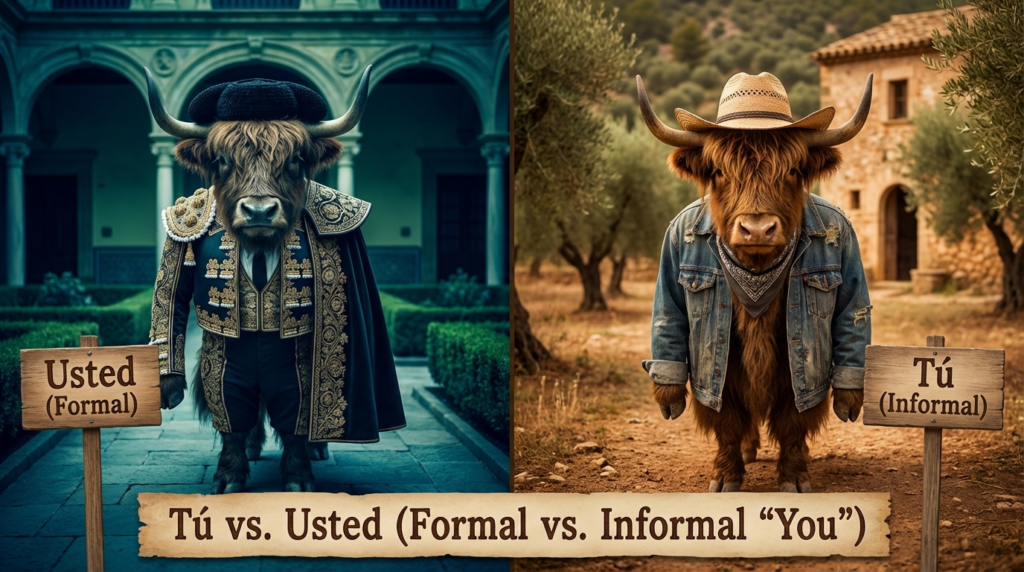
In Spanish, there are two main ways to say “you”: tú (informal) and usted (formal). The tricky part isn’t memorizing them… it’s choosing the right one in real life without sounding awkward.
This guide teaches the Mexican Spanish default (which is honestly the “don’t get yelled at” default). You’ll get quick rules, ready-to-use phrases, and practice drills so your brain stops panicking mid-conversation.
Yak Box: The One-Sentence Difference
Tú = friendly / casual “you” (people you’re close to).
Usted = respectful / formal “you” (people you don’t know well, or when you want to sound polite).
If you’re unsure, start with usted. You can always warm up later. Starting too casual is harder to undo.
Quick Rules You Can Use Today
Use Tú When…
- It’s a friend, classmate, coworker peer, or someone your age.
- Family, close neighbors, your partner.
- The vibe is casual (parties, group chats, friendly small talk).
- They use tú with you first (that’s basically an invitation).
Meaning: tú = “you” (informal).
Real sentence: ¿Tú cómo estás? = “How are you?” (casual)
Use Usted When…
- It’s a stranger, older adult, or someone you want to respect.
- Customer service, workplace hierarchy, official situations.
- You’re asking a favor and want to sound extra polite.
- You’re not sure what’s appropriate yet.
Meaning: usted = “you” (formal).
Real sentence: ¿Usted cómo está? = “How are you?” (polite)
The Verb Changes (This Is The Part That Actually Matters)
People notice the verb more than the word tú or usted. Spanish “you” isn’t just a pronoun choice—it changes how you conjugate.
| Situation | Tú (Informal) | Usted (Formal) |
|---|---|---|
| “How are you?” | ¿Cómo estás? Meaning: “How are you?” (casual) | ¿Cómo está? Meaning: “How are you?” (polite) |
| “What’s your name?” | ¿Cómo te llamas? Meaning: “What’s your name?” (casual) | ¿Cómo se llama? Meaning: “What’s your name?” (polite) |
| “Do you want…?” | ¿Quieres…? Meaning: “Do you want…?” (casual) | ¿Quiere…? Meaning: “Would you like…?” (polite) |
| “Can you help me?” | ¿Me puedes ayudar? Meaning: “Can you help me?” (casual) | ¿Me puede ayudar? Meaning: “Could you help me?” (polite) |
| “Where are you from?” | ¿De dónde eres? Meaning: “Where are you from?” (casual) | ¿De dónde es? Meaning: “Where are you from?” (polite) |
Notice the pattern? Tú usually uses a different ending than usted. If you say usted but use a tú verb (or the other way around), it sounds like mixing dress shoes with gym shorts.
Mexican Spanish Defaults (So You Don’t Accidentally Sound Rude)
- Usted is common with strangers (especially older adults, in shops, taxis, offices, and services).
- Tú is common among peers (friends, classmates, coworkers at the same level, people your age).
- Warm-up strategy: start with usted, then switch to tú if the other person does.
A Super Useful Phrase To Switch
¿Nos tuteamos? = “Should we use tú with each other?” (friendly, slightly formal)
Sentence: Si quieres, nos tuteamos. = “If you want, we can use tú.”
Real-Life Mini Dialogues
Casual (Tú)
— ¿Cómo estás? (How are you?)
— Bien, ¿y tú? (Good, and you?)
— ¿Quieres un café? (Do you want a coffee?)
— Sí, gracias. (Yes, thanks.)
Polite (Usted)
— Buenas tardes. ¿Cómo está? (Good afternoon. How are you?)
— Muy bien, gracias. ¿Y usted? (Very well, thanks. And you?)
— ¿Me puede ayudar, por favor? (Could you help me, please?)
— Claro. Dígame. (Sure. Tell me / Go ahead.)
Key Phrases You’ll Actually Use (With Meanings)
| Spanish | English Meaning | Sentence You Can Copy |
|---|---|---|
| ¿Cómo estás? | How are you? (casual) | ¿Cómo estás hoy? = How are you today? |
| ¿Cómo está? | How are you? (polite) | ¿Cómo está hoy? = How are you today? |
| ¿Cómo te llamas? | What’s your name? (casual) | ¿Cómo te llamas? Yo me llamo Ana. = What’s your name? My name is Ana. |
| ¿Cómo se llama? | What’s your name? (polite) | ¿Cómo se llama? Mucho gusto. = What’s your name? Nice to meet you. |
| ¿Me puedes ayudar? | Can you help me? (casual) | ¿Me puedes ayudar con esto? = Can you help me with this? |
| ¿Me puede ayudar? | Could you help me? (polite) | ¿Me puede ayudar, por favor? = Could you help me, please? |
| ¿Qué tal? | How’s it going? (casual-neutral) | Hola, ¿qué tal? = Hi, how’s it going? |
| Con permiso | Excuse me (passing through) | Con permiso, ¿puedo pasar? = Excuse me, can I pass? |
| Disculpe | Excuse me (polite) | Disculpe, ¿dónde está el baño? = Excuse me, where is the bathroom? |
| Oye | Hey (casual) | Oye, ¿tienes un minuto? = Hey, do you have a minute? |
Tiny Details That Save You
Tú Vs. Tu (The Accent Matters)
tú (with accent) = you.
tu (no accent) = your.
- Tú eres muy amable. = You are very kind.
- Tu nombre es bonito. = Your name is nice.
You Usually Don’t Say The Pronoun
Spanish often drops tú and usted because the verb already signals who you mean.
- ¿Cómo estás? (not ¿Tú cómo estás?) = How are you? (casual)
- ¿Cómo está? (not ¿Usted cómo está?) = How are you? (polite)
Plural “You” In Mexico: Ustedes Wins
In Mexico, ustedes is the normal plural “you” for both formal and informal situations. (You’ll see vosotros mostly in Spain.)
| Spanish | English Meaning | Sentence |
|---|---|---|
| ustedes | you all / you (plural) | ¿Ustedes quieren comer? = Do you all want to eat? |
| ¿Cómo están? | How are you all? (casual/plural) | Hola, ¿cómo están? = Hi, how are you all? |
| ¿Cómo están ustedes? | How are you all? (extra clear) | ¿Cómo están ustedes hoy? = How are you all today? |
Practice (So This Sticks)
Drill 1: Choose Tú Or Usted
Pick the best option (Mexican Spanish default).
- You meet your friend’s mom for the first time: tú or usted?
- You’re texting your best friend: tú or usted?
- You ask a stranger for directions: tú or usted?
- You talk to a coworker your age you’ve known for months: tú or usted?
- You’re speaking to a doctor at a clinic: tú or usted?
Answers
1) Usted (safe + respectful). 2) Tú. 3) Usted. 4) Usually tú. 5) Usually usted.
Drill 2: Switch The Same Sentence
Convert the tú version into usted. (Same meaning, different vibe.)
- ¿Cómo te llamas?
- ¿Me puedes ayudar?
- ¿De dónde eres?
- ¿Quieres pasar?
- ¿Cómo estás?
Answers
1) ¿Cómo se llama? 2) ¿Me puede ayudar? 3) ¿De dónde es? 4) ¿Quiere pasar? 5) ¿Cómo está?
Common Mistakes (And Quick Fixes)
- Mixing pronoun + wrong verb: “¿Usted cómo estás?” ❌
Fix: Match the verb: ¿Usted cómo está? ✅ (or just ¿Cómo está?) - Tú vs tu confusion: “Tu eres…” ❌
Fix: Tú eres… ✅ (accent = “you”) - Using Spain’s “vosotros” in Mexico: It won’t break anything, but it will sound out of place.
Fix: Use ustedes: ¿Ustedes quieren…? - Overthinking it: If you freeze, pick polite.
Fix: Default to usted + por favor.
Quick Reference Cheat Sheet
Tú (Informal)
- Friends, peers, family
- Casual settings
- Friendly tone
Go-to line: ¿Cómo estás? = How are you?
Usted (Formal)
- Strangers, elders, authority
- Services, workplaces, formal settings
- Polite / respectful tone
Go-to line: ¿Cómo está? = How are you?
| Pattern | Meaning | Tú Version | Usted Version |
|---|---|---|---|
| “Can you…?” | Ask for help | ¿Me puedes…? | ¿Me puede…? |
| “Do you want…?” | Offer / invite | ¿Quieres…? | ¿Quiere…? |
| “Where are you from?” | Small talk | ¿De dónde eres? | ¿De dónde es? |
| “What’s your name?” | Introductions | ¿Cómo te llamas? | ¿Cómo se llama? |
FAQ: Quick Nuance Questions
Can I start with tú to sound friendly?
You can, but it’s a gamble with strangers. In Mexico, starting with usted is the safer “respect first” move. If they switch to tú, follow their lead.
Is usted “too formal” for everyday life?
Nope. It’s common in stores, services, and first meetings. Think of it as “polite mode,” not “royal mode.”
Do people ever use usted with family?
Sometimes, yes—especially with grandparents or to show respect in certain families. If you hear it at home, copy what the family does.
What if someone tells me, “Háblame de tú”?
That’s a clear invitation: they want you to use tú. You can respond with ¡Perfecto! and switch.
Final Yak
If you remember nothing else: match the verb. And when in doubt, go with usted + por favor. Polite Spanish opens doors. Casual Spanish opens group chats. Choose your destiny.
One last copy-paste saver:
Disculpe, ¿me puede ayudar, por favor? = Excuse me, could you help me, please?