


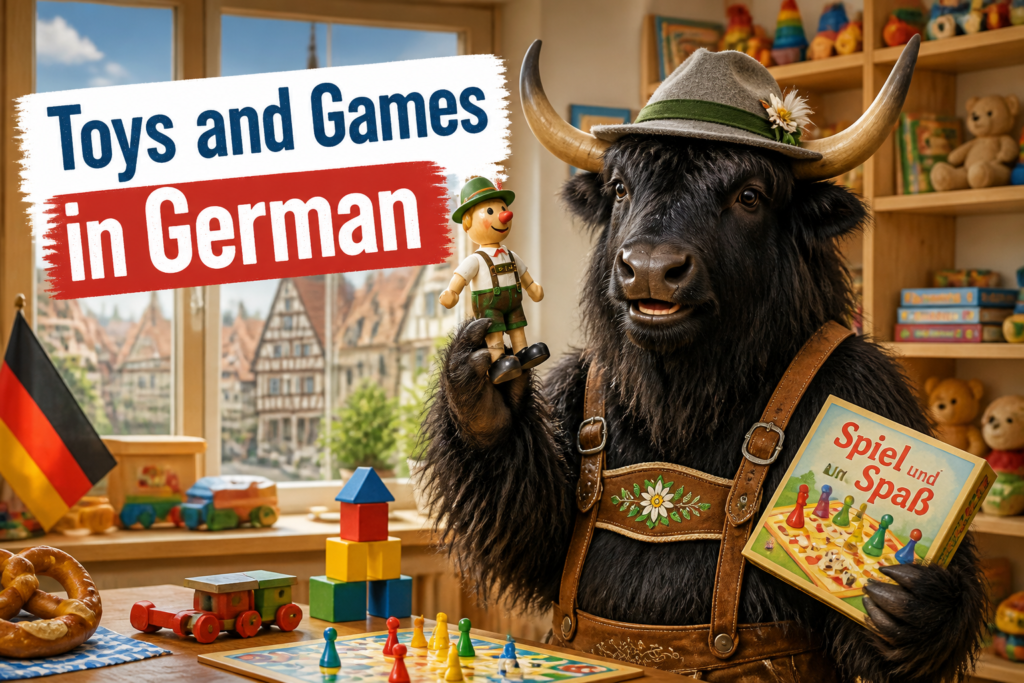
German kids do play games, argue over board-game rules, and mysteriously lose tiny pieces under the sofa just like everyone else. So if you want to talk about toys, games, hobbies, shopping, or family life in German, this topic is a very practical one. Also, yes, the article for “toys” is not optional in German. German loves its grammar paperwork.
For the broader learning path, visit our parent guide.
By the end of this guide, you’ll know the most useful German words for toys, games, and play, plus natural phrases for buying, describing, and talking about them. You’ll also pick up a few pronunciation tips, because some of these words look friendly and then bite you in the ankle.
If you want more everyday starter vocabulary after this, try Essential German Words & Phrases. And if you enjoy learning with rhythm, songs for learning German can make vocabulary stick without feeling like homework in a tiny plastic chair.
For a boring-but-useful dictionary check, Duden is the classic German reference. Not glamorous. Extremely reliable. Basically the grammar cardigan of the internet.
Core Toy And Game Words
Here are the most useful words first. These are the ones you’ll actually see in shops, at home, in schools, and in casual conversations.
| German | Pronunciation | Meaning | Example Sentence | Translation | Learner Note |
|---|---|---|---|---|---|
| das Spielzeug | SHTEEL-tsoyk | toy; toys | Das Kind räumt sein Spielzeug auf. | The child is tidying up its toys. | Neuter noun: das. Often used as a general word for toys. |
| das Spiel | shpeel | game; match; play | Wir spielen ein Spiel. | We are playing a game. | Can mean a board game, a sports match, or simply “game.” |
| spielen | SHPEE-len | to play | Die Kinder spielen draußen. | The children are playing outside. | Very common verb. Also used for music and sports in some contexts. |
| das Brettspiel | BRET-sheep | board game | Wir haben ein neues Brettspiel gekauft. | We bought a new board game. | Literally “board game.” Great for family nights. |
| die Puppe | POO-puh | doll | Meine Tochter spielt gern mit ihrer Puppe. | My daughter likes playing with her doll. | Feminine noun: die. Plural: die Puppen. |
| das Kuscheltier | KOO-shul-teer | stuffed animal; soft toy | Das Kuscheltier ist sehr weich. | The stuffed animal is very soft. | Often used for children’s plush toys. |
| der Ball | bahl | ball | Der Ball ist unter dem Tisch. | The ball is under the table. | Masculine noun: der. Common in sports and children’s play. |
| das Puzzle | POO-zuhl | puzzle | Sie macht ein Puzzle mit 1.000 Teilen. | She is doing a puzzle with 1,000 pieces. | Also used in German exactly like English in many cases. |
| die Karte | KAR-tuh | card; card game card | Welche Karte brauchst du? | Which card do you need? | Plural: die Karten. Useful for card games. |
| der Würfel | VOOR-fel | dice; die | Wirf den Würfel noch einmal. | Throw the die again. | Plural is die Würfel. One die, many dice. English gets weird here too. |
Small note: in German, a lot of toy and game nouns are neuter, but not all. German loves surprise gender assignments. No one invited it.
Useful Toy And Game Phrases
These phrases help you talk about playing, buying, sharing, losing, and asking about games without sounding like a dictionary escaped into the room.
| German | Pronunciation | Meaning | Example Sentence | Translation | Learner Note |
|---|---|---|---|---|---|
| mit dem Spielzeug spielen | mit dem SHTEEL-tsoyk SHPEE-len | to play with the toy(s) | Er spielt mit dem Spielzeugzug. | He is playing with the toy train. | mit takes dative: dem Spielzeug. |
| ein Spiel spielen | ine shpeel SHPEE-len | to play a game | Wollen wir ein Spiel spielen? | Do you want to play a game? | Very natural phrase for board games and party games. |
| etwas gewinnen | ET-vahs guh-VIH-nen | to win something | Ich habe das Spiel gewonnen. | I won the game. | Verb forms matter: gewinnen – gewann – gewonnen. |
| verlieren | fer-LEE-ren | to lose | Wir haben das Match verloren. | We lost the match. | Use for games, sports, and losing objects too. |
| an der Reihe sein | ahn der RYE-uh zyne | to be one’s turn | Du bist an der Reihe. | It’s your turn. | Very common in games. Literally “to be in line.” |
| ziehen | TSEE-en | to draw; to move a piece | Jetzt darfst du eine Karte ziehen. | Now you may draw a card. | Common in card games and board games. |
| werfen | VER-fen | to throw; to roll (dice) | Würfel zuerst! | Roll the dice first! | For dice, Germans often say würfeln, too. |
| verlieren gegen | fer-LEE-ren geyn | to lose against | Wir haben gegen die anderen verloren. | We lost against the others. | gegen means “against” here. |
| spielen lassen | SHPEE-len LAHS-sen | to let play | Lass ihn mitspielen. | Let him join in. | Good for inviting someone into a game. |
| mitspielen | MIT-shpee-len | to play along; to join in | Darf ich mitspielen? | May I join in? | Very useful at school, in groups, and with kids. |
| einfach mal ausprobieren | EYN-fakh mal OYS-proo-beer-en | to try it out for fun | Probier das Spiel einfach mal aus. | Just try the game out. | ausprobieren is a handy separable verb. |
| spielen dürfen | SHPEE-len DOOR-fen | to be allowed to play | Die Kinder dürfen heute länger spielen. | The children are allowed to play longer today. | Useful in family and school contexts. |
Everyday Shopping Words For Toys And Games
If you’re in a shop, a market, or online, these words are the practical ones. They help you ask for the right thing without playing language charades with a stranger.
| German | Pronunciation | Meaning | Example Sentence | Translation | Learner Note |
|---|---|---|---|---|---|
| kaufen | KOW-fen | to buy | Ich möchte ein Geschenk kaufen. | I would like to buy a gift. | Good basic verb for shopping. |
| das Geschenk | guh-SHENK | gift; present | Das ist ein Geschenk für meinen Neffen. | That is a gift for my nephew. | Useful when buying toys as presents. |
| neu | noy | new | Haben Sie ein neues Spiel? | Do you have a new game? | Changes for gender/case: ein neues Spiel. |
| gebraucht | geh-BROOKHT | used, second-hand | Ich suche ein gebrauchtes Brettspiel. | I’m looking for a used board game. | Very common in online marketplaces and second-hand shops. |
| billig | BIL-ikh | cheap | Das Spiel war ziemlich billig. | The game was pretty cheap. | Can mean cheap in price, sometimes also low quality. |
| teuer | TOY-er | expensive | Dieses Spielzeug ist zu teuer. | This toy is too expensive. | Very common shopping adjective. |
| der Laden | LAH-den | shop, store | Im Laden gibt es viele Spielsachen. | There are lots of toys in the shop. | Plural: die Läden. |
| die Spielsachen | SHTEEL-zakh-en | toys | Die Spielsachen liegen auf dem Boden. | The toys are lying on the floor. | Very common plural-like word for toys, especially children’s toys. |
| ab 3 Jahren | ahp drey YAH-ren | for ages 3 and up | Das Spiel ist ab 3 Jahren geeignet. | The game is suitable for ages 3 and up. | You’ll see this on packaging a lot. |
| geeignet für | geh-EYE-gnet voor | suitable for | Ist das Spiel für Kinder geeignet? | Is the game suitable for children? | Very useful on labels and in descriptions. |
Board Games And Card Games
Board games are a big deal in German-speaking countries. Family game nights are common, and Germans often love rules, strategy, and keeping the score very, very seriously. For language learners, that means lots of useful vocabulary in one place.
| German | Pronunciation | Meaning | Example Sentence | Translation | Learner Note |
|---|---|---|---|---|---|
| das Kartenspiel | KAR-ten-shpeel | card game | Wir spielen ein Kartenspiel. | We are playing a card game. | Literally “card game.” Very common word. |
| die Spielkarte | SHTEEL-kar-tuh | playing card | Lege die Karte auf den Tisch. | Put the card on the table. | Used when talking about individual cards. |
| die Punkte | POONK-tuh | points | Wie viele Punkte hast du? | How many points do you have? | Plural only in this sense. |
| der Gewinner | geh-VIN-er | winner | Der Gewinner bekommt einen Preis. | The winner gets a prize. | From gewinnen = to win. |
| die Runde | ROON-duh | round | In der ersten Runde war ich schlecht. | I was bad in the first round. | Useful in games and competitions. |
| der Zug | tsoog | turn, move | Du bist dran: Dein Zug. | Your turn: your move. | Not the train word here, though yes, German also uses Zug for train. |
| ziehen | TSEE-en | to move a piece / draw a card | Du darfst jetzt ziehen. | You may move now. | Common in strategic board games. |
| werfen | VER-fen | to roll dice | Werf bitte die Würfel. | Please roll the dice. | In many games, würfeln is even more natural. |
| würfeln | VOOR-feln | to roll dice | Ich würfle eine Sechs. | I rolled a six. | Very common in board games. |
| schummeln | SHOO-meln | to cheat | Du schummelst doch! | You’re cheating! | Casual. Often said jokingly, but not always. |
A tiny but useful note: das Spiel can mean a game, but spielen is the verb for playing. German likes to separate the thing from the action. Very organized. A little smug about it.
Outdoor Play, Sports, And Movement
Not every “game” stays on a table. If you’re talking about playground activities, sports, or movement, these words are useful too.
| German | Pronunciation | Meaning | Example Sentence | Translation | Learner Note |
|---|---|---|---|---|---|
| laufen | LOW-fen | to run; to walk; to go | Die Kinder laufen im Garten herum. | The children are running around in the garden. | Very common. Can also mean “to be running” for machines or events. |
| springen | SHPRING-en | to jump | Er springt über das Seil. | He is jumping over the rope. | Great for playground talk. |
| schaukeln | SHOW-keln | to swing | Das Kind schaukelt auf dem Spielplatz. | The child is swinging at the playground. | Also a noun: die Schaukel = swing. |
| klettern | KLET-er-n | to climb | Die Kinder klettern auf dem Klettergerüst. | The children are climbing on the climbing frame. | Good playground and outdoor word. |
| fangen spielen | FAHN-gen SHPEE-len | to play tag | Die Kinder spielen Fangen. | The children are playing tag. | Simple and very common for playground games. |
| verstecken spielen | fer-SHTEK-en SHPEE-len | to play hide-and-seek | Wir spielen Verstecken. | We are playing hide-and-seek. | Often shortened in speech to Verstecken. |
| der Spielplatz | SHTEEL-platz | playground | Der Spielplatz ist voll. | The playground is full. | Useful location word. Plural: die Spielplätze. |
| die Schaukel | SHOW-kel | swing | Meine Schwester wartet auf der Schaukel. | My sister is waiting on the swing. | Feminine noun; common at playgrounds. |
| das Seil | zyle | rope; jump rope | Ich kann gut Seil springen. | I can jump rope well. | Very handy in sports and games. |
| der Ball | bahl | ball | Wir brauchen einen Ball für draußen. | We need a ball for outside. | One of those words that appears everywhere. |
Pronunciation tip: sch sounds like English “sh,” and sp at the start of a word often sounds like “shp.” So Spiel is not “speel” with an English s. It’s closer to “shpeel.” German can be picky like that.
Useful Toy Shops And Age Labels
Want to understand toy packaging, store signs, and age labels? These phrases show up a lot in real life, especially when buying gifts.
| German | Pronunciation | Meaning | Example Sentence | Translation | Learner Note |
|---|---|---|---|---|---|
| für Kinder | fyoor KIN-der | for children | Das Buch ist für Kinder geeignet. | The book is suitable for children. | Common in product descriptions. |
| ab 3 Jahren | ahp drey YAH-ren | ages 3 and up | Dieses Spiel ist ab 3 Jahren. | This game is for ages 3 and up. | ab = from, starting at. |
| ab 6 Jahren | ahp zeks YAH-ren | ages 6 and up | Das ist ein Spiel ab 6 Jahren. | That is a game for ages 6 and up. | Very common on packaging. |
| für Anfänger | fyoor AHN-feng-er | for beginners | Das Spiel ist auch für Anfänger gut. | The game is also good for beginners. | Useful for learning-friendly games too. |
| für Erwachsene | fyoor er-VAHRK-suh-nuh | for adults | Es gibt viele Spiele für Erwachsene. | There are many games for adults. | Useful because games are not just for kids. |
| gebraucht | geh-BROOKHT | used | Wir kaufen oft gebrauchte Bücher und Spiele. | We often buy used books and games. | Second-hand markets are common and practical. |
| neu | noy | new | Ich suche etwas Neues für meinen Sohn. | I’m looking for something new for my son. | Capitalized if used as a noun in German: etwas Neues. |
| sicher | ZEE-kher | safe | Ist das Spielzeug sicher für kleine Kinder? | Is the toy safe for small children? | Important word for families and product descriptions. |
Mini Grammar Notes That Matter Here
You do not need to become a grammar wizard to talk about toys and games, but a few patterns are worth knowing.
| Pattern | Meaning | German Example | English Translation | Learner Note |
|---|---|---|---|---|
| das Spielzeug / die Spielsachen | toy / toys | Das Spielzeug liegt im Zimmer. | The toy is lying in the room. | Spielzeug is usually singular or uncountable in feel. Spielsachen is a common plural-like word for toys. |
| mit + dative | with something | mit dem Ball | with the ball | mit takes dative, so der Ball becomes dem Ball. |
| Du bist an der Reihe. | It’s your turn. | Du bist an der Reihe. | It’s your turn. | Common fixed phrase. Worth memorizing whole. |
| ein + neuter noun | a/an + neuter noun | ein Spiel, ein Brettspiel | a game, a board game | Spiel and Brettspiel are both neuter. |
| kein | no / not a | Ich habe kein Spiel. | I don’t have a game. | Use kein to negate nouns. |
| nicht | not | Ich spiele nicht heute. | I’m not playing today. | Use nicht to negate verbs, adjectives, and whole ideas. |
DW Learn German is a solid place for extra practice if you want more simple explanations and exercises after this article.
Pronunciation Tips For Tricky Words
These are the sounds that often matter most in toy and game vocabulary. No need to fear them. Just don’t treat every German word like English with a fake moustache.
| German Sound | Example Word | Simple Help | Learner Note |
|---|---|---|---|
| ch | Spielzeug, ich | Soft hiss in the throat or mouth, not “k” | In Spielzeug, the ch sound is not really there, but you will hear it in many other words. |
| sp at the start | spielen | “shp” sound | Start with “sh” and then add “p.” |
| ei | Reihe, Seil | Like English “eye” | Very common spelling in German. |
| ie | spielen, ziehen | Like English “ee” | Long “ee” sound. |
| ü | Würfel | Round your lips like “oo” while saying “ee” | Tricky at first. Worth practicing. |
| z | ziehen | Like “ts” | Not like English “z.” |
| r | Würfel, Runde | Often soft or throat-like | Don’t stress it too much at beginner level. |
| final devoicing | Spielzeug, Ball | Final consonants may sound harder | German final sounds often feel sharper than English. |
One more practical tip: in many game and toy words, the stress is often on the first part of the word, like Brettspiel, Spielzeug, and Spielplatz. German compounds like to be bossy from the front.
Real-Life Example Sentences
Here are some fuller sentences you can actually use or adapt. Say them out loud. Yes, out loud. Reading silently is nice, but your mouth needs the memo too.
| German | Pronunciation | Meaning | Translation |
|---|---|---|---|
| Ich suche ein Spiel für den Abend. | ikh ZOO-khuh ine shpeel fyoor den AH-bent | I’m looking for a game for the evening. | I’m looking for a game for the evening. |
| Meine Kinder spielen gern mit Bauklötzen. | MY-nuh KIN-der SHPEE-len gern mit BOW-kluets-tsen | My children like playing with building blocks. | My children like playing with building blocks. |
| Hast du das Brettspiel schon ausprobiert? | hahst doo dahs BRET-sheep shon OYS-proo-beert | Have you tried the board game already? | Have you tried the board game already? |
| Wir brauchen noch zwei Karten. | veer BROW-khen nokh tsvy KAR-ten | We still need two cards. | We still need two cards. |
| Das ist ein Spiel für die ganze Familie. | dahs ist ine shpeel fyoor dee GANT-suh fah-MEE-lee-uh | This is a game for the whole family. | This is a game for the whole family. |
| Wer ist als Nächstes dran? | vehr ist alss NEEKH-stes drahn | Who’s next? | Who’s next? |
| Ich habe verloren, aber es hat Spaß gemacht. | ikh hah-buh fer-LOH-ren AH-bər ess hat shpass guh-MAKHT | I lost, but it was fun. | I lost, but it was fun. |
| Das Spielzeug ist für kleine Kinder nicht geeignet. | dahs SHTEEL-tsoyk ist fyoor KLY-nuh KIN-der nikht geh-EYE-gnet | The toy is not suitable for small children. | The toy is not suitable for small children. |
| Kann ich mitspielen? | kahn ikh MIT-shpee-len | Can I join in? | Can I join in? |
| Wir spielen heute Abend Karten. | veer SHPEE-len HOY-tuh AH-bent KAR-ten | We’re playing cards this evening. | We’re playing cards this evening. |
Notice how natural German often keeps the core idea very short. Kann ich mitspielen? is enough. No need to build a legal contract around it.
Common Mistakes And Easy Fixes
- Wrong: Ich spiele mit das Spielzeug.
Correct: Ich spiele mit dem Spielzeug.
Why: mit takes dative, so das becomes dem. - Wrong: Wir spielen ein Brettspiel heute.
Correct: Wir spielen heute ein Brettspiel.
Why: In German, time often comes before the object, especially in simple sentences. - Wrong: Ich habe gewinnen.
Correct: Ich habe gewonnen.
Why: Use the past participle gewonnen with haben. - Wrong: Das Kind spielt mit der Puppe. when you mean “the doll” as direct object in another structure.
Correct: Das Kind spielt mit der Puppe.
Why: Actually, this one is fine. German grammar loves being annoying by being correct when it looks suspicious. - Wrong: ein neues Spielzeuge
Correct: neues Spielzeug or neue Spielsachen
Why: Spielzeug is usually not made plural in the same way as regular count nouns. - Wrong: Spielen wir eine Spiel?
Correct: Spielen wir ein Spiel?
Why: Spiel is neuter: ein Spiel. - Wrong: Ich bin dran nach.
Correct: Ich bin dran. or Du bist als Nächstes dran.
Why: dran is the common fixed form here.
Germany, Austria, And Switzerland Notes
Most of this vocabulary works across standard German in Germany, Austria, and Switzerland. But a few habits and labels can differ.
| Word / Phrase | Germany | Austria | Switzerland | Note |
|---|---|---|---|---|
| das Spielzeug | Very common | Very common | Very common | Standard everywhere. |
| das Brettspiel | Very common | Very common | Very common | Standard everywhere. |
| die Spielsachen | Common, especially for children’s toys | Common | Common | Natural plural-style word for toys. |
| spielen | Standard | Standard | Standard | Works everywhere in standard German. |
| das Gummitwist | Seen in some regions | Less common | Less common | Regional playground vocabulary can vary a lot. |
| der Tschisi / regional toy names | Not standard | Can be regional | Can be regional | Brand names and local words vary; standard German is safest. |
For learners, standard German is the best default. Regional toy names are fun later, but first you want words that work in Berlin, Munich, Vienna, Zurich, and basically anywhere with a toy aisle.
Quick Practice
Try these before you move on. Tiny practice beats noble intentions every time.
- Translate: “I’m looking for a board game.”
- Translate: “It’s your turn.”
- Translate: “Can I join in?”
- Choose the right word: Spielzeug or spielen?
- Fill in the blank: Wir spielen ___ Spiel.
- Fill in the blank: Du bist an der ___.
- Say aloud: Würfel, Spiel, spielen, Spielzeug, Brettspiel
- Make one sentence with mit + dative.
If you want, you can turn any of these into flashcards or build your own mini game vocabulary list. Repetition is boring, yes, but so is not remembering the word for “dice.”
Yak takeaway: In German, toys are Spielzeug, games are Spiele, and if you can say Kann ich mitspielen?, you’ve already unlocked a very useful social superpower.