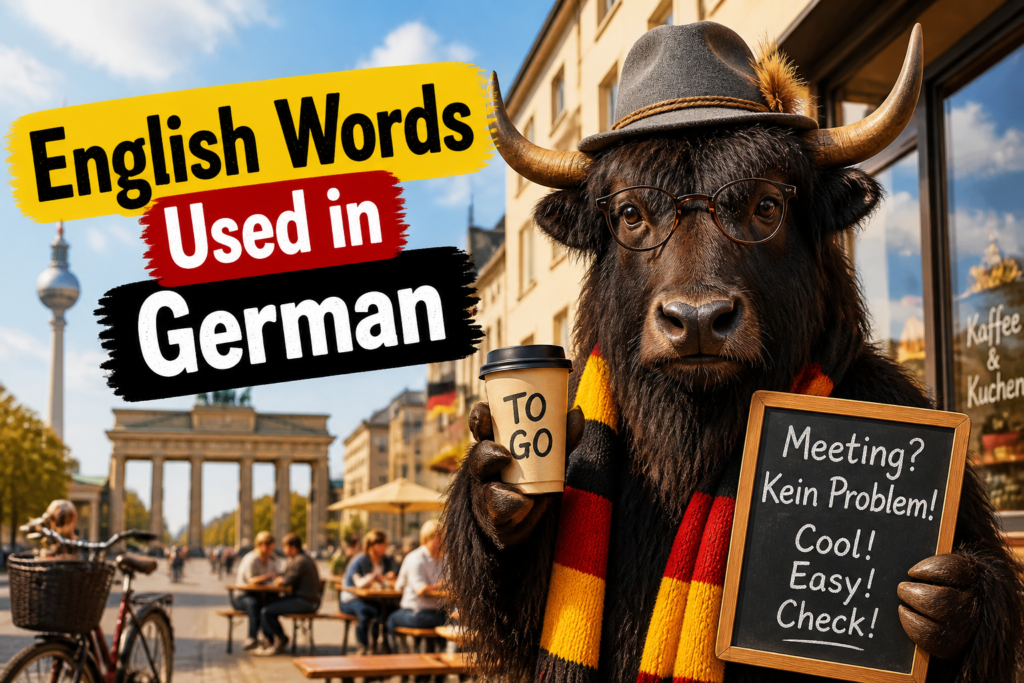
English Words Used in German are everywhere. Some are borrowed because German needed a useful new word. Some are trendy because people like sounding modern. And some are pure Denglisch — that deliciously awkward mix of German grammar and English-looking words that makes linguists sigh into their coffee.
If you already know English, this can be a small gift: many German words will feel familiar right away. But beware. A word that looks English does not always behave like English. German likes to adopt foreign words, then immediately give them articles, plurals, and grammar jobs. Very on-brand, honestly.
By the end of this guide, you’ll know the most common English loanwords in German, how they’re used in real life, and where Denglisch gets a little silly. For the big-picture overview of German learning topics, you can also keep the Learn German hub handy.
What English Loanwords Look Like In German
German borrows English words for tech, work, fashion, sports, pop culture, and internet life. Some words stay close to English. Others get German spelling, pronunciation, or endings. And some become so natural that native speakers barely notice they came from English in the first place.
A useful rule: if the word is common in German speech, learn the German pronunciation and article with it. Otherwise, you may sound like you’re reading a menu in a haunted airport.
| Type | What Happens | Example | Learner Note |
|---|---|---|---|
| Direct loanword | English word used almost as-is | das Internet | Pronunciation is German-ish, not fully English. |
| Germanized loanword | Spelling or grammar changes | der Job, die Jobs | German adds articles and plurals. |
| Denglisch | English-looking word used in a German way | downloaden, gejobbt | Looks English, behaves German. |
Common English Words Used In German
Here are the everyday ones first. These are the words you’re most likely to hear in conversation, work settings, shopping, media, and online life.
| German | Pronunciation | Meaning | Example Sentence | Translation | Learner Note |
|---|---|---|---|---|---|
| das Internet | IN-ter-net | internet | Ich suche das Rezept im Internet. | I’m looking for the recipe on the internet. | Neutral and very common. Capitalized because all nouns are. |
| der Laptop | LEP-top | laptop | Mein Laptop ist schon alt. | My laptop is already old. | Plural: die Laptops. |
| das Handy | HEN-dee | mobile phone | Kannst du mir kurz auf dem Handy schreiben? | Can you message me briefly on the phone? | Important: in German, Handy means “mobile phone,” not handy. |
| der Job | job | job | Ich suche einen neuen Job. | I’m looking for a new job. | Plural: die Jobs. |
| das Team | teem | team | Unser Team arbeitet heute von zu Hause. | Our team is working from home today. | Plural: die Teams. |
| der Manager | MEN-a-jer | manager | Der Manager hat schon angerufen. | The manager already called. | Often used in business and office contexts. |
| das Meeting | MEE-ting | meeting | Das Meeting beginnt um neun. | The meeting starts at nine. | Very common in work German. Plural: die Meetings. |
| das Event | ih-VENT | event | Das Event war gut besucht. | The event was well attended. | More modern than Veranstaltung in some contexts. |
| der Stress | sh-tress | stress | Ich habe heute viel Stress. | I have a lot of stress today. | Very common. German also uses Stress haben. |
| die App | ap | app | Die App ist kostenlos. | The app is free. | Plural: die Apps. |
More Loanwords You’ll Hear All The Time
| German | Pronunciation | Meaning | Example Sentence | Translation | Learner Note |
|---|---|---|---|---|---|
| der Drink | drink | drink, beverage | Ich nehme einen Drink ohne Alkohol. | I’ll have a drink without alcohol. | Common in bars and casual speech. |
| das Display | DIS-play | screen, display | Das Display ist leider kaputt. | The display is unfortunately broken. | Often for phones, devices, and machines. |
| der Flyer | FLEI-er | flyer, leaflet | Am Eingang gibt es einen Flyer. | There’s a flyer at the entrance. | Plural: die Flyer. |
| das Ticket | TIK-et | ticket | Ich habe das Ticket online gekauft. | I bought the ticket online. | Plural: die Tickets. |
| das Budget | byu-ZHET | budget | Das Budget ist dieses Jahr kleiner. | The budget is smaller this year. | From French via international business language, but common in German too. |
| der Deal | deel | deal, agreement | Das ist ein guter Deal. | That’s a good deal. | Very common in sales, business, and casual speech. |
| cool | kool | cool, great | Das ist wirklich cool. | That’s really cool. | Used as an adjective. German grammar treats it normally. |
| der Shop | shop | store, shop | Der Shop hat heute geschlossen. | The shop is closed today. | Often used for online stores too. |
| downloaden | DOWN-loa-den | to download | Du kannst die Datei downloaden. | You can download the file. | Verb ending is German. In speech, it behaves like a regular verb. |
| testen | TES-ten | to test | Wir müssen die neue App noch testen. | We still need to test the new app. | Also fully natural in German. |
Denglisch Verbs And German Grammar Getting Sticky
This is where English words stop being cute and start wearing German grammar like a borrowed jacket. German turns loanwords into normal verbs with endings like -en, and then conjugates them just like any other verb.
| Infinitive | Meaning | Example | Translation | Learner Note |
|---|---|---|---|---|
| downloaden | to download | Ich downloade die Datei. | I’m downloading the file. | Yes, German really says it like this. Slightly annoying, fully normal. |
| jobben | to do temporary work / have a side job | Er jobbt am Wochenende. | He works a side job on weekends. | Very Germanized. Past participle: gejobbt. |
| surfen | to surf, browse | Ich surfe im Netz. | I browse the web. | “Im Netz” is a common internet phrase. |
| chatten | to chat | Wir chatten | We’ll chat later. | Common online and in texting. |
| liken | to like | Viele Leute liken den Post. | Many people like the post. | Often used in social media talk. |
| streamen | to stream | Wir streamen heute einen Film. | We’re streaming a movie today. | Common in media and entertainment. |
| coachen | to coach | Sie coacht das Team. | She coaches the team. | Pronounced roughly KOH-chen, not English “coach” plus chaos. |
| checken | to check | Ich checke meine E-Mails. | I check my emails. | Very common, very informal. |
| starten | to start | Das Meeting startet gleich. | The meeting is starting soon. | Used for events, apps, and projects. |
| updaten | to update | Bitte update die Software. | Please update the software. | Often used in tech settings; the pronunciation is usually Germanized. |
Loanwords That Changed Meaning In German
Some words look like obvious English, but German uses them differently. These are the fun traps. A few are especially useful because they appear harmless until they embarrass a beginner in public.
| German | Pronunciation | Meaning | Example Sentence | Translation | Learner Note |
|---|---|---|---|---|---|
| das Handy | HEN-dee | mobile phone | Mein Handy ist fast leer. | My phone is almost dead. | Not “handy” as in useful. This one causes endless face-palms. |
| der Oldtimer | OLD-tai-mer | classic car | Er fährt einen alten Oldtimer. | He drives an old classic car. | Not an old person. That would be a very awkward car show. |
| das Beamer | BEE-mer | projector | Der Beamer ist schon eingeschaltet. | The projector is already on. | In English, “beamer” is a car slang term in some places, but not in standard German. |
| der Store | stor | store, shop | Der Store öffnet um zehn. | The store opens at ten. | Used in retail and branding. |
| das Smoking | smoh-KING | tuxedo / dinner jacket | Zum Fest trägt er ein Smoking. | He wears a tuxedo to the celebration. | Very important false friend: not cigarette smoke. |
| der Pulli | POO-lee | sweater | Zieh einen Pulli an, es ist kalt. | Put on a sweater, it’s cold. | Short for Pulli from Pullover. Casual and common. |
| das Handy laden | HEN-dee LAH-den | to charge the phone | Ich muss mein Handy laden. | I need to charge my phone. | Not an English phrase, but very common German usage around an English loanword. |
| das Public Viewing | PUH-blick VYOO-ing | watching a public event on a big screen | Wir gehen zum Public Viewing. | We’re going to the public viewing. | German usage is not the same as English. In German, it often means a big-screen public broadcast. |
One tiny but useful fact: German often adds der, die, or das to English loanwords immediately. So it is not just “Laptop” or “Meeting.” It is der Laptop, das Meeting, and so on. Article memory is part of the package deal.
Loanwords For Work, Office, And Business
If you work with German speakers, these words show up constantly. They are common in offices, project meetings, emails, startups, and polite-but-efficient business chat.
| German | Pronunciation | Meaning | Example Sentence | Translation | Learner Note |
|---|---|---|---|---|---|
| das Meeting | MEE-ting | meeting | Haben wir heute noch ein Meeting? | Do we have another meeting today? | Very common; plural is Meetings. |
| das Feedback | FEED-bek | feedback | Danke für dein Feedback. | Thanks for your feedback. | Often used in business and school settings. |
| das Know-how | noh-HAU | know-how, expertise | Für das Projekt brauchen wir mehr Know-how. | We need more expertise for the project. | Common in professional German. |
| der Sale | seyl | sale, discount event | Im Sale sind die Schuhe günstiger. | The shoes are cheaper in the sale. | Often seen in shops and ads. |
| das Team | teem | team | Das Team arbeitet gut zusammen. | The team works well together. | Useful in work, sport, and school. |
| der Service | SER-vis | service | Der Service war sehr freundlich. | The service was very friendly. | Often used in restaurants, shops, and customer service. |
| das Update | UP-date | update | Wir brauchen ein Update zum Projekt. | We need an update on the project. | Also used in software and general status talk. |
| das Ticket | TIK-et | ticket | Ich habe das Ticket schon bezahlt. | I already paid for the ticket. | Travel, events, transport — useful everywhere. |
| das Management | MEN-ij-ment | management | Das Management plant die nächsten Schritte. | Management is planning the next steps. | Sounds formal and businesslike. |
| der Coach | kohch | coach, trainer | Der Coach motiviert das Team. | The coach motivates the team. | Used in sports and business coaching. |
Everyday Sentences With English Loanwords
These are the kinds of sentences you’ll hear in real life. Notice how normal the English-looking words feel inside German grammar. German does not ask permission. It just moves in and starts conjugating.
| German Sentence | Meaning | Learner Note |
|---|---|---|
| Ich muss mein Handy aufladen. | I have to charge my phone. | aufladen = to charge; very useful with devices. |
| Kannst du mir das Link schicken? | Can you send me the link? | More natural German is den Link, because Link is masculine: der Link. |
| Wir haben ein kurzes Meeting um zwei. | We have a short meeting at two. | Time expression with um = at a specific time. |
| Die App funktioniert heute nicht. | The app doesn’t work today. | Simple, practical, and very common. |
| Ich finde den Look gut. | I like the look. | Fashion and style contexts only. |
| Er hat viel Stress im Job. | He has a lot of stress at work. | Stress haben is a common phrase. |
| Sie hat das Foto geliked. | She liked the photo. | Past participles of borrowed verbs can look extra weird. That is normal, sadly. |
| Das neue Update ist endlich da. | The new update is finally here. | Often used for apps, phones, and software. |
| Der Chef will sofort ein Feedback. | The boss wants feedback right away. | Chef in German usually means boss, not chef from a kitchen. |

| Ich habe den Flyer am Bahnhof gesehen. | I saw the flyer at the station. | Station = der Bahnhof. Handy little travel word pair. |
Yak wisdom: if a word looks English but gets a German article, plural, or verb ending, it has officially moved into the neighborhood.
German Pronunciation Tips For English Loanwords
A lot of English loanwords in German are pronounced in a more German way. You do not need perfect imitation, but a few patterns will make you sound much more natural.
| Pattern | Example | How To Say It | Learner Note |
|---|---|---|---|
| Final sounds are clear | Job, Club, Team | Do not fully drop the final consonant. | German final devoicing may make voiced endings sound sharper. |
| Schwa endings | downloaden, chatten | End with a light “-en” sound. | Not like a hard English ending. |
| Stress may shift | Meeting, Laptop, Update | Usually first syllable or German-style stress. | Listen to native speakers; the stress is often more even than English. |
| j often sounds like y | Job, Junior, Jazz | Closer to “yob” for some speakers in borrowed words. | Varies by word and speaker, but English “j” is often not exact. |
| vocabulary gets German vowels | App, Team, Store | Keep vowels short and clean. | German does not always copy English vowel length. |
When English Words Feel More Formal Or More Casual
Sometimes the borrowed English word sounds modern, trendy, or businesslike. The older German equivalent may sound more neutral, more formal, or just more typical in certain situations. This is where style matters.
| English-Like German | More Standard German | Meaning | Style Note |
|---|---|---|---|
| das Meeting | die Besprechung | meeting | Meeting sounds modern; Besprechung sounds more traditional. |
| das Event | die Veranstaltung | event | Veranstaltung is broader and more standard. |
| das Feedback | die Rückmeldung | feedback / response | Rückmeldung is often better in polite or formal German. |
| der Job | die Stelle / die Arbeit | job / position / work | Stelle is especially common in job ads. |
| cool | toll / super / klasse | great / cool | cool is casual; the German words fit broader contexts. |
For official or careful writing, standard German words often win. For casual chat, social media, and workplace talk, the English-looking versions can sound perfectly normal. Context is everything. Language is rude like that.
Germany, Austria, And Switzerland: Small Differences
Most of these loanwords are understood across German-speaking countries, but usage can differ a bit. Austria and Switzerland often prefer some local words, especially in formal contexts, while German media and business culture may sound more English-heavy.
| Word | Germany | Austria | Switzerland | Note |
|---|---|---|---|---|
| Handy | very common | very common | very common | Used everywhere for mobile phone. |
| Job | very common | very common | very common | Broadly understood in all three. |
| Meeting | very common | common | common | Business German often sounds quite international. |
| Event | common | common | common | Neutral enough across regions. |
| Public Viewing | common in media talk | understood | understood | Still not the same as the English phrase. |
If you want to compare how German borrows from other languages too, the sister guides on French words used in German and Spanish words used in German are a nice next stop. German is basically a very busy collector.
Common Mistakes English Speakers Make
English speakers usually understand loanwords quickly, but a few traps keep showing up. Here’s the practical version, without the grammar fog machine.
| Mistake | Better German | Why |
|---|---|---|
| Ich lade das Handy. | Ich lade mein Handy auf. | aufladen is the natural verb for charging devices. |
| Ich brauche ein Handy. | Ich brauche ein Handy. | This is correct, but remember it means “mobile phone,” not “useful.” |
| der Meeting | das Meeting | Loanwords still have grammatical gender. |
| Ich have Feedback. | Ich habe Feedback. | German uses German word order, not English sentence structure. |
| Ich bin stress. | Ich habe Stress. | Stress is usually something you “have” in German. |
| Ich downloade es. | Das ist okay, but know it sounds informal. | Borrowed verbs can be fine, but tone matters. |
Why Does German Capitalize These Words?
Because they are nouns. German capitalizes all nouns, including borrowed ones: der Job, das Ticket, die App, das Meeting. This applies even when the word came from English yesterday, more or less.
Are English Loanwords “Wrong” In German?
No. Many are completely normal. Some are just trendy. Some are more common in speech than in careful writing. The real trick is learning which ones are standard, which ones sound casual, and which ones are a little too Denglisch for formal situations.
Quick Reference Summary
- German borrows a lot from English, especially in tech, work, media, and casual speech.
- Loanwords get German articles: der Job, das Meeting, die App.
- Some words change meaning: Handy means mobile phone, not useful.
- English-looking verbs become German verbs: downloaden, chatten, liken, jobben.
- Style matters: Meeting may sound modern; Besprechung sounds more standard or formal.
- Pronunciation is often Germanized, so listen for stress and vowel shifts.
- Denglisch is real, and yes, it sometimes sounds a bit ridiculous. That is part of the charm.
For a reliable dictionary check when a word feels suspiciously English, Duden is the boring-but-useful place to look. Extremely respectable. Almost offensively so.
Yak takeaway: English words in German are your friend — until German gives them an article, a plural, and a little identity crisis.