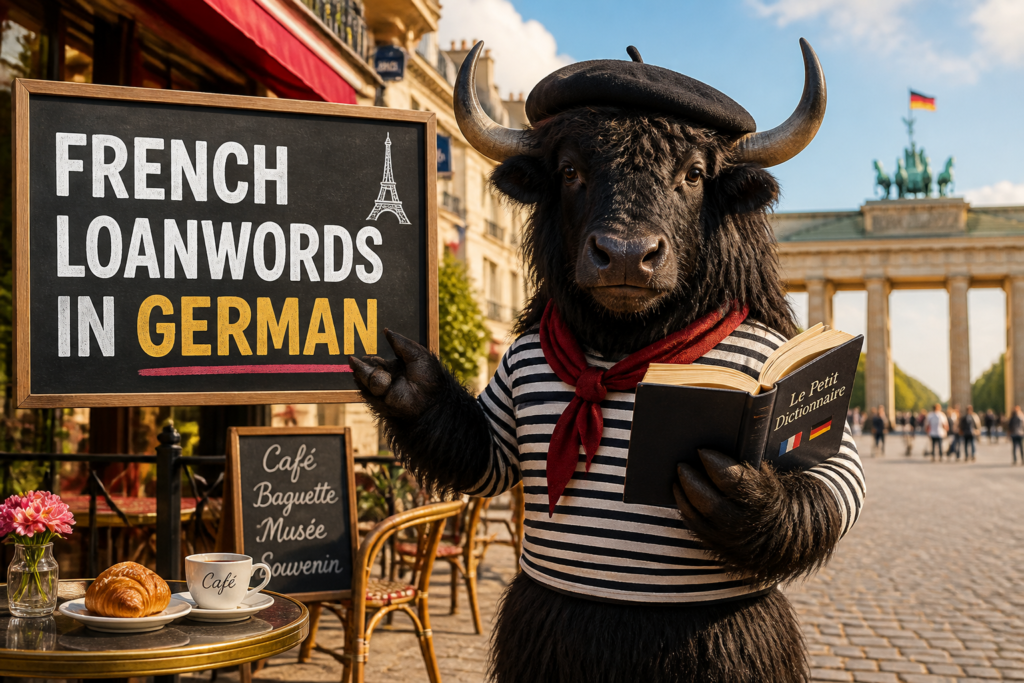
French Words Used In German Loanwords (Französische Lehnwörter Im Deutschen) show up everywhere in German: in cafés, fashion, politics, cooking, and the kind of everyday speech that quietly pretends to be very refined. German borrowed a lot from French over the centuries, and yes, some of it still sounds a bit fancy even when people are just talking about lunch.
For the broader learning path, visit our parent guide.
If you learn these words, you get a nice shortcut into real German vocabulary. You also start noticing how often German is wearing a French jacket and acting like it grew up in Berlin.
By the end of this guide, you will understand a bunch of common French-origin words in German, how to pronounce them, and when Germans actually use them. For a broader overview of related borrowing patterns, there’s also a useful companion guide on English words used in German loanwords and another on Spanish words used in German loanwords.
One quick note: borrowed words do not always keep their original French meaning. German sometimes trims, shifts, or totally redecorates them. Borrowing is polite like that, in the same way a raccoon is “polite” with your trash.
Why French Left So Many Footprints In German
French was once the language of courts, diplomacy, fashion, and high society across Europe. German picked up many French words in areas like food, clothing, administration, culture, and city life. Some of those words still feel elegant; others are just normal daily German now.
The interesting part is that many German speakers do not even notice these words are French anymore. They are simply part of the language. If you want to check how a word is used in standard German, a boring but reliable place to start is Duden.
Some French loanwords in German sound fancy. Some sound ordinary. A few sound like they went shopping in Paris and came back to work in Munich.
Core French Loanwords In German
Here are common French-origin words you will hear often in modern German. The pronunciation help is simple and learner-friendly, not a phonetics horror show.
| German | Pronunciation | Meaning | Example Sentence | Translation | Learner Note |
|---|---|---|---|---|---|
| das Restaurant | res-toh-RAHNT | restaurant | Wir gehen heute Abend ins Restaurant. | We are going to the restaurant tonight. | Very common. Same spelling as French, but German stresses the last syllable. |
| das Café | ka-FEH | café | Wir treffen uns im Café. | We’re meeting at the café. | Umlaut-free and easy. In German, cafés are everywhere, and yes, people do sit for hours. |
| die Chance | shahns | chance, opportunity | Du hast noch eine Chance. | You still have one chance. | Often means “opportunity” rather than “random luck.” |
| das Büro | byoo-roh | office | Ich bin im Büro. | I’m in the office. | French origin, but now completely standard German. |
| das Paket | pah-KET | package, parcel | Das Paket kommt morgen an. | The package arrives tomorrow. | Useful for post, shipping, and online shopping survival. |
| die Gardine | gar-DEE-nuh | curtain | Die Gardine ist weiß. | The curtain is white. | Furniture and home vocabulary love French loans. |
| der Balkon | bal-KOHN | balcony | Wir sitzen auf dem Balkon. | We’re sitting on the balcony. | Technically French origin, very common in German apartments. |
| die Terrasse | teh-RAH-suh | terrace, patio | Im Sommer essen wir auf der Terrasse. | In summer we eat on the terrace. | Good for restaurants, cafés, and home gardens. |
| das Detail | deh-TAI | detail | Das ist nur ein kleines Detail. | That’s only a small detail. | Watch the stress: de-TAI. |
| die Friseur | free-ZEUR | hairdresser | Ich gehe zum Friseur. | I’m going to the hairdresser. | German noun is masculine: der Friseur. |
| die Frisur | free-ZOOR | hairstyle | Deine Frisur sieht gut aus. | Your hairstyle looks good. | Not the person, just the haircut/style. |
| die Konfitüre | kon-fee-TYOO-ruh | jam, fruit preserve | Ich esse Brot mit Konfitüre. | I eat bread with jam. | More formal than everyday “Marmelade” in some contexts. |
| die Marmelade | mar-meh-LAH-duh | jam | Hast du Marmelade gekauft? | Did you buy jam? | In everyday German, very common. In EU-style word usage, technical distinctions can get picky. |
| das Parfum | par-FUHNG / par-FOM | perfume | Sie trägt ein neues Parfum. | She is wearing a new perfume. | German pronunciation often nasalises the end a bit, but many speakers say it simply. |
| die Toilette | twa-LEH-tuh | toilet, restroom | Wo ist die Toilette? | Where is the toilet? | Polite and practical. “WC” is also very common. |
Useful French Loanwords For Everyday German
These words appear in normal conversations, menus, travel situations, and work life. A few are so integrated that they feel fully German, which is exactly how language borrowing likes to behave.
| German | Pronunciation | Meaning | Example Sentence | Translation | Learner Note |
|---|---|---|---|---|---|
| die Adresse | ah-DRES-suh | address | Kannst du mir deine Adresse schicken? | Can you send me your address? | Stress on the second syllable. |
| das Paket | pah-KET | parcel, package | Mein Paket ist angekommen. | My package has arrived. | Very common in shopping and delivery contexts. |
| das Portemonnaie | port-mo-NAY | wallet | Ich habe mein Portemonnaie verloren. | I lost my wallet. | Sounds French because it is. Many Germans also say die Geldbörse. |
| die Serviette | zer-VYET-tuh | napkin | Kann ich noch eine Serviette haben? | Can I have another napkin? | Often used in restaurants and cafés. |
| das Dessert | deh-SERT | dessert | Zum Dessert nehmen wir Eis. | For dessert, we’ll have ice cream. | Often pronounced with a clear final -t in German. |
| die Cousine | koo-ZEE-nuh | female cousin | Meine Cousine wohnt in Hamburg. | My cousin (female) lives in Hamburg. | German distinguishes Cousin and Cousine. |
| der Cousin | koo-ZAHN / koo-ZON | male cousin | Mein Cousin kommt zu Besuch. | My cousin (male) is coming to visit. | Pronunciation varies a bit by region. |
| das Genre | ZHON-ruh | genre | Welches Genre magst du? | Which genre do you like? | Common in music, film, and books. |
| die Maschine | mah-SHEE-nuh | machine | Die Maschine ist kaputt. | The machine is broken. | Not obviously French to many learners, but historically borrowed. |
| die Garage | ga-RAH-shuh | garage | Das Auto steht in der Garage. | The car is in the garage. | Watch the German g and the ending -sche sound. |
| die Etage | eh-TAH-zhuh | floor, storey | Wir wohnen im dritten Stock, also auf der dritten Etage. | We live on the third floor, so on the third storey. | More common in building language; Stock is also very common. |
| der Sessel | SEHS-sel | armchair | Ich sitze im Sessel. | I’m sitting in the armchair. | Comfort furniture does enjoy imported vocabulary. |
| die Garderobe | gar-deh-ROH-buh | coat rack, cloakroom, wardrobe area | Die Jacke hängt in der Garderobe. | The jacket is hanging in the cloakroom. | In theatres and restaurants, this is useful. |
| die Branche | BRAN-shuh | industry, sector | Ich arbeite in der Medienbranche. | I work in the media industry. | Common in business and jobs. |
| die Branche | BRAN-shuh | sector, line of business | Die Branche verändert sich schnell. | The industry is changing quickly. | Same word, same usefulness, still a little French in a suit. |
French Loanwords With A German Life Of Their Own
Some borrowed words have changed meaning a little in German. That is normal. Languages borrow words the way people borrow tools: they use them, modify them, and sometimes forget where they got them from.
| German | Pronunciation | Meaning | Example Sentence | Translation | Learner Note |
|---|---|---|---|---|---|
| das Büro | byoo-roh | office | Ich arbeite heute im Büro. | I’m working in the office today. | Not “bureau” as a piece of furniture in English; it usually means office. |
| die Chance | shahns | chance, opportunity | Das ist deine Chance. | This is your chance. | Often used more like “opportunity” than “chance” in English. |
| das Quartier | kwar-TYEHR | neighborhood, district | Das ist ein ruhiges Quartier. | This is a quiet neighborhood. | More literary or regional in some contexts. |
| das Budget | byoo-ZHEH / byoo-ZHEHT | budget | Wir haben ein kleines Budget. | We have a small budget. | Often used in finance, planning, and business. |
| die Branche | BRAN-shuh | industry, field | Sie kennt die Modebranche gut. | She knows the fashion industry well. | Very common in professional German. |
| die Toilette | twa-LEH-tuh | toilet | Die Toilette ist rechts. | The toilet is on the right. | Polite and standard. “Klo” is more informal. |
| das Parfum | par-FUHNG | perfume | Dieses Parfum ist teuer. | This perfume is expensive. | Often used in shops and ads. |
| die Mode | MOH-duh | fashion | Mode verändert sich schnell. | Fashion changes quickly. | Common, and still a little French-flavoured in feel. |
| die Saison | zeh-ZOHN | season | Die Saison beginnt im Frühjahr. | The season starts in spring. | Used for sports, tourism, and production cycles. |
| die Chance | shahns | opportunity | Wir haben noch eine Chance. | We still have one chance. | Easy to confuse with English “chance,” but German often means “shot/opportunity.” |
Food And Lifestyle Words From French
German food vocabulary contains plenty of French loans. This is convenient, because if you can read menus, you can survive far more situations than the average tourist who thinks “salad” is a full personality.
| German | Pronunciation | Meaning | Example Sentence | Translation | Learner Note |
|---|---|---|---|---|---|
| die Marmelade | mar-meh-LAH-duh | jam | Ich mag Marmelade mit Brötchen. | I like jam with bread rolls. | Everyday, practical, breakfast-friendly. |
| die Konfitüre | kon-fee-TYOO-ruh | fruit preserve, jam | Die Konfitüre ist selbstgemacht. | The jam is homemade. | Feels a bit more formal or label-like than Marmelade. |
| das Dessert | deh-SERT | dessert | Zum Dessert gibt es Kuchen. | For dessert, there is cake. | Common on menus and in restaurants. |
| das Menü | meh-NYOO | menu, set meal | Haben Sie ein vegetarisches Menü? | Do you have a vegetarian set meal? | Can mean “menu” or “meal deal,” depending on context. |
| die Vorspeise | FOR-shpai-zuh | starter, appetizer | Als Vorspeise nehme ich Suppe. | As a starter, I’ll have soup. | Not French in form, but often paired with French-style menu culture. |
| die Serviette | zer-VYET-tuh | napkin | Hast du eine Serviette? | Do you have a napkin? | Useful in cafés and snack shops. |
| das Croissant | kroi-SAHNG | croissant | Ich möchte ein Croissant. | I would like a croissant. | Very common in bakeries. Plural can be die Croissants. |
| das Omelett | oh-meh-LETT | omelette | Zum Frühstück esse ich ein Omelett. | For breakfast I eat an omelette. | Sometimes spelled Omelette too. |
| die Delikatesse | deh-lee-kah-TEH-suh | delicacy | Käse ist hier eine Delikatesse. | Cheese is a delicacy here. | Good for food writing or upscale menus. |
| das Restaurant | res-toh-RAHNT | restaurant | Das Restaurant ist sehr beliebt. | The restaurant is very popular. | One of the most useful French loans in German. |
Fashion, Social Life, And Fancy Words
French loans also show up in clothes, style, events, and social life. These are the words that can make German sound elegant, even if the sentence is about laundry, which is a fun little betrayal.
| German | Pronunciation | Meaning | Example Sentence | Translation | Learner Note |
|---|---|---|---|---|---|
| die Bluse | BLOO-zuh | blouse | Die Bluse ist blau. | The blouse is blue. | Standard clothing vocabulary. |
| das Kleid | klite | dress | Sie trägt ein schönes Kleid. | She is wearing a nice dress. | Not French in spelling anymore, but historically linked to French fashion influence in some contexts. |
| die Mode | MOH-duh | fashion | Die Mode in Paris beeinflusst viele Leute. | Fashion in Paris influences many people. | Important in lifestyle and media language. |
| der Chic | sheek | style, elegance | Das hat wirklich Chic. | That really has style. | More stylish or magazine-like than everyday speech. |
| die Etikette | eh-tee-KET-tuh | etiquette | Bei der Etikette gibt es klare Regeln. | There are clear rules in etiquette. | Used in formal or cultural contexts. |
| die Gala | GAH-lah | gala, formal event | Die Gala findet heute Abend statt. | The gala takes place tonight. | Formal event vocabulary. |
| die Bühne | BYOO-nuh | stage | Die Sängerin steht auf der Bühne. | The singer is on stage. | Not obviously French to learners, but culturally tied to theatre language borrowed through French influence. |
| das Plakat | pla-KAHT | poster | Das Plakat hängt an der Wand. | The poster is hanging on the wall. | Very practical for signs, events, and advertising. |
Pronunciation Tips For French-Origin Words
French-origin words in German often keep a more French-like spelling, but German speakers usually pronounce them with German rhythm and stress. That means the spelling may look elegant while the sound is doing everyday German work behind the scenes.
| Sound Pattern | What To Notice | Example | Easy Tip |
|---|---|---|---|
| Final Stress | German often stresses the last or near-last syllable in these loans. | res-toh-RAHNT | Listen for the final punch. English speakers often stress the wrong part. |
| ch / sch-like spellings | Some French spellings use sounds that German adapts to its own system. | Garage, Branche | Do not read them with English spelling logic. English spelling logic is a prank anyway. |
| nasal vowels | German does not really do French nasal vowels in the same way. | Parfum, Montage | Say them cleanly with German vowel sounds, not overly Frenchy. |
| ü and ö sounds | Some loanwords contain umlauts or sound shifts after borrowing. | Büro, Friseur | If you can say ü and ö, you are already saving yourself from a lot of awkwardness. |
| Final devoicing | Final consonants are often pronounced more sharply. | Budget, Detail | The last sound may feel harder than in French. |
For a quick look at standard pronunciation and spelling conventions, the DW Learn German materials are useful and pleasantly non-chaotic.
Gender, Plural, And Little Grammar Traps
Loanwords still follow German grammar. That means every borrowed noun wants a gender, an article, and usually a plural form. Because of course it does. German never misses a chance to make things more official.
| German | Article | Plural | Example | Learner Note |
|---|---|---|---|---|
| Restaurant | das | die Restaurants | Viele Restaurants haben eine Terrasse. | Plural usually adds -s for foreign loanwords. |
| Café | das | die Cafés | Die Cafés sind am Wochenende voll. | Accent helps show pronunciation. |
| Chance | die | die Chancen | Unsere Chancen sind gut. | Plural adds -n. |
| Büro | das | die Büros | Die Büros sind geschlossen. | Very common plural pattern for loanwords. |
| Friseur | der | die Friseure | Die Friseure haben heute viel zu tun. | Masculine person noun; plural often takes -e or -en depending on the word. |
| Frisur | die | die Frisuren | Neue Frisuren sind teuer. | Different meaning from Friseur; easy to mix up. |
| Parfum | das | die Parfums | Viele Parfums riechen ähnlich. | Plural often in -s. |
| Detail | das | die Details | Die Details sind wichtig. | Common in both speech and writing. |
Quick Note On Articles
German articles do not follow French gender. A word can look French but still be das, die, or der for entirely German reasons. So yes, das Café, die Chance, and der Balkon all need to be learned individually.
Real-Life Mini Phrases Using French Loanwords
Here are short phrases that sound natural in everyday German. They are useful in cafés, shops, work, and travel situations.
| German | Pronunciation | Meaning | Example Sentence | Translation | Learner Note |
|---|---|---|---|---|---|
| im Restaurant | im res-toh-RAHNT | at the restaurant | Im Restaurant ist es ruhig. | It’s quiet in the restaurant. | Common location phrase with im = in dem. |
| ins Café gehen | ins ka-FEH geh-en | to go to the café | Wir gehen nach dem Spaziergang ins Café. | We are going to the café after the walk. | ins = in das. |
| eine Chance haben | ai-nuh shahns hah-ben | to have a chance | Du hast noch eine Chance. | You still have a chance. | Very common and flexible. |
| im Büro arbeiten | im byoo-roh ar-bai-ten | to work in the office | Sie arbeitet heute im Büro. | She is working in the office today. | Classic work-life phrase. |
| ein Parfum kaufen | ine par-FUHNG KAU-fen | to buy perfume | Ich möchte ein Parfum kaufen. | I’d like to buy a perfume. | Useful in shops and department stores. |
| auf der Terrasse sitzen | owf der teh-RAH-suh zit-sen | to sit on the terrace | Im Sommer sitzen wir gern auf der Terrasse. | In summer we like sitting on the terrace. | Great everyday phrase for weather and leisure. |
| das ist ein Detail | das ist ine deh-TAI | that is a detail | Das ist nur ein Detail. | That’s only a detail. | Useful for clarifying that something is minor. |
| zum Friseur gehen | tsoom free-ZEUR geh-en | to go to the hairdresser | Ich muss zum Friseur. | I need to go to the hairdresser. | Very common German life admin phrase. |
| mit dem Cousin sprechen | mit dem koo-ZAN/shpr-eh-chen | to speak with the male cousin | Ich spreche mit meinem Cousin. | I’m speaking with my cousin (male). | Remember the gender difference between Cousin and Cousine. |
| das Dessert bestellen | das deh-SERT beh-shtel-en | to order dessert | Wir bestellen noch ein Dessert. | We’ll order another dessert. | Useful in restaurants and cafés. |
Common Confusions For English Speakers
English speakers often get tripped up by French loanwords in German because the spelling looks familiar but the grammar and pronunciation do not always cooperate. Tragic. Predictable. Very German of them.
| Common Mistake | Correct Form | Why |
|---|---|---|
| die Restaurant | das Restaurant | German article is das, not French-style gender guessing. |
| der Chance | die Chance | Chance is feminine in German. |
| ein Cafe | ein Café | The accent on é is common in standard spelling. |
| das Toilette | die Toilette | Toilette is feminine in German. |
| Friseur / Frisur mixed up | der Friseur / die Frisur | Person vs hairstyle. One cuts hair; the other is the hair. |
| too much French pronunciation | German-style pronunciation | German uses its own sound system even when the word looks French. |
Germany, Austria, And Switzerland: A Small Difference Note
Most of these French loanwords are used across the German-speaking world, but everyday frequency can differ a bit by region. For example, das WC is very common in Germany and Austria, while some words may sound slightly more formal or less everyday in Swiss German contexts. Spelling is usually standard German, but the local choice of word can vary.
Quick Practice
Try these short checks. Small practice beats heroic cramming, which is how people end up confusing Friseur with Frisur and then blaming the universe.
| Task | Question | Answer |
|---|---|---|
| Choose the article | ___ Chance | die Chance |
| Choose the article | ___ Restaurant | das Restaurant |
| Choose the article | ___ Friseur | der Friseur |
| Choose the article | ___ Toilette | die Toilette |
| Translate | We’re sitting on the terrace. | Wir sitzen auf der Terrasse. |
| Translate | I need a chance. | Ich brauche eine Chance. |
| Translate | My package has arrived. | Mein Paket ist angekommen. |
| Translate | She is working in the office. | Sie arbeitet im Büro. |
For more standard German reference on vocabulary and usage, you can also check the official-style dictionary entry style at Duden.
Helpful Takeaways
- French loanwords are very common in German, especially in food, fashion, city life, and work.
- German keeps its own grammar: every borrowed noun still needs the right article and plural.
- Pronunciation often shifts toward German stress and sounds, even if the spelling looks French.
- Some words keep a similar meaning, while others shift slightly in everyday German.
- Learning these words is a fast way to sound more natural in real German.
Yak takeaway: French loanwords in German are not decorative extras. They are real, useful vocabulary. Learn the article, learn the pronunciation, and the language suddenly looks a lot less intimidating and a lot more civilized. –>