


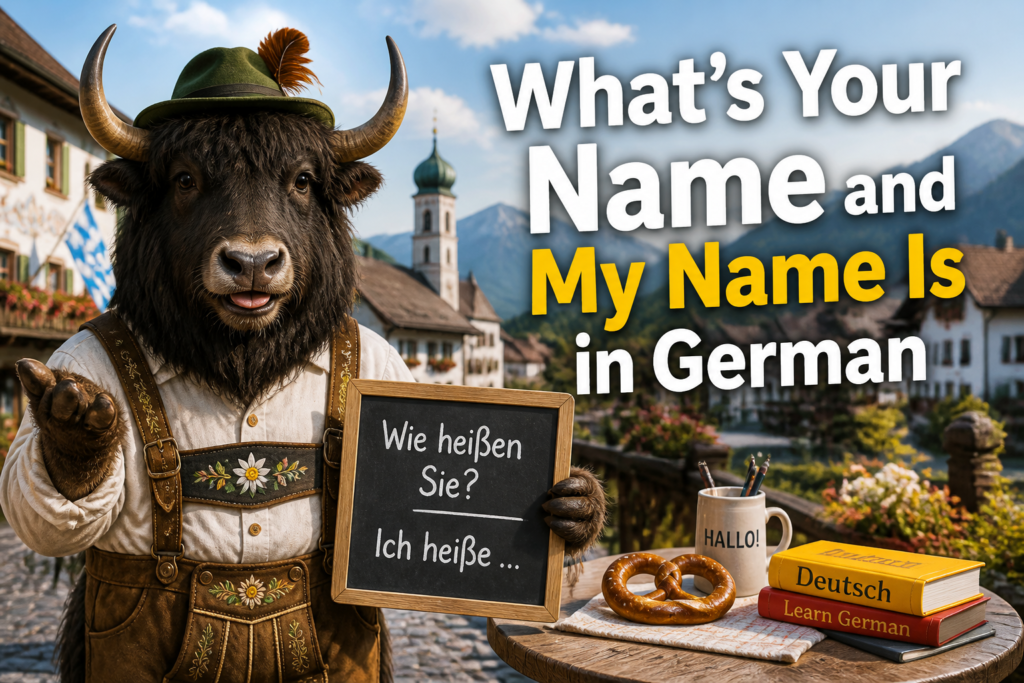
If you want to start a conversation in German without immediately sounding like a lost tourist clutching a train map, the first useful move is simple: introduce yourself. The good news? German has a handful of very common name phrases, and once you know them, you can use them everywhere — cafés, classes, hotels, online chats, and the slightly awkward moment when someone says “Und Sie?” and your brain goes completely blank.
The most important thing to know is that German often uses different phrases depending on how formal or casual the situation is. That is not German being dramatic. That is just German being German.
By the end of this guide, you’ll know how to say “What’s your name?”, “My name is…”, how to answer politely, and how to avoid a few very common beginner mistakes.
The Two Main Ways To Ask And Answer
German has one big friendly trick here: the verb heißen means “to be called” or “to be named.” So instead of literally saying “I am called…” in English style, German often says exactly that idea.
| German | Pronunciation | Meaning | Example Sentence | Translation | Learner Note |
|---|---|---|---|---|---|
| Wie heißen Sie? | vee HY-san zee | What’s your name? / What are you called? (formal) | Wie heißen Sie? – Ich heiße Maria. | What’s your name? – My name is Maria. | Use Sie with strangers, teachers, staff, and in formal situations. |
| Wie heißt du? | vee HYST doo | What’s your name? (informal) | Wie heißt du? – Ich heiße Tom. | What’s your name? – My name is Tom. | Use du with friends, children, and people who invite you to use first names. |
| Ich heiße … | ikh HY-suh | My name is … / I’m called … | Ich heiße Anna. | My name is Anna. | Very common and natural. Works in both formal and informal situations. |
| Mein Name ist … | myne NAH-muh ist | My name is … | Mein Name ist David. | My name is David. | Slightly more formal or neutral. Good for introductions, forms, and polite settings. |
A tiny pronunciation note: heißen has the sharp German ß, so it sounds like “HY-sən” or “HY-suh,” not like “hiss-en.” Also, the ei sound is like the English “eye.” Easy enough. German just likes to make one small thing look slightly more intimidating than it is.
Useful Name Phrases You’ll Actually Hear
Here are the most useful name phrases for everyday German. These are the ones that show up in real life, not the dusty textbook versions that only exist to torment students before coffee.
| German | Pronunciation | Meaning | Example Sentence | Translation | Learner Note |
|---|---|---|---|---|---|
| Wie heißen Sie? | vee HY-san zee | What’s your name? (formal) | Guten Tag. Wie heißen Sie? | Hello. What’s your name? | Very polite and safe with strangers. |
| Wie heißt du? | vee HYST doo | What’s your name? (informal) | Und wie heißt du? | And what’s your name? | Use with people you know or when the mood is casual. |
| Ich heiße … | ikh HY-suh | My name is … | Ich heiße Lena. | My name is Lena. | The most common self-introduction. |
| Mein Name ist … | myne NAH-muh ist | My name is … | Mein Name ist Karim. | My name is Karim. | Slightly more formal than Ich heiße … |
| Ich bin … | ikh bin | I am … | Ich bin Sophie. | I am Sophie. | Possible in conversation, but usually not the first choice for names. |
| Und du? | oont doo | And you? | Ich heiße Max. Und du? | My name is Max. And you? | Great for keeping the conversation moving. |
| Und Sie? | oont zee | And you? (formal) | Ich heiße Jana. Und Sie? | My name is Jana. And you? | Use in formal settings. |
| Wer sind Sie? | vehr zint zee | Who are you? (formal) | Entschuldigung, wer sind Sie? | Excuse me, who are you? | Can sound sharp if used without context. Usually fine at reception or interviews. |
| Wer bist du? | vehr bist doo | Who are you? (informal) | Hey, wer bist du? | Hey, who are you? | Often used when meeting someone new in casual settings. |
| Ich bin … | ikh bin | I am … | Ich bin Paul, der neue Kollege. | I’m Paul, the new colleague. | Useful when adding a role or relationship. |
| Freut mich. | froit mikh | Pleased to meet you. | Ich heiße Nina. Freut mich. | My name is Nina. Nice to meet you. | Short, natural, and very common. |
| Freut mich, Sie kennenzulernen. | froit mikh, zee KEN-en-zoo-ler-nen | Pleased to meet you. | Guten Abend. Freut mich, Sie kennenzulernen. | Good evening. Pleased to meet you. | More formal and polite. |
One useful pattern: German often likes a name plus a little extra. You may hear something like Ich heiße Anna, und ich komme aus Berlin. That means “My name is Anna, and I’m from Berlin.” Not required, but very common in real introductions.
How Formality Works: Sie vs Du
This part matters more than many learners expect. In German, the pronoun changes depending on whether the situation is formal or casual.
| Situation | Use | Example | Translation | Learner Note |
|---|---|---|---|---|
| Strangers, service, work, official settings | Sie | Wie heißen Sie? | What’s your name? | Sie is always capitalized when used politely. |
| Friends, classmates, children, casual chat | du | Wie heißt du? | What’s your name? | du is the informal “you.” |
| More than one person informally | ihr | Wie heißt ihr? | What are your names? | Used when speaking to a group of people you know well. |
| More than one person formally | Sie | Wie heißen Sie? | What are your names? | Yes, German uses the same Sie for singular and plural formal address. |
German tip: when in doubt, start with Sie. It is safer, politer, and less likely to make people wince politely.
Real-Life Example Sentences
These examples show how name phrases work in everyday German. Copy them, twist them, and make them your own.
| German | Pronunciation | Meaning | Example Sentence | Translation | Learner Note |
|---|---|---|---|---|---|
| Guten Morgen, wie heißen Sie? | goo-ten MOR-gen, vee HY-san zee | Good morning, what’s your name? | Guten Morgen, wie heißen Sie? | Good morning, what’s your name? | Polite opening in the morning. |
| Ich heiße Laura. | ikh HY-suh LOU-rah | My name is Laura. | Hallo, ich heiße Laura. | Hello, my name is Laura. | The simplest self-introduction. |
| Wie heißt du? | vee HYST doo | What’s your name? | Hi, wie heißt du? | Hi, what’s your name? | Casual and friendly. |
| Ich heiße Ben. Und du? | ikh HY-suh ben. oont doo | My name is Ben. And you? | Ich heiße Ben. Und du? | My name is Ben. And you? | Great for meeting classmates or new friends. |
| Mein Name ist Frau Keller. | myne NAH-muh ist frow KEL-er | My name is Ms. Keller. | Mein Name ist Frau Keller. | My name is Ms. Keller. | Useful in formal introductions, especially at work or school. |
| Freut mich, Sie kennenzulernen. | froit mikh, zee KEN-en-zoo-ler-nen | Pleased to meet you. | Freut mich, Sie kennenzulernen. | Pleased to meet you. | Very polite. Long, but worth learning. |
| Freut mich. | froit mikh | Nice to meet you. | Freut mich. | Nice to meet you. | Shorter, common, and natural. |
| Entschuldigung, wie bitte? | ent-SHOOL-di-goong, vee BIT-tuh | Sorry, what? | Entschuldigung, wie bitte? Wie heißen Sie? | Sorry, what? What’s your name? | Not a name phrase, but handy when you didn’t catch it the first time. |
Small But Important Grammar Notes
German name phrases look simple, but a few grammar details help a lot. Nothing terrible. Just enough structure to keep the chaos politely contained.
| Pattern | Meaning | German Example | English Translation | Learner Note |
|---|---|---|---|---|
| Wie heißen Sie? | Formal question using heißen | Wie heißen Sie? | What’s your name? | The verb comes second in a normal statement, but first in a question. |
| Wie heißt du? | Informal question | Wie heißt du? | What’s your name? | heißt is the du form of heißen. |
| Ich heiße … | Literal “I am called …” | Ich heiße Mira. | My name is Mira. | This is usually the safest and most natural answer. |
| Mein Name ist … | Possessive form | Mein Name ist Tobias. | My name is Tobias. | Slightly more formal; good in introductions and forms. |
| Freut mich. | Common response | Freut mich. | Nice to meet you. | Very flexible and easy to remember. |
Notice that heißen changes form depending on the subject:
- ich heiße = I’m called / my name is
- du heißt = you’re called / your name is
- er heißt = he’s called
- sie heißt = she’s called
- es heißt = it’s called
- wir heißen = we’re called
- ihr heißt = you all are called
- Sie heißen = you are called (formal)
That last one is a very classic German trap: Sie heißen looks plural, but it can also mean polite singular “you.” Context saves the day, as usual.
Pronunciation Help For The Important Bits
You do not need perfect pronunciation to be understood, but a few sounds matter a lot here.
| German Sound | Example | Easy Guide | Learner Note |
|---|---|---|---|
| ei | heißen | like “eye” | Say HY-sen, not “hee-sen.” |
| ie | Sie | like “ee” | Long “ee” sound. |
| ß | heißen | like “ss” | It is not a separate sound; it just means a sharp s. |
| ch | ich | soft throat sound | In ich heiße, the ch is soft, not like English “k.” |
| z | Sie in wie heißen Sie? | like “ts” | German z is not the English “z.” |
| st | später, stehen | usually “sht” at the start of a word | Not directly in the name phrase, but useful for German pronunciation generally. |
If you want a boring but reliable place to double-check heißen, the Duden entry for heißen is a solid reference. Not glamorous, but extremely German in the best possible way.
How To Introduce Yourself Naturally
Here are a few simple self-introduction patterns you can use right away. These are safe, natural, and not weirdly stiff.
| German | Pronunciation | Meaning | Example Sentence | Translation | Learner Note |
|---|---|---|---|---|---|
| Hallo, ich heiße Julia. | HAL-lo, ikh HY-suh YOO-lee-ah | Hello, my name is Julia. | Hallo, ich heiße Julia. | Hello, my name is Julia. | Simple and friendly. |
| Guten Tag, mein Name ist Daniel. | goo-ten tahk, myne NAH-muh ist DAH-nee-el | Good day, my name is Daniel. | Guten Tag, mein Name ist Daniel. | Good day, my name is Daniel. | Neutral and polite. |
| Hi, ich bin Aylin. | hai, ikh bin EYE-leen | Hi, I’m Aylin. | Hi, ich bin Aylin. | Hi, I’m Aylin. | Casual, but ich bin is less direct than ich heiße. |
| Ich heiße Markus. Freut mich. | ikh HY-suh MAR-koos. froit mikh | My name is Markus. Nice to meet you. | Ich heiße Markus. Freut mich. | My name is Markus. Nice to meet you. | Works almost anywhere. |
| Mein Name ist Fatima. | myne NAH-muh ist FAH-tee-mah | My name is Fatima. | Mein Name ist Fatima. | My name is Fatima. | Very good for formal introductions. |
What Not To Say — Common Mistakes
English speakers often trip over the same few things. Happily, they are easy to fix.
| Wrong / Awkward | Better | Why |
|---|---|---|
| Wie sind Sie? | Wie heißen Sie? | sein means “to be,” but the normal name question uses heißen. |
| Ich bin heiße Maria. | Ich heiße Maria. | Do not mix bin and heiße together here. |
| Ich heiße mich Maria. | Ich heiße Maria. | heißen is not reflexive in this meaning. No extra mich. |
| Wie heißt du? in a formal setting | Wie heißen Sie? | Use the right level of formality. |
| Mein Name ist ich heiße… | Choose one: Mein Name ist … or Ich heiße … | One introduction phrase is enough. German is tidy, not desperate. |
Another common issue: translating English too literally and expecting What is your name? to become Was ist dein Name? That is not the normal everyday version. German prefers Wie heißt du? or Wie heißen Sie?
Optional nuance: “Was ist dein Name?”
Was ist dein Name? is grammatically understandable, but it sounds unusual in everyday conversation. You might see it in a dramatic story, a game, or a very literal translation. For normal real life, stick to Wie heißt du? or Wie heißen Sie?
Quick Practice
Try these out loud. German gets much less scary once your mouth has met the sounds a few times.
- Say: Wie heißen Sie? in a polite tone.
- Say: Wie heißt du? in a friendly, casual tone.
- Answer: Ich heiße … with your own name.
- Answer: Mein Name ist … as a more formal version.
- Add: Freut mich.
- Say the full exchange: Wie heißen Sie? — Ich heiße Anna. Freut mich.
Now do the switch practice:
- Formal: Wie heißen Sie? → Informal: Wie heißt du?
- Formal: Und Sie? → Informal: Und du?
- Answer with Ich heiße … in both cases.
- Answer with Mein Name ist … when you want to sound a bit more formal.
Fill in the blank:
- Wie ______ Sie? → heißen
- Wie ______ du? → heißt
- Ich ______ Sophie. → heiße
- Mein ______ ist Jonas. → Name
Mini Conversation You Can Copy
Here is a very normal first-meeting dialogue. Nothing fancy. Just useful.
| German | Translation |
|---|---|
| A: Guten Tag. Wie heißen Sie? | A: Good day. What’s your name? |
| B: Ich heiße Laura. Und Sie? | B: My name is Laura. And you? |
| A: Mein Name ist Herr Weber. Freut mich. | A: My name is Mr. Weber. Nice to meet you. |
| B: Freut mich auch. | B: Nice to meet you too. |
And here is the casual version:
| German | Translation |
|---|---|
| A: Hi, wie heißt du? | A: Hi, what’s your name? |
| B: Ich heiße Noah. Und du? | B: My name is Noah. And you? |
| A: Ich bin Lea. Freut mich. | A: I’m Lea. Nice to meet you. |
| B: Freut mich auch. | B: Nice to meet you too. |
Quick Reference Summary
- Wie heißen Sie? = What’s your name? (formal)
- Wie heißt du? = What’s your name? (informal)
- Ich heiße … = My name is …
- Mein Name ist … = My name is …, slightly more formal
- Freut mich. = Nice to meet you
- Und Sie? / Und du? = And you?
- Use Sie with strangers and formal situations.
- Use du with friends and casual situations.
- Do not use Was ist dein Name? as your main everyday phrase.
If you want to keep building your German introduction skills, the next step is learning where you’re from, what you do, and how to ask someone else the same thing without sounding like a robot in a blazer. A good place to continue is the full Yak Yacker guide on your name in German, or head back to the main Learn German page for more beginner-friendly lessons.
Yak takeaway: use Wie heißen Sie? when you want to be polite, Wie heißt du? when it’s casual, and Ich heiße … when introducing yourself. Simple, useful, and way less painful than pretending you remember every German word at once.