If you learn animal vocabulary in French, birds are a sneaky good place to start. They show up in parks, on menus, in children’s books, in idioms, and outside your window at 5 a.m. when one extremely motivated creature decides sleep is optional.
For the broader learning path, visit our parent guide.
In French, un oiseau means “a bird.” It sounds roughly like wa-zoh. The plural is des oiseaux, with that famous French eau sound again. Handy word, because once you know it, you can actually start noticing what people say in real life: un pigeon, une mouette, un corbeau, and so on.
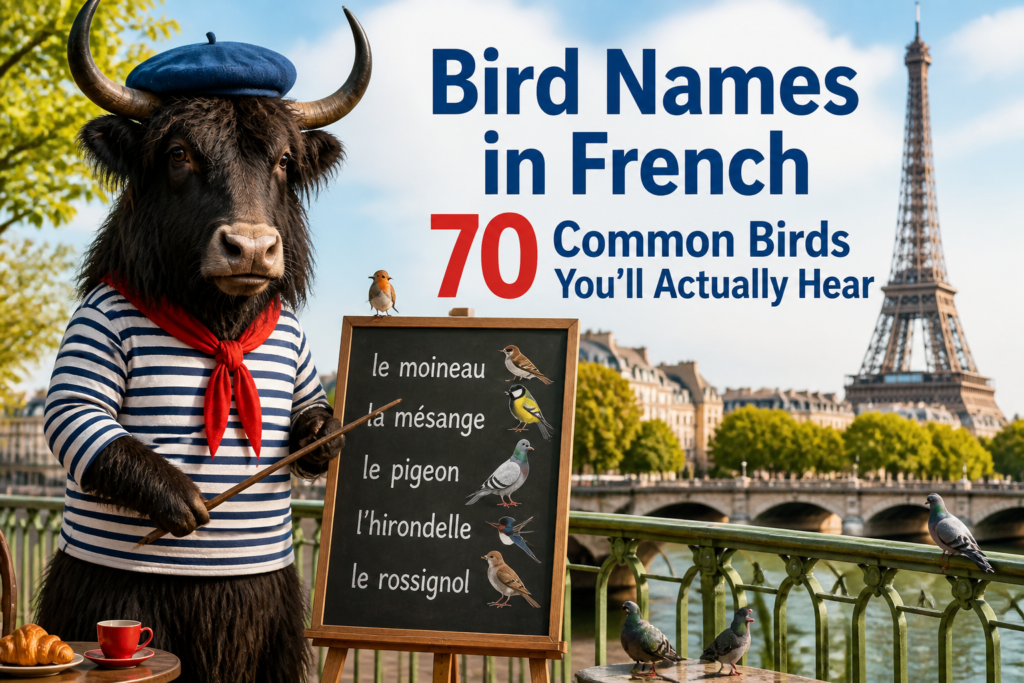
This guide gives you 70 common bird names in French, with pronunciation help, meanings, and real example sentences. You’ll get the everyday birds first, then a broader set you’re likely to hear in conversation, nature shows, school vocabulary, travel French, and the occasional dramatic weather forecast involving seagulls and coastal chaos.
If you want more everyday vocabulary after this, try the French vocabulary test or check your overall level with the French placement test.
How Bird Names Work In French
A quick note before the flock arrives: French nouns have gender. So you’ll see un for masculine bird names and une for feminine ones. The bird’s grammatical gender does not necessarily tell you whether the actual animal is male or female. It just tells you which article the noun uses.
Example: un pigeon is masculine, but it can refer to a pigeon in general. Une mouette is feminine, same idea.
Also, many final consonants are silent in French. So canard does not hit that final d hard, and paon has a nasal vowel that English speakers usually want to wrestle into something weird. Resist the urge. French is often smoother than it looks.
The Birds You’ll Hear Most Often
| French | Pronunciation | Meaning | Example Sentence | Translation | Learner Note |
|---|---|---|---|---|---|
| un oiseau | wa-zoh | bird | Cet oiseau chante très tôt le matin. | That bird sings very early in the morning. | Basic general word for bird. |
| un pigeon | pee-zhon | pigeon | Il y a beaucoup de pigeons sur la place. | There are a lot of pigeons in the square. | Very common city bird. |
| un moineau | mwah-noh | sparrow | Un moineau a pris une miette de pain. | A sparrow took a breadcrumb. | Common in parks and gardens. |
| une mouette | moo-et | seagull, gull | La mouette a volé mes frites. | The seagull stole my fries. | Honestly, believable. |
| un canard | ka-nar | duck | Les enfants regardent les canards au parc. | The children are watching the ducks in the park. | Final d is silent. |
| une poule | pool | hen | La poule cherche des graines dans la cour. | The hen is looking for seeds in the yard. | Farm vocabulary staple. |
| un coq | kok | rooster | Le coq chante au lever du soleil. | The rooster crows at sunrise. | Also a strong French symbol. |
| une colombe | ko-lomb | dove | La colombe est un symbole de paix. | The dove is a symbol of peace. | Often more symbolic than casual. |
| un corbeau | kor-boh | crow, raven | Un corbeau était posé sur le toit. | A crow was perched on the roof. | Can refer broadly; context matters. |
| une hirondelle | ee-ron-del | swallow | Les hirondelles reviennent au printemps. | Swallows return in spring. | Classic seasonal bird. |
| un hibou | ee-boo | owl | Le hibou chasse la nuit. | The owl hunts at night. | Common general owl word. |
| une chouette | shwet | owl | J’ai entendu une chouette dans les bois. | I heard an owl in the woods. | Also means “great” in casual French. |
Garden, Park, And Everyday Nature Birds
These are the birds that come up a lot in daily life, especially if you like walks, gardens, balconies, countryside trips, or pretending you know birds because you saw one once and now feel qualified.
| French | Pronunciation | Meaning | Example Sentence | Translation | Learner Note |
|---|---|---|---|---|---|
| un merle | merl | blackbird | Le merle chante dans le jardin. | The blackbird is singing in the garden. | Very common in France. |
| une mésange | may-zonzh | tit, chickadee-type bird | Une mésange s’est posée sur la branche. | A tit landed on the branch. | Common garden bird word. |
| un rouge-gorge | roozh-gorzh | robin | Le rouge-gorge est resté près de la fenêtre. | The robin stayed near the window. | Literally “red throat.” |
| une pie | pee | magpie | La pie a construit son nid dans l’arbre. | The magpie built its nest in the tree. | Short word, easy to remember. |
| un geai | zhay | jay | J’ai vu un geai bleu dans la forêt. | I saw a blue jay in the forest. | Often geai bleu for blue jay. |
| une grive | greev | thrush | La grive chante d’une voix claire. | The thrush sings with a clear voice. | Useful in nature contexts. |
| un étourneau | ay-toor-noh | starling | Les étourneaux volent en groupe. | Starlings fly in a group. | Plural often heard in documentaries. |
| un pinson | pan-son | finch | Le pinson mange des graines. | The finch eats seeds. | Nasal vowel in first syllable. |
| un rossignol | ro-see-nyol | nightingale | Le rossignol chante la nuit. | The nightingale sings at night. | Classic literary bird. |
| un pic | peek | woodpecker | Un pic frappait le tronc de l’arbre. | A woodpecker was pecking the tree trunk. | Often expanded to species names. |
| un pic-vert | peek-ver | green woodpecker | Le pic-vert a traversé la pelouse. | The green woodpecker crossed the lawn. | Very common compound noun. |
| une tourterelle | toor-te-rel | turtledove, dove | Une tourterelle roucoulait sur le balcon. | A turtledove was cooing on the balcony. | Common in towns and suburbs. |
Water Birds And Coastal Birds
If you travel in France, especially near lakes, rivers, or the coast, these names come up fast. And yes, coastal birds absolutely behave like they pay no taxes and fear nothing.
| French | Pronunciation | Meaning | Example Sentence | Translation | Learner Note |
|---|---|---|---|---|---|
| un cygne | seen-y | swan | Le cygne nage lentement sur le lac. | The swan is swimming slowly on the lake. | Final g is not hard. |
| une oie | wah | goose | L’oie traverse le chemin. | The goose is crossing the path. | Watch the elision: l’oie. |
| un jars | zhar | gander | Le jars protège les autres oies. | The gander protects the other geese. | Male goose specifically. |
| un héron | ay-ron | heron | Le héron attend près de l’eau. | The heron waits near the water. | Common in wetlands. |
| une aigrette | ay-gret | egret | J’ai aperçu une aigrette blanche. | I caught sight of a white egret. | Often seen in nature programs. |
| un flamant rose | fla-mon rohz | flamingo | Les flamants roses vivent en groupe. | Flamingos live in groups. | Plural often used. |
| un goéland | go-ay-lan | large gull | Un goéland planait au-dessus du port. | A gull was gliding above the harbor. | Often confused with mouette. |
| un pélican | pay-lee-kon | pelican | Le pélican a un grand bec. | The pelican has a large beak. | Easy cognate. |
| un cormoran | kor-mo-ran | cormorant | Le cormoran sèche ses ailes au soleil. | The cormorant is drying its wings in the sun. | Common seaside word. |
| un pingouin | pan-gwan | auk, great auk type bird | Le pingouin ne vit pas en Antarctique. | The auk does not live in Antarctica. | Classic trap for learners. |
| un manchot | man-shoh | penguin | Le manchot empereur vit dans l’Antarctique. | The emperor penguin lives in Antarctica. | This is the true “penguin.” |
| une sterne | stern | tern | La sterne plonge pour attraper un poisson. | The tern dives to catch a fish. | Useful coastal nature term. |
Quick Fix: In everyday English, people often say “penguin” for anything black-and-white and flappy. In French, un pingouin and un manchot are not the same bird. French is being annoyingly precise here, and honestly, fair enough.
Birds Of Prey In French
These names are useful in nature vocabulary, documentaries, school topics, and figurative language. French loves a dramatic eagle moment now and then.
| French | Pronunciation | Meaning | Example Sentence | Translation | Learner Note |
|---|---|---|---|---|---|
| un aigle | egl | eagle | L’aigle vole au-dessus des montagnes. | The eagle flies above the mountains. | Watch the article: l’aigle. |
| un faucon | fo-kon | falcon | Le faucon est très rapide. | The falcon is very fast. | Common general term. |
| un épervier | ay-per-vyay | sparrowhawk | Un épervier a surpris les petits oiseaux. | A sparrowhawk startled the small birds. | Good advanced everyday nature word. |
| une buse | buz | buzzard | La buse tournait dans le ciel. | The buzzard was circling in the sky. | Common in countryside French. |
| un vautour | voh-toor | vulture | Le vautour a une vue impressionnante. | The vulture has impressive eyesight. | Also figurative in insults. |
| une chouette effraie | shwet ef-ray | barn owl | La chouette effraie vit souvent près des fermes. | The barn owl often lives near farms. | Specific owl species. |
| un grand-duc | gran-dewk | eagle owl | Le grand-duc a de grands yeux orange. | The eagle owl has large orange eyes. | Very common species name. |
| un milan | mee-lan | kite | Le milan planait sans bouger les ailes. | The kite was gliding without moving its wings. | Bird, not toy kite. |
Farm Birds And Familiar Domestic Birds
| French | Pronunciation | Meaning | Example Sentence | Translation | Learner Note |
|---|---|---|---|---|---|
| un poulet | poo-lay | chicken | Le poulet court dans la cour. | The chicken is running in the yard. | Also means chicken meat. |
| un poussin | poo-san | chick | Le poussin reste près de la poule. | The chick stays near the hen. | Cute word, nasal ending. |
| une dinde | dand | turkey | La dinde est dans l’enclos. | The turkey is in the enclosure. | Also can be a silly insult. |
| un dindon | dan-don | male turkey | Le dindon fait la roue. | The male turkey fans his tail. | Specific male form. |
| une pintade | pan-tad | guinea fowl | La pintade pousse un cri très fort. | The guinea fowl makes a very loud call. | Common farm term in French. |
| une caille | kai | quail | La caille se cache dans l’herbe. | The quail hides in the grass. | Short, practical word. |
| une perdrix | pair-dree | partridge | Une perdrix a traversé le champ. | A partridge crossed the field. | Useful in rural vocabulary. |
| une grue | grü | crane | Les grues migrent en automne. | Cranes migrate in autumn. | Not to be confused with the machine crane in context. |
Colorful, Exotic, Or Zoo Birds
You may not hear these every day on a Paris sidewalk, but they are common enough in books, travel, zoos, and general vocabulary that they absolutely belong on your list.
| French | Pronunciation | Meaning | Example Sentence | Translation | Learner Note |
|---|---|---|---|---|---|
| un perroquet | pe-ro-kay | parrot | Le perroquet répète quelques mots. | The parrot repeats a few words. | Very common word. |
| une perruche | pe-rüsh | parakeet, budgie | La perruche est dans sa cage. | The budgie is in its cage. | Common pet bird term. |
| un paon | pan | peacock | Le paon ouvre ses plumes. | The peacock opens its feathers. | Nasal vowel, final n not pronounced. |
| une autruche | oh-trüsh | ostrich | L’autruche court très vite. | The ostrich runs very fast. | Elision: l’autruche. |
| un toucan | too-kan | toucan | Le toucan a un bec impressionnant. | The toucan has an impressive beak. | Easy cognate. |
| un colibri | ko-lee-bree | hummingbird | Le colibri butine les fleurs. | The hummingbird feeds from the flowers. | Useful with flower vocabulary too. |
| un faisan | feh-zan | pheasant | Le faisan s’est caché dans les buissons. | The pheasant hid in the bushes. | Common in countryside topics. |
| une alouette | a-loo-et | lark | L’alouette chante très haut dans le ciel. | The lark sings high in the sky. | Also famous from the song. |
More Common Bird Names You’ll Run Into
Here’s the rest of your useful flock, grouped in one compact table so this doesn’t turn into a bird encyclopedia wearing a scarf.
| French | Pronunciation | Meaning | Example Sentence | Translation | Learner Note |
|---|---|---|---|---|---|
| un vautour fauve | voh-toor fohv | griffon vulture | Le vautour fauve plane longtemps sans effort. | The griffon vulture glides for a long time effortlessly. | Species name. |
| une bécasse | bay-kas | woodcock | La bécasse vit dans les zones boisées. | The woodcock lives in wooded areas. | Nature term. |
| une bécassine | bay-ka-seen | snipe | La bécassine cherche sa nourriture dans la vase. | The snipe looks for food in the mud. | Also figurative in some expressions. |
| un martin-pêcheur | mar-tan peh-shur | kingfisher | Le martin-pêcheur a plongé dans la rivière. | The kingfisher dove into the river. | Literally “Martin fisher.” |
| un coucou | koo-koo | cuckoo | On entend le coucou au printemps. | You can hear the cuckoo in spring. | Also a casual “hi” in French. |
| une buse variable | buz va-ree-abl | common buzzard | La buse variable survole les champs. | The common buzzard flies over the fields. | Specific species. |
| un loriot | lo-ree-oh | oriole | Le loriot est difficile à voir. | The oriole is hard to see. | Useful birdwatching term. |
| une fauvette | fo-vet | warbler | La fauvette chante dans la haie. | The warbler sings in the hedge. | Common in nature lists. |
| un troglodyte | tro-glo-deet | wren | Le troglodyte est petit mais très bruyant. | The wren is small but very noisy. | Short for troglodyte mignon in some contexts. |
| un tarin | ta-ran | siskin | Le tarin se nourrit de graines. | The siskin feeds on seeds. | Less common but useful. |
| un bruant | brü-an | bunting | Le bruant se pose sur la clôture. | The bunting lands on the fence. | Birdwatching vocabulary. |
| une huppe | üp | hoopoe | La huppe a une crête très reconnaissable. | The hoopoe has a very recognizable crest. | Often huppe fasciée. |
| une cigogne | see-gon-y | stork | La cigogne a construit un grand nid. | The stork built a large nest. | Common in Alsace references. |
| un râle | ral | rail | Le râle vit dans les roseaux. | The rail lives in the reeds. | Nature reserve vocabulary. |
| une foulque | foolk | coot | La foulque nage près des roseaux. | The coot swims near the reeds. | Often seen on lakes. |
| un grèbe | greb | grebe | Le grèbe disparaît sous l’eau. | The grebe disappears underwater. | Water bird term. |
| une sarcelle | sar-sel | teal | La sarcelle est plus petite que le canard. | The teal is smaller than the duck. | Duck family bird. |
| un rapace | ra-pas | bird of prey | Ce rapace chasse au crépuscule. | This bird of prey hunts at dusk. | General category word. |
| un passereau | pa-suh-roh | songbird, perching bird | Le moineau est un petit passereau. | The sparrow is a small songbird. | Useful classification term. |
| une volaille | vo-lai | poultry | La ferme élève plusieurs volailles. | The farm raises several poultry birds. | More food/farm category than one species. |
Useful Bird-Related French Words
If you want to actually talk about birds, not just point at one and yell a noun, these extra words help a lot.
| French | Pronunciation | Meaning | Example Sentence | Translation | Learner Note |
|---|---|---|---|---|---|
| une aile | el | wing | L’oiseau a une aile blessée. | The bird has an injured wing. | Also used for airplane wing. |
| un bec | bek | beak | Le canard a un bec orange. | The duck has an orange beak. | Very common word. |
| une plume | ploom | feather | J’ai trouvé une plume blanche. | I found a white feather. | Also means pen in some contexts historically. |
| un nid | nee | nest | Les oiseaux construisent un nid. | Birds build a nest. | Final d is silent. |
| un œuf | uhf | egg | L’oiseau couve ses œufs. | The bird is incubating its eggs. | Plural pronunciation changes in some contexts. |
| voler | vo-lay | to fly | Les mouettes volent au-dessus de la mer. | Seagulls fly above the sea. | Also means “to steal.” French loves chaos. |
| chanter | shan-tay | to sing | Les oiseaux chantent à l’aube. | Birds sing at dawn. | Very useful verb. |
| migrer | mee-gray | to migrate | Certaines espèces migrent en hiver. | Certain species migrate in winter. | Easy cognate. |
Common Mix-Ups And Easy Fixes
- un hibou vs une chouette: both can mean owl, but they are different types. In simple learner French, both are useful. Chouette also means “great” in casual speech: C’est chouette ! = “That’s great!”
- une mouette vs un goéland: English often says “seagull” for both. In French, goéland is usually the larger gull.
- un pingouin vs un manchot: this one gets people every time. French manchot is the penguin you’re thinking of.
- un poulet can mean the living animal or chicken meat. Context does the heavy lifting.
- voler means both “to fly” and “to steal.” So La mouette a volé mes frites is technically a pronunciation lesson and a crime report.
Practice Sentences
- Je vois un rouge-gorge dans le jardin. — I see a robin in the garden.
- Les pigeons sont partout sur la place. — The pigeons are everywhere in the square.
- Une mouette crie au-dessus de la plage. — A seagull is crying out above the beach.
- Le héron attend au bord de l’eau. — The heron is waiting at the edge of the water.
- Les hirondelles arrivent au printemps. — Swallows arrive in spring.
- Le hibou chasse pendant la nuit. — The owl hunts during the night.
- Le perroquet répète mon prénom. — The parrot repeats my first name.
- Le paon montre ses plumes. — The peacock shows its feathers.
Quick Reference Summary
- un oiseau = bird
- un moineau = sparrow
- un pigeon = pigeon
- une mouette = seagull
- un canard = duck
- un hibou / une chouette = owl
- un corbeau = crow
- une hirondelle = swallow
- un héron = heron
- un aigle = eagle
- un perroquet = parrot
- un paon = peacock
- un pingouin ≠ penguin in the usual English sense
- un manchot = penguin
If you want to keep building nature vocabulary, you can also learn fish names in French and flower names in French. Or, naturally, reread this flock-friendly guide at bird names in French whenever a mysterious beaked creature appears and demands to be identified.
Yak takeaway: learn the birds you’ll actually see first: pigeon, moineau, mouette, canard, hibou, corbeau. Then add the fancier ones later. Vocabulary works better when it starts in the park, not in an imaginary rainforest full of birds you will absolutely never discuss before coffee.