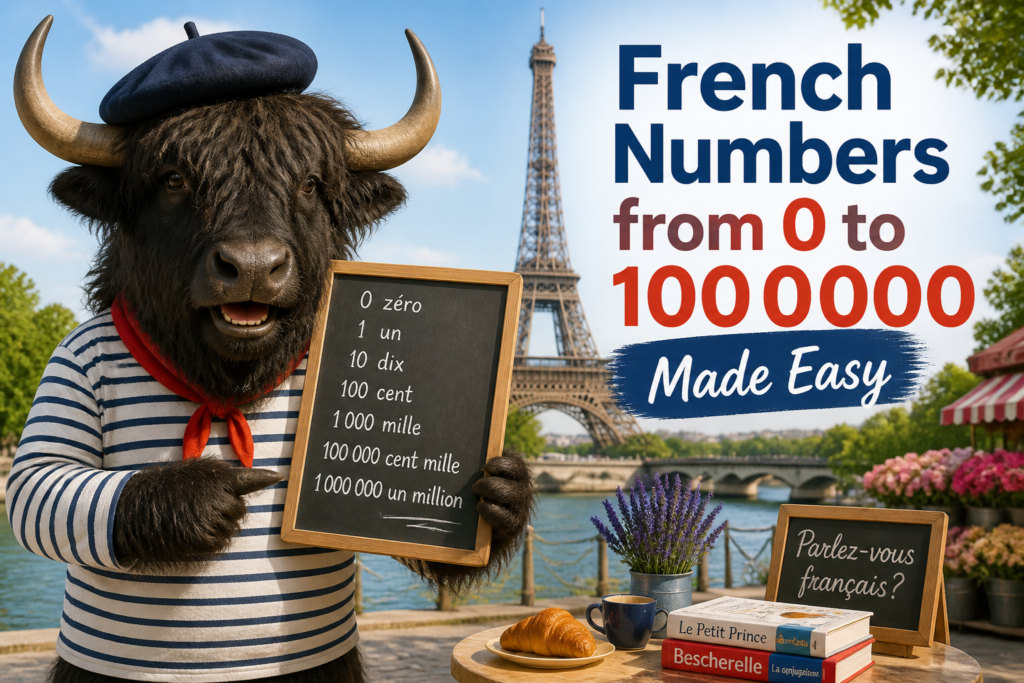
French numbers look innocent at first. Then you meet soixante-dix and realize French has chosen chaos with paperwork.
The good news: French numbers are not random. They follow patterns, and once you learn the core building blocks, you can count prices, phone numbers, dates, ages, addresses, and giant scary-looking numbers without freezing like a tourist at a bakery.
In this guide, you’ll learn the key French numbers from 0 to 1,000,000, how to pronounce them, where the weird parts start, and the common mistakes English speakers make. If you want more French basics after this, you can also explore the main Learn French hub.
The Core Numbers You Must Know First
Start with the numbers that everything else is built from. These are the bricks. The rest is mostly stacking them together in slightly dramatic ways.
| French | Pronunciation | Meaning | Example Sentence | Translation | Learner Note |
|---|---|---|---|---|---|
| zéro | zay-roh | zero | J’ai zéro euro sur moi. | I have zero euros on me. | Used like English “zero.” |
| un | uhn | one | J’ai un frère. | I have one brother. | Un is masculine; une is feminine. |
| deux | duh | two | Nous avons deux chats. | We have two cats. | The final x is silent. |
| trois | twah | three | Elle a trois enfants. | She has three children. | Don’t pronounce the final s. |
| quatre | ka-truh | four | Il est quatre heures. | It’s four o’clock. | Often shortened a bit in fast speech. |
| cinq | sank | five | Je reste cinq minutes. | I’m staying five minutes. | The final q is not pronounced separately. |
| six | seess | six | Nous sommes six à table. | There are six of us at the table. | Sometimes the final x changes sound before another word. |
| sept | set | seven | Le train part dans sept minutes. | The train leaves in seven minutes. | Final p is silent. |
| huit | weet | eight | J’ai huit euros. | I have eight euros. | Watch the silent h in linked phrases. |
| neuf | nuhf | nine | Elle habite au neuf rue Victor Hugo. | She lives at 9 Victor Hugo Street. | The f is pronounced. |
| dix | deess | ten | Le film commence à dix heures. | The movie starts at ten o’clock. | The final x is usually pronounced here. |
Numbers 11 To 16: Learn These As A Set
These are special forms, so it’s best to memorize them early. After 16, things become much more predictable.
| French | Pronunciation | Meaning | Example Sentence | Translation | Learner Note |
|---|---|---|---|---|---|
| onze | ohnz | eleven | Il est onze heures. | It’s eleven o’clock. | Common in time expressions. |
| douze | dooz | twelve | Nous sommes douze dans la classe. | There are twelve of us in the class. | Fairly smooth, one syllable-ish in fast speech. |
| treize | trehz | thirteen | Ma fille a treize ans. | My daughter is thirteen years old. | Use avoir for age in French. |
| quatorze | ka-torz | fourteen | Le rendez-vous est le quatorze mai. | The appointment is on May fourteenth. | Useful for dates. |
| quinze | kanz | fifteen | J’attends depuis quinze minutes. | I’ve been waiting for fifteen minutes. | The spelling looks meaner than the sound. |
| seize | sehz | sixteen | Il a seize ans aujourd’hui. | He is sixteen today. | After this, the pattern becomes easier. |
Numbers 17 To 19: Simple Addition
Now French starts doing what you hoped it would do from the beginning: it adds numbers together.
| French | Pronunciation | Meaning | Example Sentence | Translation | Learner Note |
|---|---|---|---|---|---|
| dix-sept | deess-set | seventeen | Le billet coûte dix-sept euros. | The ticket costs seventeen euros. | Literally “ten-seven.” |
| dix-huit | deez-weet | eighteen | J’arrive le dix-huit juillet. | I’m arriving on July eighteenth. | The x in dix links smoothly before huit. |
| dix-neuf | deez-nuhf | nineteen | Elle a dix-neuf ans. | She is nineteen years old. | Again, literally “ten-nine.” |
French number survival tip: once you hear the pattern, the system gets less scary and more annoyingly logical.
From 20 To 69: Mostly Civilized
These numbers are fairly friendly. Learn the tens first: vingt (20), trente (30), quarante (40), cinquante (50), soixante (60). Then add the smaller numbers after them.
Examples: vingt-deux = 22, trente-quatre = 34, cinquante-neuf = 59.
| French | Pronunciation | Meaning | Example Sentence | Translation | Learner Note |
|---|---|---|---|---|---|
| vingt | van | twenty | J’ai vingt ans. | I am twenty years old. | The final t is usually silent. |
| trente | tront | thirty | Le cours dure trente minutes. | The class lasts thirty minutes. | Nasal vowel in the first part. |
| quarante | ka-ront | forty | Le livre coûte quarante euros. | The book costs forty euros. | Not related to English “quarter.” Don’t let your brain improvise. |
| cinquante | sank-ont | fifty | Nous sommes cinquante au concert. | There are fifty of us at the concert. | Built from cinq. |
| soixante | swah-sont | sixty | Mon père a soixante ans. | My father is sixty years old. | This one matters a lot later. |
When To Use et With Numbers
French uses et (“and”) with numbers ending in 1 after certain tens:
- vingt et un = 21
- trente et un = 31
- quarante et un = 41
- cinquante et un = 51
- soixante et un = 61
Example: J’ai trente et un livres. = “I have thirty-one books.”
But not everything gets et. French had to keep a little mischief for later.
The Famous Weird Zone: 70 To 99
This is the part learners complain about, and honestly, fair enough. In standard France French, the system shifts:
- 70 = 60 + 10 → soixante-dix
- 80 = 4 × 20 → quatre-vingts
- 90 = 80 + 10 → quatre-vingt-dix
It looks odd, but the pattern is consistent once you accept the deal.
Numbers 70 To 79
| French | Pronunciation | Meaning | Example Sentence | Translation | Learner Note |
|---|---|---|---|---|---|
| soixante-dix | swah-sont-deess | seventy | Le musée ouvre à soixante-dix? Non, à dix heures. | The museum opens at seventy? No, at ten o’clock. | Yes, literally “sixty-ten.” |
| soixante et onze | swah-sont-ay-ohnz | seventy-one | Ma grand-mère a soixante et onze ans. | My grandmother is seventy-one years old. | Notice the return of et. |
| soixante-douze | swah-sont-dooz | seventy-two | Il y a soixante-douze pages. | There are seventy-two pages. | Built like 60 + 12. |
| soixante-quinze | swah-sont-kanz | seventy-five | Le train part à soixante-quinze minutes? Non, dans soixante-quinze minutes. | The train leaves at seventy-five minutes? No, in seventy-five minutes. | Use for quantities, timespans, prices. |
| soixante-dix-neuf | swah-sont-deez-nuhf | seventy-nine | Le produit coûte soixante-dix-neuf euros. | The product costs seventy-nine euros. | Literally 60 + 19. |
Numbers 80 To 89
80 is quatre-vingts, literally “four twenties.” Very normal. Completely reasonable. Definitely not history messing with your afternoon.
| French | Pronunciation | Meaning | Example Sentence | Translation | Learner Note |
|---|---|---|---|---|---|
| quatre-vingts | katr-van | eighty | Il a quatre-vingts ans. | He is eighty years old. | The s appears only when nothing follows. |
| quatre-vingt-un | katr-van-uhn | eighty-one | Nous avons quatre-vingt-un clients aujourd’hui. | We have eighty-one clients today. | No et here. |
| quatre-vingt-deux | katr-van-duh | eighty-two | Le bus numéro quatre-vingt-deux arrive. | Bus number eighty-two is arriving. | The final s disappears because another number follows. |
| quatre-vingt-cinq | katr-van-sank | eighty-five | Le billet coûte quatre-vingt-cinq euros. | The ticket costs eighty-five euros. | Think “4 x 20 + 5.” |
| quatre-vingt-neuf | katr-van-nuhf | eighty-nine | Elle habite au quatre-vingt-neuf. | She lives at number eighty-nine. | Common in addresses. |
Numbers 90 To 99
Now take the 80 structure and add the teen numbers.
| French | Pronunciation | Meaning | Example Sentence | Translation | Learner Note |
|---|---|---|---|---|---|
| quatre-vingt-dix | katr-van-deess | ninety | Mon grand-père a quatre-vingt-dix ans. | My grandfather is ninety years old. | Literally 80 + 10. |
| quatre-vingt-onze | katr-van-ohnz | ninety-one | Le document contient quatre-vingt-onze pages. | The document contains ninety-one pages. | No et here either. |
| quatre-vingt-quatorze | katr-van-ka-torz | ninety-four | Il est né en mille neuf cent quatre-vingt-quatorze. | He was born in nineteen ninety-four. | Very common in years. |
| quatre-vingt-seize | katr-van-sehz | ninety-six | La salle a quatre-vingt-seize places. | The room has ninety-six seats. | Built from 80 + 16. |
| quatre-vingt-dix-neuf | katr-van-deez-nuhf | ninety-nine | Le produit vaut quatre-vingt-dix-neuf centimes. | The product is worth ninety-nine cents. | Looks long, but the pattern is stable. |
A Useful Regional Note: France Vs Belgium And Switzerland
Standard France French usually uses soixante-dix, quatre-vingts, and quatre-vingt-dix.
But in parts of Belgium and Switzerland, you may hear simpler forms:
- septante = 70
- huitante or sometimes octante = 80
- nonante = 90
Example: J’ai nonante euros. = “I have ninety euros.”
These forms are real, correct in their regions, and honestly easier. But if you are learning standard France French, stick with the France forms first.
How To Build Numbers From 100 To 999
Once you get past 99, French calms down again.
100 is cent. Then you add what comes after it:
- cent = 100
- cent un = 101
- cent dix = 110
- cent vingt-trois = 123
- deux cents = 200
- deux cent un = 201
- trois cent quarante = 340
Important Rule About cent
Cent takes an s only when it is multiplied and nothing follows.
- deux cents = 200
- trois cents = 300
- deux cent un = 201
- trois cent dix = 310
So yes, French lets the spelling change depending on whether the number stops there. Tiny trap. Very French.
| French | Pronunciation | Meaning | Example Sentence | Translation | Learner Note |
|---|---|---|---|---|---|
| cent | son | one hundred | Le smartphone coûte cent euros. | The smartphone costs one hundred euros. | No un before cent. |
| deux cents | duh-son | two hundred | Ils ont deux cents abonnés. | They have two hundred subscribers. | Add s because nothing follows. |
| deux cent cinq | duh-son-sank | two hundred five | Le code contient deux cent cinq entrées. | The code contains two hundred five entries. | No s on cent here. |
| trois cent quarante-deux | twah-son-ka-ront-duh | three hundred forty-two | La bibliothèque possède trois cent quarante-deux ouvrages. | The library has three hundred forty-two works. | Just stack the parts in order. |
| neuf cent quatre-vingt-dix-neuf | nuhf-son-katr-van-deez-nuhf | nine hundred ninety-nine | Le prix est de neuf cent quatre-vingt-dix-neuf euros. | The price is nine hundred ninety-nine euros. | Long, but fully predictable. |
Thousands: Very Manageable, Actually
1,000 is mille. Good news: mille does not take un before it for 1,000.
- mille = 1,000
- mille un = 1,001
- mille dix = 1,010
- deux mille = 2,000
- dix mille = 10,000
- vingt-trois mille = 23,000
Example: La ville compte dix mille habitants. = “The town has ten thousand inhabitants.”
Unlike cent, mille does not become plural in normal number use. You write deux mille, not deux milles.
From 100000 To 1000000
Now for the bigger numbers.
- cent mille = 100,000
- deux cent mille = 200,000
- cinq cent mille = 500,000
- un million = 1,000,000
Million behaves like a normal noun, so it does take un and it can be pluralized.
- un million = one million
- deux millions = two million
Example: Cette vidéo a un million de vues. = “This video has one million views.”
Notice the de after million before another noun: un million de vues, deux millions d’euros.
| French | Pronunciation | Meaning | Example Sentence | Translation | Learner Note |
|---|---|---|---|---|---|
| mille | meel | one thousand | Le village est à mille mètres d’altitude. | The village is at an altitude of one thousand meters. | No un before it. |
| dix mille | deess-meel | ten thousand | Le stade contient dix mille places. | The stadium has ten thousand seats. | Mille stays singular. |
| cent mille | son-meel | one hundred thousand | La voiture coûte cent mille euros. | The car costs one hundred thousand euros. | Built exactly as expected. |
| cinq cent mille | sank-son-meel | five hundred thousand | L’entreprise a cinq cent mille clients. | The company has five hundred thousand customers. | No s on cent because something follows. |
| un million | uhn mee-lyon | one million | Il a gagné un million d’euros. | He won one million euros. | Use de before a noun after million. |
Useful Real-Life Number Phrases
Numbers are not just for counting in a vacuum like a nervous robot. Here are common real-life phrases you’ll actually use.
| French | Pronunciation | Meaning | Example Sentence | Translation | Learner Note |
|---|---|---|---|---|---|
| Quel âge avez-vous ? | kel ahzh ah-vay-voo | How old are you? | Quel âge avez-vous exactement ? | How old are you exactly? | French uses avoir for age. |
| J’ai vingt ans. | zhay van-ahn | I am twenty years old. | J’ai vingt ans depuis mars. | I’ve been twenty since March. | Literally “I have twenty years.” |
| Ça coûte combien ? | sah koot kom-byan | How much does it cost? | Ça coûte combien, ce pull ? | How much does this sweater cost? | Very useful while shopping. |
| C’est vingt euros. | say van-tuh-roh | It’s twenty euros. | C’est vingt euros pour une entrée. | It’s twenty euros for one ticket. | Simple price answer. |
| Nous sommes deux. | noo som duh | There are two of us. | Bonjour, nous sommes deux. | Hello, there are two of us. | Perfect in restaurants. |
| J’habite au numéro cinq. | zhah-beet oh nu-may-ro sank | I live at number five. | J’habite au numéro cinq, rue Pasteur. | I live at number five, Pasteur Street. | Common for addresses. |
| Le train part à huit heures. | luh tran par tah weet ur | The train leaves at eight o’clock. | Le train part à huit heures dix. | The train leaves at eight ten. | Great for time practice. |
| J’arrive dans dix minutes. | zhah-reev don deess mee-newt | I’ll arrive in ten minutes. | Ne t’inquiète pas, j’arrive dans dix minutes. | Don’t worry, I’ll arrive in ten minutes. | Everyday phrase, especially in texts. |
| Mon numéro, c’est le zéro six… | mon nu-may-ro say luh zay-ro seess | My number is 06… | Mon numéro, c’est le zéro six, vingt-trois… | My number is 06, 23… | Phone numbers are often said digit by digit. |
| Il y a cent personnes. | eel yah son pair-son | There are one hundred people. | Il y a cent personnes dans la salle. | There are one hundred people in the room. | Il y a = there is/there are. |
Common Mistakes English Speakers Make
- Saying “un cent” for 100.
Wrong: un cent
Correct: cent
French does not use un before 100. - Adding et everywhere.
Correct: vingt et un
But: quatre-vingt-un, not quatre-vingt-et-un. - Forgetting the special 70–99 pattern.
70 is soixante-dix, not a direct version of “septante” in standard France French. - Keeping the s in quatre-vingts when another number follows.
Correct: quatre-vingts = 80
Correct: quatre-vingt-deux = 82 - Adding an s to mille.
Correct: deux mille, not deux milles. - Using “être” for age.
Wrong: Je suis vingt ans.
Correct: J’ai vingt ans.
Quick Pattern Summary
- 0–16: learn the basic forms
- 17–19: dix + number
- 20–69: tens + number
- 21, 31, 41, 51, 61: use et un
- 70–79: soixante + 10–19
- 80: quatre-vingts
- 81–99: quatre-vingt + number
- 100: cent
- 1,000: mille
- 1,000,000: un million
Mini Practice
Try these before peeking at the answers.
- 21 = ?
- 47 = ?
- 71 = ?
- 80 = ?
- 94 = ?
- 200 = ?
- 201 = ?
- 1,000 = ?
- 10,000 = ?
- 1,000,000 = ?
Answers: vingt et un, quarante-sept, soixante et onze, quatre-vingts, quatre-vingt-quatorze, deux cents, deux cent un, mille, dix mille, un million.
A Few Handy Number Examples In Context
- J’ai deux billets pour le concert. — I have two tickets for the concert.
- Le café coûte trois euros cinquante. — The coffee costs three euros fifty.
- Nous partons dans quinze minutes. — We’re leaving in fifteen minutes.
- Ma sœur a trente-deux ans. — My sister is thirty-two years old.
- Il y a quatre-vingt-dix étudiants dans le bâtiment. — There are ninety students in the building.
- Le village se trouve à cent kilomètres d’ici. — The village is one hundred kilometers from here.
- Cette chaîne a un million d’abonnés. — This channel has one million subscribers.
Keep Going After Numbers
If you want to check your current level, try the French placement test. If you want more word power, the French vocabulary test is a good next step.
You can also revisit this lesson anytime at French numbers, and if you want a practical vocab topic next, countries, nationalities, and languages in French is a very useful follow-up.
Yak Takeaway
French numbers are not impossible. They just pretend to be. Learn the core numbers, master the patterns, pay special attention to 70–99, and the whole system gets much less dramatic. After that, you’re not “bad at French numbers.” You’re just one quatre-vingt-dix-neuf away from victory.