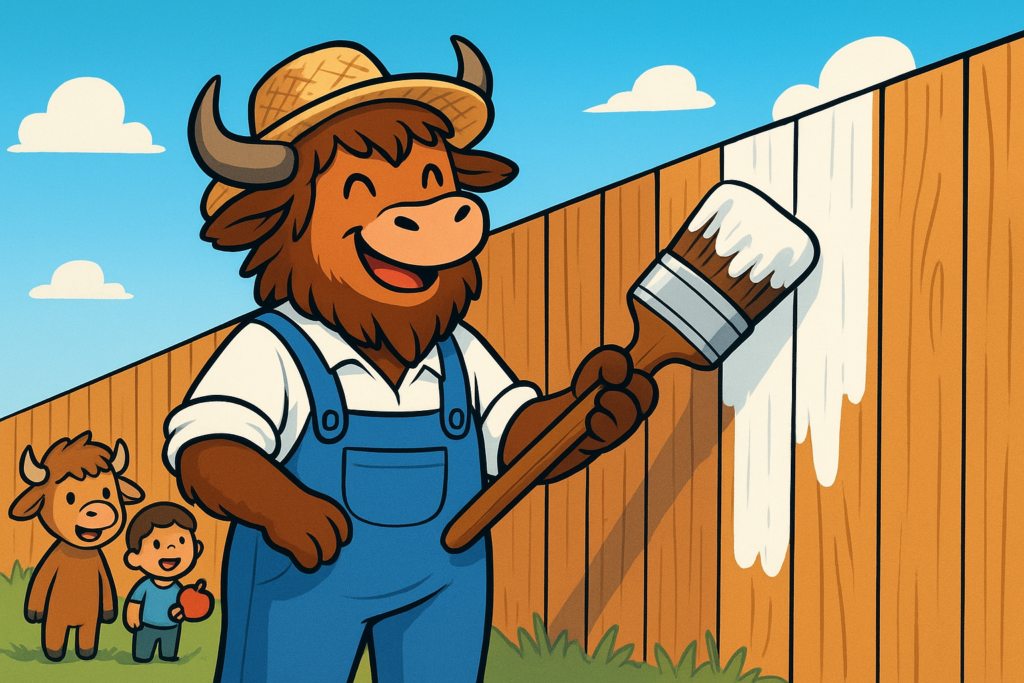
Welcome to Yak Yacker! Today, we're off to the sunny banks of the Mississippi River for one of the most famous adventures in American literature. Our A2 Elementary retelling of The Adventures of Tom Sawyer will take you back to a time of wooden rafts, hidden treasures, and endless summer fun.
Meet Tom Sawyer, a clever and playful boy who lives with his Aunt Polly in the small town of St. Petersburg. Tom loves adventures-whether he's tricking his friends into painting a fence, exploring a dark cave with Becky Thatcher, or hunting for buried gold with the fearless Huckleberry Finn. This story is full of laughs, surprises, and a little bit of danger!
In this special Yak Yacker edition, you can read and listen along at the same time. Every word is clickable for instant help, and you'll find free story audio, vocabulary support, and simple lesson notes right in the post. It's a completely free way to enjoy a classic tale while building your English reading and listening skills. So sit back, relax, and let the adventure begin!
Tom Sawyer was a boy, but he did not like . One summer day, Aunt Polly him. 'Tom! Where are you?' she shouted. Tom was in the closet, eating jam.
The next morning, Aunt Polly gave Tom a big . 'You must this long fence,' she said. Tom looked at the fence. It was very long. Then he had an .
Ben Rogers came along the street. He was eating an apple. 'I'm going swimming,' said Ben. 'Don't you wish you could come?' Tom ignored him and painted carefully. 'You call this ?' said Tom. 'Maybe it is work, maybe it isn't. Does a boy get a to whitewash a fence every day?' Ben watched. 'Let me try,' he said. Tom thought. 'Well, I don't know. Aunt Polly is very about this fence.' Ben offered his apple. Tom slowly gave him the brush.
Soon, many boys came. They all wanted to . They gave Tom a kite, a dead rat, twelve marbles, a blue bottle piece, and a key. In the afternoon, the fence was white, and Tom was .
On Sunday, Tom wore his good clothes and went to . There he saw a new girl. She had blue eyes and yellow hair. Her name was Becky Thatcher. Tom showed her his . He drew a house and a man. 'Do you like it?' he asked. Becky smiled. 'It's nice. Can you draw me?' Tom was very happy. But then he got in trouble for .
One night, Tom and his friend Huckleberry Finn went to the . They saw a fight. Three men: Dr. Robinson, Muff Potter, and Injun Joe. Injun Joe was . He took a knife and the doctor. Then he put the knife in Muff Potter's hand. Tom and Huck were scared. They ran away and promised never to tell anyone.
Tom felt sad. Becky was angry with him. So Tom, Huck, and their friend Joe Harper decided to . They went to Jackson's Island on a small boat. They felt . They swam, fished, and played. 'We are !' said Tom. They stayed for three days.
The people in the town thought the boys were dead. They had a in the church. Then, on Sunday morning, Tom, Huck, and Joe walked into the church. Everyone was and very happy. Aunt Polly cried and kissed Tom. It was a great day.
Later, Muff Potter was in trouble. People thought he killed the doctor. But Tom was . He went to the and said, 'Injun Joe killed the doctor. I saw it with my own eyes.' Injun Joe ran away. Muff Potter was free, and Tom was a .
Let's look at some important words from Tom's adventure. These words will help you talk about the story and use them in your own life.
You saw 'whitewash' - meaning to paint a wall or fence white. 'Fence' is a barrier around a garden. 'Particular' means very careful about small details, like Aunt Polly was about the fence.
- whitewash (verb) - to paint with white liquid; Tom had to whitewash the fence.
- fence (noun) - a wooden or metal wall around a house or garden; the fence was long.
- particular (adjective) - choosing carefully, not easily satisfied; Aunt Polly was particular about her fence.
- graveyard (noun) - a place where dead people are buried; Tom and Huck went to the graveyard at night.
- brave (adjective) - ready to face danger or pain; Tom was brave in court.
- funeral (noun) - a ceremony for a dead person; the town held a funeral for the boys.
The story uses the past simple tense to talk about finished actions. Many verbs are regular: paint → painted, look → looked. But many common verbs are irregular, and you need to learn their past forms.
Look at the story: Tom hid in the closet (hide → hid). Ben came along (come → came). They gave Tom treasures (give → gave). Seeing these patterns helps you remember.
- Regular: shock - shocked; call - called; shout - shouted; ignore - ignored.
- Irregular: hide - hid; eat - ate; give - gave; run - ran; see - saw; take - took; swim - swam; draw - drew; wear - wore; think - thought.
- Try to find more past verbs in the story and sort them into regular and irregular lists.
Now it's your turn! Use the key words and past tense to retell part of Tom Sawyer's adventure. You can start with: 'One day, Aunt Polly gave Tom a brush…'
Speaking practice helps you remember vocabulary and grammar. Try telling a friend or recording yourself. Don't worry about mistakes - the goal is to communicate.
You've met Tom, Huck, and Becky, and you read about their fun and trouble. Reading more stories is a great way to improve your English.
If you enjoyed this, try other simplified classics like 'The Adventures of Huckleberry Finn' or 'Little Women'. Each story brings new words and grammar in a fun way.
The Adventures of Tom Sawyer comes from the American / Mark Twain tradition and is best known as a children's/adventure novel. This Yak Yacker article is an original learner retelling based on Mark Twain, 1876; public domain, so the wording here is simplified for modern learners rather than copied from one old edition.
Older printings, translations, and retellings of this story can vary quite a bit. The original audience was usually kids/general, but this version is adapted for A2 Elementary learners studying English. Can split into episodic readers.
If you want to look into the source tradition, start with Project Gutenberg.
If you want to keep going, browse more in our English section and review the A2 English Vocabulary List. After that, try 1,200 English Phrases and Expressions for another useful next step.