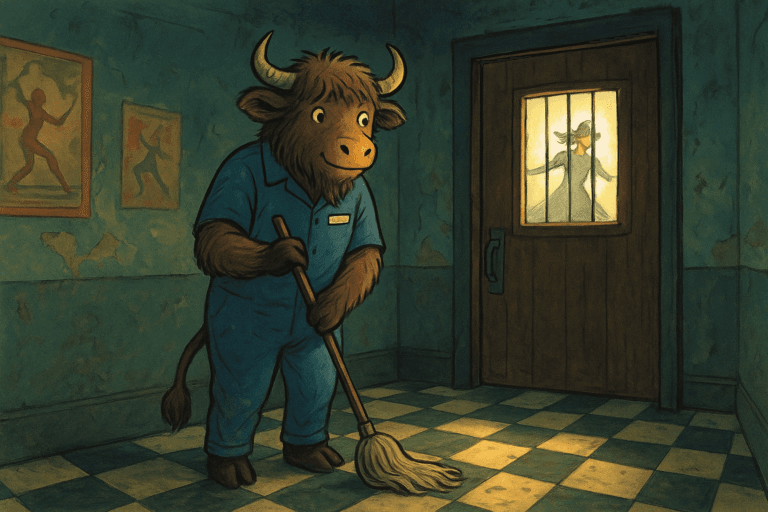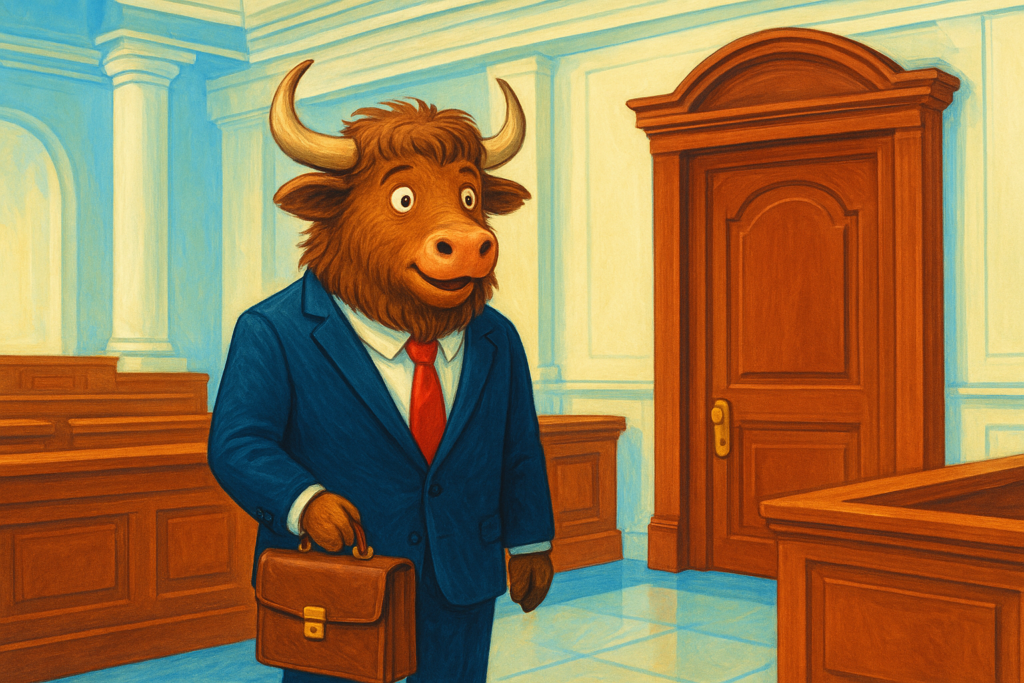
This B1 Intermediate retelling of The Trial keeps the plot clear for learners while still giving the story some atmosphere and momentum. woke up to find a stranger in his room. On Sunday, Joseph went to a crowded room in an old building.
This version is written for English-speaking learners and includes clickable word help inside the story, full story audio, and lesson notes after the reading. It is free to use on Yak Yacker and is designed to feel natural, readable, and manageable in English.
One morning, Joseph K. woke up to find a in his room. "You are ," the man said.
"But I didn't do anything!" Joseph said. The man . "You'll ." More strange men were in his living room, his breakfast.
"Can I go to work?" Joseph asked. "Yes, but you must the on Sunday," one said.
On Sunday, Joseph went to a room in an old building. A judge asked, "Are you Joseph K.?" Joseph said, "Yes. What am I ?"
"We don't know yet. what you did," the judge said. Joseph and said he did nothing, but nobody laughed with him.
Joseph felt , so he found a lawyer. The lawyer was old and sick. "The court works . Be ," he said.
"Patient? I don't know my crime!" Joseph shouted. "Nobody does. That's the of the court," the lawyer replied.
Months passed with no . Then a friend told Joseph about a painter who knew the court. The painter painted only judges in black .
"Can you help me?" Joseph asked. The painter said, "There are three : real freedom, apparent freedom, and postponement. Real freedom is ."
Joseph didn't understand. He left feeling more . Later, he went to the cathedral. A priest called his name from the .
"I want to tell you a story," the priest said. "A man sat at the his whole life, waiting to enter. Just before he died, the guard said, 'This door was only for you. Now I will it.'"
"What does it mean?" Joseph asked. "You must find your own ," the priest said.
Joseph thought about the door for many days. Was it ? Was it ? He couldn't decide.
On the night before his thirty-first birthday, two men in black came to his door. "We must ," they said. Joseph put on his best suit and them.
They walked to a stone quarry outside the city. The moon was bright. One man took out a .
Joseph looked up and thought about the door. In that moment, he felt a strange . "Like a dog," he whispered, and closed his eyes. Some say that was his .
This story uses several legal and abstract terms that are worth learning. Understanding them will help you follow the confusing situation of Joseph K. and talk about justice, rules, and difficult decisions.
Let's look at some important words and phrases from the text. Pay attention to how they are used in the context of the strange trial.
- arrest: to take someone to a police station or court because they are believed to have done something illegal. ("You are under arrest.")
- accuse: to say that someone has done something wrong or illegal. ("What am I accused of?")
- court: the place where legal trials take place, or the people (like a judge) who make decisions there.
- postponement: the act of delaying something to a later time. ("Real freedom is rare, but postponement is possible.")
- apparent freedom: a situation where someone looks free but is still under control or watching.
The story is mainly told in the past tense because it describes events that already happened. At B1 level, you need to use past tenses comfortably when sharing your own experiences or retelling stories.
Notice how the simple past (woke, said, asked) carries the main action, while the past continuous (was sitting) sets the background scene. This contrast makes the narrative flow naturally.
- Simple past: "One morning, Joseph K. woke up." - the main event.
- Past continuous: "More strange men were in his living room, eating his breakfast." - describes an ongoing situation in the past.
- Past perfect (not used much here, but useful): "He thought about the door he had heard about." - an action before another past action.
A big part of the story's mystery is the parable of the man and the door. The priest tells Joseph that the door was only for that man, but the man never entered. What does the door symbolize?
In literature, a door often represents an opportunity, a choice, or a path. The fact that the man waits his whole life suggests that sometimes we are held back by invisible fears or rules we create for ourselves. Joseph's final thought - "Like a dog" - might mean he felt powerless, but also that he finally accepted his situation, finding a strange kind of freedom.
Now that you've read the story and explored its vocabulary and grammar, take a moment to think about its meaning. What would you do if you were Joseph K.? Have you ever felt trapped by a system or situation you didn't understand?
Try writing a short paragraph about a time you felt confused by rules or expectations, using some of the vocabulary from this lesson. If you feel brave, share your story with a friend or in a study group. Every door leads to another lesson!
The Trial comes from the Czech / Franz Kafka tradition and is best known as a modernist novel. This Yak Yacker article is an original learner retelling based on Franz Kafka, 1925; public domain in U.S., so the wording here is simplified for modern learners rather than copied from one old edition.
Older printings, translations, and retellings of this story can vary quite a bit. The original audience was usually adult, but this version is adapted for B1 Intermediate learners studying English. Use public-domain translation; absurd bureaucracy theme.
If you want to look into the source tradition, start with Project Gutenberg.
If you want to keep going, browse more in our English section and review the B1 English Vocabulary List. After that, try 1,200 English Phrases and Expressions for another useful next step.