Welcome to our A2 elementary English retelling of the famous fairy tale, Hansel and Gretel. This story follows two brave children, Hansel and his sister Gretel, who get lost in a deep, dark forest. Hungry and frightened, they stumble upon a magical house made of gingerbread, cake, and candy – but a wicked witch lives inside, and she has a terrible plan!
In this free interactive graded reader, you can read and listen to the story with clear, slow audio narration. Click on any tricky word to see its meaning instantly. You'll also find simple lesson notes that highlight useful vocabulary, past simple verbs, and prepositions. As you enjoy the adventure, you'll improve your English naturally – no stress, just story time!
Once upon a time, there was a woodcutter. He lived in a near a . He had two children, Hansel and Gretel.
Their mother died, and their father married a new wife. The was . She did not like the children.
One night, the children were . They could not sleep. They heard their stepmother their father.
"We have no food," said the stepmother. "We must and ."
"Leave them? No!" said the father. But the stepmother was . The father was sad, but he said nothing.
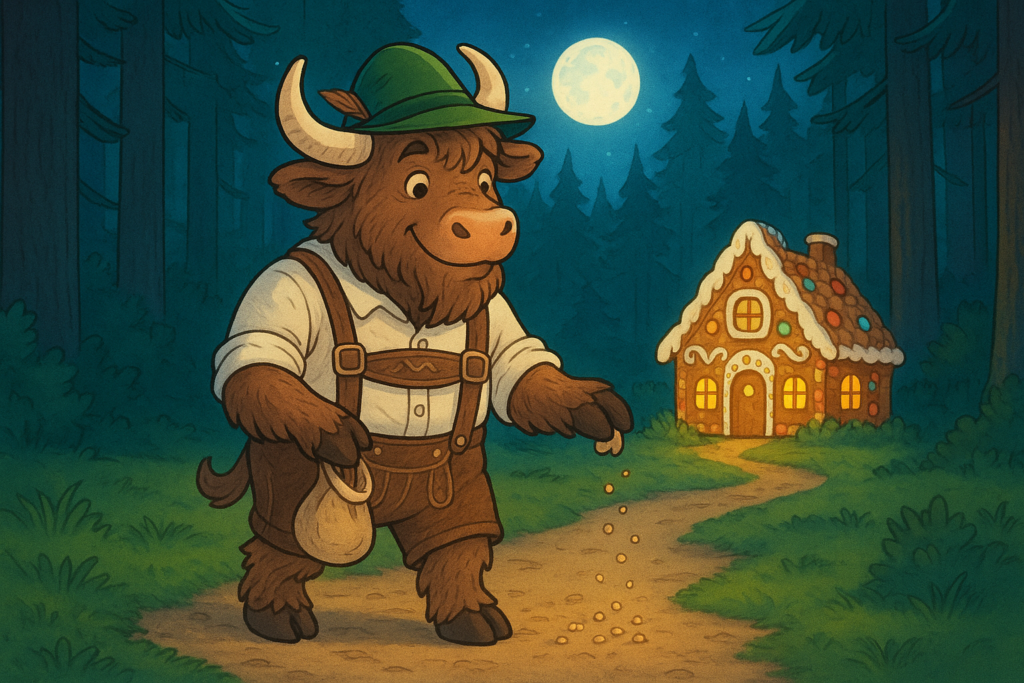
Hansel was . He went outside and with white pebbles. The moon was , so he could see them.
The next morning, the stepmother said, "Come, children. We are to ." They all walked .
Hansel stopped many times and at the house. "Hansel, what are you looking at?" asked the stepmother. "I am looking at my white cat on the roof," said Hansel. But he was really the pebbles behind him.
In the middle of the forest, the stepmother and father made a big fire. "Stay here and rest," they said. "We will come back for you." Then they left.
The children . It got dark. Gretel cried. "How will we find our way home?" But Hansel said, "Don't worry. Look!" The moon was on the white pebbles. They followed the pebbles all the way back home.
The father was very happy to see them. But the stepmother was angry. "You must take them tomorrow," she said to the father.
That night, Hansel wanted to go out to get more pebbles, but the door was . He could not go out.
The next morning, the stepmother gave them a small piece of bread. Hansel put it in his pocket. He and dropped them on the path.
Again they walked deep into the forest. The stepmother and father made a fire and . "Wait here," they said. "We will come back."
The children by the fire. When they woke up, it was dark. They looked for the , but they were gone! The birds in the forest had eaten them all.
Hansel and Gretel walked and walked. They were and very hungry. Then Gretel saw something white through the trees. "Look, Hansel! A little white bird!"
The bird was sitting on a . It sang a . Then it flew a little way. The children followed the bird. It led them to a wonderful house in a small clearing.
The house was amazing! The walls were made of bread, the roof was made of cake, and the windows were made of clear sugar. There were sweet candies all around the .
Hansel and Gretel ran to the house. Hansel of the roof. Gretel took a piece of the window. They were so happy! They ate and ate.
Then they heard a voice from inside the house: "Nibble, nibble, little mouse, who is at my house?"
The children stopped eating. The door opened, and an old woman came out. She looked , but her eyes were not kind. She smiled and said, "Come in, dear children. You must be tired and hungry. Stay with me."
She took them inside and gave them milk, pancakes, apples, and nuts. Then she showed them two nice beds with clean white sheets. Hansel and Gretel thought she was a good old woman.
But the old woman was really a ! She built the sweet house to . She wanted to cook them and eat them!
Early the next morning, the witch Hansel. She put him in a behind the house. "Now, boy, you will get fat and I will eat you!" she laughed.
She called Gretel. "Girl, go and something good for your brother. Make him fat!" Gretel cried, but she had to do it.
Every day, the witch went to the cage. She said, "Hansel, hold out your finger. I want to feel how you are." But Hansel was clever. He held out a little bone instead of his finger. The witch had , so she could not see well.
"Still too thin!" she said. She waited, but she got very angry. "Gretel, ! I want to bake bread. Then I will cook the boy and eat him anyway!"
Gretel was scared. She lit the big oven. The witch came to the oven door. "Climb inside and see if it is hot enough," she said. She wanted to .
But Gretel said, "I don't know how. Show me, please." The witch said, "Stupid girl! It's easy. Watch!" She the oven to show.
Quick as a flash, Gretel gave the witch a big push! The witch fell right into the . Gretel shut the oven door. The witch screamed and that was the end of her.
Gretel ran to the cage. She opened it and Hansel jumped out. "Gretel, you saved us!" They and danced with joy.
The witch's house was full of : gold, pearls, and beautiful stones. The children filled their pockets. "Now we can go home and never be hungry again," said Hansel.
They walked out of the forest. They found a river, and a kind white duck helped them . After a long walk, they saw their house.
Their father was sitting outside. He was . The mean stepmother was gone-she had left him. When he saw the children, he ran to them and hugged them tight.
Hansel and Gretel showed him the treasure. They were never poor or hungry again. They lived in their little house near the big forest.
In the story, the witch's house is made of delicious things! These words are all common foods and treats in English. Let's look at them so you can describe sweet and savoury items.
Notice the difference between uncountable words like "bread" and "cake" (you can say "a piece of bread" but not "a bread") and countable ones like "pancake" (one pancake, two pancakes).
- bread, cake, sugar, candy → sweet building materials
- milk, pancakes, apples, nuts → the witch's welcome meal
- crumbs → the tiny broken pieces that birds ate
- Use "made of" to say what something is built from: "The roof was made of cake."
Fairy tales almost always use the past simple tense. It tells us what happened, one event after another. The story of Hansel and Gretel is full of useful examples.
Many verbs are regular (just add -ed), but some common ones are irregular. You saw both types in the story. Here are a few key ones to remember.
- Regular: lived, walked, wanted, dropped, waited, filled, saved
- Irregular: had, went, took, broke, ate, gave, fell, shut
- To form questions and negatives in the past: did + base form → "Did you hear?" / "They did not find."
Prepositions are small words that show place or direction. In an adventure story, they help you follow the path. Hansel and Gretel moved through many places, and each needs a different preposition.
Look at these examples from the story. You can use them to describe your own journeys or even to give directions.
- near a big forest (close to)
- behind him (at the back of)
- inside the house (in the interior of)
- into the oven (movement from outside to inside)
Great job! You've practised food words, past simple verbs, and prepositions through a classic tale. Now you can tell your own stories using these building blocks.
Try retelling a part of Hansel and Gretel in your own words, or make up a new fairy-tale ending. The more you play with the language, the easier it becomes.
Hansel and Gretel - A Retelling in English comes from the German / Grimm tradition and is best known as a fairy tale. This Yak Yacker article is an original learner retelling based on Grimm/traditional; public domain, so the wording here is simplified for modern learners rather than copied from one old edition.
Older printings, translations, and retellings of this story can vary quite a bit. The original audience was usually kids, but this version is adapted for A2 Elementary learners studying English. Dark but very famous; good food/forest vocabulary.
If you want to look into the source tradition, start with Project Gutenberg.
If you want to keep going, browse more in our English section and review the A2 English Vocabulary List. After that, try 1,200 English Phrases and Expressions for another useful next step.