

Most language learners do not fail because they are incapable. They fail because their plan is too vague, too ambitious, or too easy to skip. A 14-day routine fixes that by doing something very simple and very powerful: it turns “I should study more” into a daily habit you can actually repeat.
For the broader learning path, visit our parent guide.
The goal of this plan is not to make you fluent in two weeks. It is to help you build a routine that feels natural, doable, and worth continuing. If you can show up for 14 days in a row, you will learn something important about your energy, your attention span, and the kinds of tasks that help you stick with a language.
That matters because language learning is a long game. Progress comes from repeated contact, not heroic one-day marathons. A good routine is less about motivation and more about reducing friction. The easier your routine is to start, the more likely you are to keep going after the first burst of excitement wears off.
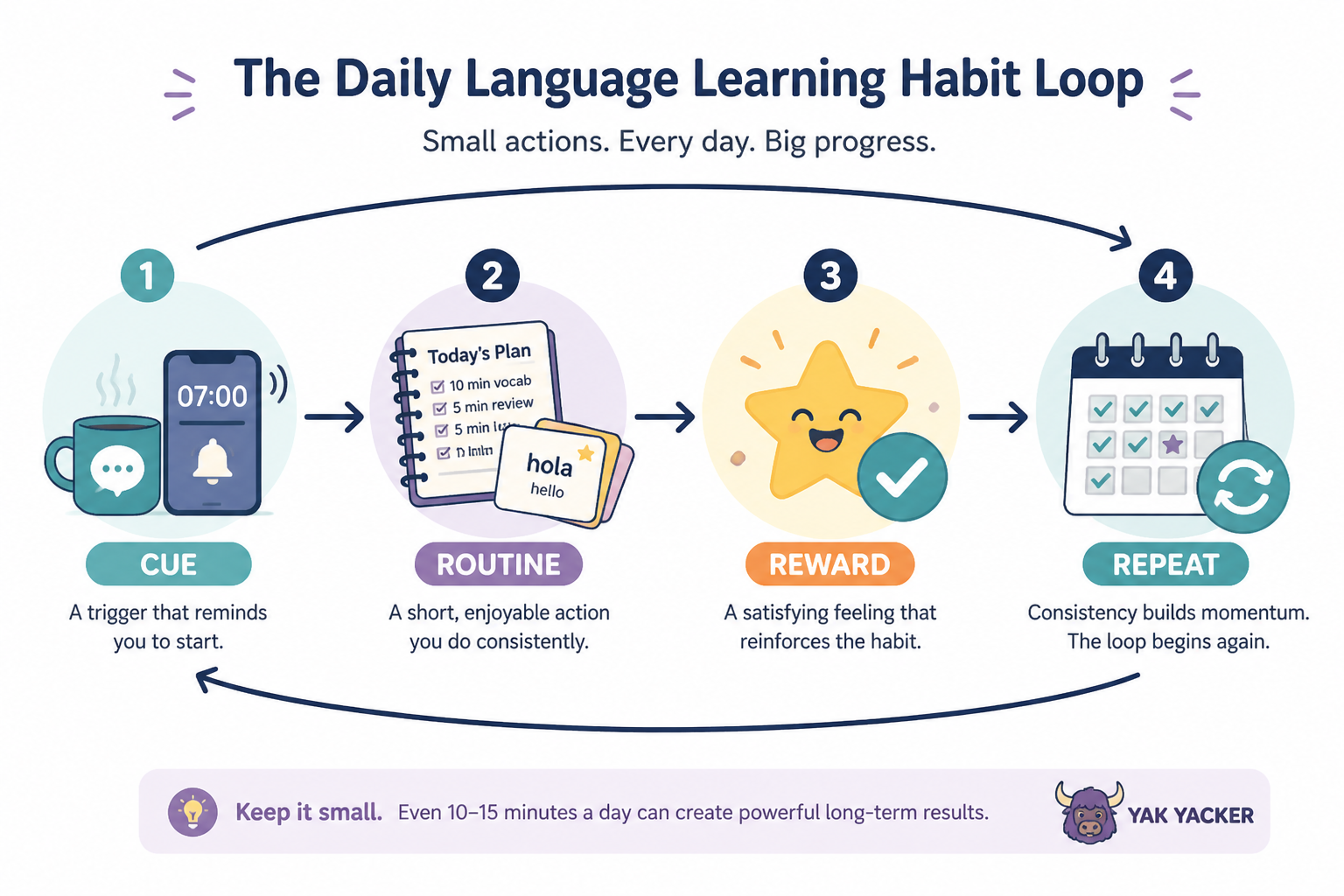
This article gives you a practical 14-day language learning routine you can actually follow. It is designed for beginner to intermediate learners and can be adapted for almost any language. You will learn what to do each day, how long to spend, how to adjust when life gets messy, and how to keep the habit going after day 14.
If you want a deeper look at the habit side of things, you may also find how to build a language learning habit useful. If you need help structuring your study time more broadly, how to build a language study plan is a good companion guide.
What this 14-day plan is designed to do
This routine is built to help you do three things:
- make language study part of your day
- remove decision fatigue by giving you a clear routine
- combine small wins so the habit feels rewarding quickly
In other words, you are not trying to “study everything.” You are trying to create a repeatable pattern that includes a little input, a little recall, a little practice, and a little review. That mix is more effective than randomly doing a different activity every day.
Here is the core idea behind the routine:
| Part of the routine | What it does | Why it matters |
|---|---|---|
| Input | You listen or read in the language | Builds familiarity and comprehension |
| Active recall | You try to remember words or phrases | Strengthens memory better than passive review |
| Production | You speak or write a little | Turns recognition into usable language |
| Review | You repeat key items from previous days | Keeps new material from slipping away |
You do not need to do all of these for hours. You just need enough of each to make the habit complete.
How to use this routine before day 1
Before you start, set yourself up so the next 14 days are easier than usual. A routine is much more likely to survive if you prepare the environment first.
Choose your daily time
Pick one time of day that you can reasonably protect. Morning, lunch break, after dinner, right before bed — any of these can work. The best time is not the “perfect” time. It is the time you can repeat most days without drama.
If your schedule is unpredictable, choose a backup window too. For example:
- Main time: 7:30 a.m.
- Backup time: 8:30 p.m.
This keeps one busy day from becoming a skipped day.
Choose your language materials
Before day 1, decide on a small set of resources. Too many tools create friction. You want a simple setup that makes starting easy.
A good starter setup might include:
- one listening source
- one reading source
- one vocabulary or review tool
- one speaking or writing outlet
If you need help choosing, the guide to best language learning resources by goal can help you match tools to what you want to do.
Decide your minimum commitment
Your minimum commitment should be so small that it feels slightly silly to skip. For most people, that means 10 to 20 minutes. If you have more time, great. But your minimum should still be tiny enough to survive a bad day.
Examples:
- minimum: 10 minutes of listening plus 5 minutes of review
- goal: 30 minutes total with speaking, reading, and vocabulary practice
When the habit is new, consistency matters more than duration. A short daily routine beats an ambitious one that collapses on day 4.
Keep a simple tracker
You do not need a fancy app. A paper calendar, a notes app, or a plain checklist is enough. You are tracking one thing only: did you do the routine today?
That tiny mark helps your brain see the streak. And once a streak exists, people tend to protect it like it is a family heirloom.
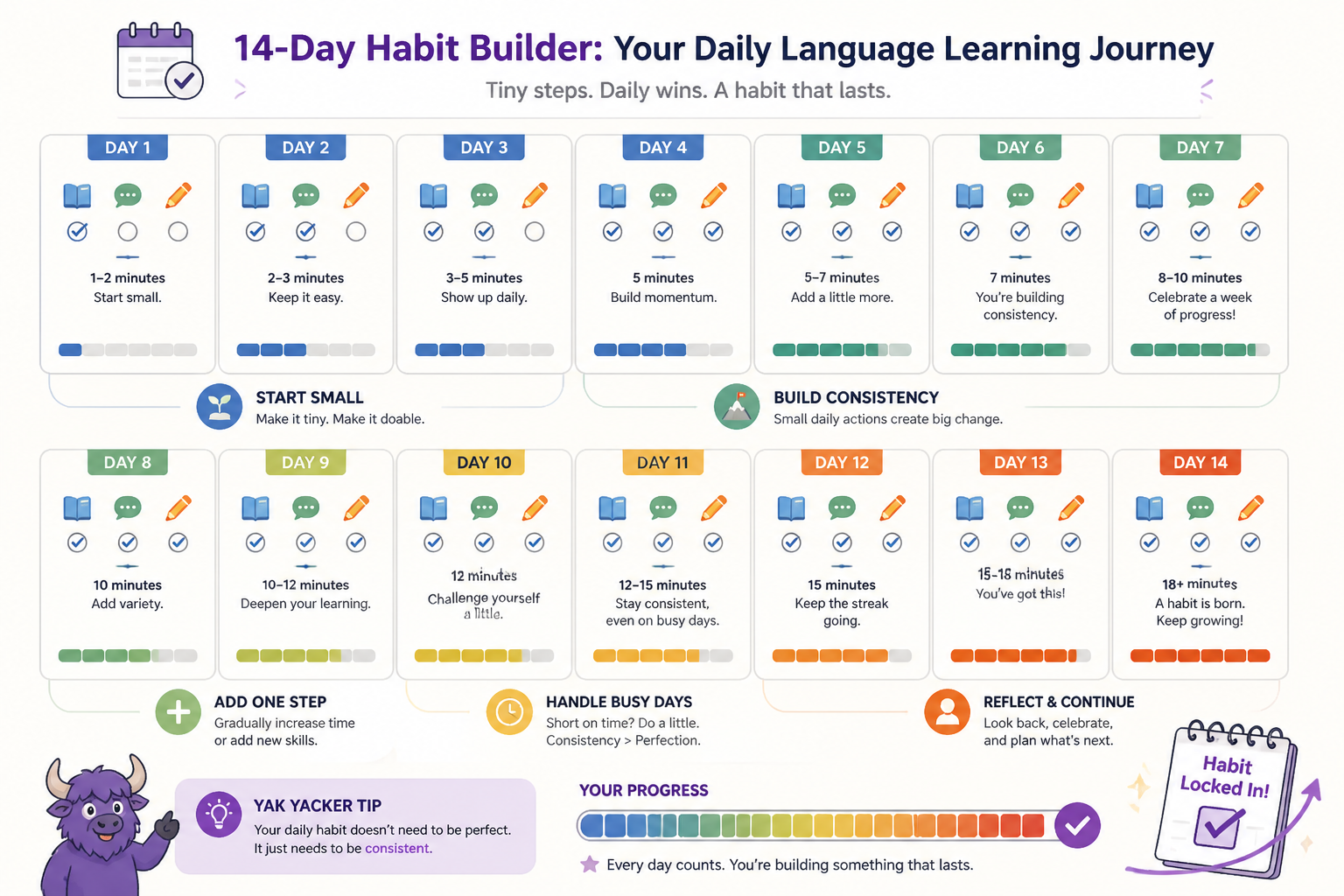
The 14-day language learning routine
The plan below grows gradually. Early days focus on making the habit feel easy. Later days add a little more active use. That way, you are not overwhelmed on day 1 and bored by day 10.
Day 1: Start ridiculously small
Your first day should be so easy that starting feels obvious.
Do this:
- 5 minutes of listening or reading in the language
- 5 minutes of reviewing 5 to 10 words or phrases
- 1 minute of saying a few words out loud
Your only job is to begin. Do not overthink whether your materials are perfect. The point is to lower the emotional cost of starting.
Ask yourself: “What can I do today that I could repeat tomorrow?”
Day 2: Repeat the same routine
Do the same basic pattern again. Repetition is the goal. Familiarity helps you stop treating the routine like a special event.
Use the same time if possible. Use the same resources if possible. Keeping the routine predictable makes it easier to stick.
If you missed day 1, do not restart with guilt. Just begin on day 2. The habit is built by returning, not by being flawless.
Day 3: Add one tiny active task
Now add one more step that makes you interact with the language instead of only consuming it.
Choose one:
- write 3 sentences
- say 5 useful phrases aloud
- answer 1 simple question in the language
This is where the routine starts to feel like learning, not just exposure.
Day 4: Review what you already know
Today is about memory. Review the words, phrases, or notes from the previous three days.
Keep it short and concrete:
- quiz yourself from memory before checking notes
- cover the answer and say it aloud
- repeat difficult items twice more than the easy ones
This matters because review is where new material starts to move from fragile to usable.
Day 5: Add a listening or reading focus
Choose one input skill and pay closer attention to it than you have so far. For example, listen to a short clip and try to catch repeated words. Or read a short text and highlight words you recognize.
The aim is not full comprehension. The aim is noticing patterns. Language learners often improve faster when they stop trying to understand everything immediately.
Day 6: Use the language for a real micro-task
Do one tiny task that feels practical.
Examples:
- introduce yourself in the language
- order a sentence pattern into the right order
- write a short message to yourself
- label 5 items around your room
Practical use makes the routine more meaningful. It answers the invisible question: “Why am I learning this?”
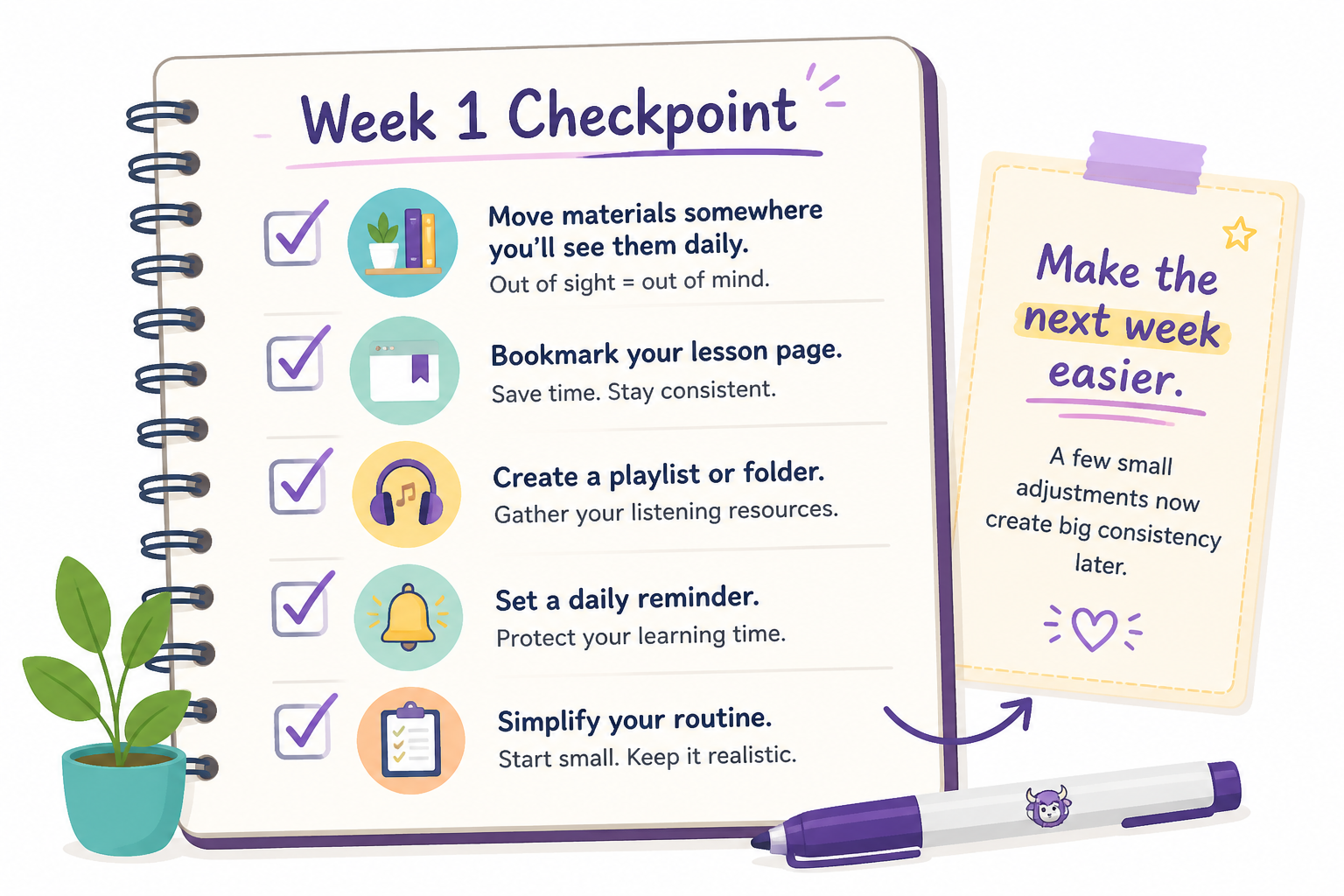
Day 7: Make the routine slightly smoother
By now, you should notice what takes the most time or energy. Today, make one improvement that reduces friction.
You might:
- move your materials to a more visible place
- bookmark the right page
- create a playlist or folder
- set a reminder
This is not a study day. It is a setup day that helps the next week feel easier.
Day 8: Increase the active recall
Today, shift slightly more time toward remembering without looking.
Try this structure:
- 5 minutes input
- 5 minutes recall from memory
- 5 minutes checking and correcting
The correction step matters. Guessing without feedback does not help much. Guessing, checking, and fixing is where learning happens.
Day 9: Practice speaking or writing with a prompt
Use one prompt and answer it in the simplest way possible.
Examples of prompts:
- What did you do today?
- What do you like?
- Where are you from?
- What is in your bag?
If speaking feels scary, write first. If writing feels slow, say it aloud first. The goal is not elegance. The goal is producing language on purpose.
Day 10: Mix old and new material
Today, combine review with one small piece of new material. This helps you avoid the common trap of endlessly reviewing the same easy words.
For example:
- review 8 old words
- learn 3 new words
- use all 11 items in 2 sentences
Mixing old and new keeps the routine balanced. Too much review can get boring. Too much new material can feel overwhelming. A mix keeps both memory and momentum alive.
Day 11: Do a short comprehension check
See what you can understand without stopping every few seconds. Use a short audio clip, a simple dialogue, or a brief reading passage.
Ask yourself:
- What is the general topic?
- What words do I recognize?
- Can I identify one key detail?
This step helps you notice progress that might otherwise feel invisible. Understanding a little more than before is a real win, even if the content is still difficult.
Day 12: Tighten your routine into a repeatable format
By now you should be seeing patterns. Today, make your routine into a clean formula you can repeat after the 14 days are over.
A simple version might be:
- 3 minutes review
- 7 minutes listening or reading
- 5 minutes active recall
- 5 minutes speaking or writing
Having a formula removes decision fatigue. Once the structure is clear, you no longer need to negotiate with yourself every day.
Day 13: Test the habit under real-life conditions
Life is not always neat, so today intentionally practice the routine in a less-than-ideal situation. Do it when you are a bit tired, distracted, or short on time.
You may need to reduce the routine to a “minimum viable version”:
- 2 minutes review
- 5 minutes listening
- 3 minutes speaking or writing
This is important because a habit is only useful if it survives ordinary life. A routine that works only on perfect days is not a routine. It is a fantasy in calendar form.
Day 14: Reflect and plan the next two weeks
Today is for review, not pressure. Look back at what worked and what felt awkward.
Answer these questions:
- What time of day worked best?
- Which activity was easiest to repeat?
- Which task actually helped me feel progress?
- What kept getting skipped?
- What should I keep exactly the same?
Then decide your next routine. Do not reinvent everything. Keep what worked, trim what didn’t, and continue.
A simple daily structure you can reuse after the 14 days
If you want a routine that lasts longer than two weeks, use a structure that is easy to remember. The best routines are simple enough to repeat without constant planning.
Here is a strong default:
| Step | What to do | Time |
|---|---|---|
| 1. Review | Recall yesterday’s words or phrases | 3–5 minutes |
| 2. Input | Listen or read something short | 5–10 minutes |
| 3. Active use | Speak or write from a prompt | 5–10 minutes |
| 4. Close the loop | Note what you learned or what to revisit tomorrow | 1 minute |
You can do this in 15 minutes or stretch it to 30 if you have time. The important thing is that the shape of the routine stays the same.
How to choose the right activities for your routine
Not every language activity is equally useful for every moment. The trick is to match the task to your goal. A good routine is not random. It has a job.
If you are a total beginner
Focus on:
- pronunciation and sound recognition
- common words and useful phrases
- very short dialogues or beginner audio
- simple writing or speaking templates
At this stage, you are building familiarity and confidence. Do not overload yourself with grammar explanations or huge vocabulary lists. You need the language to feel manageable first.
If you already know some basics
Focus on:
- reviewing core vocabulary
- understanding short native or graded content
- practicing sentence building
- speaking or writing with a prompt
This is where the routine can become more balanced. You are no longer just recognizing the language. You are using it with more intention.
If you struggle with consistency
Choose activities that are:
- easy to start
- easy to finish
- easy to repeat tomorrow
That usually means shorter sessions, fewer tools, and clear tasks. A tiny routine you can trust is better than a perfect routine that never happens.
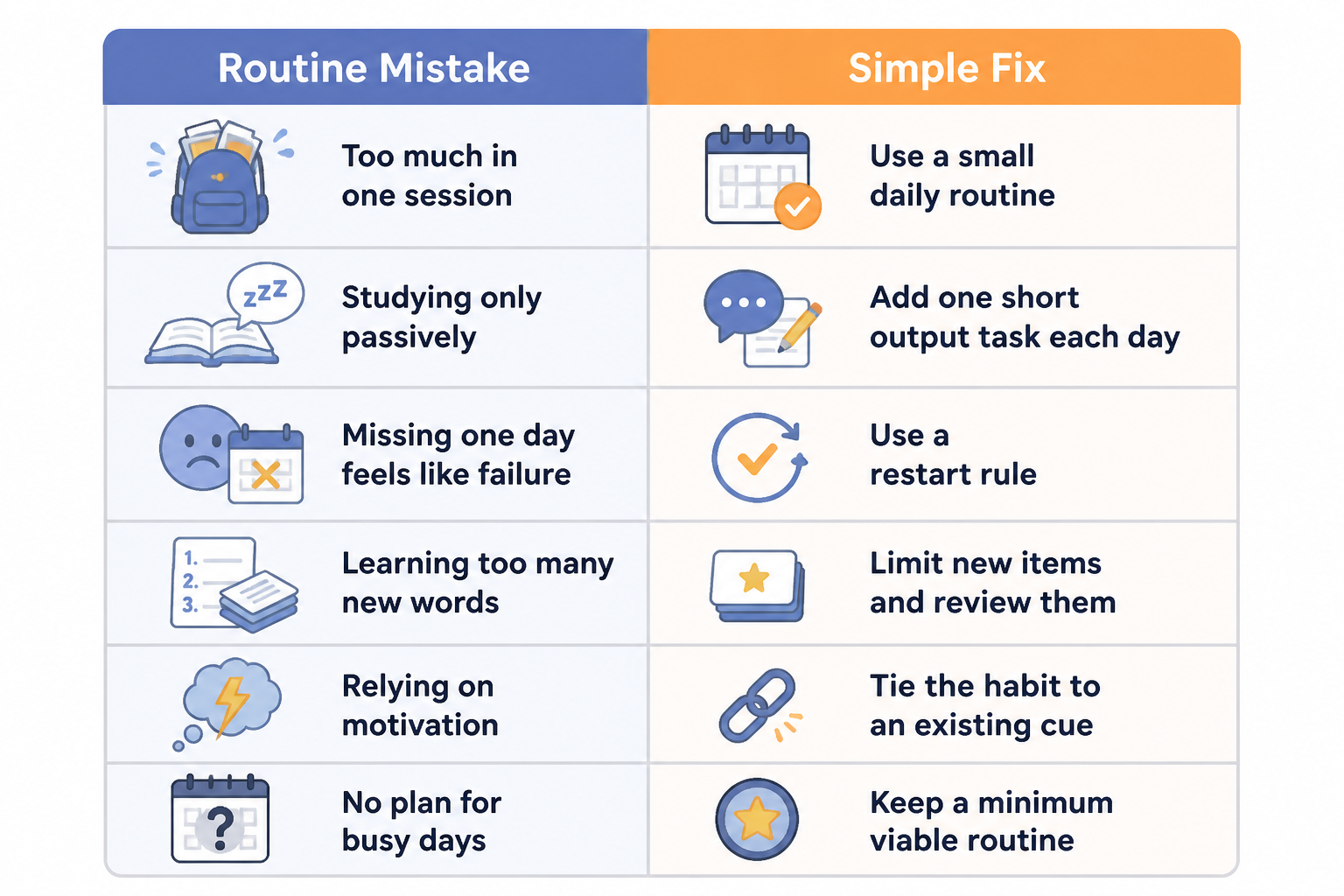
Common mistakes that break a 14-day routine
A lot of learners do not fail because of laziness. They fail because the routine is secretly set up to be hard. Here are the most common traps and how to avoid them.
1. Making the first day too big
If day 1 feels like a full-blown study marathon, your brain will start bargaining on day 2. Keep the first few days very light. Momentum matters more than volume.
Fix: start with 10 to 15 minutes max if you are not already in the habit.
2. Changing the plan every day
Constantly switching between apps, methods, and resources creates friction. You never get enough repetition to build familiarity.
Fix: use the same basic routine for the full 14 days. Change only one thing at a time.
3. Doing only passive input
Watching or listening without ever trying to recall, speak, or write can feel productive, but it often stalls progress. Recognition is useful, but it is not the whole picture.
Fix: add one small output task every day, even if it is only a few sentences.
4. Treating missed days like failure
Missing one day does not cancel the habit. The real danger is the “well, I blew it” mindset that turns one missed day into a skipped week.
Fix: use a restart rule. If you miss a day, resume the next day with the smallest version of the routine.
5. Learning too many new words at once
If you collect vocabulary like trophies, you may recognize plenty but remember little.
Fix: limit new items and review them several times over the 14 days.
6. Making the routine depend on motivation
Motivation is a helpful guest. It is not a reliable roommate.
Fix: tie the routine to an existing habit, such as coffee, lunch, or brushing your teeth. Let the cue do some of the work.
How to make the habit easier on busy days
Busy days are not exceptions. They are part of real life. If you want your routine to survive, you need a version that fits inside chaos.
The minimum viable routine
On a rough day, do this:
- 1 minute to open your materials
- 3 minutes to review a few items
- 5 minutes to listen or read
- 2 minutes to say or write something simple
That is enough to keep the streak alive and protect the identity of “I am someone who studies every day.”
Use the two-minute rule to start
If you are stuck, promise yourself only two minutes. Once you begin, you will often keep going. If not, you still preserved the habit of showing up.
The hard part is usually not the learning. It is starting.
Cut the task, not the habit
When time is short, reduce the activity, not the entire routine. Keep the sequence intact if you can.
For example:
- instead of 10 minutes of reading, do 3 minutes
- instead of writing a paragraph, write one sentence
- instead of a full lesson, review five words
This protects the habit shape, which is what you are trying to build.
How to know if your routine is working
It is easy to judge your progress by one question: “Do I feel fluent yet?” That is not a helpful question for a 14-day routine. The better question is whether your behavior is becoming more automatic and your language contact is becoming more regular.
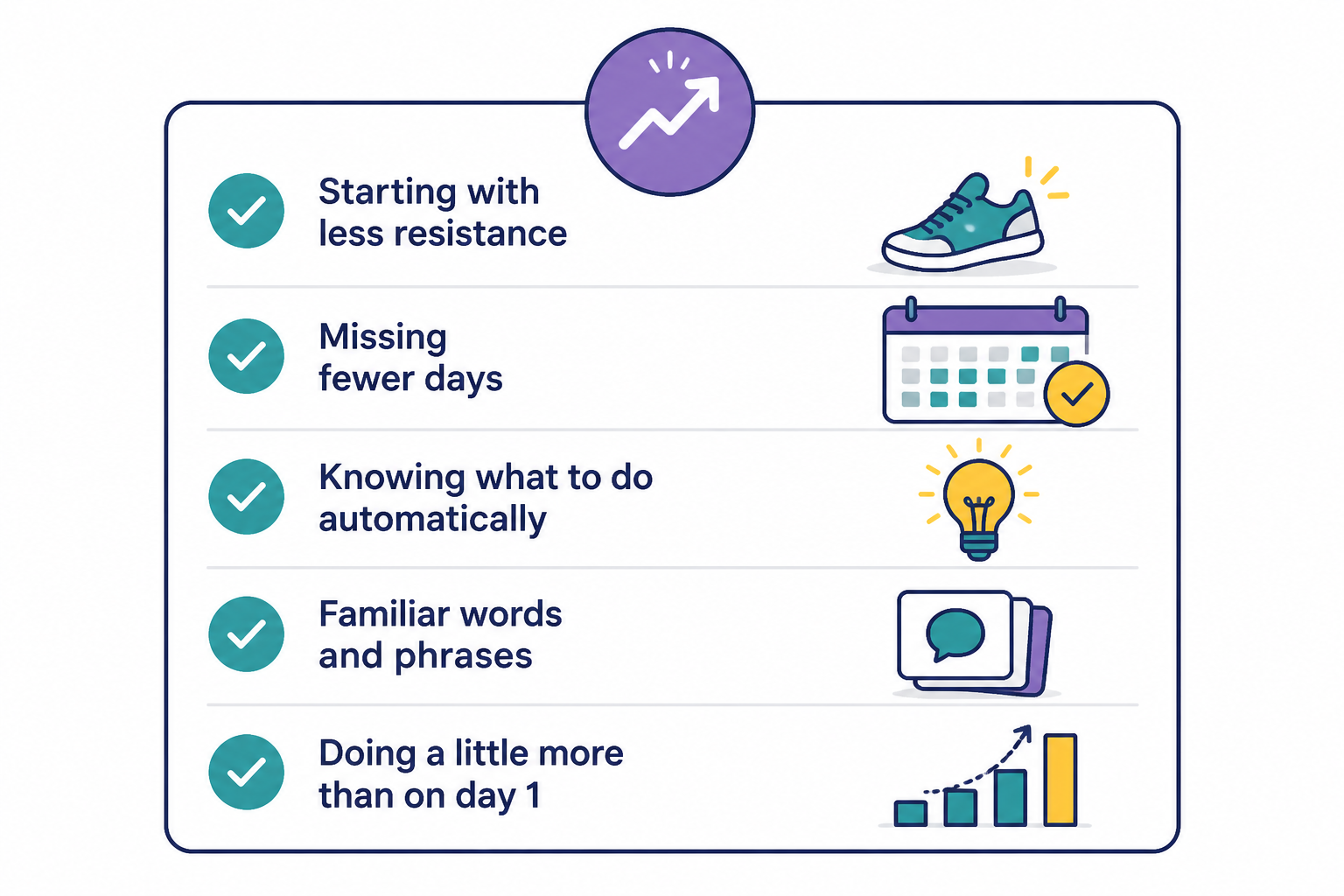
Your routine is working if:
- you are starting with less resistance
- you are missing fewer days
- you know what to do without rethinking it
- some words and phrases are becoming familiar
- you can do a little more than you could on day 1
Your routine is also working if you are learning what does not work for you. That is valuable information. It means you are designing a system around your real life, not an imaginary one.
A decision guide for choosing your daily language task
If you are unsure what to do on a given day, use this simple decision guide.
| If your energy is… | Do this | Why |
|---|---|---|
| Very low | Review + short listening | Easy to start, still keeps contact with the language |
| Medium | Review + input + one speaking or writing task | Balanced and manageable |
| High | Review + input + active use + short reflection | Best for deeper practice |
This helps you avoid the all-or-nothing trap. The goal is not to do the same intensity every day. The goal is to keep the habit alive while adjusting to your real energy level.
What to do after the 14 days end
At the end of the 14 days, you should not stop and declare the mission complete. This is the point where you move from a starter routine into a sustainable one.
Keep the parts that were easiest to repeat
The best habit is usually the one that felt almost boring after a while. That is good news. Boring often means repeatable.
Keep whichever tasks felt:
- easy to begin
- useful in practice
- low stress
- easy to fit into your day
Trim what felt heavy
If one part of the routine always felt like a chore, do not force yourself to keep it exactly as is. Adjust it. Maybe make it shorter, simpler, or less frequent.
For example, if long writing sessions drain you, switch to short spoken answers. If heavy vocabulary review bores you, cut the list size and increase repetition.
Set your next target
Pick one clear goal for the next two weeks:
- keep the daily streak going
- increase speaking time slightly
- understand one new type of input content
- review vocabulary more consistently
A good next step is specific and small. You are building a system, not performing a miracle.
Sample 15-minute routine you can copy
If you want a straightforward version after the 14-day plan, use this:
- 3 minutes: review yesterday’s words or phrases
- 5 minutes: listen to a short clip or read a short text
- 4 minutes: write 2 to 3 simple sentences or answer a prompt aloud
- 3 minutes: check corrections and note one thing to revisit tomorrow
This is small enough for busy days but still complete enough to move your learning forward.
Sample 30-minute routine if you have more time
If your schedule allows more, here is a stronger version:
- 5 minutes: review old vocabulary
- 10 minutes: read or listen to a short lesson or dialogue
- 5 minutes: note useful phrases or patterns
- 5 minutes: speak or write from a prompt
- 5 minutes: check, correct, and repeat difficult items
More time can help, but only if the routine still feels easy to repeat tomorrow. More minutes are useful. More friction is not.
Quick checklist for your 14-day routine
Use this checklist to make sure your plan is actually set up to work:
- I picked a daily time that is realistic
- I have a backup time for busy days
- I chose a small set of resources
- I know my minimum daily commitment
- I have a simple way to track completion
- I included review, input, and active use
- I planned a restart rule for missed days
- I know what I will keep after day 14
Final thoughts: the real win is consistency
A 14-day language learning routine is not about squeezing every possible fact into your head. It is about proving to yourself that you can show up daily in a way that is realistic, repeatable, and useful.
If you complete the full two weeks, great. If you only complete 11 out of 14 days, that is still useful data. If you discover that your routine needs to be shorter, that is not failure. That is smart adjustment.
The habit you want is not “I study when I feel inspired.” The habit you want is “I know exactly what to do, and I can start even on ordinary days.”
That is how language learning becomes part of life instead of a project you keep meaning to begin.
If you want to keep building from here, the most useful next step is to refine your routine into a longer-term plan. You can do that by pairing this habit plan with a clear study structure and the right resources for your goal. Start with the basics, keep the routine small, and let repetition do its very unglamorous but very effective work.
Back to the language learning hub