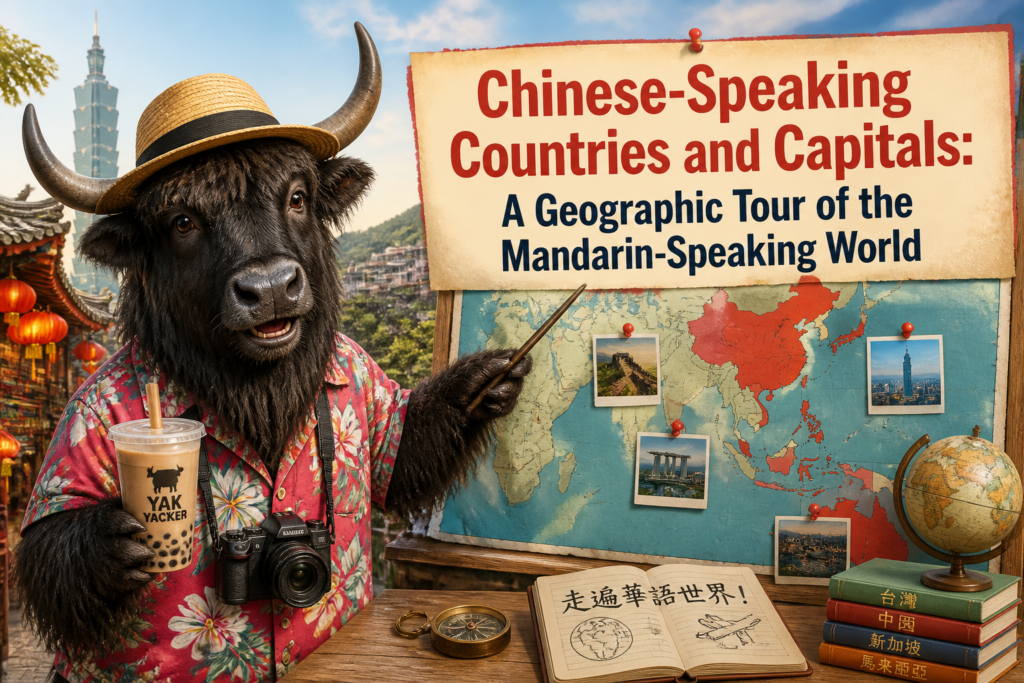
中文語言國家與首都地圖:走一圈華語世界 zhōngwén yǔyán guójiā yǔ shǒudū dìtú: zǒu yī quān Huáyǔ shìjiè
For the broader learning path, visit our parent guide.
If you learn Mandarin, geography suddenly becomes useful in a very non-boring way. Countries stop being fuzzy dots on a map and start turning into real places where people speak, study, work, and complain about the weather in Chinese. Wild concept, right?
This article gives you a practical tour of Chinese-speaking countries and capitals in Traditional Chinese. You will learn the core country names, capital cities, and the geography words you need to talk about them naturally. If you want a broader geography refresher later, keep 地理詞彙 in your back pocket.
One quick note before we travel: “Chinese-speaking countries” can mean different things depending on context. Some places use Mandarin as the official language, some use it widely in daily life, and some have a strong Chinese-speaking population without making Mandarin the state language. Language is messy like that. Geography, of course, enjoys making things slightly annoying.
Start With The Big Picture
In Mandarin, a country is 國家 guójiā, and a capital city is 首都 shǒudū. If you want to say “X is the capital of Y,” a very useful pattern is:
甲是乙的首都。 Jiǎ shì Yǐ de shǒudū. = “A is the capital of B.”
For example, 台北是臺灣的首都。 Táiběi shì Táiwān de shǒudū. Taipei is Taiwan’s capital. Easy. Clean. No drama. Well, no language drama anyway.
| Traditional Chinese | Pinyin | Meaning | Example (ZH) | Example (Pinyin) | Translation (EN) |
|---|---|---|---|---|---|
| 國家 | guójiā | country | 我想知道這個國家的首都。 | Wǒ xiǎng zhīdào zhège guójiā de shǒudū. | I want to know this country’s capital. |
| 首都 | shǒudū | capital city | 北京是中國的首都。 | Běijīng shì Zhōngguó de shǒudū. | Beijing is the capital of China. |
| 地圖 | dìtú | map | 我先看地圖,再找城市。 | Wǒ xiān kàn dìtú, zài zhǎo chéngshì. | I look at the map first, then find the city. |
| 城市 | chéngshì | city | 這是一個很大的城市。 | Zhè shì yī gè hěn dà de chéngshì. | This is a very big city. |
For a boring-but-useful official reference on the language itself, the Taiwan Ministry of Education dictionary is the kind of source that does exactly what it says on the tin.
The Core Chinese-Speaking Countries
Here are the most important places to know when talking about the Mandarin-speaking world. Some are sovereign states, some are territories, and some are special cases. Language learning loves exceptions almost as much as bureaucracy does.
| Traditional Chinese | Pinyin | Meaning | Capital | Capital Pinyin | Example Sentence |
|---|---|---|---|---|---|
| 中國 | Zhōngguó | China | 北京 | Běijīng | 中國的首都是北京。 Zhōngguó de shǒudū shì Běijīng. China’s capital is Beijing. |
| 臺灣 | Táiwān | Taiwan | 臺北 | Táiběi | 臺灣的首都是臺北。 Táiwān de shǒudū shì Táiběi. Taiwan’s capital is Taipei. |
| 新加坡 | Xīnjiāpō | Singapore | 新加坡 | Xīnjiāpō | 新加坡的首都也是新加坡。 Xīnjiāpō de shǒudū yě shì Xīnjiāpō. Singapore’s capital is also Singapore. |
| 馬來西亞 | Mǎláixīyà | Malaysia | 吉隆坡 | Jílóngpō | 吉隆坡是馬來西亞的首都嗎? Jílóngpō shì Mǎláixīyà de shǒudū ma? Is Kuala Lumpur the capital of Malaysia? |
| 香港 | Xiānggǎng | Hong Kong | 香港 | Xiānggǎng | 香港是很多人學中文時會提到的地方。 Xiānggǎng shì hěn duō rén xué Zhōngwén shí huì tídào de dìfāng. Hong Kong is a place many people mention when learning Chinese. |
| 澳門 | Àomén | Macao | 澳門 | Àomén | 澳門的中文名稱很常見。 Àomén de Zhōngwén míngchēng hěn chángjiàn. Macao’s Chinese name is very common. |
Notice something fun here: a capital city is not always a different name from the country. Singapore and Hong Kong are the same in this simple list, which is one reason map trivia can feel slightly sneaky.
首都 shǒudū means “capital,” but not every place is a neat textbook example. Real-world geography likes to keep learners humble.
Useful Phrases For Talking About Countries And Capitals
These phrases help you ask, answer, and compare country names without sounding like a memorized textbook robot. Small mercy.
| Traditional Chinese | Pinyin | English Meaning | Example (ZH) | Example (Pinyin) | Translation (EN) |
|---|---|---|---|---|---|
| 這是什麼國家? | Zhè shì shénme guójiā? | What country is this? | 這是什麼國家?我看不出來。 | Zhè shì shénme guójiā? Wǒ kàn bù chūlái. | What country is this? I can’t tell. |
| 這個國家的首都是哪裡? | Zhège guójiā de shǒudū shì nǎlǐ? | What is this country’s capital? | 這個國家的首都是哪裡? | Zhège guójiā de shǒudū shì nǎlǐ? | What is this country’s capital? |
| 它的首都是…… | Tā de shǒudū shì… | Its capital is… | 它的首都是北京。 | Tā de shǒudū shì Běijīng. | Its capital is Beijing. |
| 我來自…… | Wǒ láizì… | I am from… | 我來自臺灣。 | Wǒ láizì Táiwān. | I am from Taiwan. |
| 你來自哪裡? | Nǐ láizì nǎlǐ? | Where are you from? | 你來自哪裡? | Nǐ láizì nǎlǐ? | Where are you from? |
| 我住在…… | Wǒ zhù zài… | I live in… | 我住在臺北。 | Wǒ zhù zài Táiběi. | I live in Taipei. |
| 這裡離首都很遠。 | Zhèlǐ lí shǒudū hěn yuǎn. | This place is far from the capital. | 這裡離首都很遠。 | Zhèlǐ lí shǒudū hěn yuǎn. | This place is far from the capital. |
| 這個名字怎麼唸? | Zhège míngzì zěnme niàn? | How do you pronounce this name? | 這個名字怎麼唸? | Zhège míngzì zěnme niàn? | How do you pronounce this name? |
| 我在學地理詞彙。 | Wǒ zài xué dìlǐ cíhuì. | I’m learning geography vocabulary. | 我在學地理詞彙。 | Wǒ zài xué dìlǐ cíhuì. | I’m learning geography vocabulary. |
| 可以再說一次嗎? | Kěyǐ zài shuō yī cì ma? | Can you say it again? | 可以再說一次嗎? | Kěyǐ zài shuō yī cì ma? | Can you say it again? |
Country Names You Will Actually Use
Below is a practical set of country names and related words that come up again and again in conversation, textbooks, and map quizzes. If you know these, you can survive most basic “Where is it?” questions without sweating too much.
| Traditional Chinese | Pinyin | Meaning | Example (ZH) | Example (Pinyin) | Translation (EN) |
|---|---|---|---|---|---|
| 中國人 | Zhōngguó rén | Chinese person | 他是中國人。 | Tā shì Zhōngguó rén. | He is Chinese. |
| 臺灣人 | Táiwān rén | Taiwanese person | 她是臺灣人。 | Tā shì Táiwān rén. | She is Taiwanese. |
| 香港人 | Xiānggǎng rén | Hong Kong person | 我是香港人。 | Wǒ shì Xiānggǎng rén. | I am from Hong Kong. |
| 澳門人 | Àomén rén | Macao person | 他是澳門人。 | Tā shì Àomén rén. | He is from Macao. |
| 新加坡人 | Xīnjiāpō rén | Singaporean | 她是新加坡人。 | Tā shì Xīnjiāpō rén. | She is Singaporean. |
| 馬來西亞人 | Mǎláixīyà rén | Malaysian | 我朋友是馬來西亞人。 | Wǒ péngyou shì Mǎláixīyà rén. | My friend is Malaysian. |
| 日本 | Rìběn | Japan | 日本在亞洲。 | Rìběn zài Yàzhōu. | Japan is in Asia. |
| 韓國 | Hánguó | Korea | 韓國離中國不遠。 | Hánguó lí Zhōngguó bù yuǎn. | Korea is not far from China. |
| 美國 | Měiguó | United States | 他在美國讀書。 | Tā zài Měiguó dúshū. | He studies in the U.S. |
| 英國 | Yīngguó | United Kingdom | 我想去英國旅行。 | Wǒ xiǎng qù Yīngguó lǚxíng. | I want to travel to the U.K. |
Even when a country is not Chinese-speaking, it can still matter in Mandarin because people talk about it all the time. Geography vocabulary is like that: once you learn it, it escapes the classroom and starts appearing everywhere.
Capital Cities Worth Memorizing
Here are major capitals connected to the Mandarin-speaking world, plus a few nearby capitals that learners often mix up. Because yes, map confusion is a universal human experience.
| Traditional Chinese | Pinyin | Meaning | Country | Example (ZH) | Translation (EN) |
|---|---|---|---|---|---|
| 北京 | Běijīng | Beijing | 中國 | 北京是中國的首都。 | Beijing is the capital of China. |
| 臺北 | Táiběi | Taipei | 臺灣 | 臺北是臺灣的首都。 | Taipei is the capital of Taiwan. |
| 新加坡 | Xīnjiāpō | Singapore | 新加坡 | 新加坡是個城市國家。 | Singapore is a city-state. |
| 吉隆坡 | Jílóngpō | Kuala Lumpur | 馬來西亞 | 吉隆坡是馬來西亞的首都。 | Kuala Lumpur is the capital of Malaysia. |
| 香港 | Xiānggǎng | Hong Kong | 香港 | 香港是世界上很重要的城市。 | Hong Kong is an important city in the world. |
| 澳門 | Àomén | Macao | 澳門 | 澳門很有名。 | Macao is famous. |
| 東京 | Dōngjīng | Tokyo | 日本 | 東京是日本的首都。 | Tokyo is the capital of Japan. |
| 首爾 | Shǒu’ěr | Seoul | 韓國 | 首爾是韓國的首都。 | Seoul is the capital of Korea. |
Small pronunciation note: 首爾 Shǒu’ěr keeps the apostrophe because the syllables are separate. Mandarin likes to be clear when it matters. A rare polite trait.
Taiwan, China, Hong Kong, And Macao: How To Say Them
These four place names appear constantly in Chinese learning, so it helps to know their standard Traditional Chinese forms and how people usually talk about them in Taiwan Mandarin.
| Traditional Chinese | Pinyin | Meaning | Common Use | Example (ZH) | Translation (EN) |
|---|---|---|---|---|---|
| 臺灣 | Táiwān | Taiwan | Country / place name | 我住在臺灣。 | I live in Taiwan. |
| 中國 | Zhōngguó | China | Country / place name | 中國很大。 | China is big. |
| 香港 | Xiānggǎng | Hong Kong | Place name | 香港的天氣很熱。 | Hong Kong’s weather is very hot. |
| 澳門 | Àomén | Macao | Place name | 澳門有很多觀光客。 | Macao has many tourists. |
In Taiwan, people often use 臺灣 Táiwān in daily life and writing. You may also see 臺北 Táiběi written with 臺 rather than 台 in formal Traditional Chinese. Both are common in Taiwan usage, but 臺 is the full Traditional form. That tiny stroke difference loves to make learners nervous for no good reason.
Quick Note On Written Forms
臺 is the Traditional character used in formal writing, while 台 is also seen in many everyday contexts in Taiwan. If you are learning Traditional Chinese, get comfortable with both. They are part of the same real-world mess.
How To Ask And Answer “Where Are You From?”
This question is everywhere: classrooms, language exchanges, first meetings, and those awkward moments when someone realizes you are not from around here. So it’s worth learning well.
| Pattern | Meaning | Example (ZH) | Pinyin | English |
|---|---|---|---|---|
| 你來自哪裡? | Where are you from? | 你來自哪裡? | Nǐ láizì nǎlǐ? | Where are you from? |
| 我來自…… | I’m from… | 我來自臺灣。 | Wǒ láizì Táiwān. | I’m from Taiwan. |
| 我住在…… | I live in… | 我住在臺北。 | Wǒ zhù zài Táiběi. | I live in Taipei. |
| 你是哪裡人? | What is your hometown / where are you from? | 你是哪裡人? | Nǐ shì nǎlǐ rén? | Where are you from? |
Small nuance: 來自 láizì sounds like “originate from” or “come from,” while 住在 zhù zài means “live in.” They are not the same, and Mandarin does not forgive lazy mixing here.
Example:
我來自香港,現在住在臺北。 Wǒ láizì Xiānggǎng, xiànzài zhù zài Táiběi. I’m from Hong Kong, and I currently live in Taipei.
Geography Words You Need For Maps And Travel
If you want to talk about countries and capitals naturally, you also need the building blocks around them: north, south, city, island, sea, mountain, and so on. Basic geography words are the glue that holds the whole conversation together.
| Traditional Chinese | Pinyin | Meaning | Example (ZH) | Example (Pinyin) | Translation (EN) |
|---|---|---|---|---|---|
| 亞洲 | Yàzhōu | Asia | 中國和臺灣都在亞洲。 | Zhōngguó hé Táiwān dōu zài Yàzhōu. | China and Taiwan are both in Asia. |
| 北部 | Běibù | north side / northern part | 臺灣北部比較常下雨。 | Táiwān běibù bǐjiào cháng xià yǔ. | Northern Taiwan gets rain more often. |
| 南部 | Nánbù | south side / southern part | 我住在臺灣南部。 | Wǒ zhù zài Táiwān nánbù. | I live in southern Taiwan. |
| 海 | hǎi | sea | 這個國家靠海。 | Zhège guójiā kào hǎi. | This country is by the sea. |
| 島 | dǎo | island | 臺灣是一個島。 | Táiwān shì yī gè dǎo. | Taiwan is an island. |
| 山 | shān | mountain | 這裡有很多山。 | Zhèlǐ yǒu hěn duō shān. | There are many mountains here. |
| 河 | hé | river | 那條河很長。 | Nà tiáo hé hěn cháng. | That river is long. |
| 邊 | biān | side / edge | 首都在西邊。 | Shǒudū zài xībiān. | The capital is in the west. |
Need a more complete geography word set? There’s a handy guide on 國家和語言詞彙 if you want to pair place names with language names, which is often how people actually talk.
Common Grammar For Location And Direction
Once you start naming countries and capitals, you will want to say where things are. These location patterns come up constantly in maps, travel, and simple descriptions.
| Pattern | Meaning | Example (ZH) | Pinyin | English |
|---|---|---|---|---|
| 在 | at / in | 臺灣在亞洲。 | Táiwān zài Yàzhōu. | Taiwan is in Asia. |
| 離 | from / away from | 臺北離海邊不遠。 | Táiběi lí hǎibiān bù yuǎn. | Taipei is not far from the coast. |
| 靠近 | close to | 這個城市靠近海邊。 | Zhège chéngshì kàojìn hǎibiān. | This city is close to the coast. |
| 位於 | is located in | 北京位於中國北部。 | Běijīng wèiyú Zhōngguó běibù. | Beijing is located in northern China. |
| 東邊 / 西邊 / 南邊 / 北邊 | east / west / south / north side | 臺灣在中國的東邊。 | Táiwān zài Zhōngguó de dōngbiān. | Taiwan is to the east of China. |
Use 位於 wèiyú in more formal writing and 在 zài in everyday speech. Taiwan Mandarin often keeps the everyday style simple and direct. No need to wear a tuxedo just to say where a place is.
Real-Life Examples You Can Copy
Here are short, natural sentences you can reuse in class, during a quiz, or when discussing places with friends.
- 中國的首都是北京。 Zhōngguó de shǒudū shì Běijīng. China’s capital is Beijing.
- 臺灣的首都是臺北。 Táiwān de shǒudū shì Táiběi. Taiwan’s capital is Taipei.
- 新加坡是一個城市國家。 Xīnjiāpō shì yī gè chéngshì guójiā. Singapore is a city-state.
- 吉隆坡在馬來西亞。 Jílóngpō zài Mǎláixīyà. Kuala Lumpur is in Malaysia.
- 香港和澳門都很有名。 Xiānggǎng hé Àomén dōu hěn yǒumíng. Hong Kong and Macao are both famous.
- 我想去北京旅行。 Wǒ xiǎng qù Běijīng lǚxíng. I want to travel to Beijing.
- 你知道臺北在哪裡嗎? Nǐ zhīdào Táiběi zài nǎlǐ ma? Do you know where Taipei is?
- 這個國家不大,可是很有意思。 Zhège guójiā bù dà, kěshì hěn yǒuyìsi. This country is not big, but it is interesting.
The word 可是 kěshì means “but,” and it sounds natural in spoken Mandarin. If you want to sound less like a textbook and more like a person, this little word does a lot of work.
Common Mistakes And Easy Fixes
Here are the mistakes English speakers make most often when talking about Chinese-speaking countries and capitals.
| Mistake | Better Way | Why |
|---|---|---|
| Using Simplified forms when the article or class requires Traditional | 中國, 臺灣, 香港, 澳門 | Traditional Chinese is standard for Taiwan-focused learning. |
| Saying 我來自在臺灣 | 我來自臺灣 or 我住在臺灣 | 來自 and 在 do different jobs. |
| Mixing up capital and country | 北京是中國的首都。 | 北京 is the city; 中國 is the country. |
| Forgetting the question word in “Where are you from?” | 你來自哪裡? | 哪裡 means “where.” |
| Using only English-based spellings for names | 臺北 Táiběi, 吉隆坡 Jílóngpō | Learn the Chinese place names, not just the Romanized ones. |
| Confusing 臺灣人 and 中國人 in context | Use the term that matches the person’s identity and the conversation | Identity can be sensitive; language should stay respectful. |
One more tiny fix: remember tone marks in pinyin. Běijīng is not the same as Beijing for learning purposes. The marks are not decoration. They are the pronunciation.
Quick Tone Reminder For 一 And 不
一 yī changes tone depending on what follows: 一個 yí gè, 一天 yì tiān. 不 bù changes tone before a fourth tone, as in 不是 bú shì. These show up constantly in simple sentences about countries, cities, and travel.
Mini Practice
Try these quick drills. Yes, your brain is allowed to complain a little.
- Fill in the blank: 北京是中國的______。 zhōngguó de ______. Answer: 首都 shǒudū.
- Translate: “I am from Taiwan.” Answer: 我來自臺灣。 Wǒ láizì Táiwān.
- Translate: “What is this country’s capital?” Answer: 這個國家的首都是哪裡? Zhège guójiā de shǒudū shì nǎlǐ?
- Swap the place: 我住在臺北。 Wǒ zhù zài Táiběi. Change Taipei to Beijing.
- Spot the difference: 來自 vs 住在. Which one means “come from”? Answer: 來自 láizì.
- Make it plural-ish: 臺灣人 Táiwān rén. Say “We are Taiwanese.” Answer: 我們是臺灣人。 Wǒmen shì Táiwān rén.
If you want a quiz-style check after reading this, the Traditional Chinese vocabulary test is a handy place to see whether your brain kept anything, which is always the real question.
Quick Reference Summary
- 國家 guójiā = country
- 首都 shǒudū = capital city
- 中國 Zhōngguó = China; capital: 北京 Běijīng
- 臺灣 Táiwān = Taiwan; capital: 臺北 Táiběi
- 新加坡 Xīnjiāpō = Singapore; capital: 新加坡 Xīnjiāpō
- 馬來西亞 Mǎláixīyà = Malaysia; capital: 吉隆坡 Jílóngpō
- 香港 Xiānggǎng = Hong Kong
- 澳門 Àomén = Macao
- 你來自哪裡? Nǐ láizì nǎlǐ? = Where are you from?
- 我住在…… Wǒ zhù zài… = I live in…
If you want to check your broader level before moving on, the Traditional Chinese placement test can help you figure out what comes next, which is always nicer than guessing and pretending confidence is a study method.
And if you want to keep building outward, the next step is simple: connect country names, languages, and location words until they start sounding natural. That is how Mandarin geography becomes useful instead of just decorative map trivia. Yak takeaway: learn the country, learn the capital, then learn how to say where it is. Suddenly the whole Mandarin-speaking world feels a lot less blurry—and a lot more speakable.