This A1 Beginner retelling of 孔融讓梨 keeps the plot clear for learners while still giving the story some atmosphere and momentum.
This version teaches Traditional Chinese through English and includes clickable word help inside the story, full story audio, and lesson notes after the reading. It is free to use on Yak Yacker and is designed to feel natural, readable, and manageable for learners.
從前,有一個小男孩叫孔融。他家有爸爸、媽媽和哥哥。
一天,爸爸買了一些梨。
哥哥們看到了梨。。
。
。
」
爸爸笑了。。
Once upon a time, there was a little boy named Kong Rong. He lived with his father, mother, and older brother(s).
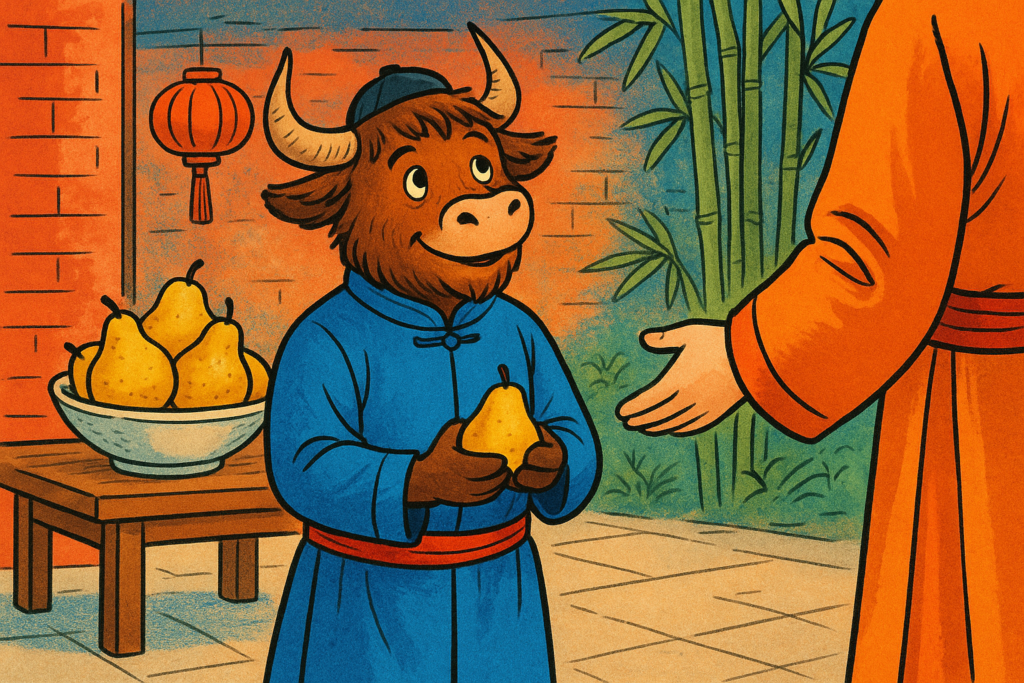
One day, Father bought some pears. They were big and fragrant. He placed them on the table.
The older brothers saw the pears. They were very happy.
Father said, "Come, eat some pears!" The older brothers took the big pears.
Kong Rong took a small pear.
Father asked, "Why did you take a small pear?" Kong Rong said, "I am young, so I should eat the small one."
Father smiled. He felt Kong Rong was very sensible. This story teaches us to be humble and yielding.
Let's look at the key words from the story. Kong Rong's family is easy to remember: 爸爸 (bàba) is dad, 媽媽 (māma) is mom, and 哥哥 (gēge) is older brother. The pears were 大 (dà) - big, and 小 (xiǎo) - small; they were also 香 (xiāng) - fragrant and delicious.
- 梨 (lí) - pear
- 大 (dà) - big; 小 (xiǎo) - small
- 香 (xiāng) - smells good
- 高興 (gāoxìng) - happy
In the story, Dad asked: 你為什麼拿小的梨? (Why did you take the small pear?). 為什麼 (wèishénme) means 'why'. To answer, you can say 因為 (yīnwèi) - because. Kong Rong said: 我年紀小,應該吃小的 (I am young, so I should eat the small one). 應該 (yīnggāi) means 'should'.
- 為什麼 (wèishénme) - why
- 因為 (yīnwèi) - because
- 應該 (yīnggāi) - should, ought to
- Try making a 'why' question: 為什麼 + [action]?
Kong Rong showed 謙讓 (qiānràng) - a humble, giving attitude. It means thinking of others before yourself. Now you can retell this famous story and use your new words!
- Practice saying 爸爸, 媽媽, 哥哥.
- Next time you share fruit, say: 我吃小的! (Wǒ chī xiǎo de!)
- Remember: 謙讓 (qiānràng) makes the world sweeter.
孔融讓梨 comes from the Chinese / idiom story tradition and is best known as a moral anecdote. This Yak Yacker article is an original learner retelling based on Traditional/ancient moral anecdote; public domain, so the wording here is simplified for modern learners rather than copied from one old edition.
Older printings, translations, and retellings of this story can vary quite a bit. The original audience was usually kids, but this version is adapted for A1 Beginner learners studying Traditional Chinese. Good family/age/food vocabulary.
If you want to look into the source tradition, start with Wikisource.
If you want to keep going, browse more in our Traditional Chinese section. After that, try Essential Traditional Chinese Phrases for another useful next step.
More Traditional Chinese to explore
Havoc in Heaven: A2 Elementary Traditional Chinese Story with Audio
The Oath of the Peach Garden: A B1 Interactive Chinese Reader with Audio
The Frog at the Bottom of the Well: A1 Beginner Traditional Chinese Story with Audio