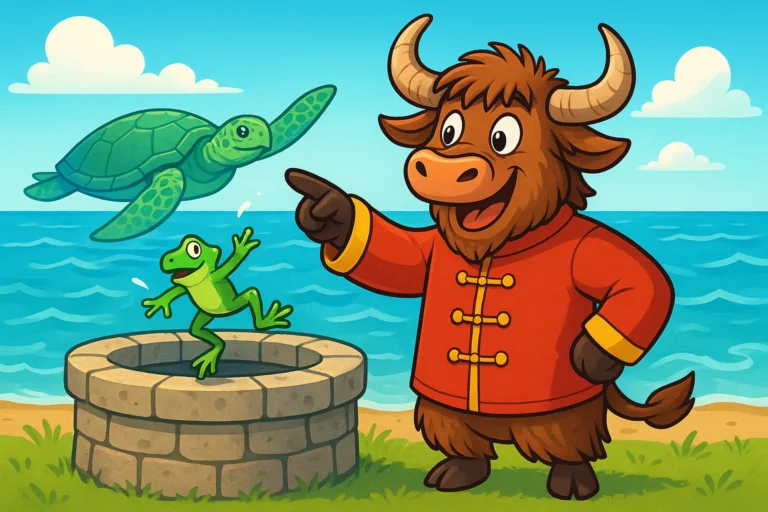

This A1 Beginner retelling of 塞翁失馬 keeps the plot clear for learners while still giving the story some atmosphere and momentum.
This version teaches Traditional Chinese through English and includes clickable word help inside the story, full story audio, and lesson notes after the reading. It is free to use on Yak Yacker and is designed to feel natural, readable, and manageable for learners.
從前,有一位老人住在。他有一匹。
有一天,馬。鄰居們說:「!」
老人說:「?這也許是。」
過了幾個月,馬,還帶了。鄰居們說:「!」
老人說:「?這也許是。」
不久,老人的兒子,。鄰居們又說:「!」
老人笑著說:「?,我兒子因為不用去。壞事有時也是好事。」
Once upon a time, an old man lived near the border. He had a fine horse.
One day, the horse ran away. The neighbors said, 'What bad luck!'
The old man said, 'Who knows? This might be a good thing.'
A few months later, the horse returned, bringing a wild horse. The neighbors said, 'Such good luck!'
The old man said, 'Who knows? This might be a bad thing.'
Soon after, the old man's son rode the wild horse and broke his leg. The neighbors again said, 'What bad luck!'
The old man smiled and said, 'Who knows? The army came, and because of his leg injury, my son didn't have to go to war. Bad things can sometimes be good.'
Here are some important nouns and adjectives from the story. Learning these will help you understand the events and the neighbors' reactions.
- 老人 (lǎo rén) - old man
- 馬 (mǎ) - horse
- 鄰居 (lín jū) - neighbor
- 倒霉 (dǎo méi) - unlucky
- 幸運 (xìng yùn) - lucky
- 腿 (tuǐ) - leg
- 軍隊 (jūn duì) - army
- 打仗 (dǎ zhàng) - go to war
The old man uses a simple phrase to stay calm: 誰知道呢? (Shéi zhīdào ne?) - "Who knows?" It's a gentle way to express uncertainty about the future.
You'll also hear the neighbors use short exclamations with 真 (zhēn) or 太…了 (tài…le). These make strong statements about good or bad luck.
- 真倒霉!(Zhēn dǎoméi!) - How unlucky!
- 太幸運了!(Tài xìngyùn le!) - So lucky!
- 壞事有時也是好事 - Bad things sometimes turn out good (literally: bad things sometimes also are good things).
Now it's your turn! Think of a small mishap and imagine how it might turn into something positive. Try using 誰知道呢? to describe your situation.
You can also make your own exclamations with 真 or 太…了 to react to daily events. For example: 真好吃! (How delicious!) or 太棒了! (Awesome!)
塞翁失馬 comes from the Chinese / idiom story tradition and is best known as a idiom/fable. This Yak Yacker article is an original learner retelling based on Ancient Chinese tale; public domain, so the wording here is simplified for modern learners rather than copied from one old edition.
Older printings, translations, and retellings of this story can vary quite a bit. The original audience was usually kids/general, but this version is adapted for A1 Beginner learners studying Traditional Chinese. Good “bad luck/good luck” structure.
If you want to look into the source tradition, start with Wikisource.
If you want to keep going, browse more in our Traditional Chinese section. After that, try 1,000 Traditional Chinese Phrases and Expressions for another useful next step.
More Traditional Chinese to explore
Kong Rong Shares the Pears: A1 Beginner Traditional Chinese Story with Audio
Havoc in Heaven: A2 Elementary Traditional Chinese Story with Audio
The Oath of the Peach Garden: A B1 Interactive Chinese Reader with Audio