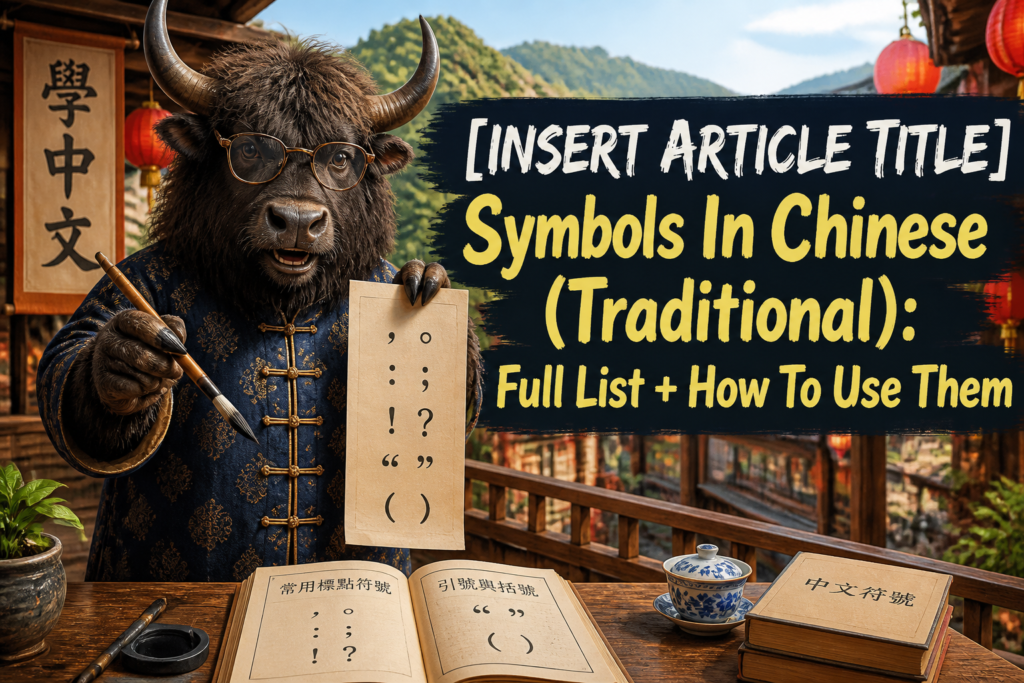
Traditional Chinese symbols can look tiny, harmless, and then suddenly cause chaos. A dot, a comma, or a pair of quotation marks can change the rhythm of a sentence, the tone of a message, or even whether something feels formal, casual, or just a little bit old-school. Fun, right?
For the broader learning path, visit our parent guide.
If you are reading or writing Mandarin in Taiwan, knowing the common symbols matters a lot. You will see them in school writing, news articles, signs, messages, and official forms. By the end of this guide, you will understand the most common symbols in Chinese, how they are used in Traditional Chinese, and how they differ from English punctuation in the places learners usually trip over like a scooter on a wet alley.
For a practical reference on language learning, you can also check the Traditional Chinese placement test for TOCFL and the Traditional Chinese vocabulary test once you want to check your progress.
Why Symbols Matter In Traditional Chinese
Chinese punctuation is not just decoration. It helps show sentence endings, pauses, dialogue, lists, titles, emphasis, and numbers. In Taiwan, you will often see full-width Chinese punctuation in books, newspapers, school materials, and formal writing. That means symbols like , and 。 are the normal, expected version, not the English-style versions used in many keyboard settings.
A helpful rule: if you are writing in Traditional Chinese, use Chinese punctuation when the text is mainly Chinese. If the sentence includes English or technical material, mixed punctuation can happen. The key is consistency. No one wants a sentence that looks like it dressed itself in two different countries.
Traditional Chinese punctuation is about readability and style, not just “correctness.” In Taiwan, it also signals that the writing belongs to a Chinese context, not just a translated English one.
Core Symbols You Will See All The Time
Below is a practical list of the most common Chinese symbols, with Traditional Chinese names, pinyin, English meaning, and a simple example sentence.
| Traditional Chinese | Pinyin | English Meaning | Example (ZH) | Example (Pinyin) | Translation (EN) |
|---|---|---|---|---|---|
| 句號 | jùhào | Period / full stop | 今天很熱。 | Jīntiān hěn rè. | It is very hot today. |
| 逗號 | dòuhào | Comma | 我去便利商店,然後回家。 | Wǒ qù biànlì shāngdiàn, ránhòu huí jiā. | I go to the convenience store, then go home. |
| 頓號 | dùnhào | List comma / pause mark | 我買了蘋果、香蕉、還有牛奶。 | Wǒ mǎi le píngguǒ, xiāngjiāo, hái yǒu niúnǎi. | I bought apples, bananas, and milk. |
| 問號 | wènhào | Question mark | 你要一起去嗎? | Nǐ yào yīqǐ qù ma? | Do you want to go together? |
| 驚嘆號 | jīngtànhào | Exclamation mark | 太好了! | Tài hǎo le! | Great! |
| 冒號 | màohào | Colon | 我有兩個問題:第一個是語法,第二個是發音。 | Wǒ yǒu liǎng gè wèntí: dì yī gè shì yǔfǎ, dì èr gè shì fāyīn. | I have two questions: the first is grammar, the second is pronunciation. |
| 分號 | fēnhào | Semicolon | 他喜歡咖啡;我比較喜歡茶。 | Tā xǐhuān kāfēi; wǒ bǐjiào xǐhuān chá. | He likes coffee; I prefer tea. |
| 引號 | yǐnhào | Quotation marks | 老師說:「明天交作業。」 | Lǎoshī shuō: “Míngtiān jiāo zuòyè.” | The teacher said, “Hand in the homework tomorrow.” |
| 括號 | kuòhào | Parentheses | 台北捷運(MRT)很方便。 | Táiběi jiéyùn (MRT) hěn fāngbiàn. | Taipei MRT is very convenient. |
| 書名號 | shūmínghào | Book title marks | 我正在看《哈利波特》。 | Wǒ zhèngzài kàn 《Hālì Bōtè》. | I am reading Harry Potter. |
| 省略號 | shěnglüèhào | Ellipsis | 我想說的是……算了。 | Wǒ xiǎng shuō de shì… suàn le. | What I wanted to say was… never mind. |
| 破折號 | pòzhéhào | Dash | 他最喜歡的城市——台南。 | Tā zuì xǐhuān de chéngshì—Táinán. | His favorite city—Tainan. |
How To Use The Big Four: 點、逗、問、嘆
These four symbols show up constantly in everyday Chinese writing: 句號(jùhào), 逗號(dòuhào), 問號(wènhào), and 驚嘆號(jīngtànhào). If you know these, you can already read a huge amount more comfortably.
| Pattern | Meaning | Example (ZH) | Pinyin | English |
|---|---|---|---|---|
| 句號。 | Ends a statement | 我住在台中。 | Wǒ zhù zài Táizhōng. | I live in Taichung. |
| 逗號, | Separates parts of a sentence | 我想喝茶,因為很冷。 | Wǒ xiǎng hē chá, yīnwèi hěn lěng. | I want to drink tea because it is cold. |
| 問號? | Ends a question | 你今天有空嗎? | Nǐ jīntiān yǒu kòng ma? | Are you free today? |
| 驚嘆號! | Shows surprise, excitement, or emphasis | 太棒了! | Tài bàng le! | Awesome! |
One small note: in Chinese, the question mark is still used, but the sentence often already has a question word or particle like 嗎(ma). So yes, the punctuation helps, but Mandarin also likes to wear its question sign on the sentence itself. Very efficient, slightly dramatic.
List And Pause Symbols
Chinese uses a few symbols that are easy to mix up if you come from English punctuation rules. The biggest one is 頓號(dùnhào), which looks like 、. It is often used in lists between items of the same type.
| Traditional Chinese | Pinyin | Meaning | Example (ZH) | Example (Pinyin) | Translation (EN) |
|---|---|---|---|---|---|
| 頓號 | dùnhào | List separator | 星期一、星期二、星期三 | xīngqī yī, xīngqī èr, xīngqī sān | Monday, Tuesday, Wednesday |
| 逗號 | dòuhào | General comma | 我先去買東西,然後回來。 | Wǒ xiān qù mǎi dōngxī, ránhòu huílái. | I’ll go buy things first, then come back. |
| 分號 | fēnhào | Links two related clauses | 她喜歡運動;我喜歡看書。 | Tā xǐhuān yùndòng; wǒ xǐhuān kàn shū. | She likes sports; I like reading. |
頓號 is especially useful in written Chinese lists. In speech, it is mostly just a small pause. In English, you might use commas or the Oxford comma depending on style. In Chinese, 、 is the clean, standard choice for item lists.
Quotation Marks, Book Titles, And Brackets
Chinese quotation marks are often written as 「」 and 『』, especially in Taiwan. You may also see Western-style quotes in some contexts, but traditional Chinese text commonly uses the Chinese pair. That is one of those details that makes writing look naturally Taiwanese instead of “I copied this from an English keyboard and hoped for the best.”
| Traditional Chinese | Pinyin | Meaning | Example (ZH) | Example (Pinyin) | Translation (EN) |
|---|---|---|---|---|---|
| 引號 | yǐnhào | Quotation marks | 她說:「我明天再來。」 | Tā shuō: “Wǒ míngtiān zài lái.” | She said, “I’ll come again tomorrow.” |
| 書名號 | shūmínghào | Marks for titles of books, films, songs, articles | 我喜歡看《小王子》。 | Wǒ xǐhuān kàn 《Xiǎo Wángzǐ》. | I like reading The Little Prince. |
| 括號 | kuòhào | Parentheses | 台灣(Taiwan)是個島嶼。 | Táiwān (Taiwan) shì gè dǎoyǔ. | Taiwan is an island. |
In Taiwan, 書名號 is very common for book titles, movie titles, and other works. If you are writing titles in Chinese, using 《 》 makes the text feel polished and native.
Dots, Dashes, And Ellipses
Some symbols are less frequent in beginner writing but still very useful. These help with pacing, emphasis, or showing an unfinished thought. Great for both reading and writing. Slightly less great if your message is already vague.
| Traditional Chinese | Pinyin | Meaning | Example (ZH) | Example (Pinyin) | Translation (EN) |
|---|---|---|---|---|---|
| 省略號 | shěnglüèhào | Ellipsis | 我只是想說……算了。 | Wǒ zhǐshì xiǎng shuō… suàn le. | I just wanted to say… forget it. |
| 破折號 | pòzhéhào | Dash / em dash | 今天最冷的地方——山上。 | Jīntiān zuì lěng de dìfāng—shān shàng. | The coldest place today—on the mountain. |
| 間隔號 | jiàngéhào | Middle dot / separator | 《哈利・波特》 | 《Hālì Bōtè》 | Harry Potter |
The 間隔號(jiàngéhào)is useful in transliterations and some proper names. You may see it less often than commas or quotation marks, but it does show up in formal writing and names.
Symbols For Dates, Numbers, And Formatting
Symbols are also part of how Chinese writes dates and numbers. If you are learning Taiwan usage, this is very practical because dates appear everywhere: forms, tickets, schedules, messages, and official notices. If you want a deeper guide, the articles on Traditional Chinese date formats and how to write the date in Traditional Chinese are very handy.
| Symbol | Pinyin | Meaning | Example (ZH) | Translation (EN) |
|---|---|---|---|---|
| 、 | dùnhào | List separator | 1、2、3 | 1, 2, 3 |
| / | xiéxiàn | Slash | 2025/05/03 | 2025/05/03 |
| - | hèngxiàn | Hyphen / dash | 台北-高雄 | Taipei–Kaohsiung |
| % | bǎifēnbǐ | Percent sign | 九折優惠,省 10%。 | 10% off, save 10%. |
| + | jiāhào | Plus sign | 2+2=4 | 2 + 2 = 4 |
| = | děngyúhào | Equals sign | 1+1=2 | 1 + 1 = 2 |
In daily writing, numbers and dates may be written in Arabic numerals or Chinese numerals depending on context. Forms and schedules often use Arabic numerals, while formal documents may use Chinese numerals to reduce confusion. That is why symbols and number style often travel together like a slightly nerdy pair.
Common Chinese Symbols And Their Taiwan Names
This quick reference is useful if you are trying to match what you see in Taiwanese textbooks or dictionaries. Some English names are familiar, but the Chinese names are what matter if you are studying vocabulary.
| Traditional Chinese | Pinyin | English Meaning | Example (ZH) | Example (Pinyin) | Translation (EN) |
|---|---|---|---|---|---|
| 句號 | jùhào | Full stop | 請寫完整句子。 | Qǐng xiě wánzhěng jùzi. | Please write a complete sentence. |
| 逗號 | dòuhào | Comma | 這裡要加逗號。 | Zhèlǐ yào jiā dòuhào. | A comma should be added here. |
| 問號 | wènhào | Question mark | 句尾要用問號。 | Jù wěi yào yòng wènhào. | Use a question mark at the end of the sentence. |
| 驚嘆號 | jīngtànhào | Exclamation mark | 這句話有驚嘆號。 | Zhè jù huà yǒu jīngtànhào. | This sentence has an exclamation mark. |
| 頓號 | dùnhào | List comma | 清單裡常用頓號。 | Qīngdān lǐ cháng yòng dùnhào. | Lists often use the list comma. |
| 冒號 | màohào | Colon | 冒號後面要接說明。 | Màohào hòumiàn yào jiē shuōmíng. | Explanation follows the colon. |
| 分號 | fēnhào | Semicolon | 分號比逗號更強。 | Fēnhào bǐ dòuhào gèng qiáng. | A semicolon is stronger than a comma. |
| 引號 | yǐnhào | Quotation marks | 引號可以標示直接引語。 | Yǐnhào kěyǐ biāoshì zhíjiē yǐnyǔ. | Quotation marks can show direct speech. |
| 括號 | kuòhào | Parentheses | 括號裡放補充資訊。 | Kuòhào lǐ fàng bǔchōng zīxùn. | Extra information goes in parentheses. |
| 書名號 | shūmínghào | Title marks | 書名號包住書名。 | Shūmínghào bāo zhù shūmíng. | Title marks surround the title. |
Useful Phrases For Talking About Symbols
If you are discussing writing, grammar, or editing, these phrases will help. They also appear in classrooms, proofreading, and test prep. For more everyday core vocabulary, the guide to Traditional Chinese basic words and phrases is a good companion.
| Traditional Chinese | Pinyin | Meaning | Example (ZH) | Example (Pinyin) | Translation (EN) |
|---|---|---|---|---|---|
| 標點符號 | biāodiǎn fúhào | Punctuation marks | 中文的標點符號很重要。 | Zhōngwén de biāodiǎn fúhào hěn zhòngyào. | Punctuation marks in Chinese are important. |
| 全形 | quánxíng | Full-width | 中文常用全形符號。 | Zhōngwén cháng yòng quánxíng fúhào. | Chinese often uses full-width symbols. |
| 半形 | bànxíng | Half-width | 英文鍵盤常是半形。 | Yīngwén jiànpán cháng shì bànxíng. | An English keyboard is often half-width. |
| 標題 | biāotí | Title | 標題要用書名號嗎? | Biāotí yào yòng shūmínghào ma? | Should the title use title marks? |
| 直接引語 | zhíjiē yǐnyǔ | Direct quotation | 直接引語要放進引號裡。 | Zhíjiē yǐnyǔ yào fàng jìn yǐnhào lǐ. | Direct quotation should go inside quotation marks. |
| 補充說明 | bǔchōng shuōmíng | Additional explanation | 括號裡可以放補充說明。 | Kuòhào lǐ kěyǐ fàng bǔchōng shuōmíng. | Additional explanation can go in parentheses. |
Simple Rules You Can Actually Use
Here are the most practical rules, without turning this into a dusty grammar museum.
- 句號(jùhào)ends a statement.
- 問號(wènhào)ends a question.
- 驚嘆號(jīngtànhào)shows strong feeling or surprise.
- 逗號(dòuhào)separates clauses inside a sentence.
- 頓號(dùnhào)separates items in a list.
- 引號(yǐnhào)mark direct speech or quotations.
- 書名號(shūmínghào)mark titles of books, films, and articles.
- 括號(kuòhào)add extra information.
- 省略號(shěnglüèhào)show a pause, hesitation, or unfinished thought.
- 破折號(pòzhéhào)adds emphasis or a sharp break in thought.
One important learner tip: Chinese punctuation is usually written in full-width form. That means the characters are visually wider and sit neatly inside Chinese text. If your keyboard keeps giving you English punctuation, that is common. It is not a disaster. But when you want text to look natural in Traditional Chinese, the Chinese forms are the standard choice.
Mini Practice: Spot The Symbol
Try matching the symbol to the job it does. No pressure. This is language learning, not a police interrogation.
| Symbol | What It Does | Answer |
|---|---|---|
| 。 | Ends a statement | 句號 |
| ? | Ends a question | 問號 |
| 、 | Separates list items | 頓號 |
| 「 」 | Shows quoted speech in Taiwan-style writing | 引號 |
| 《 》 | Shows a title | 書名號 |
| …… | Shows pause or trailing thought | 省略號 |
Now try rewriting these with the right symbol:
- 你要喝茶___
- 我買了蘋果___香蕉___牛奶。
- 老師說___明天再交。
- 這本書叫___小王子___。
Answers: ? 、 、 「」 《》
Common Mistakes English Speakers Make
These mistakes are extremely normal. The good news is that once you notice them, they stop being mysterious.
| Mistake | Why It Happens | Better Choice |
|---|---|---|
| Using English commas everywhere | Keyboard defaults and habit | Use 逗號 and 頓號 correctly in Chinese text |
| Using a plain English quote style in formal Chinese | Typing convenience | Use Chinese quotation marks such as 「」 |
| Mixing title marks and quotation marks | English formatting habits | Use 《書名號》 for titles |
| Putting too many symbols in one sentence | Trying to sound fancy | Keep punctuation simple and clear |
| Forgetting that 、 is not the same as , | They look similar at a glance | Use 、 for lists; use , for sentence pauses |
If you are unsure whether something is standard, dictionaries and educational references are helpful. For general language reference and spelling conventions, a boring but useful place to start is the Wikipedia page on 標點符號. Not glamorous. Very useful. Like a seatbelt.
Related Symbols You May See In Taiwan
These are not always beginner-level essentials, but they appear often enough to be worth recognizing.
| Traditional Chinese | Pinyin | Meaning | Example (ZH) | Example (Pinyin) | Translation (EN) |
|---|---|---|---|---|---|
| 連字號 | liánzìhào | Hyphen | 台北-高雄線 | Táiběi-Gāoxióng xiàn | Taipei-Kaohsiung line |
| 斜線 | xiéxiàn | Slash | 是/否 | shì/fǒu | yes/no |
| 波浪號 | bōlànghào | Tilde | 約在 8~9 點之間 | Yuē zài bā jiǔ diǎn zhī jiān | Around 8 to 9 o’clock |
| 百分號 | bǎifēnhào | Percent sign | 成功率是 90%。 | Chénggōng lǜ shì jiǔshí bǎifēn zhī jiǔshí. | The success rate is 90%. |
Quick Reference Summary
- 句號(jùhào)= period / full stop
- 逗號(dòuhào)= comma
- 頓號(dùnhào)= list separator
- 問號(wènhào)= question mark
- 驚嘆號(jīngtànhào)= exclamation mark
- 冒號(màohào)= colon
- 分號(fēnhào)= semicolon
- 引號(yǐnhào)= quotation marks
- 括號(kuòhào)= parentheses
- 書名號(shūmínghào)= title marks
- 省略號(shěnglüèhào)= ellipsis
- 破折號(pòzhéhào)= dash
Remember the biggest Taiwan-friendly habit: use Chinese punctuation when writing Chinese. That one choice already makes your writing look much more natural. And if you are working on broader study goals, you can always pair this lesson with the vocabulary review tools and tests above. A little repetition goes a long way. Annoying, yes. Effective, also yes.
Yak takeaway: Chinese symbols are not random little decorations. They are part of how Mandarin writes clearly, naturally, and with the right tone. Learn the common ones first, use 、 for lists and 《》 for titles, and your Traditional Chinese will start looking much more polished very fast.