


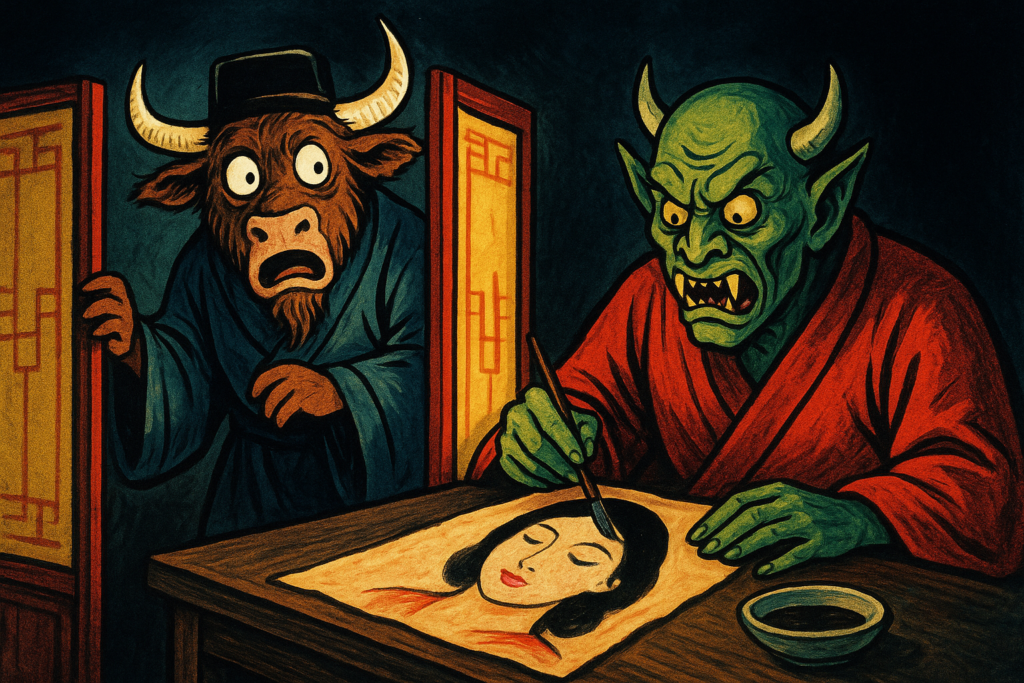
What would you do if a mysterious stranger turned out to be something terrifying? In the classic Chinese ghost story *Painted Skin*, a lonely scholar takes in a beautiful woman seeking shelter – only to discover she is a demon wearing an elaborate painted skin to hide her true, monstrous form. To save himself, he must seek the help of a wandering Taoist priest, but the demon is always one step behind. This retelling in traditional Chinese characters is written for B1 intermediate learners, so you can enjoy the suspense without drowning in difficult language. You can also listen to the full story audio on Yak Yacker.
Our interactive graded reader brings the story to life with clickable word help – just tap any word to see its meaning in English. Listen to the entire story read by a native Mandarin speaker, and check the integrated lesson notes for cultural context and language tips. No headache, no dictionary: just you and a chilling tale, ready to improve your traditional Chinese the natural way.
Whether you love folk horror, ghost stories, or simply want leveled Chinese reading practice, this self-contained post has everything you need to read, listen, and learn. Scroll down to start reading – it's free, and the demon awaits.
從前,在太原有一個書生,姓王。
一天早上,他在路上走。
忽然,他前面有一個。
那女子一個布包袱,走得很。
王生,她。
王生問:「這位姑娘,怎麼一個人呢?」
女子,說:「我的丈夫把我了,我沒有地方可以去。」
王生很她,說:「我家離這裡不遠,姑娘先到我家吧。」
女子了一下,然後。
王生,讓她住在一間書房裡。
女子說:「公子,請不要我在這裡,我怕丈夫我。」
王生了她。
幾天,女子一直住在書房裡,很少。
王生喜歡她,每天都會去。
但是,街上的人開始:「王生家裡住著一個的女人。」
有一天,王生在市場一個。
道士一看到王生,就變了。
道士說:「公子,你身上有!最近你是不是什麼?」
王生說:「沒有啊,一切都很好。」
道士,說:「的人啊!還不知道!」
王生聽了,心裡有點,但沒有。
回到家,他經過書房門口,發現門從裡面了。
他覺得,就悄悄地走到窗戶旁邊,。
房間裡很黑,但可以看見一個東西。
那不是那個女子!
一個的鬼,正坐在床上。
鬼的面前一張人皮,它正拿著一支彩筆,地畫著眉毛和嘴唇。
那張人皮上,正是女子的臉!
鬼畫完後,把筆一丟,拿起人皮,像穿衣服一樣。
一瞬間,鬼就變成了那個的女子。
王生腿都軟了,地逃出家門。
他急忙跑回去找那個道士,地說:「道長救我!」
道士說:「那鬼多年,很。我給你一個,你把它掛在房門口,鬼就不敢進去了。」
王生拿著拂塵回家,掛在自己的門上。
到了半夜,他聽到門外有。
女子站在門外,看到拂塵,不敢。
她地說:「可惡的道士!我不會放過你的!」
然後,她就。
王生以為沒事了,。
可是,沒多久,那個鬼又。
這次,她直接拂塵,門,跳到王生的床上。
「你敢我,我要你的心!」鬼,用爪子王生的胸膛,抓走了他的心。
王生的妻子陳氏聽到,跑進來一看,丈夫已經死了,胸口一個血洞。
陳氏。
第二天,鄰居幫她去找那個道士。
道士一聽,:「可惡的鬼!我本可憐它,它卻害人性命!」
道士立刻拿著,找到了鬼的。
鬼正想逃走,道士用劍一砍,鬼化成一團。
道士從黑煙裡拿出一個,把鬼收了進去。
然後,道士把那人皮捲起來,像捲畫一樣,也了。
陳氏道士面前,哭著說:「求道長救我丈夫一命!」
道士說:「我的救不了他。不過,市場上有一個瘋子,你去找他,或許有。」
陳氏立刻跑到市場,果然看到一個的乞丐,泥巴,褲子都破了。
陳氏跪在他面前,求他救命。
乞丐:「傻瓜!我又不是醫生,怎麼救人?」
陳氏不停地,頭都磕破了。
乞丐說:「好吧,好吧!你要我救他,就把這口吞下去!」
說完,乞丐一大坨黏黏的痰,手上,遞給她。
陳氏看著那痰,讓人想吐。
但想到丈夫,她一閉眼,把那口痰肚裡。
乞丐哈哈大笑:「傻女人!傻女人!」然後走了。
陳氏又羞又氣,回到家,趴在丈夫屍體上大哭。
哭著哭著,她覺得喉嚨裡有什麼東西。
突然,她張開嘴,一顆東西掉出來,直接掉進王生胸口的洞裡。
她仔細一看,那是!
人心在王生胸口起來。
陳氏又驚又喜,趕緊用布傷口。
過了一夜,王生竟然。
他看著妻子,說:「我好像做了一場很長的。」
從此以後,王生再也不敢帶回家了。
而那張的故事,也成了太原人的奇談。
Let's look at some vivid vocabulary that brings the horror of "Painted Skin" to life. These words aren't just for ghost stories-they pop up in everyday dramatic expressions.
Notice how classical elements like 書生 (shūshēng, scholar) and 拂塵 (fúchén, fly-whisk) set the scene, while words like 獠牙 (liáoyá, fangs) and 剖開 (pōukāi, to cut open) ramp up the fear.
- 人皮 (rén pí): human skin - the painted disguise itself
- 獠牙 (liáo yá): exposed fangs - often a sign of a demon or monster
- 剖開 (pōu kāi): to cut/slice open - used when the demon rips out Wang's heart
- 葫蘆 (hú lu): calabash gourd - a Daoist monk's tool to capture spirits
The story packs a punch with resultative and descriptive complements that show extreme reactions. Pay attention to the pattern: Verb/Adjective + 得 (de) + dramatic result.
For example, 嚇得腿都軟了 (xià de tuǐ dōu ruǎn le, scared so much his legs went weak) uses 得 to link the feeling (fright) to the physical outcome. Another gem: 哭得死去活來 (kū de sǐ qù huó lái, cried as if dying and coming back again) expresses overwhelming grief.
- Structure: V/Adj + 得 + result / description
- 氣得發抖 (qì de fā dǒu): so angry one trembles
- 高興得跳起來 (gāoxìng de tiào qǐlái): so happy that one jumps up
- Try your own: Choose an emotion and add a dramatic physical result with 得.
This tale gave us the idiom 畫皮 (huà pí, painted skin). It's used to describe someone who hides a sinister nature under a beautiful or kind appearance.
Even today, you might hear it in a conversation like: "小心,他可能是個畫皮,別被外表騙了。 (Be careful, he might be a 'painted skin', don't be fooled by appearances.)" It's a reminder that in Chinese storytelling, the surface often conceals a deeper-and sometimes scarier-truth.
- 畫皮 (huà pí): literally "painted skin"; figuratively, a disguise hiding evil
- Often used to warn against trusting looks alone
- The story also reflects the Daoist idea that deceptive spirits are everywhere
Wang Sheng trusted a stranger and paid a terrible price. His wife Chen's loyalty saved him, but she had to swallow humiliation and filth to do it.
Now it's your turn: If you discovered your loved one were a demon in disguise, would you run, fight, or try to redeem them? Jot down a few phrases in Chinese to describe your choice, using some of the new words or complements you've just practiced.
畫皮 comes from the Chinese / Pu Songling tradition and is best known as a strange tale / horror. This Yak Yacker article is an original learner retelling based on Pu Songling, 18th century; public domain, so the wording here is simplified for modern learners rather than copied from one old edition.
Older printings, translations, and retellings of this story can vary quite a bit. The original audience was usually adult/general, but this version is adapted for B1 Intermediate learners studying Traditional Chinese. Horror/adult; use for older B1 only.
If you want to look into the source tradition, start with Project Gutenberg.
If you want to keep going, browse more in our Traditional Chinese section. After that, try Essential Traditional Chinese Grammar Words for another useful next step.