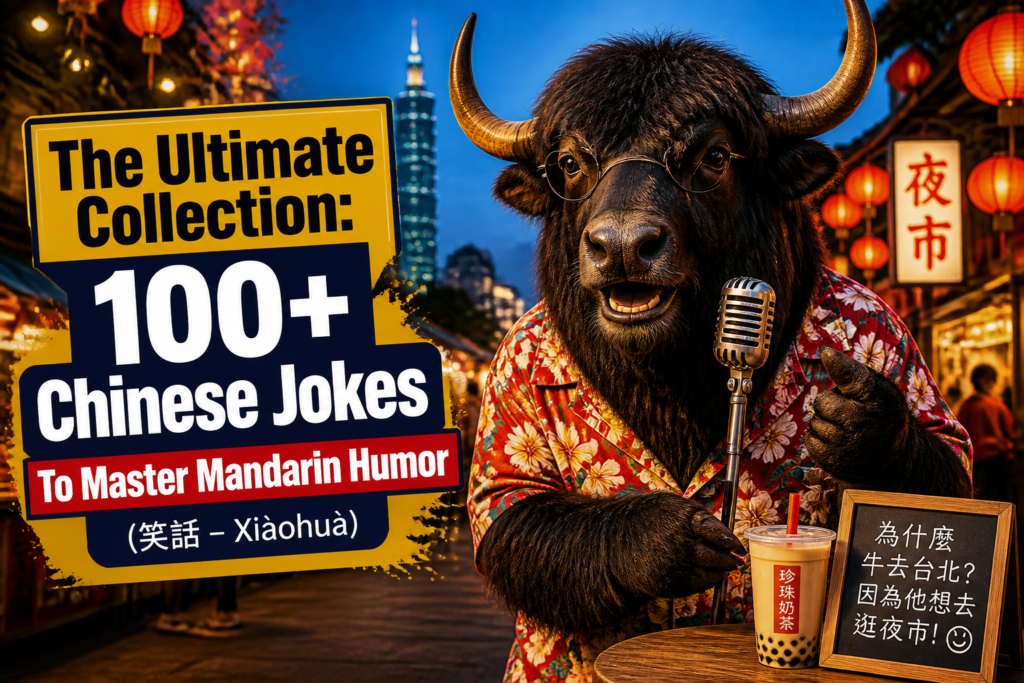
笑話(xiàohuà)means “joke” or “funny story.” In Mandarin, jokes are often a little punny, a little silly, and occasionally the kind of funny that makes everyone pause for half a second before laughing. Very efficient. Very Chinese.
For the broader learning path, visit our parent guide.
This guide gives you a big collection of joke-friendly words, punchline patterns, and real-life example sentences in Traditional Chinese. You will also see how Mandarin humor works in everyday life—at school, in the office, in group chats, and yes, at the very serious battlefield known as the convenience store.
Before you go full stand-up comedian, it helps to know the core vocabulary. If you want to check your level after this, the Traditional Chinese placement test and the Traditional Chinese vocabulary test are handy reality checks. Slightly humbling. Very useful.
Core Joke Vocabulary
| Traditional Chinese | Pinyin | Meaning | Example (ZH) | Example (Pinyin) | Translation (EN) |
|---|---|---|---|---|---|
| 笑話 | xiàohuà | joke; funny story | 這個笑話很好笑。 | Zhège xiàohuà hěn hǎoxiào. | This joke is very funny. |
| 好笑 | hǎoxiào | funny; amusing | 你剛剛說的話很有好笑的感覺。 | Nǐ gānggāng shuō de huà hěn yǒu hǎoxiào de gǎnjué. | What you just said feels funny. |
| 幽默 | yōumò | humor | 他講話很幽默。 | Tā jiǎnghuà hěn yōumò. | He speaks very humorously. |
| 搞笑 | gǎoxiào | ridiculous; laugh-making | 他昨天的表演超搞笑。 | Tā zuótiān de biǎoyǎn chāo gǎoxiào. | His performance yesterday was super funny. |
| 冷笑話 | lěng xiàohuà | corny joke; lame joke | 他又講了一個冷笑話。 | Tā yòu jiǎng le yí gè lěng xiàohuà. | He told another corny joke. |
| 梗 | gěng | gag; setup; meme-ish joke reference | 你有看懂這個梗嗎? | Nǐ yǒu kàn dǒng zhège gěng ma? | Did you get this joke reference? |
| 諧音 | xiéyīn | homophone; pun based on sound | 這是一個諧音梗。 | Zhè shì yí gè xiéyīn gěng. | This is a pun based on sound. |
| 玩笑 | wánxiào | joke; teasing remark | 我只是開個玩笑。 | Wǒ zhǐ shì kāi gè wánxiào. | I’m just kidding. |
| 開玩笑 | kāi wánxiào | to joke; to kid | 你別太認真,我在開玩笑。 | Nǐ bié tài rènzhēn, wǒ zài kāi wánxiào. | Don’t be too serious. I’m joking. |
| 逗 | dòu | to tease; to amuse | 他很會逗小孩笑。 | Tā hěn huì dòu xiǎohái xiào. | He’s really good at making kids laugh. |
| 笑翻 | xiào fān | laugh hard; laugh one’s head off | 我看到那個影片笑翻了。 | Wǒ kàn dào nàge yǐngpiàn xiào fān le. | I laughed my head off when I saw that video. |
| 爆笑 | bàoxiào | hilarious; burst out laughing | 這段影片超爆笑。 | Zhè duàn yǐngpiàn chāo bàoxiào. | This video is hilarious. |
Useful Joke Phrases You Will Actually Hear
These phrases show up in real conversation, group chats, and the classic “I’m only half laughing, half being polite” situations. Taiwanese Mandarin often uses these very naturally in daily speech.
| Traditional Chinese | Pinyin | Meaning | Example (ZH) | Example (Pinyin) | Translation (EN) |
|---|---|---|---|---|---|
| 你在開玩笑嗎? | Nǐ zài kāi wánxiào ma? | Are you joking? | 你在開玩笑嗎?這也太誇張了。 | Nǐ zài kāi wánxiào ma? Zhè yě tài kuāzhāng le. | Are you joking? This is way too exaggerated. |
| 別鬧了。 | Bié nào le. | Stop messing around. | 別鬧了,我在趕報告。 | Bié nào le, wǒ zài gǎn bàogào. | Stop messing around. I’m rushing a report. |
| 真的假的? | Zhēn de jiǎ de? | Really? | 真的假的?你真的中獎了? | Zhēn de jiǎ de? Nǐ zhēn de zhòngjiǎng le? | Really? You actually won a prize? |
| 有夠好笑 | yǒu gòu hǎoxiào | super funny; insanely funny | 那個迷因有夠好笑。 | Nàge míyīn yǒu gòu hǎoxiào. | That meme is insanely funny. |
| 太扯了 | Tài chě le | That’s ridiculous. | 你忘記帶錢包?太扯了。 | Nǐ wàngjì dài qiánbāo? Tài chě le. | You forgot your wallet? That’s ridiculous. |
| 笑死 | Xiào sǐ | laughing so hard; dead from laughing | 我看完直接笑死。 | Wǒ kàn wán zhíjiē xiào sǐ. | I finished it and instantly died laughing. |
| 笑到肚子痛 | Xiào dào dùzi tòng | laugh until your stomach hurts | 他講的故事讓大家笑到肚子痛。 | Tā jiǎng de gùshì ràng dàjiā xiào dào dùzi tòng. | His story made everyone laugh until their stomachs hurt. |
| 這個梗我懂 | Zhège gěng wǒ dǒng | I get this joke/reference | 這個梗我懂,超老派。 | Zhège gěng wǒ dǒng, chāo lǎopài. | I get this joke reference. It’s super old-school. |
| 我被你笑到了 | Wǒ bèi nǐ xiào dào le | You made me laugh | 你剛剛那句話把我笑到了。 | Nǐ gānggāng nà jù huà bǎ wǒ xiào dào le. | That thing you just said made me laugh. |
| 這是冷笑話 | Zhè shì lěng xiàohuà | This is a corny joke | 這是冷笑話,不要太認真。 | Zhè shì lěng xiàohuà, búyào tài rènzhēn. | This is a corny joke, don’t take it too seriously. |
| 很會講笑話 | hěn huì jiǎng xiàohuà | to be good at telling jokes | 他很會講笑話,氣氛很好。 | Tā hěn huì jiǎng xiàohuà, qìfēn hěn hǎo. | He’s good at telling jokes, and the mood is great. |
| 我只是隨便說說 | Wǒ zhǐshì suíbiàn shuō shuō | I was just speaking casually | 我只是隨便說說,你不要太在意。 | Wǒ zhǐshì suíbiàn shuō shuō, nǐ búyào tài zàiyì. | I was just speaking casually. Don’t mind it too much. |
Joke Patterns In Mandarin
Most Mandarin jokes are not magical. They usually use puns, exaggeration, wordplay, or a very straight-faced ending. That’s the secret sauce. And the sauce is sometimes just “say something unexpected.” Bold strategy.
| Pattern | Meaning | Example (ZH) | Pinyin | English |
|---|---|---|---|---|
| 諧音梗 | Pun based on similar sound | 我不是在偷懶,我是在投籃。 | Wǒ bú shì zài tōulǎn, wǒ shì zài tóulán. | I’m not slacking off; I’m shooting a basketball. |
| 反差梗 | Humor from contrast | 他看起來很兇,其實怕蟑螂。 | Tā kàn qǐlái hěn xiōng, qíshí pà zhāngláng. | He looks fierce, but actually fears cockroaches. |
| 假裝認真 | Deadpan style | 我今天很努力,努力不想上班。 | Wǒ jīntiān hěn nǔlì, nǔlì bù xiǎng shàngbān. | I worked very hard today—hard to avoid wanting to go to work. |
| 誇張說法 | Exaggeration | 我等你等到頭髮都白了。 | Wǒ děng nǐ děng dào tóufǎ dōu bái le. | I waited for you until my hair turned white. |
| 一句兩用 | One line with two meanings | 這工作很有挑戰性,因為我每天都想離職。 | Zhè gōngzuò hěn yǒu tiǎozhàn xìng, yīnwèi wǒ měitiān dōu xiǎng lízhí. | This job is very challenging because I want to quit every day. |
100+ Joke-Ready Chinese Lines
Here come the good bits. These are short, reusable lines you can understand, quote, or adapt. Some are true jokes, some are joke-style reactions, and some are the Mandarin equivalent of a tiny smirk.
| Traditional Chinese | Pinyin | Meaning | Example (ZH) | Example (Pinyin) | Translation (EN) |
|---|---|---|---|---|---|
| 我不是胖,我只是圓潤。 | Wǒ bú shì pàng, wǒ zhǐshì yuánrùn. | I’m not fat; I’m just rounder. | 我不是胖,我只是圓潤。 | Wǒ bú shì pàng, wǒ zhǐshì yuánrùn. | I’m not fat; I’m just rounder. |
| 我沒有拖延症,我只是比較有耐心。 | Wǒ méiyǒu tuōyán zhèng, wǒ zhǐshì bǐjiào yǒu nàixīn. | I’m not a procrastinator; I’m just patient. | 我沒有拖延症,我只是比較有耐心。 | Wǒ méiyǒu tuōyán zhèng, wǒ zhǐshì bǐjiào yǒu nàixīn. | I’m not a procrastinator; I’m just patient. |
| 我不是懶,我是在省電。 | Wǒ bú shì lǎn, wǒ shì zài shěngdiàn. | I’m not lazy; I’m saving power. | 我不是懶,我是在省電。 | Wǒ bú shì lǎn, wǒ shì zài shěngdiàn. | I’m not lazy; I’m saving power. |
| 今天的我,還是昨天的我。 | Jīntiān de wǒ, háishì zuótiān de wǒ. | I am still yesterday’s me. | 今天的我,還是昨天的我。 | Jīntiān de wǒ, háishì zuótiān de wǒ. | Today’s me is still yesterday’s me. |
| 我不是不努力,我是很努力地不努力。 | Wǒ bú shì bù nǔlì, wǒ shì hěn nǔlì de bù nǔlì. | I’m not not working hard; I’m working hard at not working hard. | 我不是不努力,我是很努力地不努力。 | Wǒ bú shì bù nǔlì, wǒ shì hěn nǔlì de bù nǔlì. | I’m not not working hard; I’m working hard at not working hard. |
| 我這個人很簡單,簡單到不簡單。 | Wǒ zhège rén hěn jiǎndān, jiǎndān dào bù jiǎndān. | I’m simple, simple to the point of not simple. | 我這個人很簡單,簡單到不簡單。 | Wǒ zhège rén hěn jiǎndān, jiǎndān dào bù jiǎndān. | I’m simple, simple to the point of not simple. |
| 我很窮,但我很有骨氣。 | Wǒ hěn qióng, dàn wǒ hěn yǒu gǔqì. | I’m poor, but I have dignity. | 我很窮,但我很有骨氣。 | Wǒ hěn qióng, dàn wǒ hěn yǒu gǔqì. | I’m poor, but I have dignity. |
| 我的錢包很安靜。 | Wǒ de qiánbāo hěn ānjìng. | My wallet is very quiet; I have no money. | 我的錢包很安靜。 | Wǒ de qiánbāo hěn ānjìng. | My wallet is very quiet. |
| 我今天很忙,忙著想放假。 | Wǒ jīntiān hěn máng, máng zhe xiǎng fàngjià. | I’m busy today, busy thinking about vacation. | 我今天很忙,忙著想放假。 | Wǒ jīntiān hěn máng, máng zhe xiǎng fàngjià. | I’m busy today, busy thinking about vacation. |
| 我不是早到,我只是來得太早。 | Wǒ bú shì zǎodào, wǒ zhǐshì lái de tài zǎo. | I’m not early; I just came too early. | 我不是早到,我只是來得太早。 | Wǒ bú shì zǎodào, wǒ zhǐshì lái de tài zǎo. | I’m not early; I just came too early. |
| 我不是晚睡,我是在修仙。 | Wǒ bú shì wǎn shuì, wǒ shì zài xiūxiān. | I’m not sleeping late; I’m cultivating immortality. | 我不是晚睡,我是在修仙。 | Wǒ bú shì wǎn shuì, wǒ shì zài xiūxiān. | I’m not sleeping late; I’m cultivating immortality. |
| 我不是失眠,我是清醒得太早。 | Wǒ bú shì shīmián, wǒ shì qīngxǐng de tài zǎo. | I’m not insomniac; I’m just awake too early. | 我不是失眠,我是清醒得太早。 | Wǒ bú shì shīmián, wǒ shì qīngxǐng de tài zǎo. | I’m not insomniac; I’m just awake too early. |
| 我有很多理想,主要是想躺平。 | Wǒ yǒu hěn duō lǐxiǎng, zhǔyào shì xiǎng tǎng píng. | I have many ideals, mainly lying flat. | 我有很多理想,主要是想躺平。 | Wǒ yǒu hěn duō lǐxiǎng, zhǔyào shì xiǎng tǎng píng. | I have many ideals, mainly lying flat. |
| 今天不想上班,明天也不想。 | Jīntiān bù xiǎng shàngbān, míngtiān yě bù xiǎng. | I don’t want to work today, and not tomorrow either. | 今天不想上班,明天也不想。 | Jīntiān bù xiǎng shàngbān, míngtiān yě bù xiǎng. | I don’t want to work today, and not tomorrow either. |
| 我不是在發呆,我是在思考人生。 | Wǒ bú shì zài fādāi, wǒ shì zài sīkǎo rénshēng. | I’m not spacing out; I’m thinking about life. | 我不是在發呆,我是在思考人生。 | Wǒ bú shì zài fādāi, wǒ shì zài sīkǎo rénshēng. | I’m not spacing out; I’m thinking about life. |
| 這不是偷懶,這是效率。 | Zhè bú shì tōulǎn, zhè shì xiàolǜ. | This isn’t slacking; this is efficiency. | 這不是偷懶,這是效率。 | Zhè bú shì tōulǎn, zhè shì xiàolǜ. | This isn’t slacking; this is efficiency. |
| 我笑了,但我沒有完全笑。 | Wǒ xiào le, dàn wǒ méiyǒu wánquán xiào. | I laughed, but not fully. | 我笑了,但我沒有完全笑。 | Wǒ xiào le, dàn wǒ méiyǒu wánquán xiào. | I laughed, but not fully. |
| 這個笑話太冷了。 | Zhège xiàohuà tài lěng le. | This joke is too corny. | 這個笑話太冷了。 | Zhège xiàohuà tài lěng le. | This joke is too corny. |
| 我聽懂了,但我不一定笑了。 | Wǒ tīng dǒng le, dàn wǒ bù yīdìng xiào le. | I understood it, but I may not have laughed. | 我聽懂了,但我不一定笑了。 | Wǒ tīng dǒng le, dàn wǒ bù yīdìng xiào le. | I understood it, but I may not have laughed. |
| 這個梗有點老。 | Zhège gěng yǒudiǎn lǎo. | This joke reference is a bit old. | 這個梗有點老。 | Zhège gěng yǒudiǎn lǎo. | This joke reference is a bit old. |
| 你這是在講道理,還是在講笑話? | Nǐ zhè shì zài jiǎng dàolǐ, háishì zài jiǎng xiàohuà? | Are you making sense, or are you telling a joke? | 你這是在講道理,還是在講笑話? | Nǐ zhè shì zài jiǎng dàolǐ, háishì zài jiǎng xiàohuà? | Are you making sense, or are you telling a joke? |
| 我差點以為你是認真的。 | Wǒ chàdiǎn yǐwéi nǐ shì rènzhēn de. | I almost thought you were serious. | 我差點以為你是認真的。 | Wǒ chàdiǎn yǐwéi nǐ shì rènzhēn de. | I almost thought you were serious. |
| 這也太會講了吧。 | Zhè yě tài huì jiǎng le ba. | That’s so well said. | 這也太會講了吧。 | Zhè yě tài huì jiǎng le ba. | That’s so well said. |
| 我被這句話打敗了。 | Wǒ bèi zhè jù huà dǎbài le. | I was defeated by that line. | 我被這句話打敗了。 | Wǒ bèi zhè jù huà dǎbài le. | I was defeated by that line. |
| 你很有梗。 | Nǐ hěn yǒu gěng. | You’re very witty; full of jokes/references. | 你很有梗。 | Nǐ hěn yǒu gěng. | You’re very witty. |
| 這句有意思。 | Zhè jù yǒu yìsi. | This line is interesting/funny. | 這句有意思。 | Zhè jù yǒu yìsi. | This line is interesting/funny. |
| 我真的沒想到。 | Wǒ zhēn de méi xiǎngdào. | I really did not expect that. | 我真的沒想到。 | Wǒ zhēn de méi xiǎngdào. | I really did not expect that. |
| 這個反轉很可以。 | Zhège fǎnzhuǎn hěn kěyǐ. | This twist works really well. | 這個反轉很可以。 | Zhège fǎnzhuǎn hěn kěyǐ. | This twist works really well. |
| 你是不是想笑死我? | Nǐ shì bù shì xiǎng xiào sǐ wǒ? | Are you trying to make me laugh to death? | 你是不是想笑死我? | Nǐ shì bú shì xiǎng xiào sǐ wǒ? | Are you trying to make me laugh to death? |
| 我先笑為敬。 | Wǒ xiān xiào wéi jìng. | I’ll laugh first as respect. | 我先笑為敬。 | Wǒ xiān xiào wéi jìng. | I’ll laugh first as respect. |
| 你這個人很有趣。 | Nǐ zhège rén hěn yǒuqù. | You are interesting/fun. | 你這個人很有趣。 | Nǐ zhège rén hěn yǒuqù. | You are interesting/fun. |
| 我只能說,絕了。 | Wǒ zhǐ néng shuō, jué le. | I can only say: incredible. | 我只能說,絕了。 | Wǒ zhǐ néng shuō, jué le. | I can only say: incredible. |
| 這句話太會了。 | Zhè jù huà tài huì le. | That line is too clever. | 這句話太會了。 | Zhè jù huà tài huì le. | That line is too clever. |
| 我只能給你一個讚。 | Wǒ zhǐ néng gěi nǐ yí gè zàn. | I can only give you a thumbs-up. | 我只能給你一個讚。 | Wǒ zhǐ néng gěi nǐ yí gè zàn. | I can only give you a thumbs-up. |
| 這不是笑點,是笑爆點。 | Zhè bú shì xiàodiǎn, shì xiào bàodiǎn. | This is not a joke point; it’s an explosion point. | 這不是笑點,是笑爆點。 | Zhè bú shì xiàodiǎn, shì xiào bàodiǎn. | This is not a joke point; it’s an explosion point. |
| 我今天的快樂來源就是你。 | Wǒ jīntiān de kuàilè láiyuán jiù shì nǐ. | You are the source of my happiness today. | 我今天的快樂來源就是你。 | Wǒ jīntiān de kuàilè láiyuán jiù shì nǐ. | You are the source of my happiness today. |
| 你這句很適合做表情包。 | Nǐ zhè jù hěn shìhé zuò biǎoqíngbāo. | This line is perfect for a meme sticker. | 你這句很適合做表情包。 | Nǐ zhè jù hěn shìhé zuò biǎoqíngbāo. | This line is perfect for a meme sticker. |
| 他講話自帶笑點。 | Tā jiǎnghuà zìdài xiàodiǎn. | His speech naturally has joke potential. | 他講話自帶笑點。 | Tā jiǎnghuà zìdài xiàodiǎn. | His speech naturally has joke potential. |
| 我今天不想做人,只想發呆。 | Wǒ jīntiān bù xiǎng zuòrén, zhǐ xiǎng fādāi. | I don’t want to be a functioning human today; I just want to zone out. | 我今天不想做人,只想發呆。 | Wǒ jīntiān bù xiǎng zuòrén, zhǐ xiǎng fādāi. | I don’t want to be a functioning human today; I just want to zone out. |
| 別問,問就是累。 | Bié wèn, wèn jiù shì lèi. | Don’t ask. The answer is tired. | 別問,問就是累。 | Bié wèn, wèn jiù shì lèi. | Don’t ask. The answer is tired. |
| 人生已經很難了,至少要好笑一點。 | Rénshēng yǐjīng hěn nán le, zhìshǎo yào hǎoxiào yìdiǎn. | Life is already hard, so at least be a little funny. | 人生已經很難了,至少要好笑一點。 | Rénshēng yǐjīng hěn nán le, zhìshǎo yào hǎoxiào yìdiǎn. | Life is already hard, so at least be a little funny. |
| 我不是在開車,我是在講比喻。 | Wǒ bú shì zài kāichē, wǒ shì zài jiǎng bǐyù. | I’m not driving; I’m speaking in metaphors. | 我不是在開車,我是在講比喻。 | Wǒ bú shì zài kāichē, wǒ shì zài jiǎng bǐyù. | I’m not driving; I’m speaking in metaphors. |
| 這句很會,真的很會。 | Zhè jù hěn huì, zhēn de hěn huì. | This line is very clever, really very clever. | 這句很會,真的很會。 | Zhè jù hěn huì, zhēn de hěn huì. | This line is very clever, really very clever. |
| 我不是沒有笑,我是笑在心裡。 | Wǒ bú shì méiyǒu xiào, wǒ shì xiào zài xīn lǐ. | I didn’t not laugh; I laughed in my heart. | 我不是沒有笑,我是笑在心裡。 | Wǒ bú shì méiyǒu xiào, wǒ shì xiào zài xīn lǐ. | I didn’t not laugh; I laughed in my heart. |
| 這真的有點好笑。 | Zhè zhēn de yǒudiǎn hǎoxiào. | This is actually a bit funny. | 這真的有點好笑。 | Zhè zhēn de yǒudiǎn hǎoxiào. | This is actually a bit funny. |
| 你很有喜劇天分。 | Nǐ hěn yǒu xǐjù tiānfèn. | You have a talent for comedy. | 你很有喜劇天分。 | Nǐ hěn yǒu xǐjù tiānfèn. | You have a talent for comedy. |
| 我笑不是因為好笑,是因為太真實。 | Wǒ xiào bú shì yīnwèi hǎoxiào, shì yīnwèi tài zhēnshí. | I’m laughing not because it’s funny, but because it’s too real. | 我笑不是因為好笑,是因為太真實。 | Wǒ xiào bú shì yīnwèi hǎoxiào, shì yīnwèi tài zhēnshí. | I’m laughing not because it’s funny, but because it’s too real. |
| 你這句話很有畫面。 | Nǐ zhè jù huà hěn yǒu huàmiàn. | That sentence creates a vivid image. | 你這句話很有畫面。 | Nǐ zhè jù huà hěn yǒu huàmiàn. | That sentence creates a vivid image. |
| 這個太有戲了。 | Zhège tài yǒu xì le. | This is very dramatic/funny. | 這個太有戲了。 | Zhège tài yǒu xì le. | This is very dramatic/funny. |
| 你是不是偷偷練過? | Nǐ shì bú shì tōutōu liànguò? | Did you secretly practice? | 你是不是偷偷練過? | Nǐ shì bú shì tōutōu liànguò? | Did you secretly practice? |
| 我聽完只有一個想法:妙。 | Wǒ tīng wán zhǐ yǒu yí gè xiǎngfǎ: miào. | After hearing it, I only had one thought: brilliant. | 我聽完只有一個想法:妙。 | Wǒ tīng wán zhǐ yǒu yí gè xiǎngfǎ: miào. | After hearing it, I only had one thought: brilliant. |
| 這笑點有點高級。 | Zhè xiàodiǎn yǒudiǎn gāojí. | This joke is a bit sophisticated. | 這笑點有點高級。 | Zhè xiàodiǎn yǒudiǎn gāojí. | This joke is a bit sophisticated. |
| 我先去笑一下。 | Wǒ xiān qù xiào yíxià. | I’m going to go laugh for a second. | 我先去笑一下。 | Wǒ xiān qù xiào yíxià. | I’m going to go laugh for a second. |
Funny but Useful: Joke-Verbs And Reactions
| Traditional Chinese | Pinyin | Meaning | Example (ZH) | Example (Pinyin) | Translation (EN) |
|---|---|---|---|---|---|
| 講 | jiǎng | to say; to tell | 他很會講笑話。 | Tā hěn huì jiǎng xiàohuà. | He’s good at telling jokes. |
| 逗笑 | dòuxiào | to make someone laugh | 這個小孩很會逗笑大家。 | Zhège xiǎohái hěn huì dòuxiào dàjiā. | This kid is good at making everyone laugh. |
| 笑場 | xiàochǎng | to break character by laughing | 演員差點笑場。 | Yǎnyuán chàdiǎn xiàochǎng. | The actor almost broke character laughing. |
| 吐槽 | tǔcáo | to roast; to complain humorously | 大家都在吐槽這個劇情。 | Dàjiā dōu zài tǔcáo zhège jùqíng. | Everyone is roasting this plot. |
| 反轉 | fǎnzhuǎn | twist; reversal | 最後的反轉很好笑。 | Zuìhòu de fǎnzhuǎn hěn hǎoxiào. | The final twist is funny. |
| 爆點 | bàodiǎn | highlight; explosive joke point | 這句話是整段的爆點。 | Zhè jù huà shì zhěng duàn de bàodiǎn. | This line is the highlight of the whole bit. |
| 接梗 | jiē gěng | to catch a joke/reference | 你有接到他的梗嗎? | Nǐ yǒu jiē dào tā de gěng ma? | Did you catch his joke reference? |
| 丟梗 | diū gěng | to drop a joke/reference | 他剛剛丟了一個很冷的梗。 | Tā gānggāng diū le yí gè hěn lěng de gěng. | He just dropped a very corny joke. |
Quick Notes On Humor In Taiwan Mandarin
Taiwanese Mandarin often sounds casual, playful, and a bit more relaxed in everyday humor. People may say 有夠(yǒu gòu)for “super,” use lots of internet slang, and react with short lines like 笑死(xiào sǐ)or 太扯了(tài chě le)instead of longer explanations. Efficiency again. Nature is healing.
Also, many jokes depend on sound. That means puns can be funny even when the meaning is a little absurd. If the joke seems weird, that may be the point. Mandarin comedy does not always introduce itself politely.
笑話(xiàohuà)often works best when it sounds serious for one second too long.
Practice: Match The Reaction To The Situation
| Situation | Best Mandarin Reaction | Pinyin | English |
|---|---|---|---|
| Your friend makes a terrible pun. | 這是冷笑話。 | Zhè shì lěng xiàohuà. | This is a corny joke. |
| Your coworker says something impossible. | 真的假的? | Zhēn de jiǎ de? | Really? |
| A meme makes you laugh out loud. | 我笑死。 | Wǒ xiào sǐ. | I’m dying laughing. |
| A line is clever but a bit old. | 這個梗有點老。 | Zhège gěng yǒudiǎn lǎo. | This joke reference is a bit old. |
| Someone starts exaggerating too much. | 太扯了。 | Tài chě le. | That’s ridiculous. |
| A joke lands perfectly. | 這句很會。 | Zhè jù hěn huì. | That line is very clever. |
Spot The Difference: Funny, Corny, Or Actually Good?
| Expression | Nuance | Example | What It Feels Like |
|---|---|---|---|
| 好笑(hǎoxiào) | Generally funny | 這部電影很好笑。 | Easy, natural laughter. |
| 搞笑(gǎoxiào) | Silly, clownish, funny in a big way | 他很搞笑。 | More energetic, more playful. |
| 冷笑話(lěng xiàohuà) | Corny joke | 這個冷笑話太冷了。 | Bad on purpose, and that’s the joke. |
| 幽默(yōumò) | Humorous, witty | 他很幽默。 | Smarter, smoother humor. |
| 笑死(xiào sǐ) | Very strong reaction | 我真的笑死。 | Internet-style laughter, dramatic but common. |
Mini Drills
- Translate: “I’m just kidding.” → 我只是開個玩笑。(Wǒ zhǐshì kāi gè wánxiào.)
- Translate: “This joke is too corny.” → 這個笑話太冷了。(Zhège xiàohuà tài lěng le.)
- Translate: “Did you get the joke?” → 你有看懂這個梗嗎?(Nǐ yǒu kàn dǒng zhège gěng ma?)
- Swap the feeling word: 很好笑(very funny)→ 很幽默(very witty)→ 很搞笑(very silly-funny)
- Use it in a sentence: 笑死(Xiào sǐ)
- Use it in a sentence: 別鬧了(Bié nào le)
Common Mistakes And Fixes
| Mistake | Better Way | Why |
|---|---|---|
| Using 笑話 for every kind of funny thing | Use 幽默, 搞笑, or 冷笑話 when needed | Different words fit different styles of humor. |
| Thinking 好笑 and 笑死 mean the same thing | 好笑 is “funny”; 笑死 is stronger and more slangy | 笑死 sounds much more dramatic. |
| Translating puns literally | Learn the sound and the joke setup | Many Mandarin jokes depend on pronunciation, not just meaning. |
| Using mainland-flavored slang everywhere | Prefer Taiwan-style casual speech when the context is Taiwan | It sounds more natural for Taiwan readers and listeners. |
| Forgetting 嗎 in questions | 你在開玩笑嗎? | It makes the question clear and natural. |
If you want more sentence rhythm practice, the essential Traditional Chinese phrases page is a good companion. For listening-style challenge work, try the conversational Traditional Chinese guide. And if your tongue gets tied by puns, the Traditional Chinese tongue twisters page will happily humble you.
Quick Reference Summary
- 笑話(xiàohuà)= joke
- 幽默(yōumò)= humor; witty
- 搞笑(gǎoxiào)= silly funny
- 冷笑話(lěng xiàohuà)= corny joke
- 梗(gěng)= joke reference; gag
- 諧音(xiéyīn)= pun based on sound
- 笑死(xiào sǐ)= dying of laughter
- 別鬧了(bié nào le)= stop messing around
- 真的假的?(zhēn de jiǎ de?)= really?
- 我只是開玩笑。(wǒ zhǐshì kāi wánxiào.)= I’m just joking
And if you want a boring, authoritative backup for the serious side of language learning, the Wikipedia page on Mandarin Chinese is at least trying to be organized about it. A rare feat.
Yak Takeaway: Mandarin humor loves puns, deadpan delivery, and short reactions. Learn a few core words like 笑話(xiàohuà), 搞笑(gǎoxiào), and 笑死(xiào sǐ), and suddenly you can follow jokes instead of just politely blinking at them. That’s progress. Beautiful, slightly chaotic progress.