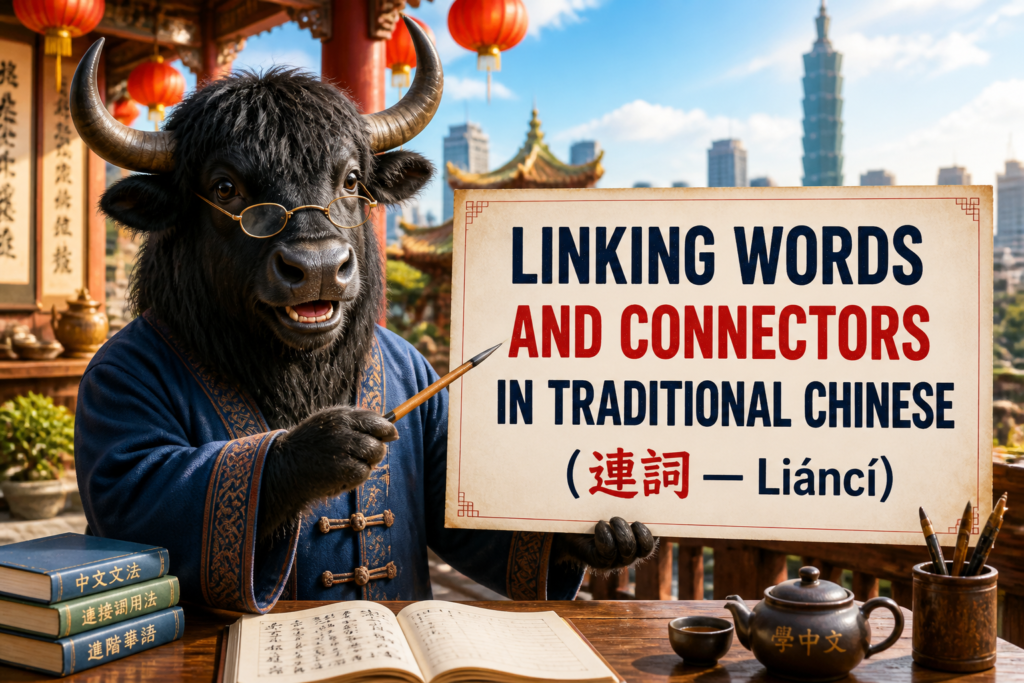
Linking words and connectors in Traditional Chinese

Linking Words And Connectors In Traditional Chinese(連詞 — Liáncí)

If your Mandarin sentences feel a little like a box of puzzle pieces dumped on the floor, connectors are the missing edges. 連詞(liáncí)are the glue words that help ideas flow: and, but, because, so, if, although, either…or, and more. They do the quiet heavy lifting. Very rude of them, honestly.

For the broader learning path, visit our parent guide.

In Traditional Chinese, connectors are especially useful because they make your speech sound smoother, more natural, and less like a list of unrelated facts. By the end of this article, you will understand the most common 連詞(liáncí)and how to use them in real-life Mandarin.

If you want a broader foundation first, it helps to review basic words and phrases and short common words. Connectors love to show up in everyday speech, and they are everywhere from group chats to MRT directions.

What Are 連詞?

連詞(liáncí)means “conjunctions” or “linking words.” In English, these are words like and, but, because, so, and although. They connect words, phrases, or full sentences.

Basic idea: one idea does not just crash into the next one. A connector walks in and politely holds their hands together. That is the job.

小提醒(xiǎo tíxǐng): In Mandarin, some connector-like words are true conjunctions, while others are adverbs or sentence connectors. Learners do not need to panic about the label. If it links ideas naturally, it is doing connector work.

Core Connectors You Will Use All The Time

Here are the most useful everyday connectors first. These are the ones that will actually earn rent in real Mandarin.

Traditional ChinesePinyinMeaningExample (ZH)Example (Pinyin)Translation (EN)
and; with我和朋友去夜市。Wǒ hé péngyǒu qù yèshì.I go to the night market with my friend.
gēnand; with我跟同事一起吃午餐。Wǒ gēn tóngshì yìqǐ chī wǔcān.I eat lunch with my coworker.
但是dànshìbut我想去,但是我沒時間。Wǒ xiǎng qù, dànshì wǒ méi shíjiān.I want to go, but I do not have time.
可是kěshìbut; however我想買,可是太貴了。Wǒ xiǎng mǎi, kěshì tài guì le.I want to buy it, but it is too expensive.
因為yīnwèibecause因為下雨,所以我坐捷運。Yīnwèi xiàyǔ, suǒyǐ wǒ zuò jiéyùn.Because it is raining, I take the MRT.
所以suǒyǐso; therefore我很累,所以早點回家。Wǒ hěn lèi, suǒyǐ zǎodiǎn huí jiā.I am very tired, so I go home early.
而且érqiěand also; moreover這家咖啡廳很安靜,而且有插座。Zhè jiā kāfēitīng hěn ānjìng, érqiě yǒu chāzuò.This café is quiet, and it also has outlets.
或者huòzhěor你要茶或者咖啡?Nǐ yào chá huòzhě kāfēi?Do you want tea or coffee?
如果rúguǒif如果你有空,我們一起去。Rúguǒ nǐ yǒu kòng, wǒmen yìqǐ qù.If you are free, we will go together.
雖然suīránalthough雖然很熱,我還是想走路。Suīrán hěn rè, wǒ háishì xiǎng zǒulù.Although it is hot, I still want to walk.

Common Connector Patterns

In Mandarin, connectors often appear in neat pairs or fixed patterns. Once you learn the pattern, you can swap in new words easily.

PatternMeaningExample (ZH)PinyinEnglish
不但……而且……not only… but also…這間店不但便宜,而且好吃。Zhè jiān diàn bùdàn piányi, érqiě hǎochī.This place is not only cheap, but also tasty.
不但……還……not only… also…他不但會中文,還會台語。Tā bùdàn huì Zhōngwén, hái huì Táiyǔ.He not only knows Chinese, but also Taiwanese Hokkien.
因為……所以……because… so…因為下雨,所以我們改天再去。Yīnwèi xiàyǔ, suǒyǐ wǒmen gǎitiān zài qù.Because it is raining, we will go another day.
雖然……但是……although… but…雖然很忙,但是我會回你訊息。Suīrán hěn máng, dànshì wǒ huì huí nǐ xùnxī.Although I am busy, I will reply to your message.
如果……就……if… then…如果你先到,就幫我點餐。Rúguǒ nǐ xiān dào, jiù bāng wǒ diǎncān.If you arrive first, then help me order.
要是……就……if… then…; used in speech要是太晚,我就搭計程車。Yàoshi tài wǎn, wǒ jiù dā jìchéngchē.If it is too late, I will take a taxi.
不是……而是……not… but rather…我不是生氣,而是太累了。Wǒ bú shì shēngqì, ér shì tài lèi le.I am not angry; I am just too tired.
一邊……一邊……while doing two things我一邊聽音樂,一邊做功課。Wǒ yìbiān tīng yīnyuè, yìbiān zuò gōngkè.I listen to music while doing homework.

And, But, Because, So: The Everyday Essentials

These are the connectors that show up constantly. Learn them early, and your Mandarin will sound much less chopped up.

和 / 跟 — And / With

(hé)and (gēn)both mean “and” or “with” when connecting people, things, or actions. In Taiwan, is extremely common in speech, and feels a little more neutral or written.

我跟我妹妹去買珍奶。(Wǒ gēn wǒ mèimei qù mǎi zhēnnǎi.)
“My sister and I go buy bubble tea.”

他和老師討論功課。(Tā hé lǎoshī tǎolùn gōngkè.)
“He discusses homework with the teacher.”

但是 / 可是 — But

但是(dànshì)and 可是(kěshì)both mean “but.” 可是 often sounds a bit more conversational. Use them when the second idea pushes back against the first one. Life is full of this.

我想出去,可是外面下雨。(Wǒ xiǎng chūqù, kěshì wàimiàn xià yǔ.)
“I want to go out, but it is raining outside.”

因為 / 所以 — Because / So

This pair is one of the most useful sentence-building tools in Mandarin. 因為(yīnwèi)gives the reason, and 所以(suǒyǐ)gives the result.

因為今天很熱,所以我不想走路。(Yīnwèi jīntiān hěn rè, suǒyǐ wǒ bù xiǎng zǒulù.)
“Because it is hot today, I do not want to walk.”

In Mandarin, 因為 and 所以 often appear together, but you can sometimes use just one if the context is already clear.

而且 — And Also; Moreover

而且(érqiě)adds extra information. It usually means “and also” or “moreover.” It is stronger than a simple “and.”

這家麵店便宜,而且份量很大。(Zhè jiā miàndiàn piányi, érqiě fènliàng hěn dà.)
“This noodle shop is cheap, and the portions are big too.”

或者 — Or

或者(huòzhě)means “or.” It is often used in questions, suggestions, or choices. In spoken Taiwan Mandarin, people also commonly say 還是(háishì)in questions, but 或者 is a solid general-purpose connector.

你想喝茶或者咖啡?(Nǐ xiǎng hē chá huòzhě kāfēi?)
“Do you want tea or coffee?”

如果 / 要是 — If

如果(rúguǒ)is the more standard “if.” 要是(yàoshi)is very common in conversation and sounds a little more casual.

如果你明天有空,我們去爬山。(Rúguǒ nǐ míngtiān yǒu kòng, wǒmen qù páshān.)
“If you are free tomorrow, let us go hiking.”

要是你不餓,就先不要點太多。(Yàoshi nǐ bù è, jiù xiān bú yào diǎn tài duō.)
“If you are not hungry, then do not order too much for now.”

Contrast, Choice, And Extra Information

Traditional ChinesePinyinMeaningExample (ZH)Example (Pinyin)Translation (EN)
雖然suīránalthough雖然很冷,我還是要出門。Suīrán hěn lěng, wǒ háishì yào chūmén.Although it is cold, I still need to go out.
但是dànshìbut他很忙,但是很有禮貌。Tā hěn máng, dànshì hěn yǒu lǐmào.He is busy, but he is very polite.
quèyet; but unexpectedly天氣很好,我卻不想出門。Tiānqì hěn hǎo, wǒ què bù xiǎng chūmén.The weather is good, but I do not feel like going out.
或者huòzhěor你可以坐公車或者搭捷運。Nǐ kěyǐ zuò gōngchē huòzhě dā jiéyùn.You can take the bus or the MRT.
還是háishìor; still; nevertheless你要咖啡還是茶?Nǐ yào kāfēi háishì chá?Do you want coffee or tea?
甚至shènzhìeven; even to the point of他很累,甚至睡著了。Tā hěn lèi, shènzhì shuìzháo le.He is so tired that he even fell asleep.
例如lìrúfor example台灣有很多好吃的,像是夜市,例如士林夜市。Táiwān yǒu hěn duō hǎochī de, xiàng shì yèshì, lìrú Shìlín Yèshì.Taiwan has many delicious foods, like night markets, for example Shilin Night Market.

Grammar Notes That Save You Headaches

Some connector pairs are fixed in a very Mandarin way. That means word order matters. A lot. Mandarin is not chaotic, even if it occasionally pretends to be.

  • 因為……所以……(yīnwèi… suǒyǐ…): reason first, result second.
  • 雖然……但是……(suīrán… dànshì…): contrast first, main idea second.
  • 如果……就……(rúguǒ… jiù…): condition first, result second.
  • 不但……而且……(bùdàn… érqiě…): two positive ideas, with the second one adding more weight.
  • 不是……而是……(bú shì… ér shì…): correct a wrong assumption.

Also, many learners overuse 而且(érqiě)or put it in places where English would use a simple “and.” In Mandarin, 而且 often adds emphasis or extra value, not just a plain list item.

自然一點的小訣竅(zìrán yīdiǎn de xiǎo juéqiào): If you can say the sentence aloud and it sounds like a real person talking to a friend, you are probably using the connector well. If it sounds like a robot making a report, check the structure.

Tone And Usage Notes

Connectors are not just about meaning. They also shape the tone of the sentence.

  • 但是(dànshì)sounds straightforward and neutral.
  • 可是(kěshì)feels a bit more conversational and soft.
  • (què)often adds surprise, contrast, or a slightly literary feel.
  • 要是(yàoshi)sounds more casual than 如果(rúguǒ).
  • 還是(háishì)is very common in questions: 你要咖啡還是茶?

For Taiwan usage, you will hear 還是 a lot in spoken questions, and is often preferred in speech over when linking people casually. Small detail, big comfort.

Useful Extra Connectors For Natural Speech

Traditional ChinesePinyinMeaningExample (ZH)Example (Pinyin)Translation (EN)
因此yīncǐtherefore他沒來,因此會議延後。Tā méi lái, yīncǐ huìyì yánhòu.He did not come, therefore the meeting was postponed.
因此 (same)yīncǐthus; for that reason天氣不好,因此取消行程。Tiānqì bù hǎo, yīncǐ qǔxiāo xíngchéng.The weather is bad, so the trip was canceled.
不過bùguòhowever; but我想去,不過有點晚了。Wǒ xiǎng qù, bùguò yǒudiǎn wǎn le.I want to go, however it is a bit late.
然後ránhòuthen; after that先洗手,然後吃飯。Xiān xǐshǒu, ránhòu chīfàn.Wash your hands first, then eat.
接著jiēzhenext; then先報到,接著去教室。Xiān bàodào, jiēzhe qù jiàoshì.First check in, then go to the classroom.
同時tóngshíat the same time她一邊工作,一邊同時照顧小孩。Tā yìbiān gōngzuò, yìbiān tóngshí zhàogù xiǎohái.She works and takes care of her child at the same time.

For a deeper look at related sentence-building words, it helps to compare connectors with other linking systems like coverbs and prepositions. That topic is covered in Prepositions And Coverbs In Traditional Chinese, which is one of those grammar corners people avoid until it suddenly becomes useful.

Practice Time

Try swapping the connector to match the meaning. Tiny practice, real payoff.

  • 1. 我很忙,但是我會去。 → Change it to “although…” using 雖然(suīrán).
  • 2. 因為下雨,所以我帶傘。 → Remove 所以 and keep the sentence natural.
  • 3. 你要茶或者咖啡? → Change it to a more spoken Taiwan-style question.
  • 4. 我先回家,然後洗澡。 → Replace 然後 with 接著(jiēzhe).
  • 5. 他不但很高,而且很會打籃球。 → Say it with instead of 而且.

Sample answers:

  • 1. 雖然我很忙,但是我會去。(Suīrán wǒ hěn máng, dànshì wǒ huì qù.)
  • 2. 因為下雨,我帶傘。(Yīnwèi xiàyǔ, wǒ dài sǎn.)
  • 3. 你要茶還是咖啡?(Nǐ yào chá háishì kāfēi?)
  • 4. 我先回家,接著洗澡。(Wǒ xiān huí jiā, jiēzhe xǐzǎo.)
  • 5. 他不但很高,還很會打籃球。(Tā bùdàn hěn gāo, hái hěn huì dǎ lánqiú.)

Common Mistakes And Fixes

Common MistakeWhy It Is OffBetter Version
因為我很忙,所以。The sentence is incomplete. 所以 needs a result.因為我很忙,所以我不能去。
雖然下雨,所以我不去。雖然 should pair with a contrast, not 所以.雖然下雨,但是我不去。
我和他和去。 cannot be used like a verb.我和他去。 / 我跟他去。
你要茶或者咖啡嗎?Sounds a bit stiff in spoken questions.你要茶還是咖啡?
我很累,可是睡覺。Missing the correct relation between ideas.我很累,所以想睡覺。

If you keep mixing up these tiny words, do not worry. Everyone does it. Connectors are small, but they have large opinions.

Quick Reference Summary

  • 和 / 跟(hé / gēn)= and / with
  • 但是 / 可是 / 不過(dànshì / kěshì / bùguò)= but / however
  • 因為……所以……(yīnwèi… suǒyǐ…)= because… so…
  • 而且(érqiě)= and also; moreover
  • 或者 / 還是(huòzhě / háishì)= or
  • 如果 / 要是(rúguǒ / yàoshi)= if
  • 雖然……但是……(suīrán… dànshì…)= although… but…
  • 不但……而且……(bùdàn… érqiě…)= not only… but also…
  • 不是……而是……(bú shì… ér shì…)= not… but rather…
  • 然後 / 接著(ránhòu / jiēzhe)= then / next

For extra study practice, you can also try a Traditional Chinese vocabulary test or check your level with the Traditional Chinese placement test. Nothing says “fun” like discovering where your grammar actually is.

Yak takeaway: connectors are the bridge between ideas, and Mandarin uses them with a lot of structure. Learn the patterns, not just the translation, and your sentences will stop sounding like separate thoughts wearing awkward disguises.