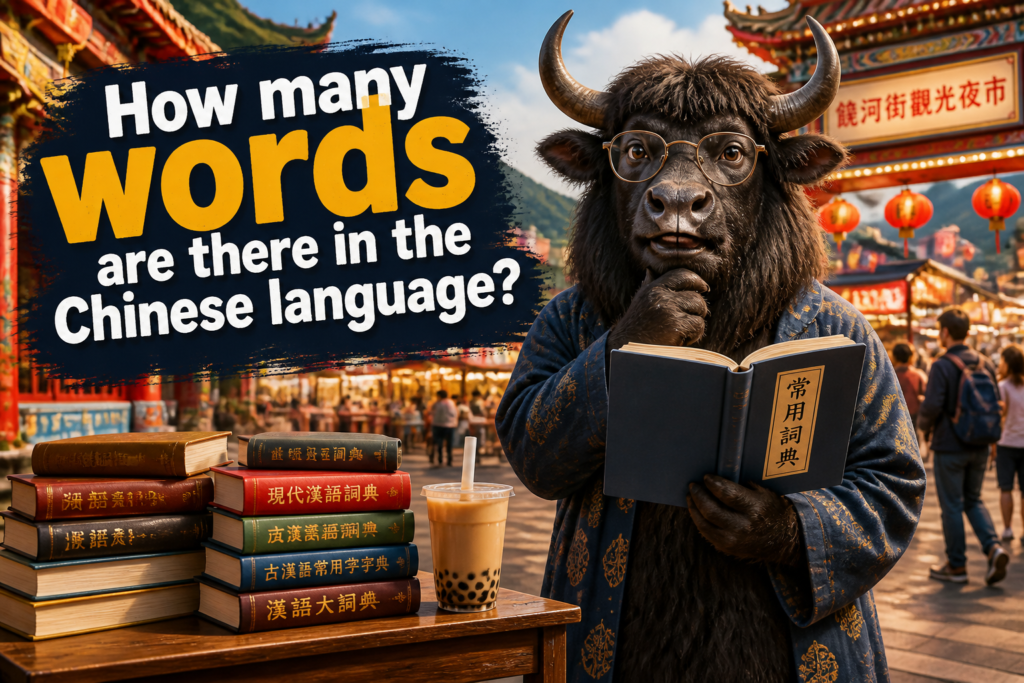
中文有多少字詞? Zhōngwén yǒu duōshǎo zìcí? That question sounds simple. It is not. Chinese is a bit like a giant night market: you can point at one stall, and suddenly there are fifty more things to try, compare, and argue about. Very polite chaos.
For the broader learning path, visit our parent guide.
The short answer is: there is no fixed number. Chinese has a huge number of words, and the total changes depending on what you count, which dictionary you trust, and whether you treat word-like expressions, idioms, names, or technical terms as “words.”
By the end of this article, you will understand why the answer is messy, how Chinese vocabulary is counted, and how to talk about “word count” in Chinese without accidentally sounding like a textbook that fell down the stairs.
First, What Does “Word” Mean In Chinese?
In English, a word is usually easy to spot because spaces help. In Chinese, things are less convenient. Written Chinese does not use spaces between most words, so the idea of a “word” depends on how speakers group characters into meaning units.
That means one character can be a word, two characters can be a word, and sometimes a longer phrase acts like a fixed word too. The language is not being difficult on purpose. It just enjoys making learners earn their tea.
| Traditional Chinese | Pinyin | English Meaning | Example (ZH) | Example (Pinyin) | Translation (EN) |
|---|---|---|---|---|---|
| 字 | zì | character; written unit | 這個字很常見。 | Zhège zì hěn chángjiàn. | This character is very common. |
| 詞 | cí | word; term | 我在學一個新詞。 | Wǒ zài xué yí ge xīn cí. | I am learning a new word. |
| 語詞 | yǔcí | vocabulary item; lexical item | 這個語詞很實用。 | Zhège yǔcí hěn shíyòng. | This vocabulary item is very useful. |
| 詞彙 | cíhuì | vocabulary; lexicon | 他的詞彙很豐富。 | Tā de cíhuì hěn fēngfù. | His vocabulary is very rich. |
| 詞典 | cídiǎn | dictionary | 我查了詞典。 | Wǒ chá le cídiǎn. | I checked the dictionary. |
So, How Many Words Are There?
Answer: nobody can give one exact number that everyone agrees on.
If you count only common everyday words, the number is already very large. If you include technical terms, names, idioms, classical expressions, regional vocabulary, slang, and borrowed terms, the total becomes even larger. Big surprise: human language is messy.
For learners, the more useful question is not “How many words exist?” but “Which words do I need first?” That is where good study lists, placement tests, and vocabulary tests come in. For example, you can explore Traditional Chinese Placement Test TOCFL and Traditional Chinese Vocabulary Test to get a sense of what common words look like in real study levels.
中文詞彙不是一座小山,是一整片山脈。
Zhōngwén cíhuì bù shì yí zuò xiǎoshān, shì yì zhěng piàn shānmài.
Chinese vocabulary is not a small hill; it is a whole mountain range.
Useful Words For Talking About Vocabulary Size
If you want to discuss this topic in Chinese, these words are handy. Not glamorous, but useful. Like a good umbrella.
| Traditional Chinese | Pinyin | Meaning | Example (ZH) | Example (Pinyin) | Translation (EN) |
|---|---|---|---|---|---|
| 多少 | duōshǎo | how many; how much | 你知道有多少嗎? | Nǐ zhīdào yǒu duōshǎo ma? | Do you know how many there are? |
| 詞彙量 | cíhuì liàng | vocabulary size | 我的中文詞彙量還不大。 | Wǒ de Zhōngwén cíhuì liàng hái bù dà. | My Chinese vocabulary size is still not big. |
| 收錄 | shōulù | to include in a dictionary or database | 這個詞沒有被收錄。 | Zhège cí méiyǒu bèi shōulù. | This word was not included. |
| 常用 | chángyòng | commonly used | 這是很常用的說法。 | Zhè shì hěn chángyòng de shuōfǎ. | This is a very common expression. |
| 生字 | shēngzì | new character; unfamiliar word | 這篇文章有很多生字。 | Zhè piān wénzhāng yǒu hěn duō shēngzì. | This article has many unfamiliar words. |
| 詞典 | cídiǎn | dictionary | 我用詞典查意思。 | Wǒ yòng cídiǎn chá yìsi. | I use a dictionary to check meanings. |
| 語料庫 | yǔliàokù | corpus | 研究者常用語料庫分析語言。 | Yánjiū zhě cháng yòng yǔliàokù fēnxī yǔyán. | Researchers often use corpora to analyze language. |
| 總數 | zǒngshù | total number | 這個總數很難算。 | Zhège zǒngshù hěn nán suàn. | This total is hard to calculate. |
| 估計 | gūjì | estimate | 這只是大概估計。 | Zhè zhǐ shì dàgài gūjì. | This is only an estimate. |
| 範圍 | fànwéi | range; scope | 答案要看你的範圍怎麼定。 | Dá’àn yào kàn nǐ de fànwéi zěnme dìng. | The answer depends on how you define the scope. |
Why The Number Changes So Much
There are several reasons the count is slippery.
- Characters are not the same as words. One character may stand alone, or it may combine with others.
- Word boundaries are flexible. Some expressions feel like one word, even if they are several characters long.
- New words keep appearing. Technology, social media, pop culture, and daily life keep adding fresh vocabulary.
- Regional differences matter. Taiwan, Mainland China, Hong Kong, and other Chinese-speaking communities may prefer different words.
- Technical language expands quickly. Science, medicine, law, and business add huge numbers of specialized terms.
- Dictionaries do not all count the same way. One dictionary may include a phrase; another may not.
In other words, asking for one final number is a little like asking, “How many noodles are in Asia?” The answer exists in theory, but in practice, good luck.
Common Types Of Chinese “Words”
Chinese vocabulary is usually easier to understand when you break it into categories. Here are the main ones.
| Traditional Chinese | Pinyin | Meaning | Example (ZH) | Example (Pinyin) | Translation (EN) |
|---|---|---|---|---|---|
| 單字 | dānzì | single character; single-word item | 這個單字很簡單。 | Zhège dānzì hěn jiǎndān. | This single character is very simple. |
| 雙字詞 | shuāngzì cí | two-character word | 很多常見詞都是雙字詞。 | Hěn duō chángjiàn cí dōu shì shuāngzì cí. | Many common words are two-character words. |
| 成語 | chéngyǔ | idiom | 這個成語很有意思。 | Zhège chéngyǔ hěn yǒu yìsi. | This idiom is interesting. |
| 俗語 | súyǔ | common saying; proverb | 這句俗語很生活化。 | Zhè jù súyǔ hěn shēnghuóhuà. | This proverb is very down-to-earth. |
| 專有名詞 | zhuānyǒu míngcí | proper noun; technical term | 這是醫學專有名詞。 | Zhè shì yīxué zhuānyǒu míngcí. | This is a medical term. |
| 外來語 | wàiláiyǔ | borrowed word | 很多現代詞是外來語。 | Hěn duō xiàndài cí shì wàiláiyǔ. | Many modern words are borrowed words. |
Taiwan Usage Notes
In Taiwan, people often say 詞彙 (cíhuì) for “vocabulary,” and in education you may also hear 語詞 (yǔcí) in school materials. In everyday conversation, people more often talk about 單字 (dānzì) for “word” or “vocabulary item” when learning English or Chinese.
Also, Taiwan uses 繁體中文 (fántǐ Zhōngwén, Traditional Chinese). If you are studying written Chinese, this matters because counting “words” in Traditional Chinese often happens in the same general way as elsewhere, but the forms of characters and many word choices are different. For a broader country and language overview, see Traditional Chinese speaking countries.
If you want to check official language and dictionary resources, a reliable boring source is the Taiwan Ministry of Education Dictionary. Boring, yes. Useful, absolutely.
Real-Life Examples Of How “Many Words” Can Mean Different Things
| Situation | What People Usually Mean | Example | Why It Matters |
|---|---|---|---|
| General conversation | common vocabulary | 我還有很多詞不會。 | They mean everyday words they have not learned yet. |
| Language test prep | test-level vocabulary | TOCFL 要準備哪些字詞? | Only the tested words matter for the exam. |
| Dictionary research | dictionary entries | 這本詞典收了多少詞? | Dictionary “word count” depends on the compiler. |
| Academic research | corpus-based vocabulary | 研究者分析語料庫中的高頻詞。 | Frequency and real usage matter more than raw totals. |
| Casual learner talk | useful study vocabulary | 先學最常用的兩千個詞。 | Practical learning starts with frequency, not infinity. |
The Number Learners Actually Care About
Most learners do not need the total number of Chinese words. They need a working range: enough to read signs, order food, chat a little, and survive a form that asks for three kinds of personal information you did not expect.
A rough learning approach is:
- First 500–1000 words: survival basics, daily life, greetings, food, transport
- Next 1000–2000 words: simple conversations, reading, routine topics
- Beyond that: more nuanced expression, news, work, study, and social life
This is why many learners focus on common phrases first. If you need a starting point, try Essential Traditional Chinese Phrases and then build from there. “What is the exact total?” is a fun pub quiz question. “Can I order a drink without panic?” is more useful.
Word Count Vs Character Count
English speakers often mix up 字 (zì, character) and 詞 (cí, word). That confusion is normal, but it causes problems.
| Traditional Chinese | Pinyin | Meaning | Example (ZH) | Example (Pinyin) | Translation (EN) |
|---|---|---|---|---|---|
| 漢字 | Hànzì | Chinese character | 我在學漢字。 | Wǒ zài xué Hànzì. | I am learning Chinese characters. |
| 一個字 | yí ge zì | one character | 這是一個字。 | Zhè shì yí ge zì. | This is one character. |
| 一個詞 | yí ge cí | one word | 這是一個詞。 | Zhè shì yí ge cí. | This is one word. |
| 兩個字的詞 | liǎng ge zì de cí | a two-character word | 很多中文詞是兩個字的詞。 | Hěn duō Zhōngwén cí shì liǎng ge zì de cí. | Many Chinese words are two-character words. |
Notice the tone-change pattern in 一個 (yí ge)? In everyday speech, 一 changes tone in some situations, so 一個 is pronounced yí ge, not yī ge. Tiny detail, large payoff.
How To Ask About Word Count In Chinese
If you want to ask this kind of question naturally, here are a few useful patterns.
| Pattern | Meaning | Example (ZH) | Pinyin | English |
|---|---|---|---|---|
| 有多少……? | How many … are there? | 中文有多少詞? | Zhōngwén yǒu duōshǎo cí? | How many Chinese words are there? |
| ……的詞彙量有多大? | How large is the vocabulary size of …? | 你的中文詞彙量有多大? | Nǐ de Zhōngwén cíhuì liàng yǒu duō dà? | How big is your Chinese vocabulary? |
| ……算不算一個詞? | Does … count as one word? | 這個算不算一個詞? | Zhège suàn bù suàn yí ge cí? | Does this count as one word? |
| ……怎麼說? | How do you say …? | 這個中文怎麼說? | Zhège Zhōngwén zěnme shuō? | How do you say this in Chinese? |
Practice: Make The Sentences Your Own
Try swapping the bold parts. This is the language-learning version of lifting small weights before pretending to deadlift a refrigerator.
- 中文有多少詞? → 日文有多少詞? Rìwén yǒu duōshǎo cí?
- 我的中文詞彙量還不大。 → 我的英文詞彙量還不大。 Wǒ de Yīngwén cíhuì liàng hái bù dà.
- 這是一個常用詞。 → 這是一個很實用的詞。 Zhè shì yí ge hěn shíyòng de cí.
- 這個詞沒有被收錄。 → 這個詞已經被收錄了。 Zhège cí yǐjīng bèi shōulù le.
Now try answering in Chinese:
- What is your vocabulary size?
- Do you know how many common words there are in beginner Chinese?
- Does this expression count as one word?
Possible answer starter:
我覺得很難說有固定數字。
Wǒ juéde hěn nán shuō yǒu gùdìng shùzì.
I think it is hard to say there is a fixed number.
Common Mistakes Learners Make
| Common Mistake | Better Way | Why |
|---|---|---|
| Thinking one Chinese character = one word | Remember that a word can be one, two, or more characters | Chinese word boundaries do not match English neatly |
| Asking for one exact vocabulary number | Ask about a dictionary, level list, or common words instead | The number depends on what is being counted |
| Ignoring Taiwan vocabulary differences | Check Taiwan usage when you study Traditional Chinese | Some words differ in choice or style |
| Studying random rare words first | Learn high-frequency words first | Common words give faster real-world results |
| Using “字” and “詞” as if they mean the same thing in every context | Use 字 for characters and 詞 for words when needed | This avoids confusion in explanation |
Quick Reference Summary
- There is no single exact number.
- Chinese words are counted differently depending on the source.
- Characters are not the same as words.
- Two-character words are very common.
- Vocabulary size matters more than a magic total.
- For learners, frequency is your friend.
- Taiwan Mandarin often uses 詞彙 and 語詞 in educational contexts.
If you want to keep building your everyday Chinese, the next smart step is to practice common greetings and survival phrases, then move into more useful study lists. If you are just starting, How Are You In Traditional Chinese is a friendly place to begin. No drama, no dictionary wrestling match required.
Yak Takeaway: Chinese does not have one neat little word count. It has a living vocabulary that keeps growing, shifting, and refusing to sit still. So instead of chasing one perfect number, focus on the words that actually help you speak, read, and understand real life. That is the only count that really matters.