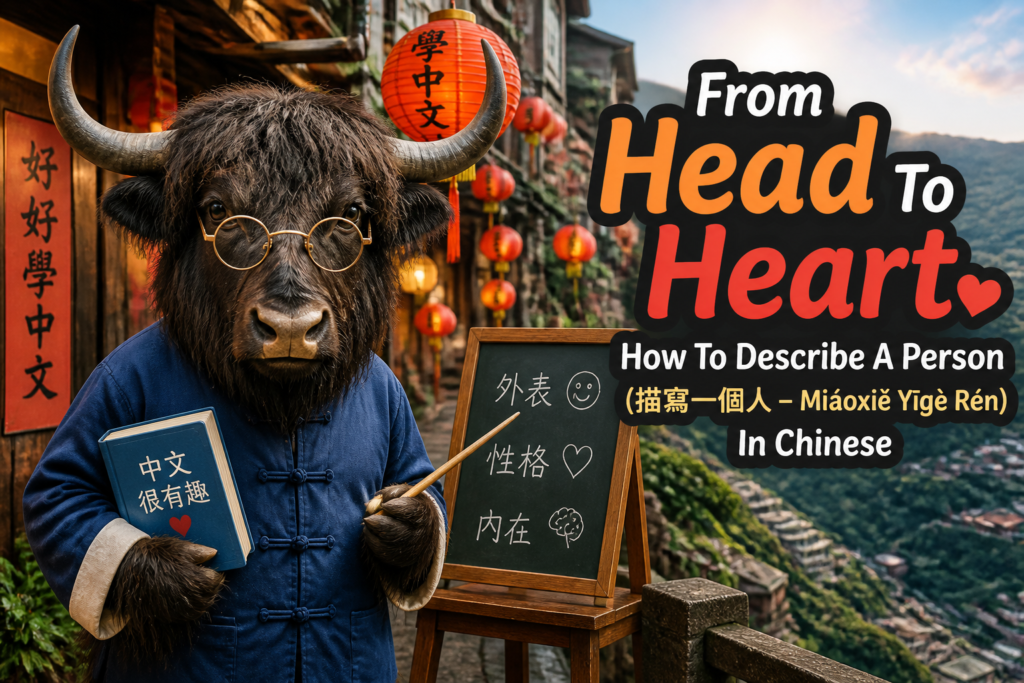
描寫一個人 (miáoxiě yí gè rén) means “to describe a person.” In Chinese, people usually start with the most visible things first: height, face, hair, age, and then move into personality. Very practical. Very efficient. A little bit like ordering a meal before you get too emotionally attached to the menu.
By the end of this guide, you’ll be able to describe someone’s appearance and personality in natural Traditional Chinese, with clear pinyin and real example sentences. You’ll also pick up common Taiwan-style wording, because language learning is easier when the examples sound like real life instead of a textbook wearing a fake moustache.
If you want more basic conversation practice first, these lessons can help: introduce yourself in Traditional Chinese, basic questions in Traditional Chinese, and where are you from in Traditional Chinese.
Quick Core Idea
When you describe a person in Mandarin, you often use this order:
- 外表 (wàibiǎo) — appearance
- 個性 (gèxìng) — personality
- 感覺 (gǎnjué) — impression or vibe
- 關係 (guānxì) — relationship, if relevant
That is not a strict rule, but it is a very common and natural way to speak. Start with what people can see, then talk about what they are like. Humans, apparently, still enjoy judging the outside before they understand the inside.
Useful Words For Appearance
| Traditional Chinese | Pinyin | Meaning | Example (ZH) | Example (Pinyin) | Translation (EN) |
|---|---|---|---|---|---|
| 高 | gāo | tall | 他很高。 | Tā hěn gāo. | He is tall. |
| 矮 | ǎi | short | 我朋友比較矮。 | Wǒ péngyǒu bǐjiào ǎi. | My friend is shorter. |
| 胖 | pàng | fat, chubby | 那隻貓有點胖。 | Nà zhī māo yǒudiǎn pàng. | That cat is a little chubby. |
| 瘦 | shòu | thin | 她看起來很瘦。 | Tā kàn qǐlái hěn shòu. | She looks thin. |
| 帥 | shuài | handsome | 這個男生很帥。 | Zhège nánshēng hěn shuài. | This guy is handsome. |
| 漂亮 | piàoliang | beautiful, pretty | 她很漂亮。 | Tā hěn piàoliang. | She is beautiful. |
| 年輕 | niánqīng | young | 她看起來很年輕。 | Tā kàn qǐlái hěn niánqīng. | She looks young. |
| 老 | lǎo | old | 他已經不老了。 | Tā yǐjīng bù lǎo le. | He is not old anymore. |
| 可愛 | kě’ài | cute | 那個小孩很可愛。 | Nàgè xiǎohái hěn kě’ài. | That child is very cute. |
| 好看 | hǎokàn | good-looking, nice to look at | 這件外套很好看。 | Zhè jiàn wàitào hěn hǎokàn. | This coat looks nice. |
小提醒 (xiǎo tíxǐng): 漂亮 (piàoliang) is often used for women or things, while 帥 (shuài) is commonly used for men. 好看 (hǎokàn) is more general and safer when you do not want to sound too specific. Very handy. Very polite. Very less awkward.
Useful Words For Face And Body
| Traditional Chinese | Pinyin | Meaning | Example (ZH) | Example (Pinyin) | Translation (EN) |
|---|---|---|---|---|---|
| 頭髮 | tóufǎ | hair | 她的頭髮很長。 | Tā de tóufǎ hěn cháng. | Her hair is long. |
| 長 | cháng | long | 他留長頭髮。 | Tā liú cháng tóufǎ. | He wears long hair. |
| 短 | duǎn | short | 我想剪短頭髮。 | Wǒ xiǎng jiǎn duǎn tóufǎ. | I want to cut my hair short. |
| 臉 | liǎn | face | 他的臉很圓。 | Tā de liǎn hěn yuán. | His face is round. |
| 眼睛 | yǎnjīng | eyes | 她的眼睛很大。 | Tā de yǎnjīng hěn dà. | Her eyes are big. |
| 鼻子 | bízǐ | nose | 他的鼻子很高。 | Tā de bízi hěn gāo. | His nose is high/bridged. |
| 嘴巴 | zuǐba | mouth | 她的嘴巴很小。 | Tā de zuǐba hěn xiǎo. | Her mouth is small. |
| 皮膚 | pífū | skin | 他皮膚很白。 | Tā pífū hěn bái. | His skin is fair. |
| 身材 | shēncái | figure, build | 她的身材很好。 | Tā de shēncái hěn hǎo. | She has a nice figure. |
| 微笑 | wēixiào | smile | 他總是帶著微笑。 | Tā zǒngshì dàizhe wēixiào. | He always has a smile. |
In real conversation, Chinese speakers often use 看起來 (kàn qǐlái), meaning “looks” or “seems,” to soften a description.
Example: 她看起來很年輕。 (Tā kàn qǐlái hěn niánqīng.) — She looks young.
Useful Words For Personality
| Traditional Chinese | Pinyin | Meaning | Example (ZH) | Example (Pinyin) | Translation (EN) |
|---|---|---|---|---|---|
| 友善 | yǒushàn | friendly | 她對每個人都很友善。 | Tā duì měi gè rén dōu hěn yǒushàn. | She is friendly to everyone. |
| 開朗 | kāilǎng | cheerful, open | 他很開朗,大家都喜歡他。 | Tā hěn kāilǎng, dàjiā dōu xǐhuān tā. | He is cheerful, and everyone likes him. |
| 安靜 | ānjìng | quiet | 她個性很安靜。 | Tā gèxìng hěn ānjìng. | Her personality is quiet. |
| 活潑 | huópo | lively | 那個小朋友很活潑。 | Nàgè xiǎopéngyǒu hěn huópo. | That child is lively. |
| 聰明 | cōngmíng | smart | 他很聰明,學得很快。 | Tā hěn cōngmíng, xué de hěn kuài. | He is smart and learns fast. |
| 認真 | rènzhēn | serious, diligent | 她工作很認真。 | Tā gōngzuò hěn rènzhēn. | She works diligently. |
| 溫柔 | wēnróu | gentle | 他說話很溫柔。 | Tā shuōhuà hěn wēnróu. | He speaks gently. |
| 幽默 | yōumò | humorous | 他很幽默,常常講笑話。 | Tā hěn yōumò, chángcháng jiǎng xiàohuà. | He is funny and often tells jokes. |
| 善良 | shànliáng | kind | 她是一個善良的人。 | Tā shì yí gè shànliáng de rén. | She is a kind person. |
| 大方 | dàfāng | generous; confident, natural | 她很大方,不會緊張。 | Tā hěn dàfāng, bú huì jǐnzhāng. | She is confident and not nervous. |
大方 (dàfāng) is a little slippery. It can mean “generous,” but in daily speech it often also means someone is relaxed, confident, and not awkward. Context matters, because Mandarin enjoys tiny traps like that.
Common Sentence Patterns
| Pattern | Meaning | Example (ZH) | Pinyin | English |
|---|---|---|---|---|
| 他/她很+形容詞 | He/She is very… | 她很漂亮。 | Tā hěn piàoliang. | She is beautiful. |
| 他/她看起來很+形容詞 | He/She looks… | 他看起來很累。 | Tā kàn qǐlái hěn lèi. | He looks tired. |
| 他/她是一個+形容詞+的人 | He/She is a … person | 她是一個很認真的人。 | Tā shì yí gè hěn rènzhēn de rén. | She is a very serious/diligent person. |
| 他/她的+名詞+很+形容詞 | His/Her … is very… | 他的頭髮很短。 | Tā de tóufǎ hěn duǎn. | His hair is short. |
| 他/她比+人+還要+形容詞 | He/She is even more… than… | 她比我還要高。 | Tā bǐ wǒ hái yào gāo. | She is taller than me. |
One useful point: 很 (hěn) does not always mean “very” in the dramatic English sense. In Chinese, it often just links the subject to the adjective naturally. So 她很漂亮 can simply mean “She is pretty,” not necessarily “She is extremely pretty.” No need to imagine fireworks.
Real-Life Descriptions You Can Actually Use
| Traditional Chinese | Pinyin | Meaning | Example (ZH) | Example (Pinyin) | Translation (EN) |
|---|---|---|---|---|---|
| 他個子很高。 | Tā gèzi hěn gāo. | He is tall. | 他個子很高,打籃球很好。 | Tā gèzi hěn gāo, dǎ lánqiú hěn hǎo. | He is tall and plays basketball well. |
| 她留著長頭髮。 | Tā liúzhe cháng tóufǎ. | She has long hair. | 她留著長頭髮,看起來很溫柔。 | Tā liúzhe cháng tóufǎ, kàn qǐlái hěn wēnróu. | She has long hair and looks gentle. |
| 他戴眼鏡。 | Tā dài yǎnjìng. | He wears glasses. | 他戴眼鏡,講話很清楚。 | Tā dài yǎnjìng, jiǎnghuà hěn qīngchǔ. | He wears glasses and speaks clearly. |
| 她的笑容很甜。 | Tā de xiàoróng hěn tián. | Her smile is sweet. | 她的笑容很甜,大家都喜歡她。 | Tā de xiàoróng hěn tián, dàjiā dōu xǐhuān tā. | Her smile is sweet, and everyone likes her. |
| 他看起來很有精神。 | Tā kàn qǐlái hěn yǒu jīngshén. | He looks energetic. | 他今天看起來很有精神。 | Tā jīntiān kàn qǐlái hěn yǒu jīngshén. | He looks energetic today. |
| 她個性很外向。 | Tā gèxìng hěn wàixiàng. | She has an outgoing personality. | 她個性很外向,很會聊天。 | Tā gèxìng hěn wàixiàng, hěn huì liáotiān. | She is outgoing and very good at chatting. |
| 他很容易親近。 | Tā hěn róngyì qīnjìn. | He is easy to get close to. | 他很容易親近,第一次見面也不會緊張。 | Tā hěn róngyì qīnjìn, dì yī cì jiànmiàn yě bú huì jǐnzhāng. | He is easy to get close to, and you won’t feel nervous the first time you meet him. |
| 她很有自信。 | Tā hěn yǒu zìxìn. | She is confident. | 她在台上很有自信。 | Tā zài táishàng hěn yǒu zìxìn. | She is confident on stage. |
| 他看起來有點嚴肅。 | Tā kàn qǐlái yǒudiǎn yánsù. | He looks a little serious. | 他看起來有點嚴肅,其實很友善。 | Tā kàn qǐlái yǒudiǎn yánsù, qíshí hěn yǒushàn. | He looks a little serious, but he is actually very friendly. |
| 她很有氣質。 | Tā hěn yǒu qìzhí. | She has elegance. | 她很有氣質,說話也很溫柔。 | Tā hěn yǒu qìzhí, shuōhuà yě hěn wēnróu. | She is elegant and speaks gently. |
Personality Words In More Natural Chinese
When describing personality, Chinese speakers often combine a basic adjective with a little context. This makes the sentence feel more alive. Not everything has to sound like a dictionary entry wearing a tie.
- 他很安靜。 (Tā hěn ānjìng.) — He is quiet.
- 她不太外向。 (Tā bú tài wàixiàng.) — She is not very outgoing.
- 他很會照顧人。 (Tā hěn huì zhàogù rén.) — He takes good care of people.
- 她很會替別人著想。 (Tā hěn huì tì biérén zháoxiǎng.) — She is thoughtful.
- 他有點急性子。 (Tā yǒudiǎn jíxìngzi.) — He is a bit impatient.
- 她做事很仔細。 (Tā zuòshì hěn zǐxì.) — She is careful when doing things.
- 他說話很直接。 (Tā shuōhuà hěn zhíjiē.) — He speaks very directly.
- 她很愛笑。 (Tā hěn ài xiào.) — She loves to smile.
- 他很有耐心。 (Tā hěn yǒu nàixīn.) — He is patient.
- 她很有責任感。 (Tā hěn yǒu zérèngǎn.) — She is responsible.
Notice the little phrase 很會 (hěn huì). It often means someone is good at doing something in a practical, natural way. For example, 很會照顧人 means “good at taking care of people,” but it also feels warmer than a plain skill statement.
Useful Nuance: Positive, Neutral, And Careful Words
Some descriptions are friendly and safe. Others need a little caution. Chinese can sound blunt if you choose the wrong word for a person’s body, age, or personality. You do not want to accidentally sound like a rude auntie at a family dinner.
| Word | Use It For | Careful Note |
|---|---|---|
| 高 (gāo) | height | safe and common |
| 瘦 (shòu) | thin | can sound neutral or negative depending on context |
| 胖 (pàng) | fat, chubby | can sound rude for people; more acceptable for babies or pets |
| 可愛 (kě’ài) | cute | very safe for children, pets, sometimes adults in a sweet way |
| 有氣質 (yǒu qìzhí) | elegant, classy | often polite and flattering |
| 普通 (pǔtōng) | ordinary | can sound plain, not insulting, but not exciting either |
If you are not sure, use softer expressions like 看起來 (kàn qǐlái), 有點 (yǒudiǎn), or 比較 (bǐjiào). These help your sentence sound less sharp.
How To Describe Someone In A Natural Flow
Here is a simple pattern you can copy:
| Step | What To Say | Example |
|---|---|---|
| 1 | Start with general impression | 她看起來很親切。 |
| 2 | Add appearance details | 她留長頭髮,個子也很高。 |
| 3 | Add personality | 她很開朗,也很認真。 |
| 4 | End with a small judgment or feeling | 跟她聊天很舒服。 |
Full example:
她看起來很親切,留長頭髮,個子也很高。她很開朗,也很認真,跟她聊天很舒服。
Tā kàn qǐlái hěn qīnqiè, liú cháng tóufǎ, gèzi yě hěn gāo. Tā hěn kāilǎng, yě hěn rènzhēn, gēn tā liáotiān hěn shūfu.
English: She looks friendly, has long hair, and is quite tall. She is cheerful and serious, and talking with her feels comfortable.
Mini Comparison: English Thinking vs Chinese Thinking
| English Style | Chinese Style | Example |
|---|---|---|
| “She is a beautiful girl with long hair and a nice personality.” | 先外表,再個性 | 她很漂亮,留長頭髮,個性也很好。 |
| “He has a sharp jaw and deep eyes.” | More likely in detailed portrait or fiction | 他五官很立體,眼睛很有神。 |
| “She’s so nice to talk to.” | Often expressed with feeling words | 跟她聊天很輕鬆。 |
五官 (wǔguān) means the facial features: eyes, ears, nose, mouth, and eyebrows. If you want to describe someone in a more detailed or literary way, this is useful. It sounds more formal than just saying 臉 (liǎn), but not too fancy to be useless.
Common Mistakes And Fixes
- Mistake: Using 漂亮 for every person. Fix: Use 帥 for men, 漂亮 for women, and 好看 when you want a neutral option.
- Mistake: Translating “He is very tall” as 他是很高. Fix: Say 他很高.
- Mistake: Forgetting that 很 can be a natural linker, not just “very.” Fix: Do not overthink it. Mandarin already does enough of that for everyone.
- Mistake: Using 胖 for people without thinking. Fix: Be careful; it can sound rude. For a child or pet, it is much safer.
- Mistake: Saying personality words too directly without softeners. Fix: Add 看起來, 有點, or 比較 when needed.
- Mistake: Mixing up 安靜 and 內向. Fix: 安靜 = quiet; 內向 = introverted.
- Mistake: Forgetting measure words when talking about “a person.” Fix: Use 一個人 (yí gè rén) or 那個人 (nà gè rén).
Practice Time
Try changing the adjective or detail in each sentence. Small edits help the pattern stick. Annoyingly effective, like flashcards that actually work.
| Prompt | Your Turn | Example Answer |
|---|---|---|
| He is tall. | 他很___。 | 高 |
| She is friendly. | 她很___。 | 友善 |
| He has short hair. | 他留___頭髮。 | 短 |
| She looks young. | 她看起來很___。 | 年輕 |
| He is very patient. | 他很有___。 | 耐心 |
Answer Key:
- 他很高。
- 她很友善。
- 他留短頭髮。
- 她看起來很年輕。
- 他很有耐心。
Now do a quick transformation drill:
- 他很安靜。 → Make it “He is a quiet person.”
他是一個很安靜的人。
Tā shì yí gè hěn ānjìng de rén.
He is a very quiet person. - 她很漂亮。 → Add hair detail.
她很漂亮,留長頭髮。
Tā hěn piàoliang, liú cháng tóufǎ.
She is beautiful and has long hair. - 他很聰明。 → Add a reason.
他很聰明,學東西很快。
Tā hěn cōngmíng, xué dōngxi hěn kuài.
He is smart and learns quickly.
One Little Pronunciation And Usage Note
In spoken Mandarin, 個子 (gèzi) is often used to talk about someone’s height or build. For example, 他個子很高 sounds natural in Taiwan. It is a very everyday phrase, and it feels a bit more personal than simply saying 他很高.
Also, when you describe someone respectfully, it is usually better to focus on neutral or positive points first. In Taiwan, people often like warm, modest language. That means 親切 (qīnqiè), 有禮貌 (yǒu lǐmào), and 好相處 (hǎo xiāngchǔ) come in handy a lot.
Extra Helpful Phrase Bank
| Traditional Chinese | Pinyin | Meaning | Example (ZH) | Example (Pinyin) | Translation (EN) |
|---|---|---|---|---|---|
| 看起來很親切 | kàn qǐlái hěn qīnqiè | looks friendly | 她看起來很親切。 | Tā kàn qǐlái hěn qīnqiè. | She looks friendly. |
| 好相處 | hǎo xiāngchǔ | easy to get along with | 他很好相處。 | Tā hěn hǎo xiāngchǔ. | He is easy to get along with. |
| 有禮貌 | yǒu lǐmào | polite | 那個孩子很有禮貌。 | Nàgè háizi hěn yǒu lǐmào. | That child is polite. |
| 不愛說話 | bù ài shuōhuà | doesn’t like to talk much | 他不太愛說話。 | Tā bú tài ài shuōhuà. | He doesn’t like talking much. |
| 很會聊天 | hěn huì liáotiān | good at chatting | 她很會聊天。 | Tā hěn huì liáotiān. | She is good at chatting. |
| 有點害羞 | yǒudiǎn hàixiū | a little shy | 他有點害羞。 | Tā yǒudiǎn hàixiū. | He is a little shy. |
| 很有魅力 | hěn yǒu mèilì | very charming | 她很有魅力。 | Tā hěn yǒu mèilì. | She is very charming. |
| 看起來很累 | kàn qǐlái hěn lèi | looks tired | 你今天看起來很累。 | Nǐ jīntiān kàn qǐlái hěn lèi. | You look tired today. |
| 很有精神 | hěn yǒu jīngshén | energetic | 他早上總是很有精神。 | Tā zǎoshang zǒngshì hěn yǒu jīngshén. | He is always energetic in the morning. |
| 氣質很好 | qìzhí hěn hǎo | has a good elegant presence | 她氣質很好。 | Tā qìzhí hěn hǎo. | She has a very elegant presence. |
If you want a more official language level check, try the boring-but-useful Traditional Chinese placement test for TOCFL or the Traditional Chinese vocabulary test. The results may be less glamorous than a personality quiz, but they are much more useful.
For a reliable reference on word meaning and usage, a standard source like Wikipedia’s Mandarin Chinese overview can be a starting point, though a dictionary is even better when you need exact nuance. Yes, this is the unexciting part of learning. That is how you know it matters.
Quick Reference Summary
- Use 他/她很+形容詞 for simple descriptions.
- Use 看起來 to describe appearance or impression.
- Use 一個+形容詞+的人 for personality.
- Use 個子 for height/build in natural speech.
- Use 好看 when you want a safer, more general compliment.
- Be careful with 胖; it can sound rude for adults.
- Use softeners like 有點 and 比較 when you want to sound gentle.
Yak Takeaway: When you describe a person in Chinese, start with what people can see, then add personality, then finish with a feeling. Keep it simple, natural, and polite. If it sounds warm in English, it will usually sound better in Mandarin too. Funny how that works.