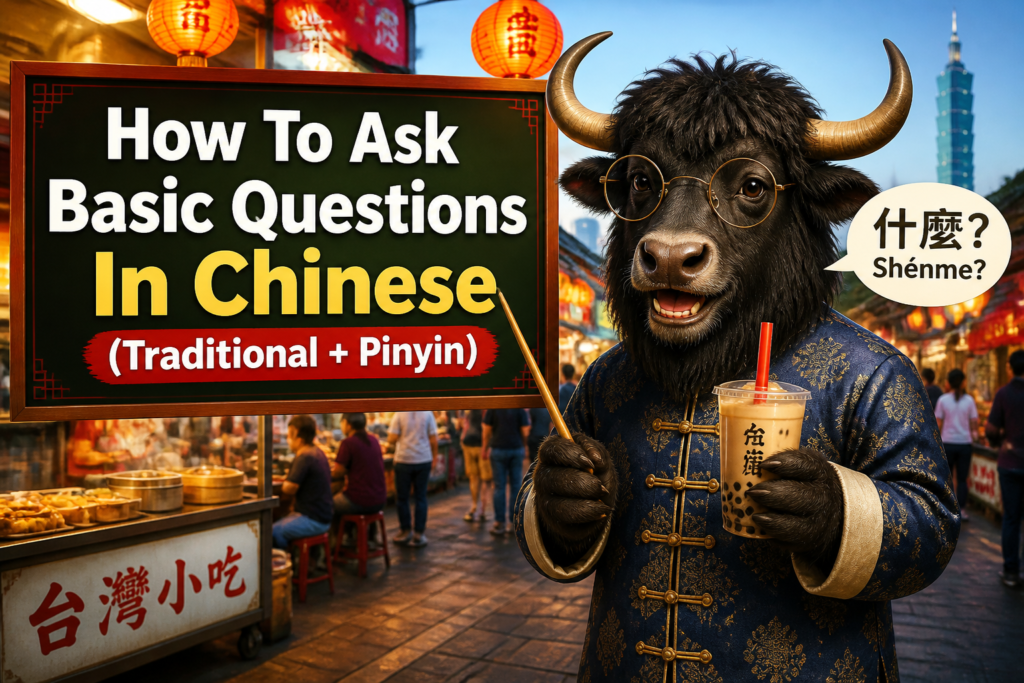
If you can ask a few basic questions in Chinese, life gets much easier very quickly. You can ask where something is, what something means, who someone is, and whether the drink you just ordered is actually hot or cold. Important stuff.
The good news: Chinese question words are pretty logical. The slightly annoying news: they show up in different places than English question words sometimes do. No drama, just a tiny grammar detour with a useful destination.
If you want a quick background on standard Chinese and its writing system, a boring-but-useful place to poke around is Wikipedia’s Standard Chinese page. For this article, though, we stay practical and focus on the questions you actually need in real life.
The Most Useful Basic Question Words
| Traditional Chinese | Pinyin | English Meaning | Example (ZH) | Example (Pinyin) | Translation (EN) |
|---|---|---|---|---|---|
| 什麼 | shén me | what | 這是什麼? | Zhè shì shén me? | What is this? |
| 誰 | shéi | who | 誰在門口? | Shéi zài mén kǒu? | Who is at the door? |
| 哪裡 | nǎ lǐ | where | 洗手間在哪裡? | Xǐ shǒu jiān zài nǎ lǐ? | Where is the bathroom? |
| 哪個 | nǎ ge | which one | 你要哪個? | Nǐ yào nǎ ge? | Which one do you want? |
| 怎麼 | zěn me | how | 這個要怎麼用? | Zhè ge yào zěn me yòng? | How do I use this? |
| 為什麼 | wèi shén me | why | 你為什麼這麼早來? | Nǐ wèi shén me zhè me zǎo lái? | Why did you come so early? |
| 幾 | jǐ | how many / how much for small numbers | 你幾點到? | Nǐ jǐ diǎn dào? | What time will you arrive? |
| 多少 | duō shǎo | how many / how much | 這個多少錢? | Zhè ge duō shǎo qián? | How much is this? |
| 是不是 | shì bú shì | is it / whether | 你是不是台灣人? | Nǐ shì bú shì Táiwān rén? | Are you Taiwanese? |
| 有沒有 | yǒu méi yǒu | have / whether there is | 你有沒有時間? | Nǐ yǒu méi yǒu shí jiān? | Do you have time? |
Quick note: 幾 jǐ is usually for smaller amounts, while 多少 duō shǎo is broader and often used for prices, quantities, and bigger numbers. Chinese loves choosing the “right-sized” question word. Very considerate, a little fussy.
The Easiest Question Pattern: Yes / No Questions
In Mandarin, one very common way to ask a yes/no question is to repeat the verb or use 是不是 shì bú shì or 有沒有 yǒu méi yǒu. This sounds natural in everyday conversation in Taiwan.
| Pattern | Meaning | Example (ZH) | Pinyin | English |
|---|---|---|---|---|
| 你是學生嗎? | Are you a student? | 你是學生嗎? | Nǐ shì xué shēng ma? | Are you a student? |
| 你是不是學生? | Are you a student? | 你是不是學生? | Nǐ shì bú shì xué shēng? | Are you a student? |
| 你有沒有空? | Do you have time? | 你有沒有空? | Nǐ yǒu méi yǒu kòng? | Do you have time? |
| 你喜不喜歡咖啡? | Do you like coffee? | 你喜不喜歡咖啡? | Nǐ xǐ bù xǐ huān kā fēi? | Do you like coffee? |
| 可以嗎? | Is it okay? / Can I? | 我現在可以進去嗎? | Wǒ xiàn zài kě yǐ jìn qù ma? | Can I go in now? |
The little particle 嗎 ma turns a statement into a direct question. Super common. Very handy. No fancy gymnastics required.
Useful Basic Questions You Will Actually Use
| Traditional Chinese | Pinyin | English Meaning | Example (ZH) | Example (Pinyin) | Translation (EN) |
|---|---|---|---|---|---|
| 這是什麼? | Zhè shì shén me? | What is this? | 這是什麼? | Zhè shì shén me? | What is this? |
| 你叫什麼名字? | Nǐ jiào shén me míng zì? | What is your name? | 你叫什麼名字? | Nǐ jiào shén me míng zì? | What is your name? |
| 你是哪裡人? | Nǐ shì nǎ lǐ rén? | Where are you from? | 你是哪裡人? | Nǐ shì nǎ lǐ rén? | Where are you from? |
| 你住在哪裡? | Nǐ zhù zài nǎ lǐ? | Where do you live? | 你住在哪裡? | Nǐ zhù zài nǎ lǐ? | Where do you live? |
| 洗手間在哪裡? | Xǐ shǒu jiān zài nǎ lǐ? | Where is the bathroom? | 洗手間在哪裡? | Xǐ shǒu jiān zài nǎ lǐ? | Where is the bathroom? |
| 這個多少錢? | Zhè ge duō shǎo qián? | How much is this? | 這個多少錢? | Zhè ge duō shǎo qián? | How much is this? |
| 現在幾點? | Xiàn zài jǐ diǎn? | What time is it? | 現在幾點? | Xiàn zài jǐ diǎn? | What time is it? |
| 你會說英文嗎? | Nǐ huì shuō Yīngwén ma? | Can you speak English? | 你會說英文嗎? | Nǐ huì shuō Yīngwén ma? | Can you speak English? |
| 可以再說一次嗎? | Kě yǐ zài shuō yí cì ma? | Can you say it again? | 可以再說一次嗎? | Kě yǐ zài shuō yí cì ma? | Can you say it again? |
| 可以慢一點嗎? | Kě yǐ màn yí diǎn ma? | Can you speak more slowly? | 可以慢一點嗎? | Kě yǐ màn yí diǎn ma? | Can you speak more slowly? |
| 你有沒有空? | Nǐ yǒu méi yǒu kòng? | Do you have time? | 你有沒有空? | Nǐ yǒu méi yǒu kòng? | Do you have time? |
| 你要不要一起去? | Nǐ yào bú yào yì qǐ qù? | Do you want to go together? | 你要不要一起去? | Nǐ yào bú yào yì qǐ qù? | Do you want to go together? |
Want a tiny survival shortcut? If you forget everything else, ……在哪裡? …… zài nǎ lǐ? will get you far. Location questions are the bread and butter of basic Mandarin.
How To Ask Questions With Chinese Word Order
Chinese question words usually stay in the same spot as the thing they replace. That sounds weird at first, but it is actually nice once it clicks.
| Pattern | Meaning | Example (ZH) | Pinyin | English |
|---|---|---|---|---|
| 這是 + 什麼 | What is this? | 這是什麼? | Zhè shì shén me? | What is this? |
| 你住在 + 哪裡 | Where do you live? | 你住在哪裡? | Nǐ zhù zài nǎ lǐ? | Where do you live? |
| 你要 + 哪個 | Which one do you want? | 你要哪個? | Nǐ yào nǎ ge? | Which one do you want? |
| 你今天 + 為什麼 + 來晚了? | Why were you late today? | 你今天為什麼來晚了? | Nǐ jīn tiān wèi shén me lái wǎn le? | Why were you late today? |
Notice that the question word is not thrown to the front like in English. Chinese often keeps it in the sentence slot where the answer belongs. Clean. Logical. Slightly smug.
Real-Life Mini Dialogues
| Traditional Chinese | Pinyin | English Translation |
|---|---|---|
| A:這是什麼? B:這是台灣茶。 | A: Zhè shì shén me? B: Zhè shì Táiwān chá. | A: What is this? B: This is Taiwanese tea. |
| A:洗手間在哪裡? B:在那邊。 | A: Xǐ shǒu jiān zài nǎ lǐ? B: Zài nà biān. | A: Where is the bathroom? B: Over there. |
| A:這個多少錢? B:三百塊。 | A: Zhè ge duō shǎo qián? B: Sān bǎi kuài. | A: How much is this? B: 300 dollars. |
| A:你會說英文嗎? B:會一點。 | A: Nǐ huì shuō Yīngwén ma? B: Huì yì diǎn. | A: Can you speak English? B: A little. |
| A:可以再說一次嗎? B:可以。 | A: Kě yǐ zài shuō yí cì ma? B: Kě yǐ. | A: Can you say it again? B: Sure. |
| A:你要不要一起去? B:好啊。 | A: Nǐ yào bú yào yì qǐ qù? B: Hǎo a. | A: Do you want to go together? B: Sure. |
Fun Taiwan note: In casual speech, people often answer very briefly. So if someone says 會一點 huì yì diǎn, it means “a little,” not “I am currently performing a grand act of language mastery.”
Important Particles: 嗎, 呢, 吧, 啊
| Particle | Pinyin | Meaning / Use | Example (ZH) | Pinyin | English |
|---|---|---|---|---|---|
| 嗎 | ma | turns a statement into a yes/no question | 你餓嗎? | Nǐ è ma? | Are you hungry? |
| 呢 | ne | asks “what about…?” or softens the question | 你呢? | Nǐ ne? | And you? |
| 吧 | ba | suggestion or soft guess | 我們走吧? | Wǒ men zǒu ba? | Shall we go? |
| 啊 | a | adds tone; can sound more friendly or surprised | 你在哪裡啊? | Nǐ zài nǎ lǐ a? | Where are you? |
These little particles matter more than English learners expect. Drop them wrong and you are not doomed, but the sentence may sound stiff, abrupt, or oddly intense. Mandarin can be polite without being dramatic. A miracle.
Common Mistakes And Fixes
| Mistake | Better Version | Why |
|---|---|---|
| 你是誰嗎? | 你是誰? | “誰” already makes it a question. You usually do not need 嗎 too. |
| 你會英文嗎? | 你會說英文嗎? | In Mandarin, 說英文 is more natural than just saying 會英文. |
| 哪裡你住? | 你住在哪裡? | Put the question word where the answer belongs. |
| 多少錢這個? | 這個多少錢? | Normal word order sounds much more natural. |
| 你有空嗎沒有? | 你有沒有空? | Use one clear question pattern, not a soup of them. |
| 幾多錢? | 多少錢? | “幾多” is not standard Mandarin. It is not the helper you want here. |
Another small trap: English often asks “Do you have?” but Chinese may prefer 有沒有 yǒu méi yǒu for a softer yes/no question, especially when you ask about time, space, or availability.
Practice: Change The Statement Into A Question
| Statement | Question Form | Pinyin | English |
|---|---|---|---|
| 你是老師。 | 你是老師嗎? | Nǐ shì lǎo shī ma? | Are you a teacher? |
| 你有時間。 | 你有沒有時間? | Nǐ yǒu méi yǒu shí jiān? | Do you have time? |
| 你要咖啡。 | 你要不要咖啡? | Nǐ yào bú yào kā fēi? | Do you want coffee? |
| 你住在台北。 | 你住在哪裡? | Nǐ zhù zài nǎ lǐ? | Where do you live? |
| 你知道答案。 | 你知道答案嗎? | Nǐ zhī dào dá àn ma? | Do you know the answer? |
Try this mentally: swap the part you want to ask about with a question word, then keep the rest of the sentence in place. That tiny habit saves a lot of “Why does this sound weird?” moments.
Spot The Difference
- 你叫什麼名字? Nǐ jiào shén me míng zì? = What is your name?
- 你叫名字什麼? Nǐ jiào míng zì shén me? = Not natural in Mandarin
- 這個多少錢? Zhè ge duō shǎo qián? = How much is this?
- 多少錢這個? Duō shǎo qián zhè ge? = Sounds awkward
- 你住在哪裡? Nǐ zhù zài nǎ lǐ? = Where do you live?
- 哪裡你住? Nǎ lǐ nǐ zhù? = Not the natural order
Quick Reference Summary
| Question Word | Pinyin | Use It For | Example |
|---|---|---|---|
| 什麼 | shén me | what | 這是什麼? |
| 誰 | shéi | who | 誰來了? |
| 哪裡 | nǎ lǐ | where | 你在哪裡? |
| 哪個 | nǎ ge | which one | 你要哪個? |
| 怎麼 | zěn me | how | 這個怎麼做? |
| 為什麼 | wèi shén me | why | 你為什麼笑? |
| 幾 | jǐ | how many / small numbers | 你幾歲? |
| 多少 | duō shǎo | how many / how much | 多少錢? |
| 嗎 | ma | yes/no question particle | 你累嗎? |
| 有沒有 | yǒu méi yǒu | yes/no about having something | 你有沒有空? |
If you want to check your overall level after practicing these questions, try the Traditional Chinese vocabulary test or the Traditional Chinese placement test (TOCFL). Slightly terrifying, but helpful. Educational fear is still educational.
Related Basics You Should Learn Next
Once you can ask questions, the next step is learning the words and phrases people use in replies. It also helps to practice self-introductions and everyday numbers, because questions about names, dates, and prices show up all the time in real life.
- Introduce Yourself In Traditional Chinese
- Write The Date In Traditional Chinese
- Traditional Chinese Basic Words And Phrases
Yak Takeaway: if you remember just a few patterns like 什麼 shén me, 在哪裡 zài nǎ lǐ, 嗎 ma, and 有沒有 yǒu méi yǒu, you can already ask a lot of useful questions. Not bad for a language that likes putting the question word where the answer should live.