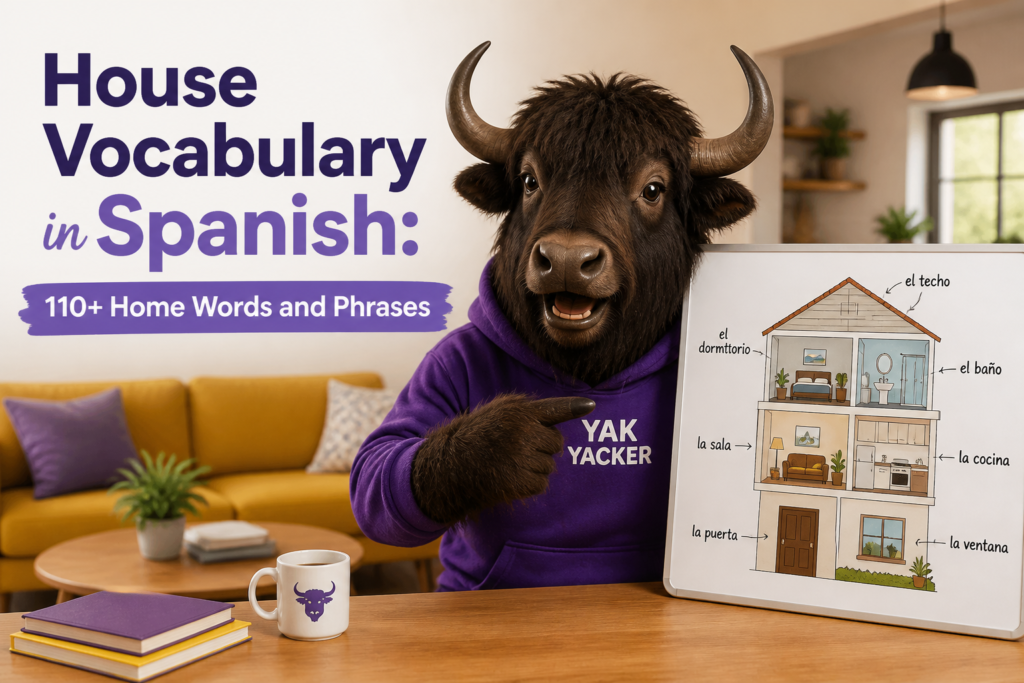
If you’ve ever wanted to stop doing the classic tourist mime—pointing at a chair like it owes you money—this guide is for you. House vocabulary in Spanish is one of those topics that pays off fast, because homes are full of useful words: rooms, furniture, appliances, cleaning items, and the little phrases people actually say every day.
Here you’ll learn practical, modern Spanish for talking about a house or apartment, whether you’re describing your place, asking for directions inside a home, or complaining that the water heater is acting up again. Because of course it is.
The examples use standard Latin American Spanish by default, with a few notes where Spain Spanish differs. For spelling and usage questions, the boring-but-useful Real Academia Española is there when you need it.
This guide also links to related lessons like Furniture Vocabulary in Spanish, Technology Devices in Spanish, Colors in Spanish, and Body Care & Hygiene in Spanish.
Quick Starter: The Most Common House Words
| Spanish | Pronunciation | Meaning | Example Sentence | Translation | Learner Note |
|---|---|---|---|---|---|
| la casa | KAH-sah | house; home | Mi casa es pequeña. | My house is small. | Casa means “house,” but people also use it for “home” in many contexts. |
| el apartamento | ah-pahr-tah-MEN-toh | apartment | Vivo en un apartamento nuevo. | I live in a new apartment. | In Latin America, apartamento and departamento are both common. |
| la habitación | ah-bee-tah-see-ON | room; bedroom | La habitación tiene una ventana grande. | The room has a big window. | In many places, cuarto is also very common for “room.” |
| la cocina | koh-SEE-nah | kitchen | La cocina está limpia. | The kitchen is clean. | Simple, useful, and extremely hard to avoid in real life. |
| el baño | BAH-nyoh | bathroom | ¿Dónde está el baño? | Where is the bathroom? | The ñ sound is like the “ny” in “canyon.” |
Small but important note: in Spanish, “house” words often use a definite article: la casa, la cocina, el baño. English often drops articles in lists, but Spanish likes to keep them around like a nosy neighbor.
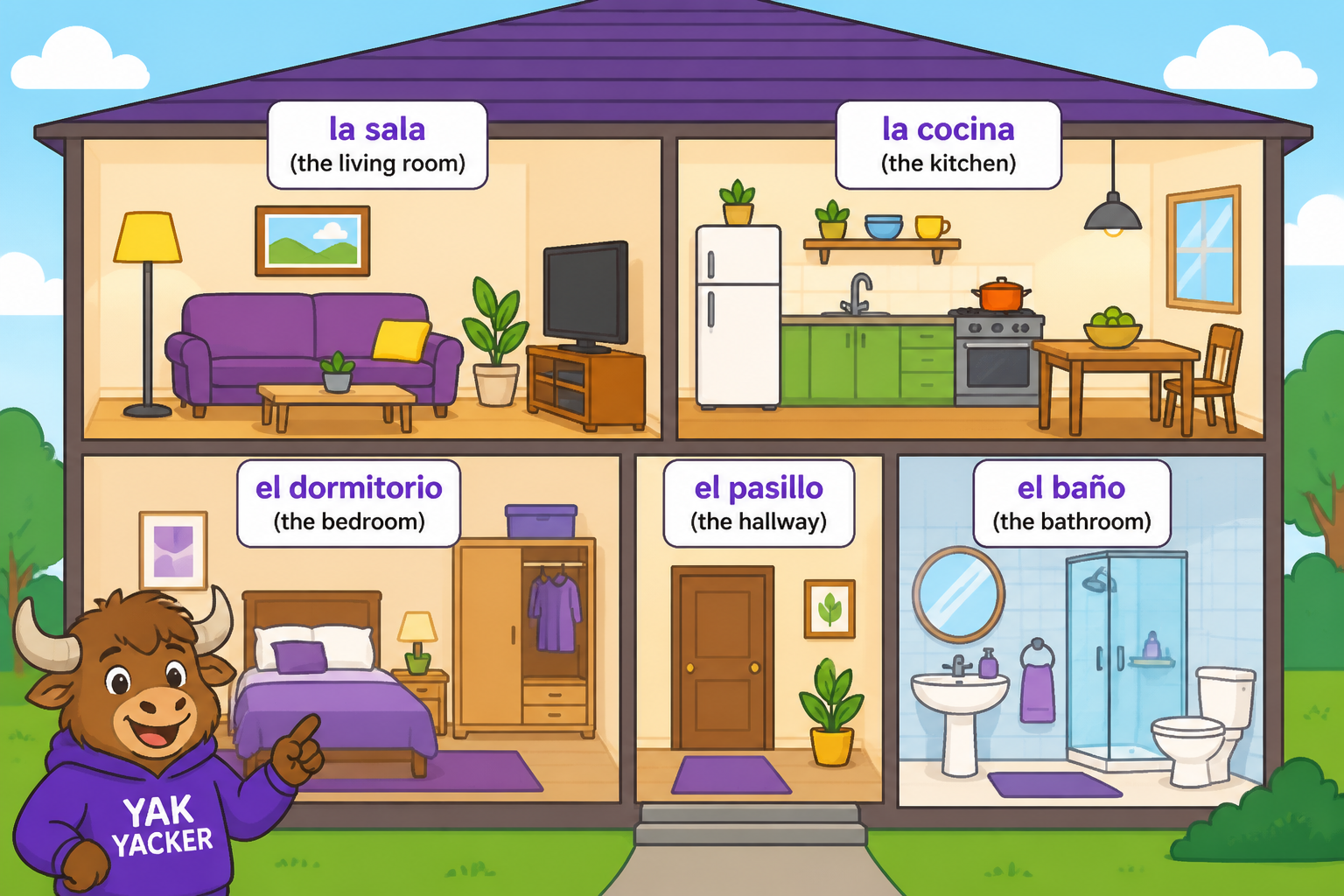
Rooms In The House
These are the rooms and spaces you’ll use most often when describing a home. If you can say these smoothly, you’re already way ahead of the “uhh… the thing next to the other thing” stage.
| Spanish | Pronunciation | Meaning | Example Sentence | Translation | Learner Note |
|---|---|---|---|---|---|
| la sala | SAH-lah | living room | La sala tiene un sofá grande. | The living room has a big sofa. | In many countries, sala is the most common word for living room. |
| la sala de estar | SAH-lah deh ehs-TAHR | living room / lounge | Nos sentamos en la sala de estar. | We sat in the living room. | More descriptive, a little more formal. |
| el comedor | koh-meh-DOHR | dining room | La familia come en el comedor. | The family eats in the dining room. | Can also mean the dining area in an apartment. |
| el dormitorio | dore-mee-TOH-ryoh | bedroom | Mi dormitorio está arriba. | My bedroom is upstairs. | Very common in Spain; understood widely in Latin America too. |
| el cuarto | KWAHR-toh | room; bedroom | El cuarto tiene dos camas. | The room has two beds. | Very common in Latin America. Can be more casual than dormitorio. |
| el pasillo | pah-SEE-yoh | hallway | El pasillo es largo. | The hallway is long. | The double l sounds like a soft “y” in many places. |
| la entrada | en-TRAH-dah | entrance; entryway | Deja tus zapatos en la entrada. | Leave your shoes at the entrance. | Useful for homes, buildings, and apartments. |
| el estudio | ehs-TOO-dyoh | study; home office | Trabajo en el estudio. | I work in the study. | Can also mean “study” as a room or work area. |
| la lavandería | lah lahn-vahn-DEH-ree-ah | laundry room | La lavandería está al fondo. | The laundry room is at the back. | Very practical in homes and apartments. |
| el patio | PAH-tyoh | yard; patio | Los niños juegan en el patio. | The children play in the yard. | Can be a backyard or an open patio area. |
| la terraza | teh-RAH-sah | terrace; patio; balcony area | Tomamos café en la terraza. | We drank coffee on the terrace. | Meaning varies by country, but it usually suggests an outdoor relaxation space. |
| el sótano | SOH-tah-noh | basement | Guardamos las cajas en el sótano. | We keep the boxes in the basement. | The accent mark matters: sotano is not correct. |
| el ático | AH-tee-koh | attic; loft | Hay polvo en el ático. | There is dust in the attic. | Common in houses; less common in many apartments. |
Yak note: If you hear cuarto, dormitorio, and habitación used for “room,” don’t panic. Spanish just likes having options. How rude of it.
Furniture And Large Home Items
Here are the big things you’re likely to point at first. For more furniture detail, check the related guide on Furniture Vocabulary in Spanish.
| Spanish | Pronunciation | Meaning | Example Sentence | Translation | Learner Note |
|---|---|---|---|---|---|
| el sofá | soh-FAH | sofa | Me siento en el sofá. | I sit on the sofa. | Accent mark changes stress. In some places, sofá is also spelled the same but pronounced naturally with stress on the last syllable. |
| el sillón | see-lyohn | armchair; recliner | Mi abuelo duerme en el sillón. | My grandfather sleeps in the armchair. | Can also be a comfy chair, sometimes like a recliner. |
| la mesa | MEH-sah | table | Pon los libros sobre la mesa. | Put the books on the table. | Very common and very useful. |
| la silla | SEE-yah | chair | Necesito otra silla. | I need another chair. | The double l sound is usually soft in Latin America. |
| la cama | KAH-mah | bed | La cama es cómoda. | The bed is comfortable. | Feminine noun: la cama. |
| el armario | ahr-MAH-ryoh | wardrobe; closet; cabinet | La ropa está en el armario. | The clothes are in the closet. | Can mean a wardrobe or cabinet depending on context. |
| el clóset | KLOH-set | closet | Mi clóset está ordenado. | My closet is organized. | Common in Latin America. In Spain, armario is more common. |
| la estantería | ehs-tahn-teh-REE-ah | shelf; bookcase; shelving unit | Los libros están en la estantería. | The books are on the shelf/bookcase. | Useful when you want something more specific than mueble. |
| la repisa | reh-PEE-sah | shelf; ledge | La planta está en la repisa. | The plant is on the shelf. | Often a smaller shelf or ledge. |
| la cómoda | KOH-moh-dah | dresser; chest of drawers | Mis camisetas están en la cómoda. | My T-shirts are in the dresser. | Don’t confuse it with cómoda as “comfortable” in feminine form. Context saves the day. |
| el escritorio | ehs-kree-TOH-ryoh | desk | Mi computadora está en el escritorio. | My computer is on the desk. | Very useful for school and work talk. |
| el escritorio plegable | ehs-kree-TOH-ryoh pleh-GAH-bleh | folding desk | Compré un escritorio plegable para el estudio. | I bought a folding desk for the study. | Good modern phrase for small apartments. |
| la alfombra | ahl-FOM-brah | rug; carpet | La alfombra es azul. | The rug is blue. | Some countries use tapete more often for rug. |
| la cortina | kohr-TEE-nah | curtain | Abre la cortina, por favor. | Open the curtain, please. | Plural las cortinas is very common. |
Kitchen Vocabulary You’ll Actually Use
The kitchen is where Spanish learners often need words fast, because food, dishes, and appliances come up constantly. Also, kitchens are where people seem to hide all the mysterious household items.
| Spanish | Pronunciation | Meaning | Example Sentence | Translation | Learner Note |
|---|---|---|---|---|---|
| la cocina | koh-SEE-nah | kitchen | La cocina huele bien. | The kitchen smells good. | The h is silent, so it sounds like “koh-SEE-nah.” |
| la estufa | ehs-TOO-fah | stove; cooker | La sopa está en la estufa. | The soup is on the stove. | In some places, this can refer to a stove or burner setup. |
| el horno | OHR-noh | oven | El pan está en el horno. | The bread is in the oven. | Easy word, very useful, no drama. |
| la nevera | neh-VEH-rah | fridge | Hay leche en la nevera. | There is milk in the fridge. | Very common in Latin America. In Spain, la nevera is also common, though frigorífico is heard too. |
| el refrigerador | reh-free-heh-rah-DOHR | refrigerator | El refrigerador está vacío. | The refrigerator is empty. | Longer, more formal or descriptive. |
| el microondas | MEE-kroh-OHN-dahs | microwave | Calienta la comida en el microondas. | Heat the food in the microwave. | Common in many countries. Also useful if you are impatient, which is fair. |
| el fregadero | freh-gah-DEH-roh | kitchen sink | Lavo los platos en el fregadero. | I wash the dishes in the sink. | Very common household word. |
| el lavaplatos | lah-vah-PLAH-tohs | dishwasher | Metí los vasos en el lavaplatos. | I put the glasses in the dishwasher. | Literally “dish-washer.” In some places, this can also mean a dish towel person in old usage, but appliance meaning is standard. |
| la licuadora | lee-kwah-DOH-rah | blender | La licuadora está rota. | The blender is broken. | Very common in Latin America. |
| la cafetera | kah-feh-TEH-rah | coffee maker | La cafetera está encendida. | The coffee maker is on. | Great word for coffee-loving households. |
| la olla | OY-yah | pot | La sopa está en la olla. | The soup is in the pot. | The double l is often pronounced like a soft “y” sound. |
| la sartén | sahr-TEN | frying pan | Fríe los huevos en la sartén. | Fry the eggs in the frying pan. | Accent mark changes stress; the ending sounds sharp. |
| el plato | PLAH-toh | plate | Deja el plato en la mesa. | Leave the plate on the table. | Also means “dish” as in a meal, depending on context. |
| el vaso | BAH-soh | glass; cup | Quiero un vaso de agua. | I want a glass of water. | The b/v sound is very similar in Spanish. |
| el tenedor | teh-neh-DOHR | fork | El tenedor está en la mesa. | The fork is on the table. | Easy, everyday word. |
| la cuchara | koo-CHAH-rah | spoon | Necesito una cuchara. | I need a spoon. | The ch sound is like “ch” in “chocolate.” |
| el cuchillo | koo-CHEE-yoh | knife | El cuchillo está afilado. | The knife is sharp. | Double l usually sounds like a soft “y” in Latin America. |
Bathroom And Cleaning Words
If you can talk about the bathroom and cleaning supplies, you can survive a lot of real-life situations. Not glamorous, but deeply useful. For hygiene-related words, you may also like Body Care & Hygiene in Spanish.
| Spanish | Pronunciation | Meaning | Example Sentence | Translation | Learner Note |
|---|---|---|---|---|---|
| el baño | BAH-nyoh | bathroom | Voy al baño. | I’m going to the bathroom. | Very common and polite enough for everyday use. |
| el inodoro | ee-noh-DOH-roh | toilet | El inodoro está limpio. | The toilet is clean. | More direct than just saying baño. |
| el lavamanos | lah-vah-MAH-nohs | sink; washbasin | El lavamanos está ocupado. | The sink is occupied. | Literally “hand-washer.” Useful in bathrooms. |
| la ducha | DOO-chah | shower | Me ducho por la mañana. | I shower in the morning. | Related verb: ducharse = to shower oneself. |
| la toalla | toh-AH-yah | towel | La toalla está seca. | The towel is dry. | The double l again sounds like a soft “y” sound. |
| el jabón | hah-BON | soap | ¿Dónde está el jabón? | Where is the soap? | Accent mark matters for stress. |
| el champú | shahm-POO | shampoo | Se me acabó el champú. | I ran out of shampoo. | In many places, shampoo is also used, but champú is standard Spanish. |
| la pasta de dientes | PAHS-tah deh DYEHN-tehs | toothpaste | <