


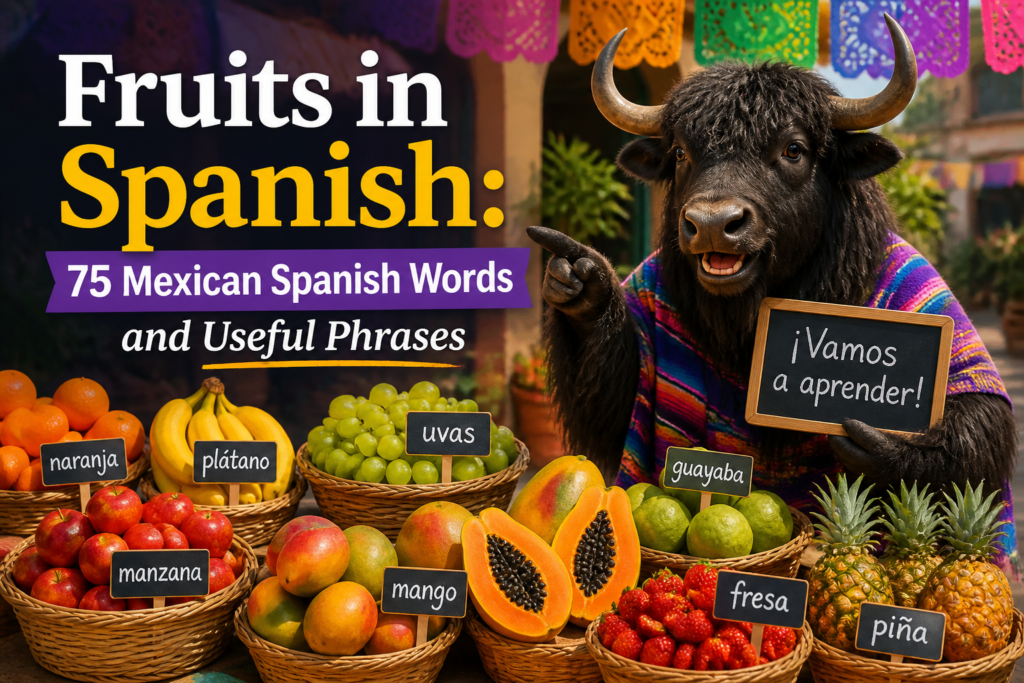
Learning fruit names in Spanish is one of those tiny wins that pays off fast. Suddenly you can order in a market, ask for a smoothie, or understand why someone keeps bragging about mango con chile like it’s a personality trait.
For the broader learning path, visit our parent guide.
In Mexico, fruit is everywhere: street stalls, lunchboxes, mercados, juice bars, and the occasional very serious fruit salad. The good news? Mexican Spanish is warm, natural, and practical. By the end of this guide, you’ll know 75 useful fruit words, plus the phrases you actually need in real life.
For a bigger word bank, you can also check 100 Essential Spanish Words and Phrases, and if you want to keep building your everyday vocabulary, the guides to vegetables in Spanish, colors in Spanish, and even weather in Spanish are handy companions.
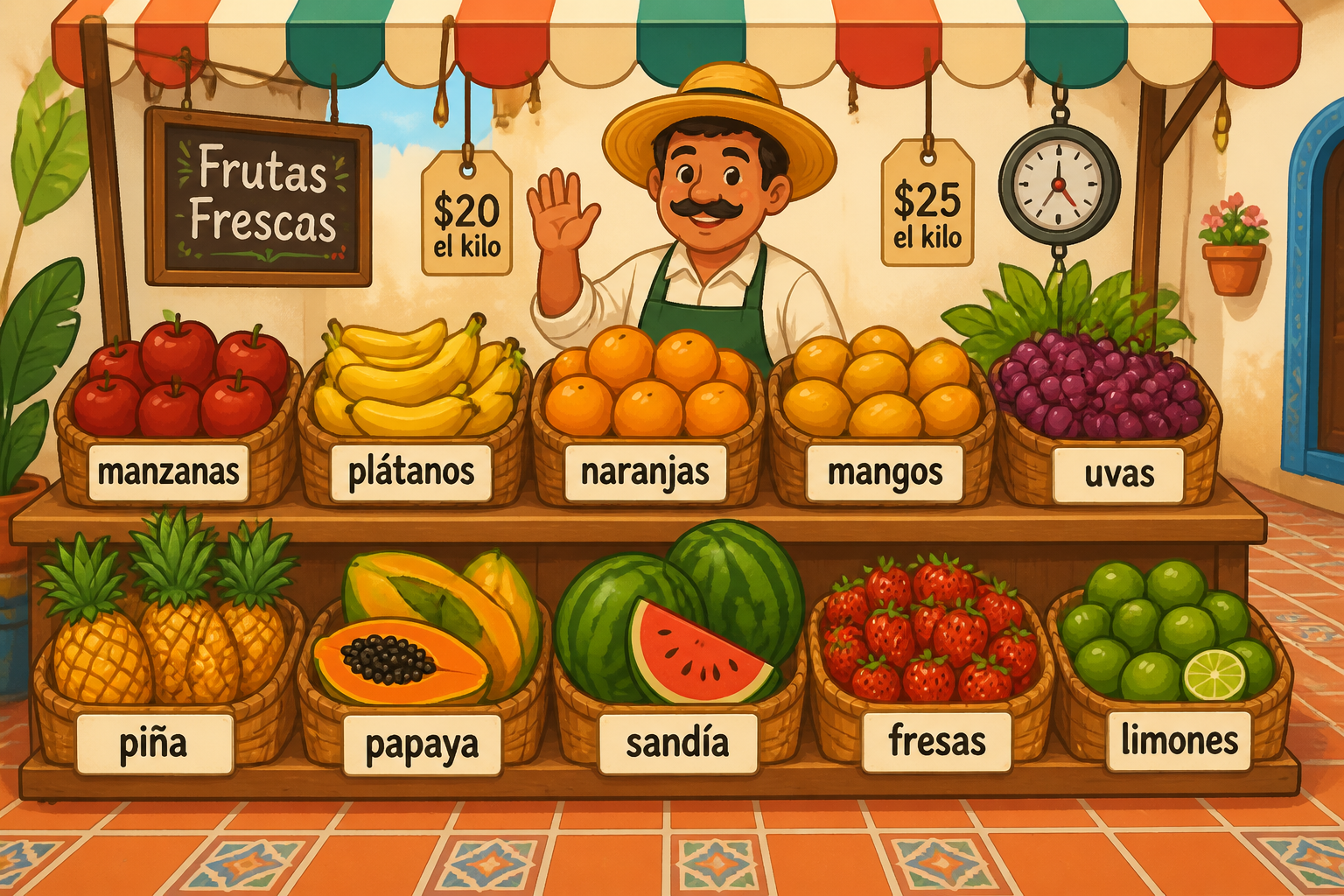
12 Useful Fruit Phrases In Mexican Spanish
These are the phrases you’ll actually hear in a market, café, or at a family meal. Mexican Spanish uses very natural, everyday wording here. Nothing fancy. Just useful.
| Spanish | Pronunciation | Meaning | Example Sentence | Translation | Learner Note |
|---|---|---|---|---|---|
| ¿Qué frutas tienen? | keh FROO-tahs TYE-nen | What fruits do you have? | ¿Qué frutas tienen hoy? | What fruits do you have today? | Useful in markets and fruit shops. |
| Quiero una fruta | KYEH-roh OO-nah FROO-tah | I want a fruit / some fruit | Quiero una fruta para el camino. | I want a fruit for the road. | Better in context: usually you’ll name the fruit. |
| Deme dos kilos de mango | DEH-meh dohs KEE-lohs deh MAN-goh | Give me two kilos of mango | Deme dos kilos de mango, por favor. | Give me two kilos of mango, please. | Very polite and common in Mexico. |
| Está maduro | es-TAH mah-DOO-roh | It’s ripe | Este plátano está maduro. | This banana is ripe. | Use this a lot when buying fruit. |
| Está verde | es-TAH BEHR-deh | It’s unripe / green | La papaya está verde todavía. | The papaya is still unripe. | Verde can mean green or unripe. |
| ¿Lo quiere con chile? | loh KYEH-reh kohn CHEE-leh | Do you want it with chili? | ¿Lo quiere con chile y limón? | Do you want it with chili and lime? | Very Mexican. Fruit + chili is a classic combo. |
| Sin azúcar, por favor | seen ah-SOO-kahr por fah-VOR | Without sugar, please | El jugo, sin azúcar, por favor. | The juice, without sugar, please. | Handy for smoothies and juices. |
| Me da alergia | meh dah ah-LEHR-hyah | It gives me an allergy / I’m allergic | Me da alergia el durazno. | Peaches give me an allergy. | Natural in conversation, though “soy alérgico/a” is also common. |
| ¿Cuánto cuesta? | KWAN-toh KWEHS-tah | How much does it cost? | ¿Cuánto cuesta la piña? | How much does the pineapple cost? | Essential market Spanish. No way around it. |
| Está muy dulce | es-TAH mooy DOOL-seh | It’s very sweet | Esta sandía está muy dulce. | This watermelon is very sweet. | Dulce is sweet in taste, not just “cute.” |
| ¿Me lo puede pelar? | meh loh PWEH-deh peh-LAHR | Can you peel it for me? | ¿Me lo puede pelar, por favor? | Can you peel it for me, please? | Very useful for mango, pineapple, and similar fruits. |
| Voy a hacer licuado | voy ah ah-SEHR lee-KWAH-doh | I’m going to make a smoothie | Voy a hacer licuado de fresa. | I’m going to make a strawberry smoothie. | Licuado is very common in Mexico; in some places people say batido. |
Small Mexican Spanish truth: fruit is not just fruit. It’s a snack, dessert, breakfast, and occasionally a whole personality.
75 Mexican Spanish Fruit Words
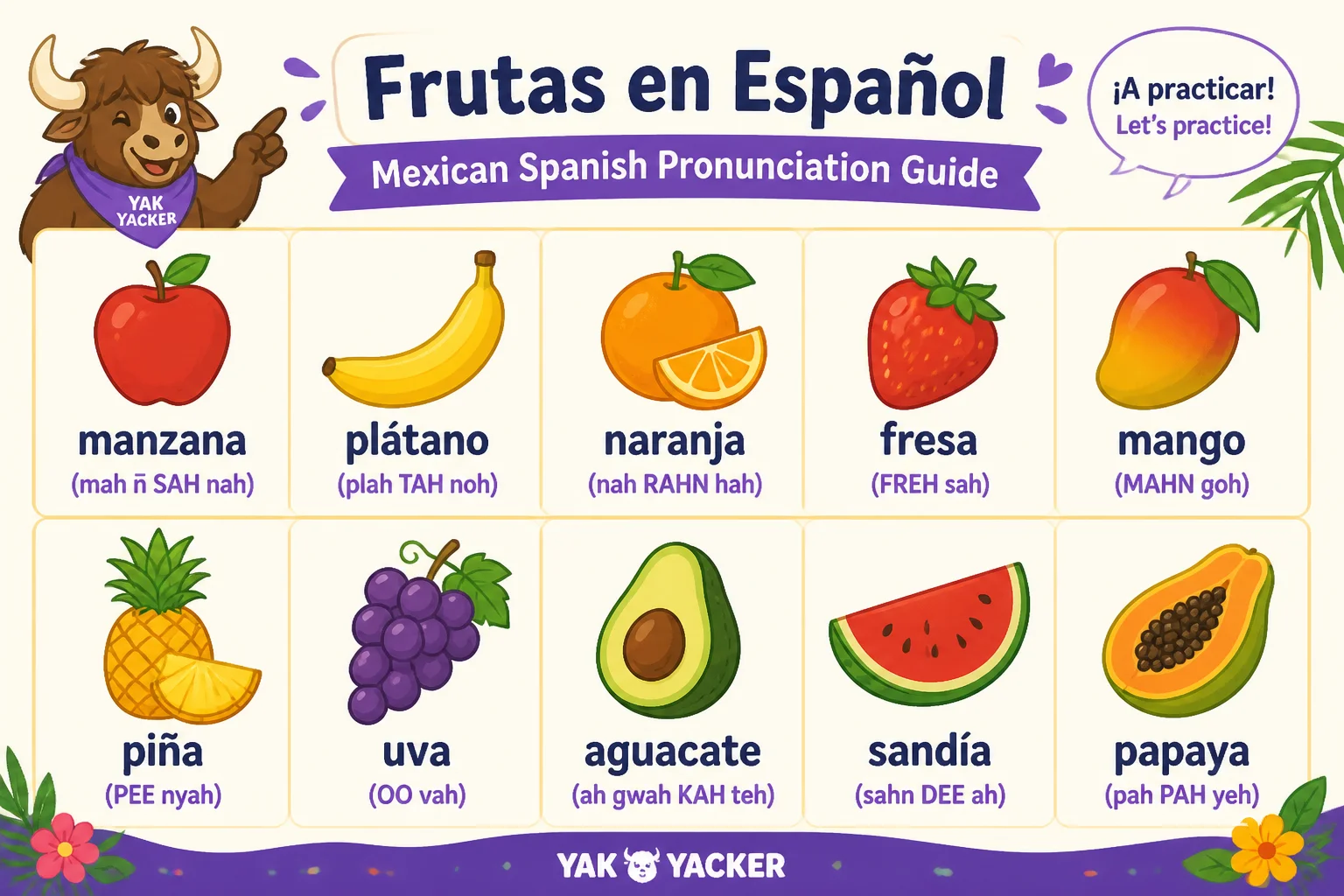
Below are 75 common fruit words used in Mexican Spanish. Most are standard across the Spanish-speaking world, but a few have regional naming differences. When there’s a common Mexican usage to know, it’s noted.
| Spanish | Pronunciation | Meaning | Example Sentence | Translation | Learner Note |
|---|---|---|---|---|---|
| la manzana | lah man-SAH-nah | apple | La manzana está crujiente. | The apple is crisp. | Feminine noun. |
| el plátano | el PLAH-tah-noh | banana / plantain | El plátano está maduro. | The banana is ripe. | In Mexico, plátano is usually banana. |
| el banano | el bah-NAH-noh | banana | El banano es dulce. | The banana is sweet. | Used in some Latin American countries; less common in Mexico. |
| la naranja | lah nah-RAHN-hah | orange | La naranja tiene mucho jugo. | The orange has a lot of juice. | Same word for the color and the fruit. |
| el limón | el lee-MOHN | lime | El limón va con casi todo. | Lime goes with almost everything. | In Mexico, limón usually means lime. |
| la lima | lah LEE-mah | lime | La lima es menos ácida. | The lime is less acidic. | Often used for the larger green citrus fruit in some places. |
| la fresa | lah FREH-sah | strawberry | La fresa está muy dulce. | The strawberry is very sweet. | Also common in drinks and desserts. |
| la uva | lah OO-bah | grape | Las uvas están frías. | The grapes are cold. | Plural uvas is very common. |
| el mango | el MAN-goh | mango | El mango está delicioso. | The mango is delicious. | Very common in Mexico. |
| la piña | lah PEE-nyah | pineapple | La piña está jugosa. | The pineapple is juicy. | Watch the ñ sound: “ny.” |
| la papaya | lah pah-PAH-yah | papaya | La papaya está madura. | The papaya is ripe. | Very common breakfast fruit. |
| la sandía | lah san-DEE-ah | watermelon | La sandía está fría. | The watermelon is cold. | Accent on -dí-. |
| el melón | el meh-LOHN | melon | El melón está dulce. | The melon is sweet. | Common in fruit salads and breakfasts. |
| la pera | lah PEH-rah | pear | La pera está suave. | The pear is soft. | Feminine noun. |
| el durazno | el doo-RAHS-noh | peach | El durazno está maduro. | The peach is ripe. | Very common in Mexico. |
| la ciruela | lah see-ROO-eh-lah | plum | La ciruela está jugosa. | The plum is juicy. | Nice, easy word to remember. |
| el albaricoque | el al-bah-ree-KOH-keh | apricot | El albaricoque es pequeño. | The apricot is small. | Less common in everyday Mexico than some other fruits. |
| la guayaba | lah gwah-YAH-bah | guava | La guayaba huele muy bien. | The guava smells very good. | Very common in juices and sweets. |
| el zapote | el sah-POH-teh | sapote | El zapote es muy dulce. | The sapote is very sweet. | Common in Mexico and Central America. |
| la tuna | lah TOO-nah | prickly pear fruit | La tuna tiene semillas. | The prickly pear fruit has seeds. | Do not confuse with the fish in English. Language loves chaos. |
| el higo | el EE-goh | fig | El higo es suave. | The fig is soft. | The h is silent. |
| el kiwi | el KEE-bee | kiwi | El kiwi está ácido. | The kiwi is tart. | Same word as English, just Spanish pronunciation. |
| el coco | el KOH-koh | coconut | El coco está frío. | The coconut is cold. | Also useful in drinks. |
| la cereza | lah seh-REH-sah | cherry | La cereza es pequeña. | The cherry is small. | Feminine noun. |
| el arándano | el ah-RAHN-dah-noh | blueberry / cranberry | El arándano se usa en jugos. | The blueberry is used in juices. | Meaning can vary by context and region. |
| la mora | lah MOH-rah | blackberry | La mora está dulce. | The blackberry is sweet. | Very common in Mexico. |
| la frambuesa | lah frahm-BWEH-sah | raspberry | La frambuesa cuesta más. | The raspberry costs more. | Longer word, but very useful. |
| la grosella | lah groh-SEH-yah | currant / gooseberry | La grosella es ácida. | The currant/gooseberry is sour. | Can vary by region. |
| la granada | lah gra-NAH-dah | pomegranate | La granada tiene muchas semillas. | The pomegranate has many seeds. | Not to be confused with the city name. |
| el tamarindo | el tah-mah-REEN-doh | tamarind | El tamarindo se usa en aguas frescas. | Tamarind is used in fresh drinks. | Very Mexican in candy and drinks. |
| la pitahaya | lah pee-tah-HYEH-ah | dragon fruit | La pitahaya es muy bonita. | The dragon fruit is very pretty. | Also called fruta del dragón. |
| la carambola | lah kah-rahm-BOH-lah | star fruit | La carambola tiene forma de estrella. | The star fruit has a star shape. | Easy visual memory trick. |
| el maracuyá | el mah-rah-koo-YAH | passion fruit | El maracuyá tiene aroma fuerte. | Passion fruit has a strong aroma. | Common in drinks and desserts. |
| la chabacana | lah chah-bah-KAH-nah | apricot | La chabacana está madura. | The apricot is ripe. | Used in Mexico; in some regions albaricoque is more common. |
| el níspero | el NEES-peh-roh | loquat | El níspero sabe dulce. | The loquat tastes sweet. | Not super common everywhere, but worth knowing. |
| la guanábana | lah gwah-NAH-bah-nah | soursop | La guanábana queda muy bien en licuado. | Soursop works really well in a smoothie. | Very common in Mexican drinks. |
| la chirimoya | lah chee-ree-MOY-ah | cherimoya | La chirimoya es cremosa. | The cherimoya is creamy. | Soft fruit with a rich texture. |
| el mamey | el mah-MEY | mamey sapote | El mamey es muy popular en licuados. | Mamey is very popular in smoothies. | Very Mexican and very worth knowing. |
| el chicozapote | el chee-koh-sah-POH-teh | sapodilla | El chicozapote es dulce. | The sapodilla is sweet. | Long word, but useful in Mexico. |
| la jícama | lah HEE-kah-mah | jicama | La jícama se come con limón. | Jicama is eaten with lime. | Not a fruit in the strict sense, but commonly grouped with fruit snacks in Mexico. |
| el membrillo | el mem-BREE-yoh | quince | El membrillo se usa en dulces. | Quince is used in sweets. | More common in food contexts than casual chat. |
| la toronja | lah toh-ROHN-hah | grapefruit | La toronja es un poco amarga. | The grapefruit is a little bitter. | Very common in Mexico. |
| la mandarina | lah man-dah-REE-nah | tangerine / mandarin | La mandarina es fácil de pelar. | The tangerine is easy to peel. | Great beginner fruit word. |
| el pomelo | el poh-MEH-loh | grapefruit | El pomelo es grande. | The grapefruit is big. | More common in Spain and some regions than in Mexico. |
| la lima dulce | lah LEE-mah DOOL-seh | sweet lime | La lima dulce es suave. | Sweet lime is mild. | Regionally specific. |
| el ciruelo | el see-ROO-eh-loh | plum tree / plum | El ciruelo da mucha fruta. | The plum tree gives a lot of fruit. | Good to recognize, even if you don’t use it often. |
| la maca | lah MAH-kah | maca fruit / maca | La maca se usa en bebidas saludables. | Maca is used in healthy drinks. | More of a specialty item. |
| la uvilla | lah oo-BEE-yah | cape gooseberry | La uvilla es pequeña y ácida. | The cape gooseberry is small and sour. | Regional word; useful in some markets. |
| el litchi | el LEE-chee | lychee | El litchi es jugoso. | The lychee is juicy. | Same fruit, Spanish pronunciation. |
| la mora azul | lah MOH-rah ah-SOOL | blueberry | La mora azul es buena para el desayuno. | BlueMore Spanish to explore Best graded readers for Spanish The Boy and the Sheep: A1 Beginner Spanish Story with Audio Martina the Little Cockroach: A1 Beginner Spanish Story with Audio Marianela: A B1 Intermediate Spanish Story with Audio |