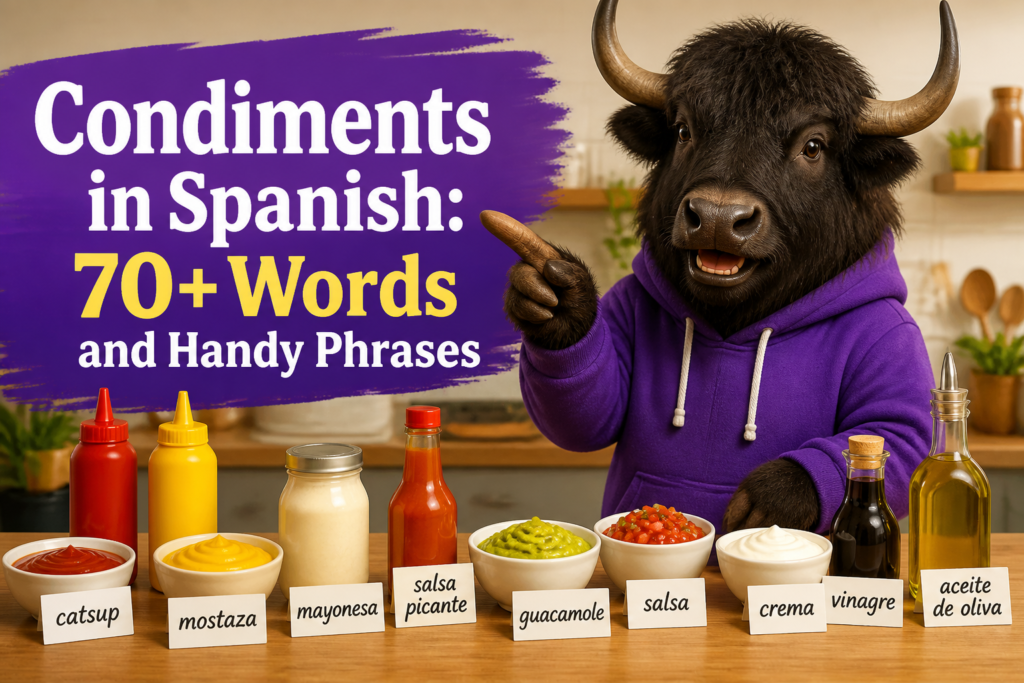
If you’ve ever stared at a restaurant menu and thought, “I know this dish… but what exactly is that sauce doing there?” then welcome. Condiments are tiny words with big flavor, and in Spanish they show up everywhere: at the table, in recipes, in grocery stores, and in the eternal question of whether you want picante or “not trying to ruin my day” spicy.
In this guide, you’ll learn practical Spanish words for condiments, sauces, and seasoning basics, plus real phrases you can actually use when ordering food, cooking, or shopping. By the end, you’ll know how to talk about salsa, vinagre, aceite, mayonesa, and a whole lineup of tasty troublemakers.
For the broader learning path, visit our parent guide.
Quick note: Spanish condiments can vary a little by country, but the everyday words below are broadly useful across Latin America and Spain.
Essential Condiment Words In Spanish
Here are the most useful condiment words first. These are the words you’ll actually meet in kitchens, supermarkets, and menus. Not the dusty vocabulary that only appears in a food museum.
| Spanish | Pronunciation | Meaning | Example Sentence | Translation | Learner Note |
|---|---|---|---|---|---|
| salsa | SAHL-sah | sauce | La salsa está muy rica. | The sauce is very tasty. | Very common. Can mean sauce in general. |
| aderezo | ah-deh-REH-so | dressing / seasoning / sauce | ¿Tienen aderezo para la ensalada? | Do you have dressing for the salad? | Often used for salad dressing. |
| condimento | kohn-dee-MEN-toh | seasoning / condiment | Este condimento le da más sabor a la sopa. | This seasoning gives the soup more flavor. | Broader word for seasoning or condiment. |
| aceite | ah-SEH-ee-teh | oil | Pásame el aceite, por favor. | Pass me the oil, please. | Usually olive oil in many cooking contexts. |
| vinagre | bee-NAH-greh | vinegar | Le puse un poco de vinagre a la ensalada. | I put a little vinegar on the salad. | The h is not there; pronounce the g softly like in “go.” |
| sal | sahl | salt | Necesito más sal. | I need more salt. | One of the simplest and most useful words in the kitchen. |
| pimienta | pee-MYEN-tah | pepper | ¿Quiere pimienta encima? | Do you want pepper on top? | Can refer to black pepper or pepper seasoning. |
| mostaza | mohs-TAH-sah | mustard | Me gusta la mostaza con las papas. | I like mustard with fries. | Common in restaurants and sandwiches. |
| mayonesa | mah-yoh-NEH-sah | mayonnaise | ¿Me das mayonesa, por favor? | Can you give me mayonnaise, please? | Often shortened to mayo in casual speech. |
| kétchup | KEH-chup | ketchup | El niño quiere kétchup con las papas. | The child wants ketchup with the fries. | Also spelled catsup in some places, but kétchup is common. |
| picante | pee-KAHN-teh | spicy / hot sauce style | Esta salsa está muy picante. | This sauce is very spicy. | Can describe the flavor or a spicy condiment. |
| ají | ah-HEE | chili pepper / hot sauce / chili paste | En Perú, el ají es parte de muchas comidas. | In Peru, ají is part of many dishes. | Meaning varies by country; very useful in Latin America. |
| salsa picante | SAHL-sah pee-KAHN-teh | hot sauce | Quiero salsa picante con los tacos. | I want hot sauce with the tacos. | Literal and easy to understand everywhere. |
| chimichurri | chee-mee-CHOOR-ree | chimichurri sauce | La carne va muy bien con chimichurri. | Meat goes very well with chimichurri. | Especially associated with Argentina and Uruguay. |
| guacamole | gwah-kah-MOH-leh | guacamole | Pidieron guacamole extra. | They asked for extra guacamole. | Borrowed from Nahuatl; common in many countries. |
| soya | SOH-yah | soy sauce | ¿Tienes salsa de soya? | Do you have soy sauce? | Also salsa de soja in Spain. |
| soja | SOH-hah | soy / soy sauce (Spain) | La salsa de soja está en la mesa. | The soy sauce is on the table. | More common in Spain than in Latin America. |
| mantequilla | mahn-teh-KEE-yah | butter | Quiero mantequilla en el pan. | I want butter on the bread. | Not always a condiment, but often treated like one at the table. |
| mermelada | mehr-meh-LAH-dah | jam / marmalade | La mermelada de fresa está dulce. | The strawberry jam is sweet. | Common with breakfast foods. |
| miel | mee-EHL | honey | Pon un poco de miel en el té. | Put a little honey in the tea. | Simple, useful, and deliciously universal. |
| crema | KREH-mah | cream / sour cream / dressing cream | La crema va con los tacos. | The cream goes with the tacos. | Can mean different dairy products depending on country. |
| ajo | AH-ho | garlic | El ajo le da mucho sabor a la salsa. | Garlic gives the sauce a lot of flavor. | The j sounds like a strong airy h. |
| cebolla | seh-BOH-yah | onion | La salsa lleva cebolla. | The sauce includes onion. | Often part of condiments and salsas. |
| orégano | oh-REH-gah-no | oregano | Le pongo orégano a la pizza. | I put oregano on the pizza. | Common in pizzas, sauces, and grilled foods. |
Small pronunciation helper: Spanish vowels are clean and steady. So salsa is basically “SAHL-sah,” not “sawl-zuh,” and mayonesa is four neat chunks, not one dramatic English blob.
15 Handy Spanish Phrases For Condiments
These phrases are the real-life stuff: ordering, asking for extras, understanding menus, and avoiding the awkward “I definitely wanted sauce, but now I’m just smiling politely” situation.
| Spanish | Pronunciation | Meaning | Example Sentence | Translation | Learner Note |
|---|---|---|---|---|---|
| ¿Me puede dar…? | meh PWEH-deh dahr | Can you give me…? | ¿Me puede dar salsa, por favor? | Can you give me sauce, please? | Polite and useful in restaurants. |
| ¿Me das…? | meh dahs | Can you give me…? / Pass me…? | ¿Me das la mostaza? | Can you pass me the mustard? | Casual with friends or family. |
| ¿Tienen…? | tee-EH-nen | Do you have…? | ¿Tienen mayonesa sin huevo? | Do you have egg-free mayonnaise? | Useful in stores and restaurants. |
| Quisiera… | kee-see-EH-rah | I would like… | Quisiera salsa picante, por favor. | I would like hot sauce, please. | Polite and natural. Very handy. |
| ¿Le pongo…? | leh POHN-goh | Should I put … on it? | ¿Le pongo aderezo a la ensalada? | Should I put dressing on the salad? | Common server question. |
| Con salsa, por favor. | kohn SAHL-sah por fah-VOR | With sauce, please. | Quiero las papas con salsa, por favor. | I want the fries with sauce, please. | Short, natural, and restaurant-friendly. |
| Sin picante, por favor. | seen pee-KAHN-teh por fah-VOR | No spicy, please. | La sopa, sin picante, por favor. | The soup, not spicy, please. | Great if your taste buds are not in a dare-devil mood. |
| Más sal, por favor. | mahs sahl por fah-VOR | More salt, please. | ¿Me puede traer más sal? | Can you bring me more salt? | Use politely at the table. |
| Me gusta con… | meh GOO-stah kohn | I like it with… | Me gusta con mostaza. | I like it with mustard. | Simple way to state preference. |
| ¿Qué salsa lleva? | keh SAHL-sah YEH-vah | What sauce does it have? | ¿Qué salsa lleva el sándwich? | What sauce does the sandwich have? | Useful when reading menus. |
| ¿Está muy picante? | ehs-TAH mwee pee-KAHN-teh | Is it very spicy? | ¿Está muy picante la salsa? | Is the sauce very spicy? | Very practical question before committing. |
| Me encanta el ajo. | meh en-KAHN-tah ehl AH-ho | I love garlic. | Me encanta el ajo en la comida. | I love garlic in food. | Good for showing preference. |
| Le falta sabor. | leh FAHL-tah sah-BOR | It needs more flavor. | Esta sopa le falta sabor. | This soup needs more flavor. | Useful and a little bold. Use kindly. |
| ¿Lo quiere aparte? | loh KYEH-reh ah-PAHR-teh | Do you want it on the side? | ¿La mayonesa la quiere aparte? | Do you want the mayonnaise on the side? | Very common in service situations. |
| Todo junto, por favor. | TOH-doh HOON-toh por fah-VOR | Everything together, please. | La ensalada, todo junto, por favor. | The salad, everything together, please. | Useful when ordering dressing or toppings. |
Notice how many of these phrases are built with por favor. Spanish is very friendly about politeness. Tiny magic words go a long way. Shocking, really.
How To Talk About Condiments Naturally
Spanish often uses simple structures like llevar (to include), tener (to have), and poner (to put). These are very common around food.
| Pattern | Meaning | Spanish Example | English Translation | Learner Note |
|---|---|---|---|---|
| llevar + ingredient | to include / to contain | ¿Qué salsa lleva? | What sauce does it have? | Very natural on menus and in recipes. |
| tener + condiment | to have | ¿Tienen ketchup? | Do you have ketchup? | Simple and direct. |
| poner + noun | to put / add | Ponga un poco de sal. | Add a little salt. | Often used as a command in cooking. |
| ir con + condiment | to go well with | La carne va con chimichurri. | The meat goes with chimichurri. | Great for describing food pairings. |
| gustar + con | to like with | Me gusta con mostaza. | I like it with mustard. | Remember the indirect object pronoun: me gusta, not “yo gusto.” |
If you want a broader food vocabulary base, it helps to connect this topic with vegetables in Spanish and 100 essential Spanish words and phrases. Food words like these tend to travel in packs.
Regional Differences Worth Knowing
Spanish food vocabulary is mostly shared, but a few words shift by region. The big one here is soya versus soja: in much of Latin America, salsa de soya is common, while in Spain you’ll often hear salsa de soja.
ají is another word with regional flavor. In some places it means a chili pepper, in others a spicy sauce, and in others a paste or condiment made from chili. Context does the heavy lifting, as usual. Language loves a little chaos.
For a boring-but-solid reference on word usage and standard meanings, you can check the Diccionario de la lengua española from the Real Academia Española. Not glamorous, but reliable. Like a good spoon.
Common Mistakes And Easy Fixes
Let’s save you from the classic condiment traps. They are small words, but small words love causing drama.
| Common Mistake | Better Version | Why |
|---|---|---|
| ¿Tienes una mayonesa? | ¿Tienes mayonesa? | Mayonesa is usually uncountable in this context. You normally just ask for the substance, not “a mayonnaise.” |
| La salsa está muy picante caliente. | La salsa está muy picante. | Picante already means spicy/hot. Adding caliente is usually redundant unless you mean temperature. |
| ¿Me puedes dar ketchup? | ¿Me puede dar ketchup? | Use usted for politeness in restaurants unless the setting is very casual. |
| La comida lleva de salsa. | La comida lleva salsa. | Usually no de is needed here. |
| Yo gusto la mostaza. | Me gusta la mostaza. | Gustar works differently in Spanish. It’s more like “it pleases me.” |