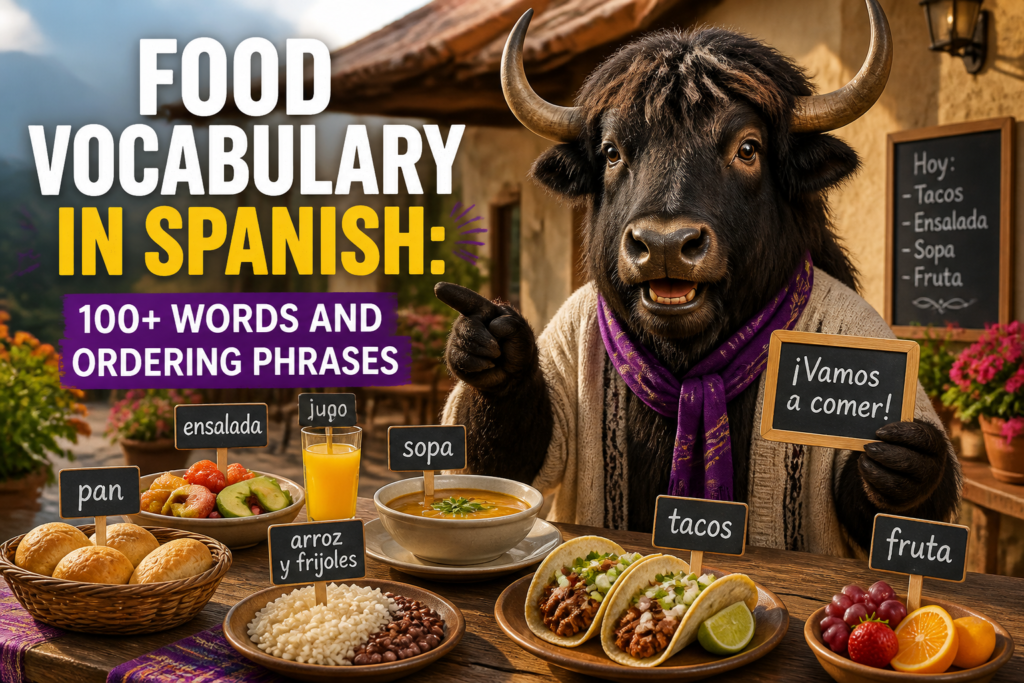
Ordering food in Spanish should feel like a normal human activity, not an interpretive dance with a menu. The good news: once you know a few key nouns, verbs, and polite phrases, you can ask for food, understand the basics of a menu, and survive the “¿Para tomar?” moment without blinking like a confused tomato.
For the broader learning path, visit our parent guide.
This guide gives you practical food vocabulary in Spanish: common foods, drinks, restaurant phrases, and the tiny grammar bits that make your Spanish sound less like a dictionary and more like an actual person. If you want to build a stronger base first, you can also review 100 Essential Spanish Words and Phrases.
By the end, you should be able to read simple menus, ask for what you want, and handle food conversations without summoning panic from the depths of your soul.
Useful Food Words In Spanish
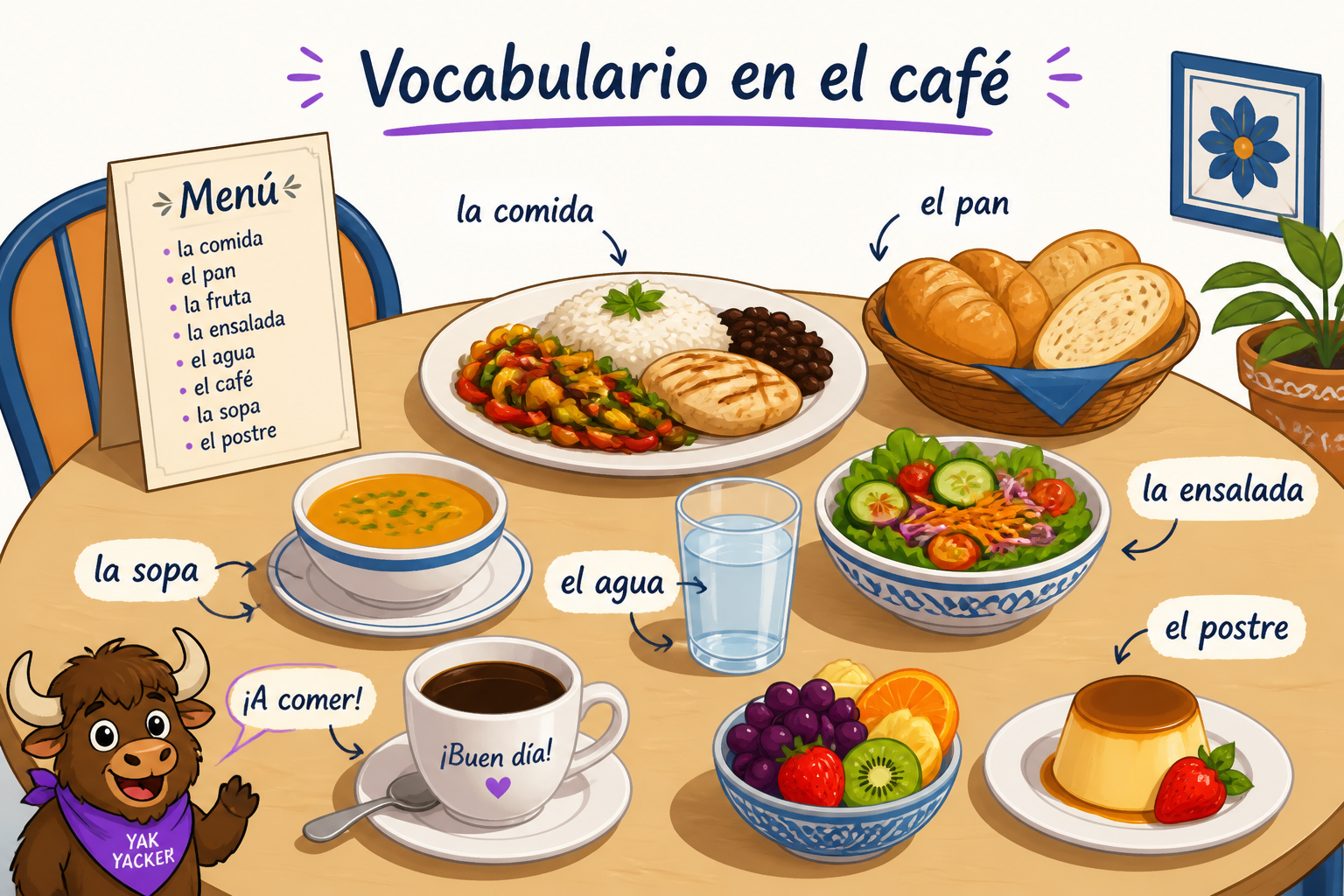
Here are the basics first. These are the words you’ll see constantly in cafes, restaurants, grocery stores, and conversations about lunch, dinner, and snacks that mysteriously disappear before you “save some for later.”
| Spanish | Pronunciation | Meaning | Example Sentence | Translation | Learner Note |
|---|---|---|---|---|---|
| la comida | koh-MEE-dah | food; meal | La comida está lista. | The food is ready. | Very common. Comida can mean food in general or a meal. |
| el desayuno | deh-sah-YOO-noh | breakfast | Desayuno a las ocho. | I eat breakfast at eight. | Notice the stress on yu. |
| el almuerzo | ahl-mwehr-soh | lunch | Voy a comer el almuerzo con mi familia. | I’m going to eat lunch with my family. | Common in Latin America. In Spain, comida often means lunch. |
| la cena | SEH-nah | dinner | La cena está a las ocho. | Dinner is at eight. | Simple and useful. No drama. |
| el desayuno | deh-sah-YOO-noh | breakfast | Tomamos el desayuno temprano. | We have breakfast early. | Often used with tomar or desayunar. |
| la merienda | meh-ree-EN-dah | afternoon snack | Después de la escuela, tomo la merienda. | After school, I have a snack. | Very common in Spain and some Latin American countries. |
| el snack / el bocadillo | es-NACK / boh-kah-DEE-yoh | snack; sandwich | Quiero un bocadillo de queso. | I want a cheese sandwich. | Bocadillo often means sandwich in Spain; in Latin America, meanings vary. |
| la sopa | SOH-pah | soup | La sopa está caliente. | The soup is hot. | Watch gender: la sopa. |
| la ensalada | en-sah-LAH-dah | salad | Quiero una ensalada pequeña. | I want a small salad. | Feminine noun, so use una. |
| el arroz | ah-ROHS | rice | El arroz está muy bueno. | The rice is very good. | R is rolled lightly; rr is stronger when doubled. |
| la pasta | PAHS-tah | pasta | Me gusta la pasta con salsa. | I like pasta with sauce. | Same spelling as in English, but Spanish pronunciation is different. |
| el pan | pahn | bread | ¿Tiene pan fresco? | Do you have fresh bread? | Very common in bakeries and restaurants. |
| el queso | KEH-soh | cheese | Me encanta el queso. | I love cheese. | One of life’s great truths. |
| el huevo | WEH-boh | egg | Quiero un huevo revuelto. | I want a scrambled egg. | Spelled with h, but the h is silent. |
| la carne | KAR-neh | meat | No como carne. | I don’t eat meat. | Can also mean meat as a category in a menu. |
| el pollo | POH-yoh | chicken | Prefiero el pollo asado. | I prefer roasted chicken. | The ll sounds like “y” in most Latin American accents. |
| el pescado | pes-KAH-doh | fish | El pescado está fresco. | The fish is fresh. | Useful in menus and markets. |
| la fruta | FROO-tah | fruit | La fruta está madura. | The fruit is ripe. | Remember the feminine article. |
| la verdura | behr-DOO-rah | vegetable; greens | Comemos más verdura ahora. | We eat more vegetables now. | Often used in plural too: verduras. |
| el postre | POHS-treh | dessert | ¿Qué postre recomienda? | What dessert do you recommend? | A very useful restaurant word. |
| la bebida | beh-BEE-dah | drink; beverage | ¿Qué bebida quiere? | What drink do you want? | Common on menus and in ordering. |
| el agua | AH-gwah | water | Necesito agua, por favor. | I need water, please. | Use el in the singular: el agua, because of the stress pattern. |
| el café | kah-FEH | coffee | Tomo café todas las mañanas. | I drink coffee every morning. | Accent mark matters. Without it, pronunciation can shift. |
| el té | teh | tea | Prefiero té con limón. | I prefer tea with lemon. | Short and easy, which is nice for once. |
| el jugo | HOO-goh | juice | Quiero jugo de naranja. | I want orange juice. | Latin America usually says jugo; Spain often says zumo. |
| la leche | LEH-cheh | milk | ¿Tiene leche sin lactosa? | Do you have lactose-free milk? | Helpful for cafés and breakfast spots. |
| el azúcar | ah-SOO-kar | sugar | No le pongas azúcar al café. | Don’t put sugar in the coffee. | Starts with a, but it’s feminine: el azúcar. |
| la sal | sahl | salt | ¿Me pasa la sal? | Can you pass me the salt? | Very common at the table. |
| la pimienta | pee-MYEN-tah | pepper | Quiero más pimienta. | I want more pepper. | Useful for seasoning requests. |
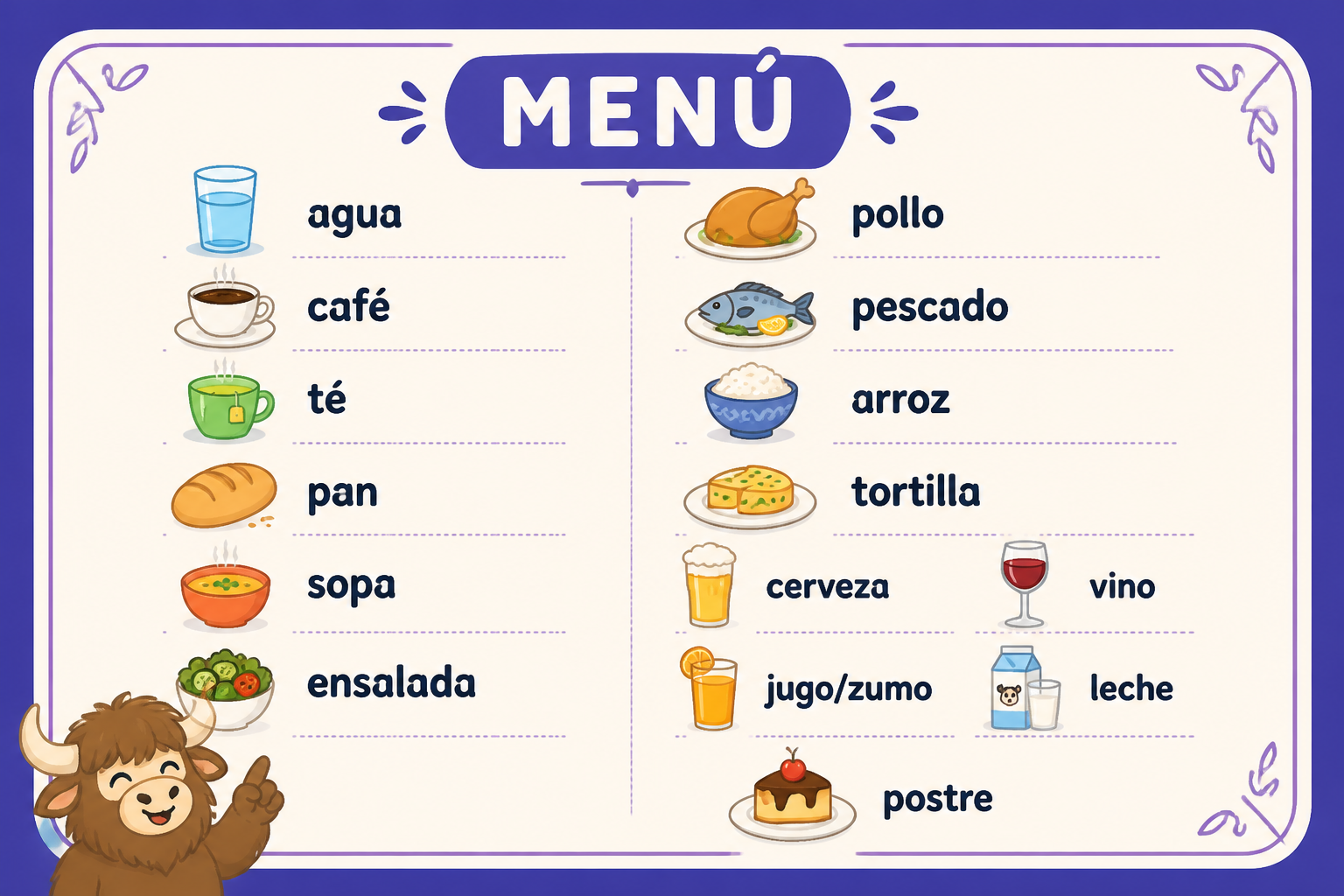
Ordering Food In Spanish
These are the phrases that help you order like a grown-up instead of pointing at the menu and hoping the universe is in a generous mood.
| Spanish | Pronunciation | Meaning | Example Sentence | Translation | Learner Note |
|---|---|---|---|---|---|
| Quisiera… | kee-syeh-RAH | I would like… | Quisiera una sopa, por favor. | I would like a soup, please. | Very polite and common in restaurants. |
| Quiero… | kee-EH-roh | I want… | Quiero una mesa para dos. | I want a table for two. | Grammatically fine, but sounds more direct than quisiera. |
| Me gustaría… | meh goos-TAH-ree-ah | I would like… | Me gustaría ver el menú, por favor. | I would like to see the menu, please. | Polite and natural. Good default choice. |
| ¿Me trae…? | meh TRAH-eh | Can you bring me…? | ¿Me trae la cuenta, por favor? | Can you bring me the bill, please? | Common in Spain and many Latin American countries. |
| ¿Me da…? | meh dah | Can you give me…? / Can I have…? | ¿Me da un vaso de agua? | Can I have a glass of water? | Very common, polite, and useful. |
| Para mí… | PAH-rah mee | For me… | Para mí, la ensalada y el jugo. | For me, the salad and the juice. | Easy way to order several items. |
| Sin… | seen | without… | Quiero café sin azúcar. | I want coffee without sugar. | Great for customizing orders. |
| Con… | kohn | with… | Un sándwich con queso, por favor. | A sandwich with cheese, please. | Simple and universal. |
| ¿Qué me recomienda? | keh meh reh-koh-myen-DAH | What do you recommend? | ¿Qué me recomienda hoy? | What do you recommend today? | Very handy in restaurants. Staff hear this constantly. |
| ¿Qué incluye? | keh in-KLOO-yeh | What does it include? | ¿Qué incluye el menú del día? | What does the daily menu include? | Great for asking about combos or set meals. |
| La cuenta, por favor. | lah KWEHN-tah por fah-VOR | The bill, please. | La cuenta, por favor. | The bill, please. | Works in most places. In some countries people also say la factura. |
| ¿Está incluido el servicio? | ehs-TAH in-kloo-YEE-doh el ser-BEE-syoh | Is service included? | ¿Está incluido el servicio? | Is service included? | Useful where tips or service charges are unclear. |
| Para llevar | PAH-rah yeh-VAR | to go | Lo quiero para llevar. | I want it to go. | Very common in Latin America and Spain. |
| Aquí | ah-KEE | here / for here | ¿Es para aquí o para llevar? | Is it for here or to go? | Common question in cafes and fast-food places. |
| Para aquí | PAH-rah ah-KEE | for here | Es para aquí, gracias. | It’s for here, thanks. | Opposite of para llevar. |
| ¿Nos puede atender? | nohs PWEH-deh ah-ten-DER | Can you help us / serve us? | Disculpe, ¿nos puede atender? | Excuse me, can you help us? | Polite and very useful if nobody has looked your way in a while. |
| Estamos listos. | ehs-TAH-mohs LEES-tohs | We’re ready. | Estamos listos para pedir. | We’re ready to order. | Handy when the waiter comes by. |
| Estoy lleno/a. | es-TOY YEH-noh / YEH-nah | I’m full. | Estoy lleno después de la cena. | I’m full after dinner. | Use lleno if male, llena if female. |
Restaurant Phrases That Sound Natural
A few expressions do a lot of heavy lifting. They’re polite, practical, and way better than just saying sí and hoping the waiter guesses your life story.
- ¿Me puede traer…? — Can you bring me…?
- ¿Me da…? — Can I have…?
- Quisiera pedir… — I’d like to order…
- Voy a tomar… — I’m going to have…
- ¿Qué me recomienda? — What do you recommend?
- Sin hielo, por favor. — No ice, please.
- Con hielo, por favor. — With ice, please.
- Más despacio, por favor. — More slowly, please.
- ¿Puede repetir, por favor? — Can you repeat, please?
- Estoy listo/a para ordenar. — I’m ready to order.
- ¿Tienen menú en inglés? — Do you have a menu in English?
- La misma, por favor. — The same one, please.
| Spanish | Pronunciation | Meaning | Example Sentence | Translation | Learner Note |
|---|---|---|---|---|---|
| ¿Qué va a querer? | keh vah ah keh-RER | What would you like? | ¿Qué va a querer de tomar? | What would you like to drink? | Very common in service settings. |
| ¿Algo más? | AL-goh mahs | Anything else? | ¿Algo más para usted? | Anything else for you? | Short and useful. |
| Eso es todo. | EH-soh ehs TOH-doh | That’s all. | Eso es todo, gracias. | That’s all, thanks. | Perfect when you’re done ordering. |
| Buen provecho. | bwen proh-VEH-choh | Enjoy your meal | —Buen provecho. —Gracias. | —Enjoy your meal. —Thanks. | Used before or during a meal. A nice little cultural touch. |
| Salud. | sah-LOOD | Cheers / bless you | ¡Salud! Por el viaje. | Cheers! To the trip. | Very common in toasts. |
Food And Drink Categories
Menus move faster when you can spot categories quickly. Also, a lot of Spanish food vocabulary is wonderfully transparent, which is Spanish’s way of being almost too reasonable for once.
| Spanish | Pronunciation | Meaning | Example Sentence | Translation | Learner Note |
|---|---|---|---|---|---|
| el aperitivo | ah-peh-ree-TEE-boh | appetizer; snack before meal | Pedimos un aperitivo para compartir. | We ordered an appetizer to share. | Useful for tapas and starters. |
| la entrada | en-TRAH-dah | starter; appetizer | La entrada es una sopa de verduras. | The starter is a vegetable soup. | In many menus, entradas = starters. |
| el plato fuerte | PLAH-toh FWER-teh | main dish | Mi plato fuerte es el pollo. | My main dish is chicken. | Very common in restaurants. |
| la guarnición | gwahr-nee-SYON | side dish | ¿Qué guarnición trae el plato? | What side dish does the plate come with? | Common on formal menus. |
| la salsa | SAHL-sah | sauce | La salsa está picante. | The sauce is spicy. | Can refer to many kinds of sauce. |
| el aceite | ah-THEY-teh / ah-SEY-teh | oil | Usa menos aceite, por favor. | Use less oil, please. | Spain often uses a softer “th” sound for c before e/i; Latin America usually says “s.” |
| la mantequilla | mahn-teh-KEE-yah | butter | ¿Tiene mantequilla? | Do you have butter? | Double ll is a “y” sound in many regions. |
| el yogur | yoh-GOOR | yogurt | Como yogur por la mañana. | I eat yogurt in the morning. | Spelling and pronunciation are easy enough to be suspicious. |
| el helado | eh-LAH-doh | ice cream | Quiero un helado de vainilla. | I want a vanilla ice cream. | <