


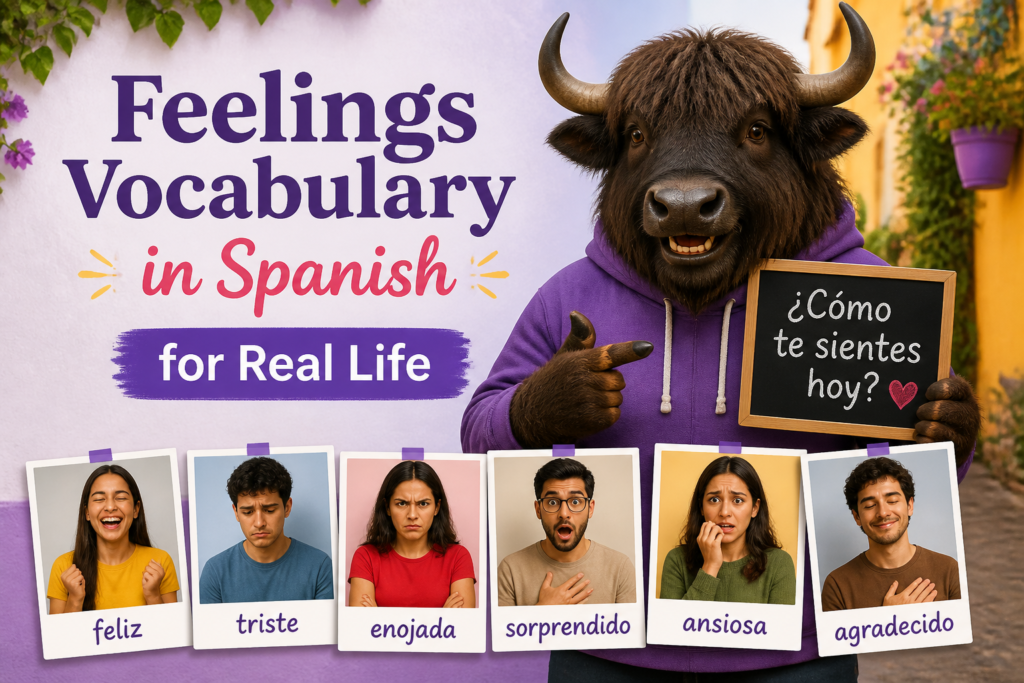
If you want to talk about feelings in Spanish without sounding like a robot that swallowed a phrasebook, you need more than just feliz and triste. Real life is messier than that. People are nervioso, aliviado, frustrado, emocionado, agotado, and occasionally de buenas for no clear reason at all.
For the broader learning path, visit our parent guide.
This guide gives you practical feelings vocabulary in Spanish for everyday life: emotions, moods, reactions, and the phrases people actually use in conversations. You’ll learn how to say how you feel, how to ask someone else, and how to avoid the classic learner trap of translating English too literally. Spanish loves nuance. Annoyingly, but usefully.
For a broader look at emotions, you can also check the related guide on emotions in Spanish. And if you want to build your core base first, the 100 essential Spanish words and phrases guide is a solid place to start.
How To Say How You Feel In Spanish
The most common pattern is simple:
estar + feeling = how you feel right now
Spanish often uses estar for temporary states, moods, and emotions. That’s why people say estoy cansado or estoy feliz. The verb ser is for identity, traits, and more permanent descriptions. Feelings usually live in the estar camp. Spanish grammar: always keeping you humble.
| Pattern | Meaning | Spanish Example | English Translation | Learner Note |
|---|---|---|---|---|
| Estoy + adjective | I am feeling… | Estoy cansado. | I am tired. | Use cansado/cansada to match your gender. |
| Me siento + adjective | I feel… | Me siento mejor hoy. | I feel better today. | Sentirse is great for emotional or physical states. |
| Estoy + noun phrase | I’m in a mood/state of… | Estoy de mal humor. | I’m in a bad mood. | Very natural in everyday Spanish. |
| Tengo + noun | I have… | Tengo miedo. | I’m afraid / I’m scared. | Some feelings use tener, not estar. |
Quick rule: Spanish often says “I have hunger,” “I have fear,” and “I am tired.” English says “I’m hungry,” “I’m scared,” and “I’m tired.” Same feeling, different plumbing.
Essential Feelings Vocabulary In Spanish
These are the big everyday feelings you’ll hear constantly. Some are adjectives, some are nouns, and some are phrases. Don’t worry about memorizing everything at once. Learn the ones that match your real life first. That usually helps more than collecting vocabulary like shiny rocks.
| Spanish | Pronunciation | Meaning | Example Sentence | Translation | Learner Note |
|---|---|---|---|---|---|
| feliz | feh-LEES | happy | Estoy feliz por ti. | I’m happy for you. | Very common and neutral. |
| contento / contenta | kohn-TEN-toh / kohn-TEN-tah | happy, pleased | Estoy contenta con los resultados. | I’m pleased with the results. | Slightly softer than feliz. |
| triste | TREES-teh | sad | Ella está triste hoy. | She is sad today. | Works for people, not moods like “a sad day” in a literal way. |
| enojado / enojada | eh-noh-HAH-doh / eh-noh-HAH-dah | angry, mad | Estoy enojado por eso. | I’m angry about that. | Common in Latin America. |
| molesto / molesta | moh-LES-toh / moh-LES-tah | annoyed, upset | Está molesta con su hermano. | She’s annoyed with her brother. | Also means “bothersome” depending on context. |
| frustrado / frustrada | froo-STRAH-doh / froo-STRAH-dah | frustrated | Me siento frustrada con este trámite. | I feel frustrated with this process. | Very useful for bureaucracy. Sadly, very useful. |
| decepcionado / decepcionada | deh-sep-syoh-NAH-doh / deh-sep-syoh-NAH-dah | disappointed | Estoy decepcionado con el servicio. | I’m disappointed with the service. | Often followed by con. |
| nervioso / nerviosa | nehr-VYOH-soh / nehr-VYOH-sah | nervous | Estoy nerviosa antes de la entrevista. | I’m nervous before the interview. | Also means “anxious” in some contexts. |
| preocupado / preocupada | preh-oh-koo-PAH-doh / preh-oh-koo-PAH-dah | worried | Mi mamá está preocupada por mí. | My mom is worried about me. | Use por or por + person/situation. |
| ansioso / ansiosa | ahn-syOH-soh / ahn-syOH-sah | anxious, eager | Estoy ansioso por empezar. | I’m eager to start. | Can mean nervous or excited depending on tone and region. |
| emocionado / emocionada | eh-moh-syoh-NAH-doh / eh-moh-syoh-NAH-dah | excited | Estamos emocionados por el viaje. | We’re excited about the trip. | One of the most useful celebration words. |
| aburrido / aburrida | ah-boo-RREE-doh / ah-boo-RREE-dah | bored | Estoy aburrido en la clase. | I’m bored in class. | Also means “boring” depending on who is doing the boring. |
| cansado / cansada | kahn-SAH-doh / kahn-SAH-dah | tired | Estoy cansada después del trabajo. | I’m tired after work. | Extremely common in daily speech. |
| agotado / agotada | ah-goh-TAH-doh / ah-goh-TAH-dah | exhausted | Estoy agotado después del viaje. | I’m exhausted after the trip. | Stronger than cansado. |
| relajado / relajada | reh-lah-HAH-doh / reh-lah-HAH-dah | relaxed | Me siento relajada en la playa. | I feel relaxed at the beach. | Good for calm, easygoing situations. |
| contentísimo / contentísima | kohn-ten-TEES-ee-moh / kohn-ten-TEES-ee-mah | very happy | Estoy contentísima con la noticia. | I’m extremely happy about the news. | Superlative form; expressive and natural. |
| tranquilo / tranquila | trahn-KEE-loh / trahn-KEE-lah | calm, relaxed | Ahora estoy más tranquila. | Now I’m calmer. | Also used to mean “don’t worry.” |
| estresado / estresada | eh-streh-SAH-doh / eh-streh-SAH-dah | stressed | Estoy estresada por el examen. | I’m stressed about the exam. | Very common modern vocabulary. |
| abrumado / abrumada | ah-broo-MAH-doh / ah-broo-MAH-dah | overwhelmed | Me siento abrumado con tanto trabajo. | I feel overwhelmed with so much work. | Useful in work and family contexts. |
| asustado / asustada | ah-soos-TAH-doh / ah-soos-TAH-dah | scared, frightened | El niño está asustado. | The child is scared. | Common with sudden fear. |
| temeroso / temerosa | teh-meh-ROH-soh / teh-meh-ROH-sah | fearful, afraid | Está temerosa de conducir de noche. | She’s afraid to drive at night. | Slightly more formal or literary. |
| sorprendido / sorprendida | sor-prehn-DEE-doh / sor-prehn-DEE-dah | surprised | Me sorprendió la noticia. | The news surprised me. | Can be used as an adjective or with sorprender. |
Notice the gender endings: -o for masculine, -a for feminine. If you’re describing yourself, the adjective usually changes to match you: estoy cansado or estoy cansada. Yes, Spanish makes adjectives do their own paperwork.
More Feelings And Moods You’ll Hear In Real Conversation
This next set covers the less obvious but very useful feelings that come up in conversations, texts, and everyday complaints. Some are softer, some are more intense, and some are the kind of words you hear right after someone says, “We need to talk.”
| Spanish | Pronunciation | Meaning | Example Sentence | Translation | Learner Note |
|---|---|---|---|---|---|
| aliviado / aliviada | ah-lee-vyAH-doh / ah-lee-vyAH-dah | relieved | Estoy aliviada porque todo salió bien. | I’m relieved because everything went well. | Great after exams, problems, or bad news. |
| orgulloso / orgullosa | or-goo-YOH-soh / or-goo-YOH-sah | proud | Estamos orgullosos de ti. | We’re proud of you. | Usually followed by de. |
| vergonzoso / vergonzosa | behr-gohn-SOH-soh / behr-gohn-SOH-sah | embarrassing | Fue una situación vergonzosa. | It was an embarrassing situation. | For the situation; for the person, use avergonzado. |
| avergonzado / avergonzada | ah-behr-gohn-ZAH-doh / ah-behr-gohn-ZAH-dah | embarrassed | Me sentí avergonzado. | I felt embarrassed. | Very common with social awkwardness. |
| confundido / confundida | kohn-foon-DEE-doh / kohn-foon-DEE-dah | confused | Estoy confundido con las instrucciones. | I’m confused by the instructions. | Use when something is unclear. |
| curioso / curiosa | koo-ryOH-soh / koo-ryOH-sah | curious | Estoy curiosa por saber más. | I’m curious to know more. | Also used for “interesting” in some contexts. |
| indiferente | een-dee-feh-REN-teh | indifferent | Le da igual; está indiferente. | It doesn’t matter to him; he’s indifferent. | Neutral, but often sounds a bit cold. |
| de mal humor | deh mahl oo-MOR | in a bad mood | Hoy estoy de mal humor. | I’m in a bad mood today. | Super common phrase. |
| de buen humor | deh bwen oo-MOR | in a good mood | Hoy está de buen humor. | He’s in a good mood today. | Often used about someone’s general mood. |
| deprimido / deprimida | deh-preh-MEE-doh / deh-preh-MEE-dah | depressed, down | Se siente deprimida últimamente. | She’s been feeling down lately. | Can mean emotionally low; serious depression needs careful context. |
| desanimado / desanimada | deh-sah-nee-MAH-doh / deh-sah-nee-MAH-dah | discouraged | Estoy desanimado con mis resultados. | I’m discouraged by my results. | Very useful in study or work contexts. |
| ilusionado / ilusionada | ee-loo-syoh-NAH-doh / ee-loo-syoh-NAH-dah | excited, hopeful | Está ilusionada con el nuevo proyecto. | She’s excited about the new project. | Common in many countries; positive anticipation. |
| loco / loca | LOH-koh / LOH-kah | crazy, crazy excited | Estoy loco por ver la película. | I’m really excited to see the movie. | Can be playful or serious depending on context. |
| enchufado / enchufada | en-choo-FAH-doh / en-choo-FAH-dah | plugged in, connected | Estoy enchufada al tema. | I’m really into the topic. | Regional and more colloquial; not for beginners. |
If you see me siento instead of estoy, that’s also common. Me siento confundido and estoy confundido both work. Sentirse often sounds a little more personal, like you’re talking about your inner state, not just a temporary label.
Useful Phrases For Talking About Feelings
These phrases are the real lifesavers. They help you talk about feelings more naturally than just naming a single adjective. You’ll hear them in conversations with friends, coworkers, family members, and in the kinds of messages people send when life gets weird.
| Spanish | Pronunciation | Meaning | Example Sentence | Translation | Learner Note |
|---|---|---|---|---|---|
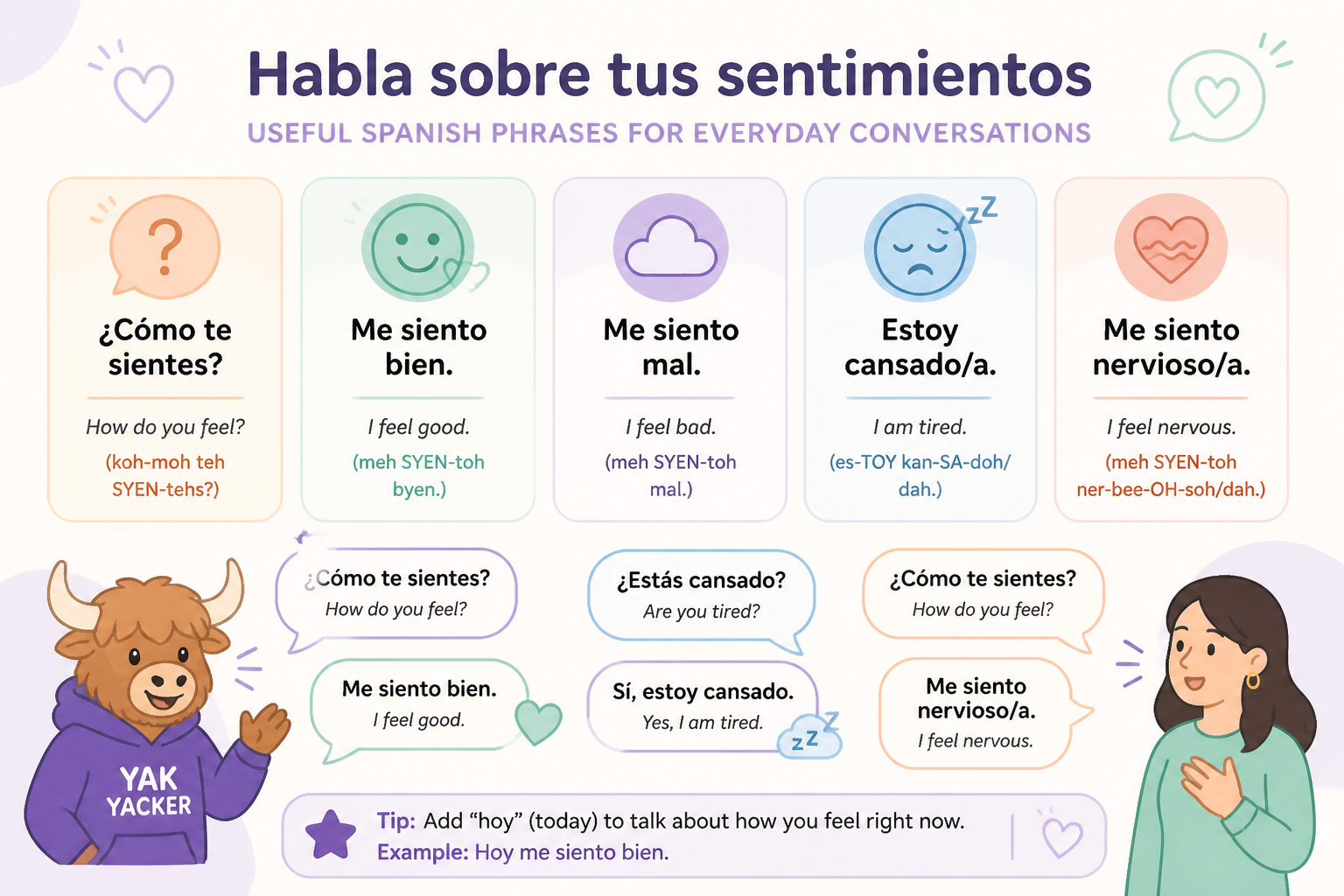
| ¿Cómo te sientes? | KOH-moh teh SYEN-tes | How do you feel? | ¿Cómo te sientes hoy? | How do you feel today? | Informal singular “you.” |
| ¿Cómo se siente? | KOH-moh seh SYEN-teh | How do you feel? / How is he or she feeling? | ¿Cómo se siente después de la operación? | How does he/she feel after the operation? | Formal usted or third person. |
| Me siento bien. | meh SYEN-toh byen | I feel good. | Hoy me siento bien. | Today I feel good. | Very flexible and common. |
| Me siento mal. | meh SYEN-toh mahl | I feel bad. | Me siento mal después de comer eso. | I feel sick after eating that. | Can mean physically or emotionally bad. |
| Me siento mejor. | meh SYEN-toh meh-HOR | I feel better. | Ya me siento mejor. | I already feel better. | Useful after illness or stress. |
| Me siento peor. | meh SYEN-toh peh-OR | I feel worse. | Hoy me siento peor que ayer. | Today I feel worse than yesterday. | Good for health and mood. |
| Tengo miedo. | TEN-goh MYEH-doh | I’m scared / I’m afraid. | El perro ladra y tengo miedo. | The dog is barking and I’m scared. | One of those “tener + noun” expressions. |
| Tengo ganas de… | TEN-goh GAH-nahs deh | I feel like / I want to… | Tengo ganas de dormir. | I feel like sleeping. | Extremely common in natural speech. |
| Me da miedo. | meh dah MYEH-doh | It scares me. | Me da miedo conducir de noche. | Driving at night scares me. | Very natural expression. |
| Me da pena. | meh dah PEH-nah | I feel sorry / I feel embarrassed | Me da pena hablar en público. | I feel embarrassed speaking in public. | Can mean pity, embarrassment, or awkwardness depending on context. |
| Estoy de acuerdo. | eh-STOY deh ah-KWER-doh | I agree. | Estoy de acuerdo con tu idea. | I agree with your idea. | Not a feeling word exactly, but it shows emotional alignment. |
| No me importa. | noh meh eem-POR-tah | I don’t care. | No me importa si llueve. | I don’t care if it rains. | Can sound neutral or rude depending on tone. |
| Me alegra… | meh ah-LEG-rah | It makes me happy… | Me alegra verte. | I’m happy to see you. | Lovely phrase for warm conversation. |
| Qué alivio. | keh ah-LEE-vyohMore Spanish to explore Best graded readers for Spanish The Boy and the Sheep: A1 Beginner Spanish Story with Audio Martina the Little Cockroach: A1 Beginner Spanish Story with Audio Marianela: A B1 Intermediate Spanish Story with Audio |