


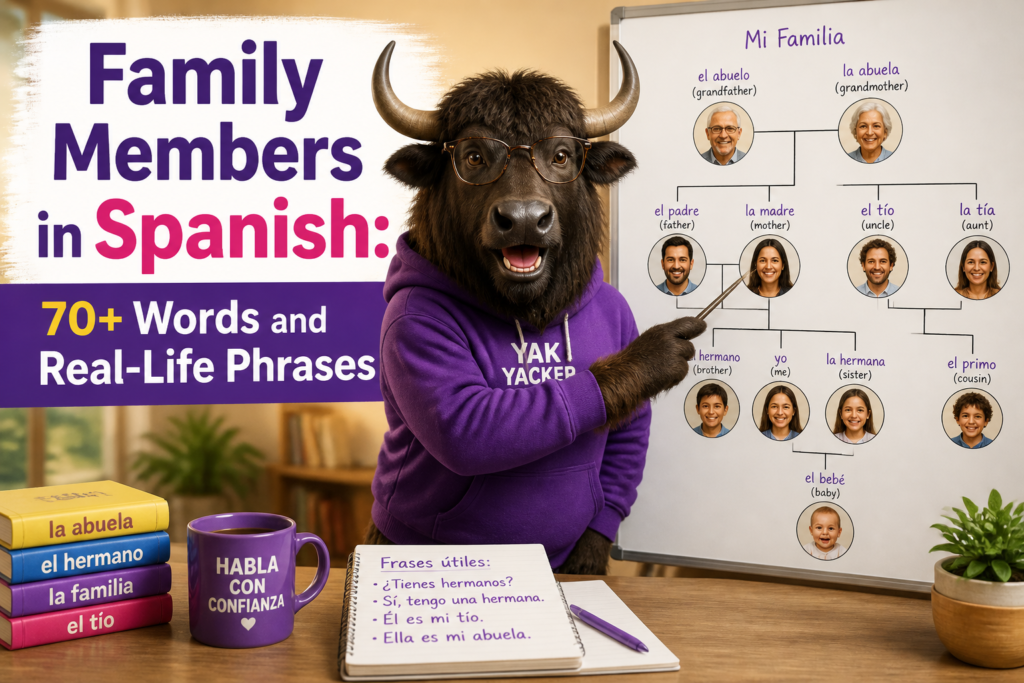
Family vocabulary looks simple until you actually need it in a real conversation and suddenly “that guy” is doing a lot of heavy lifting. In Spanish, family words are everywhere: introductions, birthdays, holidays, forms, small talk, and those extremely normal conversations where someone asks, “¿Y tu familia?” and expects more than a blank stare.
For the broader learning path, visit our parent guide.
Good news: once you know the core family words, Spanish gets much easier to use in the real world. You can talk about parents, siblings, in-laws, grandparents, and all the lovely family chaos that comes with them.
This guide uses standard Latin American Spanish by default, and when Spain uses a different word, you’ll see it clearly. No weird dictionary museum pieces. Just the words people actually use.
For a quick grammar side note, remember that family nouns are often masculine or feminine based on the person, not just the ending. Spanish is polite like that, and also mildly annoying.
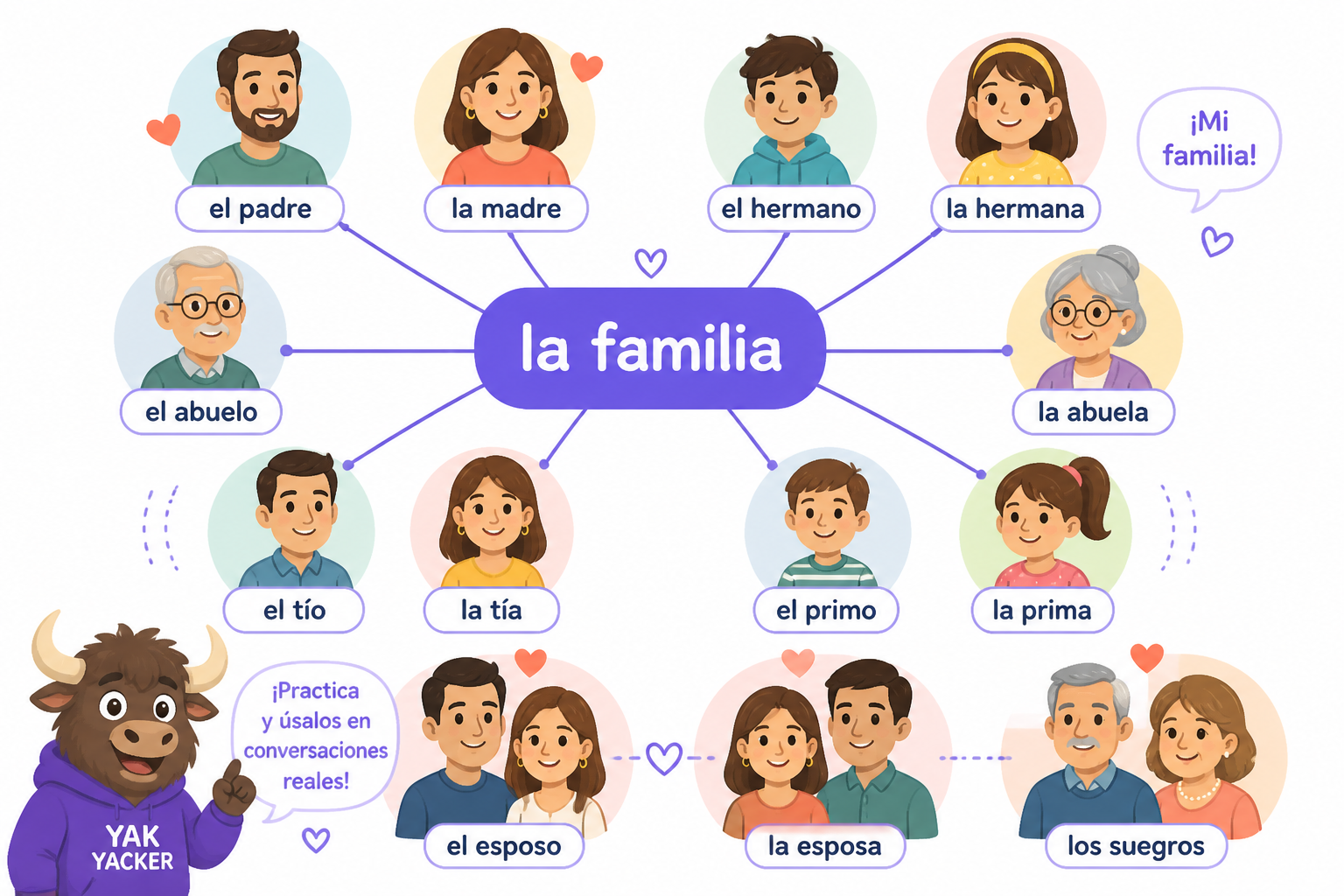
Core Family Members in Spanish
Here are the most useful family words first. These are the ones you’ll actually reach for in conversations, texts, and birthday cards.
| Spanish | Pronunciation | Meaning | Example Sentence | Translation | Learner Note |
|---|---|---|---|---|---|
| la familia | lah fah-MEE-lyah | family | Mi familia vive en Lima. | My family lives in Lima. | Feminine singular noun. |
| el padre | el PAH-dreh | father | Mi padre trabaja mucho. | My father works a lot. | Neutral and common; “papá” is more affectionate. |
| la madre | lah MAH-dreh | mother | Mi madre cocina muy bien. | My mother cooks very well. | Neutral and common; “mamá” is more affectionate. |
| el papá | el pah-PAH | dad | Mi papá llega tarde hoy. | My dad is arriving late today. | Very common and warm. |
| la mamá | lah mah-MAH | mom | Mi mamá habla con mi tía. | My mom is talking with my aunt. | Very common and warm. |
| los padres | lohs PAH-dres | parents | Mis padres viven cerca. | My parents live nearby. | “Padres” can mean parents, not just fathers. |
| el hijo | el EE-ho | son | Su hijo estudia medicina. | Her/His son studies medicine. | h is silent. |
| la hija | lah EE-hah | daughter | Mi hija tiene seis años. | My daughter is six years old. | h is silent. |
| los hijos | lohs EE-hohs | children; sons | Tiene tres hijos. | He/She has three children. | Can mean children in general, depending on context. |
| el hermano | el ehr-MAH-no | brother | Mi hermano vive en Bogotá. | My brother lives in Bogotá. | Use for male sibling. |
| la hermana | lah ehr-MAH-nah | sister | Mi hermana estudia francés. | My sister studies French. | Use for female sibling. |
| los hermanos | lohs ehr-MAH-nohs | siblings; brothers | Somos tres hermanos. | We are three siblings. | Can mean brothers or siblings, depending on context. |
| el abuelo | el ah-BWEH-lo | grandfather | Mi abuelo cuenta historias. | My grandfather tells stories. | Very common. |
| la abuela | lah ah-BWEH-lah | grandmother | Mi abuela hace pan dulce. | My grandmother makes sweet bread. | Very common. |
| los abuelos | lohs ah-BWEH-lohs | grandparents | Mis abuelos viven juntos. | My grandparents live together. | Plural for both grandparents. |
More Family Words You’ll Hear All the Time
Once you get past the basics, family conversations start expanding fast. Spanish has plenty of words for extended family and the people who get invited to the group chat whether they want to or not.
| Spanish | Pronunciation | Meaning | Example Sentence | Translation | Learner Note |
|---|---|---|---|---|---|
| el tío | el TEE-oh | uncle | Mi tío vive en Chile. | My uncle lives in Chile. | Accent mark matters: tío. |
| la tía | lah TEE-ah | aunt | Mi tía es doctora. | My aunt is a doctor. | Accent mark matters: tía. |
| los tíos | lohs TEE-ohs | aunts and uncles | Mis tíos vienen mañana. | My aunt and uncle are coming tomorrow. | Plural can mean both aunts and uncles together. |
| el primo | el PREE-moh | male cousin | Mi primo vive en Madrid. | My cousin lives in Madrid. | Spain word is the same. |
| la prima | lah PREE-mah | female cousin | Mi prima toca el piano. | My cousin plays the piano. | Use for female cousin. |
| los primos | lohs PREE-mohs | cousins | Los primos juegan en el patio. | The cousins are playing in the yard. | Plural for mixed or male group. |
| el sobrino | el soh-BREE-no | nephew | Mi sobrino tiene ocho años. | My nephew is eight years old. | Pronounce the stress on bri. |
| la sobrina | lah soh-BREE-nah | niece | Su sobrina estudia arte. | His/Her niece studies art. | Very common in family talk. |
| los sobrinos | lohs soh-BREE-nohs | nieces and nephews | Mis sobrinos están de visita. | My nieces and nephews are visiting. | Plural family word. |
| el nieto | el NEE-eh-to | grandson | Mi nieto aprende a leer. | My grandson is learning to read. | Clear vowel sounds help a lot here. |
| la nieta | lah NEE-eh-tah | granddaughter | Su nieta canta muy bonito. | Her/His granddaughter sings very beautifully. | Nice word for family stories. |
| los nietos | lohs NEE-eh-tohs | grandchildren | Los nietos llegan el sábado. | The grandchildren arrive on Saturday. | Plural family reference. |
| el esposo | el eh-SPOH-so | husband | Mi esposo trabaja desde casa. | My husband works from home. | Neutral, common, and a bit more formal than mi marido. |
| la esposa | lah eh-SPOH-sah | wife | Su esposa es muy amable. | His/Her wife is very kind. | Neutral and common. |
| el marido | el mah-REE-doh | husband | Mi marido cocina mejor que yo. | My husband cooks better than I do. | Very common in many countries; slightly more informal than esposo. |
| la mujer | lah moo-HEHR | wife; woman | Mi mujer trabaja en una escuela. | My wife works at a school. | Can mean wife or woman depending on context. |
Small note: in some places, people say la vieja or el viejo for “my wife” or “my husband,” but that can sound rude or too familiar in many contexts. Use with caution unless you know the local vibe. Language loves traps.
Useful Family Phrases For Real Life
These are the phrases that help you actually talk about family instead of just naming relatives like you’re reading a census form.
| Spanish | Pronunciation | Meaning | Example Sentence | Translation | Learner Note |
|---|---|---|---|---|---|
| Tengo una hermana. | TEHN-goh OO-nah ehr-MAH-nah | I have a sister. | Tengo una hermana menor. | I have a younger sister. | Use tener for “have” in family relationships. |
| ¿Tienes hermanos? | TYEH-nes ehr-MAH-nohs | Do you have siblings? | ¿Tienes hermanos o eres hijo único? | Do you have siblings, or are you an only child? | Very common conversation question. |
| Soy hijo único. | soy EE-ho OO-nee-koh | I’m an only child. | Ella es hija única. | She is an only child. | Feminine form: hija única. |
| Mi hermano mayor | mee ehr-MAH-noh mah-YOR | my older brother | Mi hermano mayor estudia ingeniería. | My older brother studies engineering. | Mayor = older, bigger, or greater depending on context. |
| Mi hermana menor | mee ehr-MAH-nah meh-NOR | my younger sister | Mi hermana menor es muy divertida. | My younger sister is very funny. | Menor = younger or smaller. |
| Mis padres | mees PAH-dres | my parents | Mis padres van a visitarme. | My parents are going to visit me. | Plural possessive adjective + plural noun. |
| Mi familia es grande. | mee fah-MEE-lyah es GRAHN-deh | My family is big. | Mi familia es grande y unida. | My family is big and close-knit. | Unida means close, united, tight-knit. |
| ¿Cómo se llama tu mamá? | KOH-moh seh YAH-mah too mah-MAH | What is your mom’s name? | ¿Cómo se llama tu papá? | What is your dad’s name? | Literally “How does your mom call herself?” but yes, that’s how Spanish does it. |
| Se parece a su padre. | seh pah-REH-seh ah soo PAH-dreh | He/She looks like his/her father. | Se parece mucho a su madre. | He/She looks a lot like his/her mother. | Useful for family resemblance. |
| Vivo con mi familia. | VEE-boh kohn mee fah-MEE-lyah | I live with my family. | Vive con sus abuelos. | He/She lives with his/her grandparents. | Simple, natural, and useful. |
| Voy a visitar a mis abuelos. | boy ah vee-see-TAR ah mees ah-BWEH-lohs | I’m going to visit my grandparents. | Vamos a visitar a la familia. | We’re going to visit the family. | Notice the personal a with people. |
| Mi primo y yo somos muy parecidos. | mee PREE-moh ee yoh SOH-mohs moo-ee pah-reh-SEE-dohs | My cousin and I look very similar. | Mis hermanas son muy parecidas. | My sisters are very similar. | Parecido means similar or alike. |
| Tenemos una reunión familiar. | teh-NEH-mohs OO-nah reh-oo-nee-OHN fah-mee-lyahr | We have a family gathering. | La reunión familiar es el domingo. | The family gathering is on Sunday. | Familiar here means “family-related.” |
| Mi familia se lleva bien. | mee fah-MEE-lyah seh YEH-bah byehn | My family gets along well. | Mis hermanos se llevan muy bien. | My siblings get along very well. | Llevarse bien/mal = get along / not get along. |
| Somos una familia pequeña. | SOH-mohs OO-nah fah-MEE-lyah peh-KEY-nyah | We are a small family. | Somos una familia pequeña pero muy unida. | We are a small but very close family. | Pequeña = small. |
| Mi bebé es adorable. | mee beh-BEH es ah-doh-RAH-bleh | My baby is adorable. | Mi bebé tiene tres meses. | My baby is three months old. | Bebé works for baby in many Spanish-speaking countries. |
Need a broader conversation around feelings and family situations? That often pairs nicely with emotions in Spanish, because family chats are basically emotions with snacks.
Family Relationship Words And Useful Extras
These words help you go beyond the basic nuclear family. They’re useful for holidays, introductions, forms, and those moments when someone asks about your whole family tree, as if you carry that around in your pocket.
| Spanish | Pronunciation | Meaning | Example Sentence | Translation | Learner Note |
|---|---|---|---|---|---|
| la suegra | lah SWEH-grah | mother-in-law | Mi suegra cocina muy bien. | My mother-in-law cooks very well. | Common in family talk. |
| el suegro | el SWEH-groh | father-in-law | Mi suegro vive cerca. | My father-in-law lives nearby. | Useful after marriage or when talking about in-laws. |
| la nuera | lah NWEH-rah | daughter-in-law | Su nuera trabaja en una oficina. | His/Her daughter-in-law works in an office. | Pronounce the nue like “nweh.” |
| el yerno | el YEHR-no | son-in-law | Mi yerno habla tres idiomas. | My son-in-law speaks three languages. | Very common in family introductions. |
| la cuñada | lah koon-YAH-dah | sister-in-law | Mi cuñada es muy simpática. | My sister-in-law is very nice. | ñ sounds like the ny in “canyon.” |
| el cuñado | el koon-YAH-doh | brother-in-law | Mi cuñado trabaja conmigo. | My brother-in-law works with me. | Same sound pattern as cuñada. |
| los cuñados | lohs koon-YAH-dohs | brother(s)-in-law / in-laws | Mis cuñados viven en otra ciudad. | My in-laws live in another city. | Plural can cover multiple people. |
| la madrina | lah mah-DREE-nah | godmother | Mi madrina me regaló un libro. | More Spanish to explore Best graded readers for Spanish The Boy and the Sheep: A1 Beginner Spanish Story with Audio Martina the Little Cockroach: A1 Beginner Spanish Story with Audio Marianela: A B1 Intermediate Spanish Story with Audio |