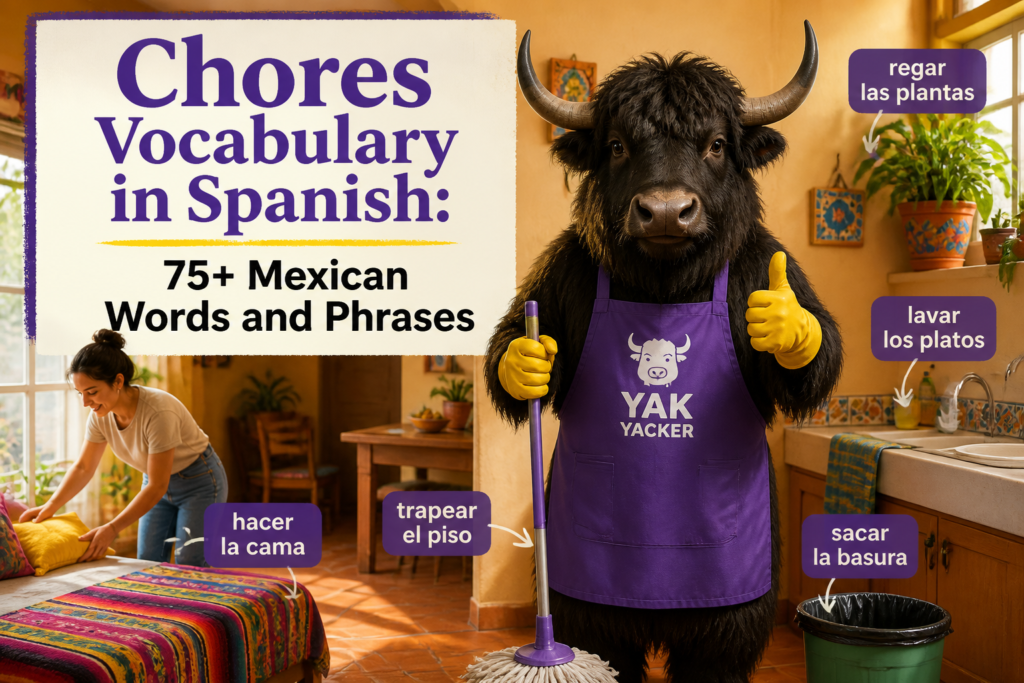
If you share a house, an apartment, or even a family kitchen, chores are where language gets real fast. Nobody cares how charming your Spanish is when the trash is overflowing and someone has to wash the dishes. Suddenly, words like barrer, lavar los platos, and sacar la basura become very important. Very quickly.
For the broader learning path, visit our parent guide.
This guide teaches practical Mexican Spanish for everyday chores, cleaning, and “please do your part” situations. The Spanish is natural, modern, and useful in real life, not the kind of vocabulary that lives forever in a dusty workbook and never sees a broom.
Need a quick reference for broader everyday vocabulary too? You can also compare related household words in Furniture Vocabulary in Spanish and pair this with Actions and Gestures in Spanish for extra everyday fluency.
Small truth: many Spanish learners know how to order tacos long before they know how to say “I already took out the trash.” Life is unfair, but fixable.
Useful Chores Phrases For Real Life
Below are the phrases you will actually hear in homes, apartments, and group chats. Mexican Spanish is the focus here, but most of these are widely understood across Latin America.
| Spanish | Pronunciation | Meaning | Example Sentence | Translation | Learner Note |
|---|---|---|---|---|---|
| hacer el quehacer | ah-SEH-rehl keh-ah-SEHR | to do the chores / household work | Hoy me toca hacer el quehacer. | Today it’s my turn to do the chores. | Very natural in Mexico. Quehacer is a common word for household chores. |
| limpiar | leem-PYAHR | to clean | Tengo que limpiar mi cuarto. | I have to clean my room. | Super common and useful. Works for rooms, kitchens, bathrooms, and more. |
| ordenar | or-deh-NAHR | to tidy up / put in order | Voy a ordenar la sala. | I’m going to tidy up the living room. | In Mexico, ordenar often means “tidy,” not “to order” like in restaurants. |
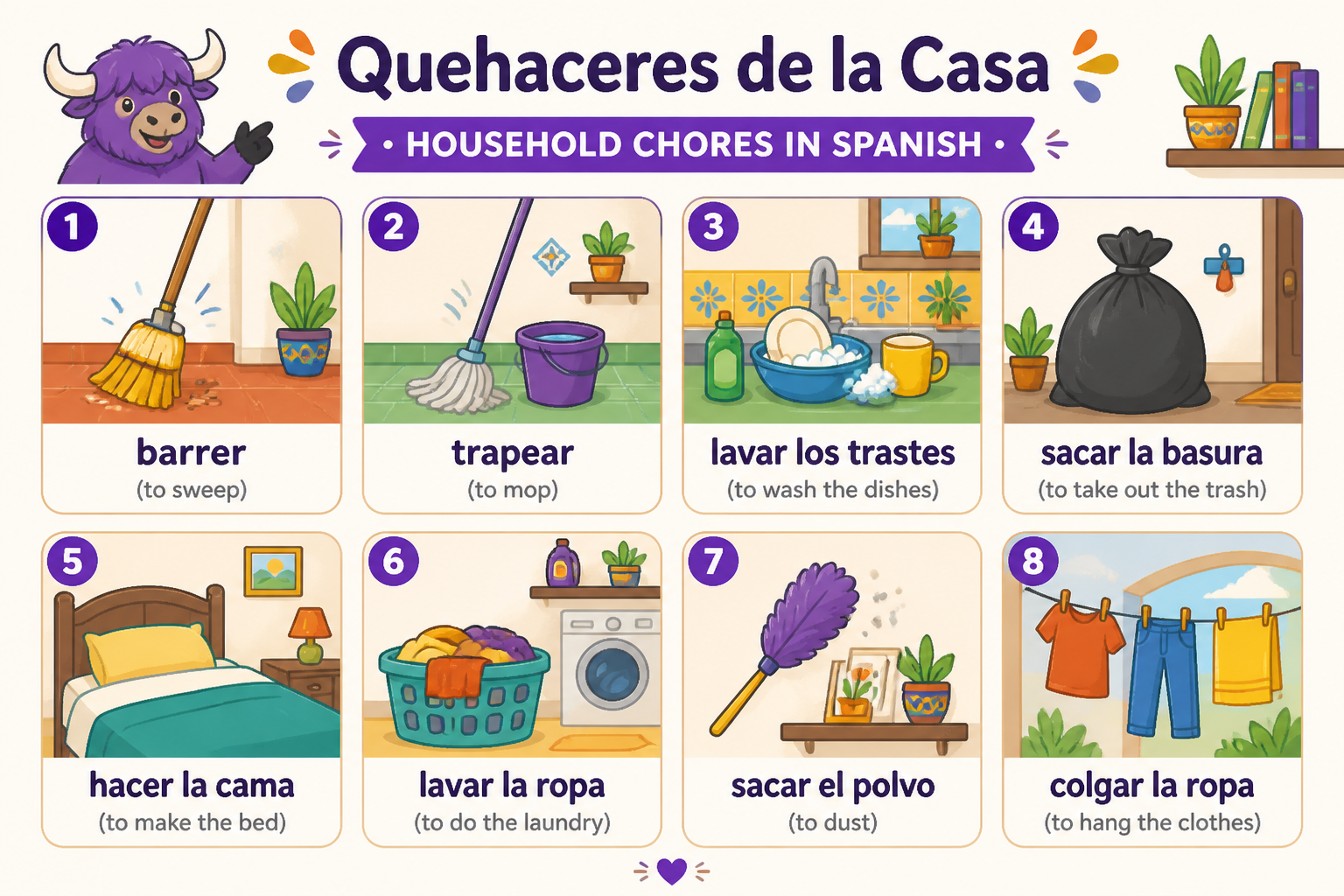
| barrer | bah-REHR | to sweep | Mi hermano barre la cocina. | My brother sweeps the kitchen. | The double r is rolled or tapped strongly, depending on speed and accent. |
| trapear | trah-peh-AHR | to mop | Voy a trapear el piso. | I’m going to mop the floor. | Very Mexican. In other places, people may say fregar el piso or pasar la mopa. |
| sacudir | sah-koo-DEER | to dust / shake off | Hay que sacudir los muebles. | The furniture needs dusting. | Can mean “dust” in cleaning contexts and “shake” in other contexts. |
| sacar la basura | sah-KAHR lah bah-SOO-rah | to take out the trash | No olvides sacar la basura. | Don’t forget to take out the trash. | Classic roommate sentence. Survival-level vocabulary. |
| lavar los platos | lah-VAHR lohs PLAH-tohs | to wash the dishes | Yo lavo los platos después de cenar. | I wash the dishes after dinner. | Also common: lavar la vajilla for “wash the dishes/dishware.” |
| poner la mesa | poh-NEHR lah MEH-sah | to set the table | ¿Me ayudas a poner la mesa? | Can you help me set the table? | Polite and very everyday. |
| desocupar la mesa | deh-soh-koo-PAHR lah MEH-sah | to clear the table | Primero hay que desocupar la mesa. | First we need to clear the table. | Common in Mexico and parts of Latin America. Also recoger la mesa. |
| lavar la ropa | lah-VAHR lah ROH-pah | to do the laundry | Hoy me toca lavar la ropa. | Today it’s my turn to do the laundry. | Use for the whole laundry task, not just “wash clothes” literally. |
| tender la ropa | ten-DEHR lah ROH-pah | to hang the laundry to dry | Después de lavar, hay que tender la ropa. | After washing, the clothes need to be hung up to dry. | Very practical if your clothesline is doing all the heavy lifting. |
| doblar la ropa | doh-BLAHR lah ROH-pah | to fold the clothes | Siempre dejo de doblar la ropa al final. | I always leave folding the clothes for last. | Relatable. Painfully relatable. |
| cambiar las sábanas | kam-BYAHR lahs SAH-bah-nahs | to change the sheets | Hay que cambiar las sábanas hoy. | The sheets need to be changed today. | Sábanas = bed sheets. |
| hacer la cama | ah-SEHR lah KAH-mah | to make the bed | Antes de salir, haz la cama. | Before leaving, make the bed. | Very common in homes, hotels, and family advice. |
| limpiar el baño | leem-PYAHR ehl BAH-nyoh | to clean the bathroom | Hoy toca limpiar el baño. | Today it’s time to clean the bathroom. | Baño can mean bathroom or bath depending on context. |
| aspirar | ahs-pee-RAHR | to vacuum | Voy a aspirar la sala. | I’m going to vacuum the living room. | Common in Latin America and Spain, though some regions prefer different everyday wording. |
| sacudir el polvo | sah-koo-DEER ehl POHL-boh | to dust off the dust | Hay que sacudir el polvo de los estantes. | The dust needs to be wiped off the shelves. | Useful if you want to be a little more specific than just limpiar. |
| lavar los trastes | lah-VAHR lohs TRAHS-tehs | to wash the dishes | ¿Quién va a lavar los trastes? | Who is going to wash the dishes? | Very Mexican. Trastes = dishes, pots, and kitchenware. |
| colgar la ropa | kohl-GAHR lah ROH-pah | to hang up the clothes | Voy a colgar la ropa en el balcón. | I’m going to hang the clothes on the balcony. | Useful with laundry, closets, and hangers. |
Chores Vocabulary You’ll Hear Around The House
Here are more words that show up constantly in home life. Some are nouns, some are verbs, and some are the kind of words you hear during a very pointed conversation about “shared responsibilities.”
| Spanish | Pronunciation | Meaning | Example Sentence | Translation | Learner Note |
|---|---|---|---|---|---|
| el quehacer | ehl keh-ah-SEHR | chores, housework | Mis quehaceres no son tantos hoy. | My chores aren’t that many today. | Quehaceres is the plural. Very handy for “the chores.” |
| la limpieza | lah leem-PYEH-sah | cleaning, cleanliness | La limpieza de la casa es importante. | Cleaning the house is important. | Can mean the act of cleaning or the state of being clean. |
| el polvo | ehl POHL-boh | dust | Hay mucho polvo en el estante. | There is a lot of dust on the shelf. | Good to know for homes, allergies, and general annoyance. |
| la basura | lah bah-SOO-rah | trash, garbage | La basura ya huele mal. | The trash already smells bad. | Basura is feminine. Yes, Spanish gender likes to keep you alert. |
| el balde | ehl BAHL-deh | bucket | Necesito un balde con agua. | I need a bucket with water. | Common in Latin America. In some places, people may also say cubo. |
| la escoba | lah ehs-KOH-bah | broom | La escoba está detrás de la puerta. | The broom is behind the door. | Useful household noun. Gender note: la escoba, not el escoba. |
| el trapeador | ehl trah-peh-ah-DOHR | mop | El trapeador está en el patio. | The mop is in the patio. | Very common in Mexico. Related to trapear. |
| el jabón | ehl hah-BOHN | soap | Se acabó el jabón para trastes. | The dish soap ran out. | Accent mark matters: jabón, not jabon. |
| el detergente | ehl deh-tehr-HEN-teh | detergent, cleaner | Compré detergente para la ropa. | I bought laundry detergent. | Used for laundry detergent or cleaning products more broadly. |
| el recogedor | ehl reh-koh-geh-DOHR | dustpan | Pásame el recogedor, por favor. | Pass me the dustpan, please. | Handy when sweeping. Also a good “adulting” word. |
| el cubo de basura | ehl KOO-boh deh bah-SOO-rah | trash bin | El cubo de basura está lleno. | The trash bin is full. | Very clear and practical. |
| el tendedero | ehl ten-deh-DEH-roh | clothesline, drying rack area | La ropa está en el tendedero. | The clothes are on the clothesline. | Useful in homes where clothes air-dry. Very common in everyday life. |
| la fregona | lah freh-GOH-nah | mop | En España dicen fregona con más frecuencia. | In Spain, they say fregona more often. | Regional note: in Mexico, trapeador is usually more common. |
| el estropajo | ehl ehs-troh-PAH-hoh | scrubbing sponge | Necesito un estropajo nuevo. | I need a new scrubbing sponge. | Very useful in the kitchen. The word may be new, but the mess is familiar. |
| la cubeta | lah koo-BEH-tah | bucket / pail | Pon agua en la cubeta. | Put water in the bucket. | Common in Mexico, especially in home and cleaning contexts. |
| la servilleta | lah sehr-bee-YEH-tah | napkin | Necesito servilletas para la mesa. | I need napkins for the table. | Helpful for setting the table and after meals. |
| el paño | ehl PAH-nyoh | cloth, rag, cleaning cloth | Usa un paño húmedo para limpiar la mesa. | Use a damp cloth to clean the table. | The ñ sound is like the ny in “canyon.” |
| el mandil | ehl mahn-DEEL | apron | Me pongo el mandil para cocinar y limpiar. | I put on the apron to cook and clean. | Common in Mexico. Helpful if chores include kitchen work. |
| recoger | reh-koh-HEHR | to pick up, tidy away | Recoge tus cosas del sofá. | Pick up your things from the sofa. | Very useful for cleanup and for sounding mildly impatient. |
| lavarse | lah-VAHR-seh | to wash oneself | Antes de comer, me lavo las manos. | Before eating, I wash my hands. | Reflexive form. Great for daily routines too. |
Verbs And Commands For Getting Things Done
When people talk about chores, they often use commands or casual requests. In Spanish, that means verbs like haz, lava, barre, and pon. Tiny words, huge emotional weight.
| Spanish | Pronunciation | Meaning | Example Sentence | Translation | Learner Note |
|---|---|---|---|---|---|
| haz | ahs | do / make | Haz tu parte, por favor. | Do your part, please. | Command form of hacer with tú. |
| lava | LAH-vah | wash | Lava los platos cuando termines. | Wash the dishes when you finish. | Friendly, direct, and very household-real. |
| barre | BAH-reh | sweep | Barre la cocina antes de salir. | Sweep the kitchen before leaving. | Short command. Easy to hear in homes. |
| trapea | trah-PEH-ah | mop | Trapea el piso, por favor. | Mop the floor, please. | Mexican everyday command. |
| ordena | or-DEH-nah | tidy up | Ordena tu cuarto antes de dormir. | Tidy your room before sleeping. | Simple and common. Great for family and roommates. |
| recoge | reh-KOH-heh | pick up, put away | Recoge la ropa del piso. | Pick up the clothes from the floor. | Not to be confused with recolectar, which is more “collect.” |
| saca la basura | SAH-kah lah bah-SOO-rah | take out the trash | Saca la basura antes de que llegue el camión. | Take out the trash before the truck arrives. | Very common as a household instruction. |
| dobla | DOH-blah | fold | Dobla las toallas, por favor. | Fold the towels, please. | Useful for laundry day and laundry-based bargaining. |
| tiende | TYEN-deh | hang up to dry | Tiende la ropa al sol. | Hang the clothes in the sun. | Common in laundry contexts. The “ie” sound is quick. |
| pasa el trapo | PAH-sah ehl TRAH-poh | wipe with a cloth | Pasa el trapo por la mesa. | Wipe the table with a cloth. | Very natural in spoken Mexican Spanish. |
| pone | POH-neh | put, place | Pone los platos en la mesa. | Put the plates on the table. | Wait — if you are giving a command to tú, it should be pon. Pone is for usted or third person. Spanish likes to test your attention span. |
| limpia | LEEM-pyah | clean | Limpia tu escritorio, por favor. | Clean your desk, please. | Works for surfaces, rooms, and general mess. |
For a neat little pronunciation reminder, the letter hMore Spanish to explore