City buildings labeled with Spanish place vocabulary

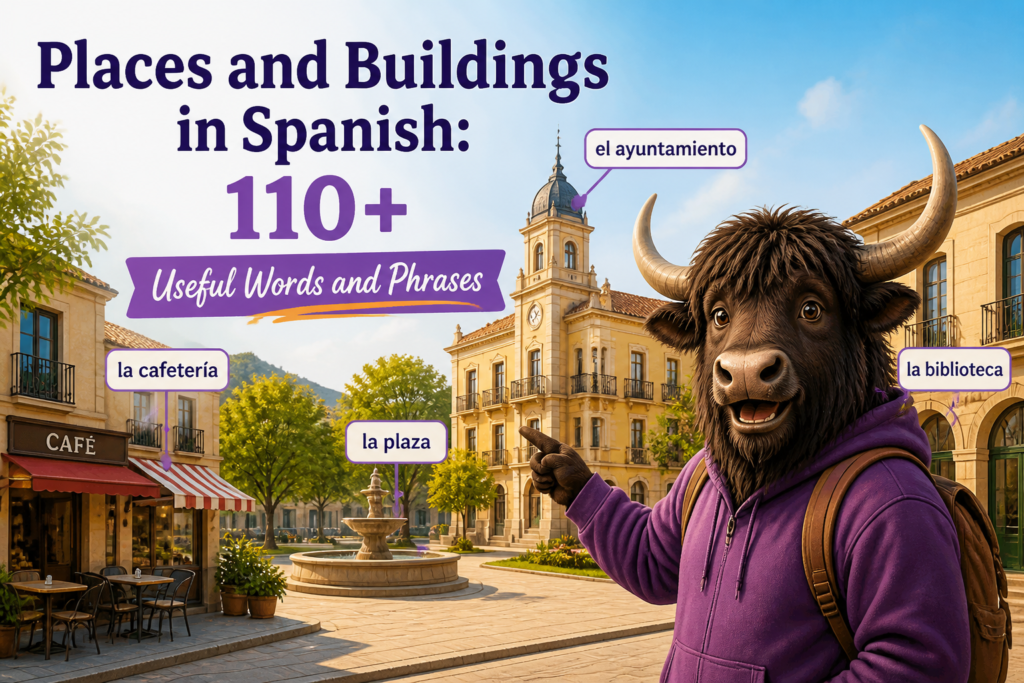
Places and Buildings in Spanish: 110+ Useful Words and Phrases

SpanishPronunciationMeaningExample SentenceTranslationLearner Note
la casaKAH-sahhouseMi casa está lejos del centro.My house is far from downtown.Very common and basic.
el apartamentoah-pahr-tah-MEN-tohapartmentVivo en un apartamento pequeño.I live in a small apartment.Common in Latin America.
el pisoPEE-sohapartment; floorBuscamos un piso cerca del trabajo.We’re looking for an apartment near work.More common in Spain for “apartment.”
el departamentodeh-pahr-tah-MEN-tohapartment; departmentRentamos un departamento en la ciudad.We rent an apartment in the city.Very common in Latin America.
la habitaciónah-bee-tah-SYONroom; bedroomLa habitación tiene balcón.The room has a balcony.Also used for hotel rooms.
el dormitoriodor-mee-TOR-yohbedroom; dormitoryMi dormitorio es pequeño pero cómodo.My bedroom is small but comfortable.Often a bedroom in a house; also dorm room.
la cocinakoh-SEE-nahkitchenLa cocina está limpia.The kitchen is clean.Also means “cooking” in some contexts.
la salaSAH-lahliving roomLa sala tiene un sofá grande.The living room has a big sofa.Very common in Latin America.
el bañoBAH-nyohbathroom¿Dónde está el baño?Where is the bathroom?One of the first phrases travelers need.
el comedorkoh-meh-DORdining roomComemos en el comedor.We eat in the dining room.Also the restaurant dining area.
la oficinaoh-fee-SEE-nahofficeTrabajo en una oficina pequeña.I work in a small office.Very common in work settings.
el consultoriokohn-sool-TOR-yohoffice; clinic officeLa doctora atiende en su consultorio.The doctor sees patients in her office.Medical or professional office depending on context.
la fábricaFAH-bree-kahfactoryMi tío trabaja en una fábrica.My uncle works in a factory.Accent mark: fábrica.
la plantaPLAHN-tahfloor; plantLa oficina está en la segunda planta.The office is on the second floor.In Spain, planta is very common for “floor.”
el sótanoSOH-tah-nohbasementEl sótano está húmedo.The basement is damp.Accent mark matters: sótano.
la azoteaah-soh-TEH-ahroof; rooftopSubimos a la azotea a ver la vista.We went up to the rooftop to see the view.Useful for buildings with terraces or roof spaces.
el pasillopah-SEE-yohhallwayEl baño está al final del pasillo.The bathroom is at the end of the hallway.Very useful in homes, hotels, and schools.
la entradaen-TRAH-dahentrance; entry ticketLa entrada está por la izquierda.The entrance is on the left.Can also mean a ticket in some contexts.
la salidasah-LEE-dahexitLa salida está por allá.The exit is over there.Very common in signs and directions.
la recepciónreh-sep-SYONreception deskPregunta en la recepción.Ask at reception.Common in hotels and offices.

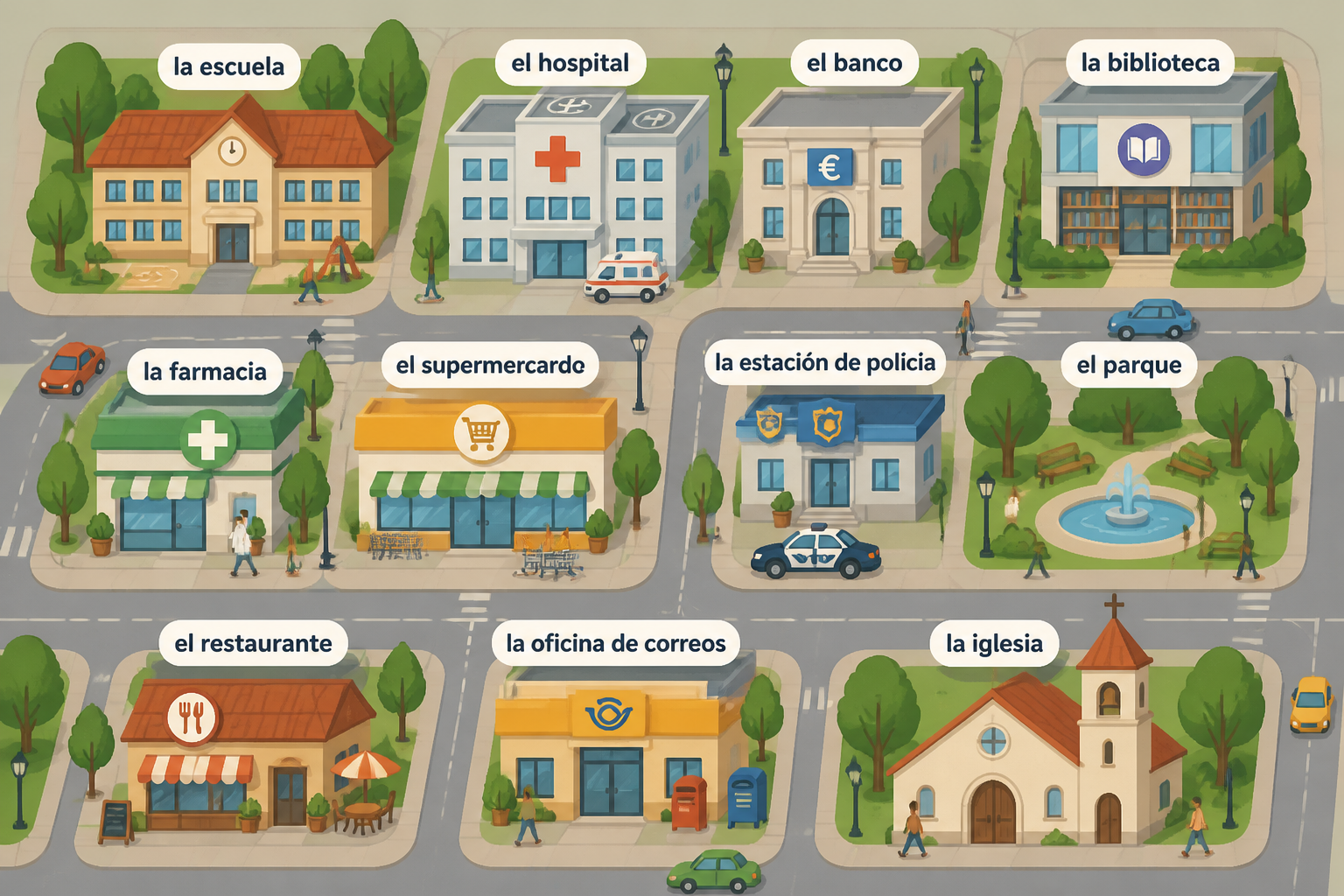
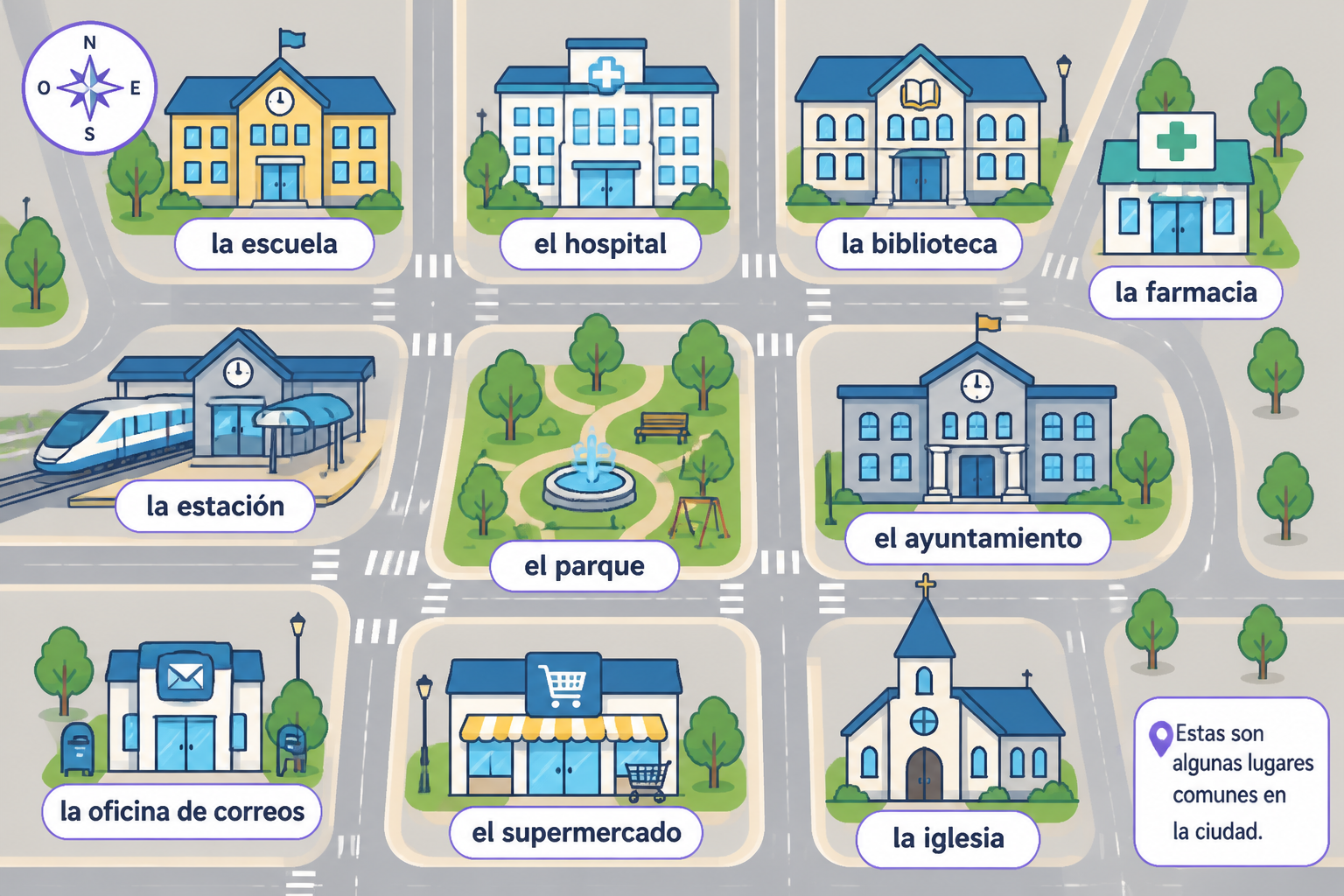
Labeled map of common places in a city block

Public Services, Transport, And Community Places

These words show up on signs, maps, and conversations with actual humans who expect you to know what you’re looking for. Sadly, they are not impressed by vague pointing.

SpanishPronunciationMeaningExample SentenceTranslationLearner Note
el ayuntamientoahy-oon-tah-MYEN-tohtown hall; city councilEl ayuntamiento está en el centro.The town hall is downtown.Common in official and city contexts.
la alcaldíaahl-kahl-DEE-ahcity hall; mayor’s officeLa alcaldía anunció nuevas reglas.The city hall announced new rules.Very common in Latin America.
la comisaríakoh-mee-sah-REE-ahpolice stationFui a la comisaría para hacer una denuncia.I went to the police station to file a report.Useful in formal and practical situations.
la estación de policíaes-tah-SYON deh poh-lee-SEE-ahpolice stationLa estación de policía queda cerca.The police station is nearby.Longer but very clear.
el juzgadohoos-GAH-dohcourthouseEl juicio es en el juzgado.The trial is at the courthouse.Formal/legal word.
SpanishPronunciationMeaningExample SentenceTranslationLearner Note
el bancoBAHN-kohbankVoy al banco después del trabajo.I’m going to the bank after work.Also means “bench,” so context matters.
la farmaciafahr-MAH-syahpharmacyNecesito ir a la farmacia.I need to go to the pharmacy.Very useful when you’re sick and no longer romantic about travel.
el hospitalohs-pee-TAHLhospitalLo llevaron al hospital.He was taken to the hospital.In Spanish, the h is silent.
la clínicaklee-NEE-kahclinicLa clínica abre a las ocho.The clinic opens at eight.Good for medical appointments.
el consultoriokohn-sool-TOR-yohdoctor’s office; clinic roomLa cita es en el consultorio del doctor.The appointment is in the doctor’s office.Common in Latin America.
la escuelaes-KWEH-lahschoolLos niños van a la escuela.The children go to school.Escuela is the general word for school.
la universidadoo-nee-ver-see-DAHDuniversityEstudia en la universidad.He studies at the university.Often shortened to la uni in casual speech.
la bibliotecabee-blee-oh-TEH-kahlibraryLa biblioteca está cerrada hoy.The library is closed today.Not to be confused with librería (bookstore).
la libreríalee-breh-REE-ahbookstoreCompré ese libro en la librería.I bought that book at the bookstore.Classic false friend trap. Books live in the library; Spanish disagrees.
la tiendaTYEN-dahstore; shopVoy a la tienda por agua.I’m going to the store for water.Very common general word.
el supermercadosoop-er-mahr-KEH-dohsupermarketCompramos fruta en el supermercado.We buy fruit at the supermarket.Long word, very real life.
el mercadomahr-KAH-dohmarketEl mercado tiene comida fresca.The market has fresh food.Can mean a food market or a general market.
la panaderíapah-nah-deh-REE-ahbakeryLa panadería abre temprano.The bakery opens early.Great place for bread, pastries, and happiness.
la carniceríakahr-nee-seh-REE-ahbutcher shopCompramos carne en la carnicería.We buy meat at the butcher shop.Very common in neighborhood shopping.
la pescaderíapeh-skah-deh-REE-ahfish market / fish shopLa pescadería está cerca del puerto.The fish shop is near the port.Useful in coastal areas and markets.
la cafeteríakah-feh-teh-REE-ahcafé; cafeteriaNos vemos en la cafetería a las cinco.We’ll meet at the café at five.Meaning can vary by country, but usually a casual café.
el restauranterehs-too-RAHN-tehrestaurantEl restaurante está lleno.The restaurant is full.Works across most Spanish-speaking countries.
el hoteloh-TELhotelEl hotel queda cerca de la playa.The hotel is near the beach.The h is silent, of course. Spanish remains committed to mystery.
la estaciónes-tah-SYONstationLa estación de tren está lejos.The train station is far away.Accent mark matters: estación.
el aeropuertoah-eh-roh-PWEHR-tohairportVamos al aeropuerto mañana.We’re going to the airport tomorrow.Common travel word.

Useful Places In Daily Life

This set covers places you’ll need for errands, routines, housing, and basic city life. If you can name these, you can ask for directions without pointing at random buildings like a stressed raccoon.

SpanishPronunciationMeaningExample SentenceTranslationLearner Note
la casaKAH-sahhouseMi casa está lejos del centro.My house is far from downtown.Very common and basic.
el apartamentoah-pahr-tah-MEN-tohapartmentVivo en un apartamento pequeño.I live in a small apartment.Common in Latin America.
el pisoPEE-sohapartment; floorBuscamos un piso cerca del trabajo.We’re looking for an apartment near work.More common in Spain for “apartment.”
el departamentodeh-pahr-tah-MEN-tohapartment; departmentRentamos un departamento en la ciudad.We rent an apartment in the city.Very common in Latin America.
la habitaciónah-bee-tah-SYONroom; bedroomLa habitación tiene balcón.The room has a balcony.Also used for hotel rooms.
el dormitoriodor-mee-TOR-yohbedroom; dormitoryMi dormitorio es pequeño pero cómodo.My bedroom is small but comfortable.Often a bedroom in a house; also dorm room.
la cocinakoh-SEE-nahkitchenLa cocina está limpia.The kitchen is clean.Also means “cooking” in some contexts.
la salaSAH-lahliving roomLa sala tiene un sofá grande.The living room has a big sofa.Very common in Latin America.
el bañoBAH-nyohbathroom¿Dónde está el baño?Where is the bathroom?One of the first phrases travelers need.
el comedorkoh-meh-DORdining roomComemos en el comedor.We eat in the dining room.Also the restaurant dining area.
la oficinaoh-fee-SEE-nahofficeTrabajo en una oficina pequeña.I work in a small office.Very common in work settings.
el consultoriokohn-sool-TOR-yohoffice; clinic officeLa doctora atiende en su consultorio.The doctor sees patients in her office.Medical or professional office depending on context.
la fábricaFAH-bree-kahfactoryMi tío trabaja en una fábrica.My uncle works in a factory.Accent mark: fábrica.
la plantaPLAHN-tahfloor; plantLa oficina está en la segunda planta.The office is on the second floor.In Spain, planta is very common for “floor.”
el sótanoSOH-tah-nohbasementEl sótano está húmedo.The basement is damp.Accent mark matters: sótano.
la azoteaah-soh-TEH-ahroof; rooftopSubimos a la azotea a ver la vista.We went up to the rooftop to see the view.Useful for buildings with terraces or roof spaces.
el pasillopah-SEE-yohhallwayEl baño está al final del pasillo.The bathroom is at the end of the hallway.Very useful in homes, hotels, and schools.
la entradaen-TRAH-dahentrance; entry ticketLa entrada está por la izquierda.The entrance is on the left.Can also mean a ticket in some contexts.
la salidasah-LEE-dahexitLa salida está por allá.The exit is over there.Very common in signs and directions.
la recepciónreh-sep-SYONreception deskPregunta en la recepción.Ask at reception.Common in hotels and offices.

Labeled map of common places in a city block

Public Services, Transport, And Community Places

These words show up on signs, maps, and conversations with actual humans who expect you to know what you’re looking for. Sadly, they are not impressed by vague pointing.

SpanishPronunciationMeaningExample SentenceTranslationLearner Note
el ayuntamientoahy-oon-tah-MYEN-tohtown hall; city councilEl ayuntamiento está en el centro.The town hall is downtown.Common in official and city contexts.
la alcaldíaahl-kahl-DEE-ahcity hall; mayor’s officeLa alcaldía anunció nuevas reglas.The city hall announced new rules.Very common in Latin America.
la comisaríakoh-mee-sah-REE-ahpolice stationFui a la comisaría para hacer una denuncia.I went to the police station to file a report.Useful in formal and practical situations.
la estación de policíaes-tah-SYON deh poh-lee-SEE-ahpolice stationLa estación de policía queda cerca.The police station is nearby.Longer but very clear.
el juzgadohoos-GAH-dohcourthouseEl juicio es en el juzgado.The trial is at the courthouse.Formal/legal word.

If you’ve ever stood in a Spanish-speaking city looking lost and politely pretending you were “just enjoying the architecture,” this article is for you. By the end, you’ll know how to name common places and buildings in Spanish, ask where things are, and sound a lot less like a tourist using hand gestures as a language.

For the broader learning path, visit our parent guide.

We’ll use practical, modern Spanish, with standard Latin American Spanish by default. You’ll also get pronunciation help, example sentences, and a few useful notes about regional differences when they actually matter. For a boring but reliable reference, the Real Academia Española is always there doing the grammar equivalent of wearing sensible shoes.

One tiny but important thing: in Spanish, many places use el or la depending on gender, and some location words like hospital or hotel can look a little odd to English eyes because the article is part of the normal noun package. Spanish likes its nouns dressed properly.

Illustrated city map with common buildings labeled in Spanish

Core Places Vocabulary

Here are the everyday words you’ll hear in cities, towns, neighborhoods, and travel conversations. The pronunciation is simple and practical, not a phonetics thesis wearing a backpack.

SpanishPronunciationMeaningExample SentenceTranslationLearner Note
la ciudadsee-oo-DAHDcityVivo en una ciudad grande.I live in a big city.Feminine noun: la ciudad.
el puebloPWEH-blohtown; small townMis abuelos viven en un pueblo pequeño.My grandparents live in a small town.Can mean “town” or “village” depending on context.
el centroSEN-trohdowntown; centerEl hotel está en el centro.The hotel is downtown.Very common in travel directions.
el barrioBAH-ryohneighborhoodVivo en un barrio tranquilo.I live in a quiet neighborhood.Useful for home and city conversations.
la calleKAH-yehstreetLa farmacia está en esa calle.The pharmacy is on that street.ll sounds like “y” in most Latin American Spanish.
la avenidaah-veh-NEE-dahavenueLa escuela queda sobre la avenida principal.The school is on the main avenue.Often used for larger streets.
la plazaPLAH-sahsquare; plazaNos vemos en la plaza central.We’ll meet in the central square.Also used for public squares and town centers.
el parquePAHR-kehparkLos niños juegan en el parque.The children play in the park.Very common and very useful.
la esquinaes-KEE-nahcornerLa cafetería está en la esquina.The café is on the corner.Often used in directions.
la direccióndee-rek-SYONaddress; direction¿Cuál es tu dirección?What is your address?Accent mark matters: dirección.
el caminokah-MEE-nohroad; path; wayEse camino lleva al pueblo.That road leads to the town.Good for roads, paths, and figurative “way.”
la rutaROO-tahrouteLa ruta más rápida pasa por el centro.The fastest route goes through downtown.Common in travel and navigation.
el mapaMAH-pahmap¿Tienes un mapa de la ciudad?Do you have a map of the city?Useful with buscar and directions.
el edificioeh-dee-FEE-syohbuildingEse edificio es muy alto.That building is very tall.General word for a building.
la construcciónkohn-strook-SYONconstruction; buildingHay mucha construcción en esta zona.There’s a lot of construction in this area.Can mean the process or the structure.
el inmuebleeen-MOO-eh-blehproperty; real-estate buildingEl inmueble está en venta.The property is for sale.More formal; common in real estate.
el terrenoteh-REH-nohland; plotCompraron un terreno cerca del río.They bought a plot near the river.Useful in housing and property talk.
el solarsoh-LAHRlot; plot of landEse solar está vacío.That lot is empty.More common in some countries than others.
la zonaSOH-naharea; zoneEs una zona muy segura.It’s a very safe area.Very useful in everyday conversation.
el vecindarioveh-seen-DAH-ryohneighborhood areaMe gusta mucho este vecindario.I really like this neighborhood.Similar to barrio, a bit broader.

Common Buildings You’ll Actually Use

These are the places people ask about all the time: shopping, health, transport, hotels, and those random errands that somehow happen at the worst possible moment.

SpanishPronunciationMeaningExample SentenceTranslationLearner Note
el bancoBAHN-kohbankVoy al banco después del trabajo.I’m going to the bank after work.Also means “bench,” so context matters.
la farmaciafahr-MAH-syahpharmacyNecesito ir a la farmacia.I need to go to the pharmacy.Very useful when you’re sick and no longer romantic about travel.
el hospitalohs-pee-TAHLhospitalLo llevaron al hospital.He was taken to the hospital.In Spanish, the h is silent.
la clínicaklee-NEE-kahclinicLa clínica abre a las ocho.The clinic opens at eight.Good for medical appointments.
el consultoriokohn-sool-TOR-yohdoctor’s office; clinic roomLa cita es en el consultorio del doctor.The appointment is in the doctor’s office.Common in Latin America.
la escuelaes-KWEH-lahschoolLos niños van a la escuela.The children go to school.Escuela is the general word for school.
la universidadoo-nee-ver-see-DAHDuniversityEstudia en la universidad.He studies at the university.Often shortened to la uni in casual speech.
la bibliotecabee-blee-oh-TEH-kahlibraryLa biblioteca está cerrada hoy.The library is closed today.Not to be confused with librería (bookstore).
la libreríalee-breh-REE-ahbookstoreCompré ese libro en la librería.I bought that book at the bookstore.Classic false friend trap. Books live in the library; Spanish disagrees.
la tiendaTYEN-dahstore; shopVoy a la tienda por agua.I’m going to the store for water.Very common general word.
el supermercadosoop-er-mahr-KEH-dohsupermarketCompramos fruta en el supermercado.We buy fruit at the supermarket.Long word, very real life.
el mercadomahr-KAH-dohmarketEl mercado tiene comida fresca.The market has fresh food.Can mean a food market or a general market.
la panaderíapah-nah-deh-REE-ahbakeryLa panadería abre temprano.The bakery opens early.Great place for bread, pastries, and happiness.
la carniceríakahr-nee-seh-REE-ahbutcher shopCompramos carne en la carnicería.We buy meat at the butcher shop.Very common in neighborhood shopping.
la pescaderíapeh-skah-deh-REE-ahfish market / fish shopLa pescadería está cerca del puerto.The fish shop is near the port.Useful in coastal areas and markets.
la cafeteríakah-feh-teh-REE-ahcafé; cafeteriaNos vemos en la cafetería a las cinco.We’ll meet at the café at five.Meaning can vary by country, but usually a casual café.
el restauranterehs-too-RAHN-tehrestaurantEl restaurante está lleno.The restaurant is full.Works across most Spanish-speaking countries.
el hoteloh-TELhotelEl hotel queda cerca de la playa.The hotel is near the beach.The h is silent, of course. Spanish remains committed to mystery.
la estaciónes-tah-SYONstationLa estación de tren está lejos.The train station is far away.Accent mark matters: estación.
el aeropuertoah-eh-roh-PWEHR-tohairportVamos al aeropuerto mañana.We’re going to the airport tomorrow.Common travel word.

Useful Places In Daily Life

This set covers places you’ll need for errands, routines, housing, and basic city life. If you can name these, you can ask for directions without pointing at random buildings like a stressed raccoon.

SpanishPronunciationMeaningExample SentenceTranslationLearner Note
la casaKAH-sahhouseMi casa está lejos del centro.My house is far from downtown.Very common and basic.
el apartamentoah-pahr-tah-MEN-tohapartmentVivo en un apartamento pequeño.I live in a small apartment.Common in Latin America.
el pisoPEE-sohapartment; floorBuscamos un piso cerca del trabajo.We’re looking for an apartment near work.More common in Spain for “apartment.”
el departamentodeh-pahr-tah-MEN-tohapartment; departmentRentamos un departamento en la ciudad.We rent an apartment in the city.Very common in Latin America.
la habitaciónah-bee-tah-SYONroom; bedroomLa habitación tiene balcón.The room has a balcony.Also used for hotel rooms.
el dormitoriodor-mee-TOR-yohbedroom; dormitoryMi dormitorio es pequeño pero cómodo.My bedroom is small but comfortable.Often a bedroom in a house; also dorm room.
la cocinakoh-SEE-nahkitchenLa cocina está limpia.The kitchen is clean.Also means “cooking” in some contexts.
la salaSAH-lahliving roomLa sala tiene un sofá grande.The living room has a big sofa.Very common in Latin America.
el bañoBAH-nyohbathroom¿Dónde está el baño?Where is the bathroom?One of the first phrases travelers need.
el comedorkoh-meh-DORdining roomComemos en el comedor.We eat in the dining room.Also the restaurant dining area.
la oficinaoh-fee-SEE-nahofficeTrabajo en una oficina pequeña.I work in a small office.Very common in work settings.
el consultoriokohn-sool-TOR-yohoffice; clinic officeLa doctora atiende en su consultorio.The doctor sees patients in her office.Medical or professional office depending on context.
la fábricaFAH-bree-kahfactoryMi tío trabaja en una fábrica.My uncle works in a factory.Accent mark: fábrica.
la plantaPLAHN-tahfloor; plantLa oficina está en la segunda planta.The office is on the second floor.In Spain, planta is very common for “floor.”
el sótanoSOH-tah-nohbasementEl sótano está húmedo.The basement is damp.Accent mark matters: sótano.
la azoteaah-soh-TEH-ahroof; rooftopSubimos a la azotea a ver la vista.We went up to the rooftop to see the view.Useful for buildings with terraces or roof spaces.
el pasillopah-SEE-yohhallwayEl baño está al final del pasillo.The bathroom is at the end of the hallway.Very useful in homes, hotels, and schools.
la entradaen-TRAH-dahentrance; entry ticketLa entrada está por la izquierda.The entrance is on the left.Can also mean a ticket in some contexts.
la salidasah-LEE-dahexitLa salida está por allá.The exit is over there.Very common in signs and directions.
la recepciónreh-sep-SYONreception deskPregunta en la recepción.Ask at reception.Common in hotels and offices.

Labeled map of common places in a city block

Public Services, Transport, And Community Places

These words show up on signs, maps, and conversations with actual humans who expect you to know what you’re looking for. Sadly, they are not impressed by vague pointing.

SpanishPronunciationMeaningExample SentenceTranslationLearner Note
el ayuntamientoahy-oon-tah-MYEN-tohtown hall; city councilEl ayuntamiento está en el centro.The town hall is downtown.Common in official and city contexts.
la alcaldíaahl-kahl-DEE-ahcity hall; mayor’s officeLa alcaldía anunció nuevas reglas.The city hall announced new rules.Very common in Latin America.
la comisaríakoh-mee-sah-REE-ahpolice stationFui a la comisaría para hacer una denuncia.I went to the police station to file a report.Useful in formal and practical situations.
la estación de policíaes-tah-SYON deh poh-lee-SEE-ahpolice stationLa estación de policía queda cerca.The police station is nearby.Longer but very clear.
el juzgadohoos-GAH-dohcourthouseEl juicio es en el juzgado.The trial is at the courthouse.Formal/legal word.
SpanishPronunciationMeaningExample SentenceTranslationLearner Note
el bancoBAHN-kohbankVoy al banco después del trabajo.I’m going to the bank after work.Also means “bench,” so context matters.
la farmaciafahr-MAH-syahpharmacyNecesito ir a la farmacia.I need to go to the pharmacy.Very useful when you’re sick and no longer romantic about travel.
el hospitalohs-pee-TAHLhospitalLo llevaron al hospital.He was taken to the hospital.In Spanish, the h is silent.
la clínicaklee-NEE-kahclinicLa clínica abre a las ocho.The clinic opens at eight.Good for medical appointments.
el consultoriokohn-sool-TOR-yohdoctor’s office; clinic roomLa cita es en el consultorio del doctor.The appointment is in the doctor’s office.Common in Latin America.
la escuelaes-KWEH-lahschoolLos niños van a la escuela.The children go to school.Escuela is the general word for school.
la universidadoo-nee-ver-see-DAHDuniversityEstudia en la universidad.He studies at the university.Often shortened to la uni in casual speech.
la bibliotecabee-blee-oh-TEH-kahlibraryLa biblioteca está cerrada hoy.The library is closed today.Not to be confused with librería (bookstore).
la libreríalee-breh-REE-ahbookstoreCompré ese libro en la librería.I bought that book at the bookstore.Classic false friend trap. Books live in the library; Spanish disagrees.
la tiendaTYEN-dahstore; shopVoy a la tienda por agua.I’m going to the store for water.Very common general word.
el supermercadosoop-er-mahr-KEH-dohsupermarketCompramos fruta en el supermercado.We buy fruit at the supermarket.Long word, very real life.
el mercadomahr-KAH-dohmarketEl mercado tiene comida fresca.The market has fresh food.Can mean a food market or a general market.
la panaderíapah-nah-deh-REE-ahbakeryLa panadería abre temprano.The bakery opens early.Great place for bread, pastries, and happiness.
la carniceríakahr-nee-seh-REE-ahbutcher shopCompramos carne en la carnicería.We buy meat at the butcher shop.Very common in neighborhood shopping.
la pescaderíapeh-skah-deh-REE-ahfish market / fish shopLa pescadería está cerca del puerto.The fish shop is near the port.Useful in coastal areas and markets.
la cafeteríakah-feh-teh-REE-ahcafé; cafeteriaNos vemos en la cafetería a las cinco.We’ll meet at the café at five.Meaning can vary by country, but usually a casual café.
el restauranterehs-too-RAHN-tehrestaurantEl restaurante está lleno.The restaurant is full.Works across most Spanish-speaking countries.
el hoteloh-TELhotelEl hotel queda cerca de la playa.The hotel is near the beach.The h is silent, of course. Spanish remains committed to mystery.
la estaciónes-tah-SYONstationLa estación de tren está lejos.The train station is far away.Accent mark matters: estación.
el aeropuertoah-eh-roh-PWEHR-tohairportVamos al aeropuerto mañana.We’re going to the airport tomorrow.Common travel word.

Useful Places In Daily Life

This set covers places you’ll need for errands, routines, housing, and basic city life. If you can name these, you can ask for directions without pointing at random buildings like a stressed raccoon.

SpanishPronunciationMeaningExample SentenceTranslationLearner Note
la casaKAH-sahhouseMi casa está lejos del centro.My house is far from downtown.Very common and basic.
el apartamentoah-pahr-tah-MEN-tohapartmentVivo en un apartamento pequeño.I live in a small apartment.Common in Latin America.
el pisoPEE-sohapartment; floorBuscamos un piso cerca del trabajo.We’re looking for an apartment near work.More common in Spain for “apartment.”
el departamentodeh-pahr-tah-MEN-tohapartment; departmentRentamos un departamento en la ciudad.We rent an apartment in the city.Very common in Latin America.
la habitaciónah-bee-tah-SYONroom; bedroomLa habitación tiene balcón.The room has a balcony.Also used for hotel rooms.
el dormitoriodor-mee-TOR-yohbedroom; dormitoryMi dormitorio es pequeño pero cómodo.My bedroom is small but comfortable.Often a bedroom in a house; also dorm room.
la cocinakoh-SEE-nahkitchenLa cocina está limpia.The kitchen is clean.Also means “cooking” in some contexts.
la salaSAH-lahliving roomLa sala tiene un sofá grande.The living room has a big sofa.Very common in Latin America.
el bañoBAH-nyohbathroom¿Dónde está el baño?Where is the bathroom?One of the first phrases travelers need.
el comedorkoh-meh-DORdining roomComemos en el comedor.We eat in the dining room.Also the restaurant dining area.
la oficinaoh-fee-SEE-nahofficeTrabajo en una oficina pequeña.I work in a small office.Very common in work settings.
el consultoriokohn-sool-TOR-yohoffice; clinic officeLa doctora atiende en su consultorio.The doctor sees patients in her office.Medical or professional office depending on context.
la fábricaFAH-bree-kahfactoryMi tío trabaja en una fábrica.My uncle works in a factory.Accent mark: fábrica.
la plantaPLAHN-tahfloor; plantLa oficina está en la segunda planta.The office is on the second floor.In Spain, planta is very common for “floor.”
el sótanoSOH-tah-nohbasementEl sótano está húmedo.The basement is damp.Accent mark matters: sótano.
la azoteaah-soh-TEH-ahroof; rooftopSubimos a la azotea a ver la vista.We went up to the rooftop to see the view.Useful for buildings with terraces or roof spaces.
el pasillopah-SEE-yohhallwayEl baño está al final del pasillo.The bathroom is at the end of the hallway.Very useful in homes, hotels, and schools.
la entradaen-TRAH-dahentrance; entry ticketLa entrada está por la izquierda.The entrance is on the left.Can also mean a ticket in some contexts.
la salidasah-LEE-dahexitLa salida está por allá.The exit is over there.Very common in signs and directions.
la recepciónreh-sep-SYONreception deskPregunta en la recepción.Ask at reception.Common in hotels and offices.

Labeled map of common places in a city block

Public Services, Transport, And Community Places

These words show up on signs, maps, and conversations with actual humans who expect you to know what you’re looking for. Sadly, they are not impressed by vague pointing.

SpanishPronunciationMeaningExample SentenceTranslationLearner Note
el ayuntamientoahy-oon-tah-MYEN-tohtown hall; city councilEl ayuntamiento está en el centro.The town hall is downtown.Common in official and city contexts.
la alcaldíaahl-kahl-DEE-ahcity hall; mayor’s officeLa alcaldía anunció nuevas reglas.The city hall announced new rules.Very common in Latin America.
la comisaríakoh-mee-sah-REE-ahpolice stationFui a la comisaría para hacer una denuncia.I went to the police station to file a report.Useful in formal and practical situations.
la estación de policíaes-tah-SYON deh poh-lee-SEE-ahpolice stationLa estación de policía queda cerca.The police station is nearby.Longer but very clear.
el juzgadohoos-GAH-dohcourthouseEl juicio es en el juzgado.The trial is at the courthouse.Formal/legal word.

If you’ve ever stood in a Spanish-speaking city looking lost and politely pretending you were “just enjoying the architecture,” this article is for you. By the end, you’ll know how to name common places and buildings in Spanish, ask where things are, and sound a lot less like a tourist using hand gestures as a language.

For the broader learning path, visit our parent guide.

We’ll use practical, modern Spanish, with standard Latin American Spanish by default. You’ll also get pronunciation help, example sentences, and a few useful notes about regional differences when they actually matter. For a boring but reliable reference, the Real Academia Española is always there doing the grammar equivalent of wearing sensible shoes.

One tiny but important thing: in Spanish, many places use el or la depending on gender, and some location words like hospital or hotel can look a little odd to English eyes because the article is part of the normal noun package. Spanish likes its nouns dressed properly.

Illustrated city map with common buildings labeled in Spanish

Core Places Vocabulary

Here are the everyday words you’ll hear in cities, towns, neighborhoods, and travel conversations. The pronunciation is simple and practical, not a phonetics thesis wearing a backpack.

SpanishPronunciationMeaningExample SentenceTranslationLearner Note
la ciudadsee-oo-DAHDcityVivo en una ciudad grande.I live in a big city.Feminine noun: la ciudad.
el puebloPWEH-blohtown; small townMis abuelos viven en un pueblo pequeño.My grandparents live in a small town.Can mean “town” or “village” depending on context.
el centroSEN-trohdowntown; centerEl hotel está en el centro.The hotel is downtown.Very common in travel directions.
el barrioBAH-ryohneighborhoodVivo en un barrio tranquilo.I live in a quiet neighborhood.Useful for home and city conversations.
la calleKAH-yehstreetLa farmacia está en esa calle.The pharmacy is on that street.ll sounds like “y” in most Latin American Spanish.
la avenidaah-veh-NEE-dahavenueLa escuela queda sobre la avenida principal.The school is on the main avenue.Often used for larger streets.
la plazaPLAH-sahsquare; plazaNos vemos en la plaza central.We’ll meet in the central square.Also used for public squares and town centers.
el parquePAHR-kehparkLos niños juegan en el parque.The children play in the park.Very common and very useful.
la esquinaes-KEE-nahcornerLa cafetería está en la esquina.The café is on the corner.Often used in directions.
la direccióndee-rek-SYONaddress; direction¿Cuál es tu dirección?What is your address?Accent mark matters: dirección.
el caminokah-MEE-nohroad; path; wayEse camino lleva al pueblo.That road leads to the town.Good for roads, paths, and figurative “way.”
la rutaROO-tahrouteLa ruta más rápida pasa por el centro.The fastest route goes through downtown.Common in travel and navigation.
el mapaMAH-pahmap¿Tienes un mapa de la ciudad?Do you have a map of the city?Useful with buscar and directions.
el edificioeh-dee-FEE-syohbuildingEse edificio es muy alto.That building is very tall.General word for a building.
la construcciónkohn-strook-SYONconstruction; buildingHay mucha construcción en esta zona.There’s a lot of construction in this area.Can mean the process or the structure.
el inmuebleeen-MOO-eh-blehproperty; real-estate buildingEl inmueble está en venta.The property is for sale.More formal; common in real estate.
el terrenoteh-REH-nohland; plotCompraron un terreno cerca del río.They bought a plot near the river.Useful in housing and property talk.
el solarsoh-LAHRlot; plot of landEse solar está vacío.That lot is empty.More common in some countries than others.
la zonaSOH-naharea; zoneEs una zona muy segura.It’s a very safe area.Very useful in everyday conversation.
el vecindarioveh-seen-DAH-ryohneighborhood areaMe gusta mucho este vecindario.I really like this neighborhood.Similar to barrio, a bit broader.

Common Buildings You’ll Actually Use

These are the places people ask about all the time: shopping, health, transport, hotels, and those random errands that somehow happen at the worst possible moment.

SpanishPronunciationMeaningExample SentenceTranslationLearner Note
el bancoBAHN-kohbankVoy al banco después del trabajo.I’m going to the bank after work.Also means “bench,” so context matters.
la farmaciafahr-MAH-syahpharmacyNecesito ir a la farmacia.I need to go to the pharmacy.Very useful when you’re sick and no longer romantic about travel.
el hospitalohs-pee-TAHLhospitalLo llevaron al hospital.He was taken to the hospital.In Spanish, the h is silent.
la clínicaklee-NEE-kahclinicLa clínica abre a las ocho.The clinic opens at eight.Good for medical appointments.
el consultoriokohn-sool-TOR-yohdoctor’s office; clinic roomLa cita es en el consultorio del doctor.The appointment is in the doctor’s office.Common in Latin America.
la escuelaes-KWEH-lahschoolLos niños van a la escuela.The children go to school.Escuela is the general word for school.
la universidadoo-nee-ver-see-DAHDuniversityEstudia en la universidad.He studies at the university.Often shortened to la uni in casual speech.
la bibliotecabee-blee-oh-TEH-kahlibraryLa biblioteca está cerrada hoy.The library is closed today.Not to be confused with librería (bookstore).
la libreríalee-breh-REE-ahbookstoreCompré ese libro en la librería.I bought that book at the bookstore.Classic false friend trap. Books live in the library; Spanish disagrees.
la tiendaTYEN-dahstore; shopVoy a la tienda por agua.I’m going to the store for water.Very common general word.
el supermercadosoop-er-mahr-KEH-dohsupermarketCompramos fruta en el supermercado.We buy fruit at the supermarket.Long word, very real life.
el mercadomahr-KAH-dohmarketEl mercado tiene comida fresca.The market has fresh food.Can mean a food market or a general market.
la panaderíapah-nah-deh-REE-ahbakeryLa panadería abre temprano.The bakery opens early.Great place for bread, pastries, and happiness.
la carniceríakahr-nee-seh-REE-ahbutcher shopCompramos carne en la carnicería.We buy meat at the butcher shop.Very common in neighborhood shopping.
la pescaderíapeh-skah-deh-REE-ahfish market / fish shopLa pescadería está cerca del puerto.The fish shop is near the port.Useful in coastal areas and markets.
la cafeteríakah-feh-teh-REE-ahcafé; cafeteriaNos vemos en la cafetería a las cinco.We’ll meet at the café at five.Meaning can vary by country, but usually a casual café.
el restauranterehs-too-RAHN-tehrestaurantEl restaurante está lleno.The restaurant is full.Works across most Spanish-speaking countries.
el hoteloh-TELhotelEl hotel queda cerca de la playa.The hotel is near the beach.The h is silent, of course. Spanish remains committed to mystery.
la estaciónes-tah-SYONstationLa estación de tren está lejos.The train station is far away.Accent mark matters: estación.
el aeropuertoah-eh-roh-PWEHR-tohairportVamos al aeropuerto mañana.We’re going to the airport tomorrow.Common travel word.

Useful Places In Daily Life

This set covers places you’ll need for errands, routines, housing, and basic city life. If you can name these, you can ask for directions without pointing at random buildings like a stressed raccoon.

SpanishPronunciationMeaningExample SentenceTranslationLearner Note
la casaKAH-sahhouseMi casa está lejos del centro.My house is far from downtown.Very common and basic.
el apartamentoah-pahr-tah-MEN-tohapartmentVivo en un apartamento pequeño.I live in a small apartment.Common in Latin America.
el pisoPEE-sohapartment; floorBuscamos un piso cerca del trabajo.We’re looking for an apartment near work.More common in Spain for “apartment.”
el departamentodeh-pahr-tah-MEN-tohapartment; departmentRentamos un departamento en la ciudad.We rent an apartment in the city.Very common in Latin America.
la habitaciónah-bee-tah-SYONroom; bedroomLa habitación tiene balcón.The room has a balcony.Also used for hotel rooms.
el dormitoriodor-mee-TOR-yohbedroom; dormitoryMi dormitorio es pequeño pero cómodo.My bedroom is small but comfortable.Often a bedroom in a house; also dorm room.
la cocinakoh-SEE-nahkitchenLa cocina está limpia.The kitchen is clean.Also means “cooking” in some contexts.
la salaSAH-lahliving roomLa sala tiene un sofá grande.The living room has a big sofa.Very common in Latin America.
el bañoBAH-nyohbathroom¿Dónde está el baño?Where is the bathroom?One of the first phrases travelers need.
el comedorkoh-meh-DORdining roomComemos en el comedor.We eat in the dining room.Also the restaurant dining area.
la oficinaoh-fee-SEE-nahofficeTrabajo en una oficina pequeña.I work in a small office.Very common in work settings.
el consultoriokohn-sool-TOR-yohoffice; clinic officeLa doctora atiende en su consultorio.The doctor sees patients in her office.Medical or professional office depending on context.
la fábricaFAH-bree-kahfactoryMi tío trabaja en una fábrica.My uncle works in a factory.Accent mark: fábrica.
la plantaPLAHN-tahfloor; plantLa oficina está en la segunda planta.The office is on the second floor.In Spain, planta is very common for “floor.”
el sótanoSOH-tah-nohbasementEl sótano está húmedo.The basement is damp.Accent mark matters: sótano.
la azoteaah-soh-TEH-ahroof; rooftopSubimos a la azotea a ver la vista.We went up to the rooftop to see the view.Useful for buildings with terraces or roof spaces.
el pasillopah-SEE-yohhallwayEl baño está al final del pasillo.The bathroom is at the end of the hallway.Very useful in homes, hotels, and schools.
la entradaen-TRAH-dahentrance; entry ticketLa entrada está por la izquierda.The entrance is on the left.Can also mean a ticket in some contexts.
la salidasah-LEE-dahexitLa salida está por allá.The exit is over there.Very common in signs and directions.
la recepciónreh-sep-SYONreception deskPregunta en la recepción.Ask at reception.Common in hotels and offices.

Labeled map of common places in a city block

Public Services, Transport, And Community Places

These words show up on signs, maps, and conversations with actual humans who expect you to know what you’re looking for. Sadly, they are not impressed by vague pointing.

SpanishPronunciationMeaningExample SentenceTranslationLearner Note
el ayuntamientoahy-oon-tah-MYEN-tohtown hall; city councilEl ayuntamiento está en el centro.The town hall is downtown.Common in official and city contexts.
la alcaldíaahl-kahl-DEE-ahcity hall; mayor’s officeLa alcaldía anunció nuevas reglas.The city hall announced new rules.Very common in Latin America.
la comisaríakoh-mee-sah-REE-ahpolice stationFui a la comisaría para hacer una denuncia.I went to the police station to file a report.Useful in formal and practical situations.
la estación de policíaes-tah-SYON deh poh-lee-SEE-ahpolice stationLa estación de policía queda cerca.The police station is nearby.Longer but very clear.
el juzgadohoos-GAH-dohcourthouseEl juicio es en el juzgado.The trial is at the courthouse.Formal/legal word.