


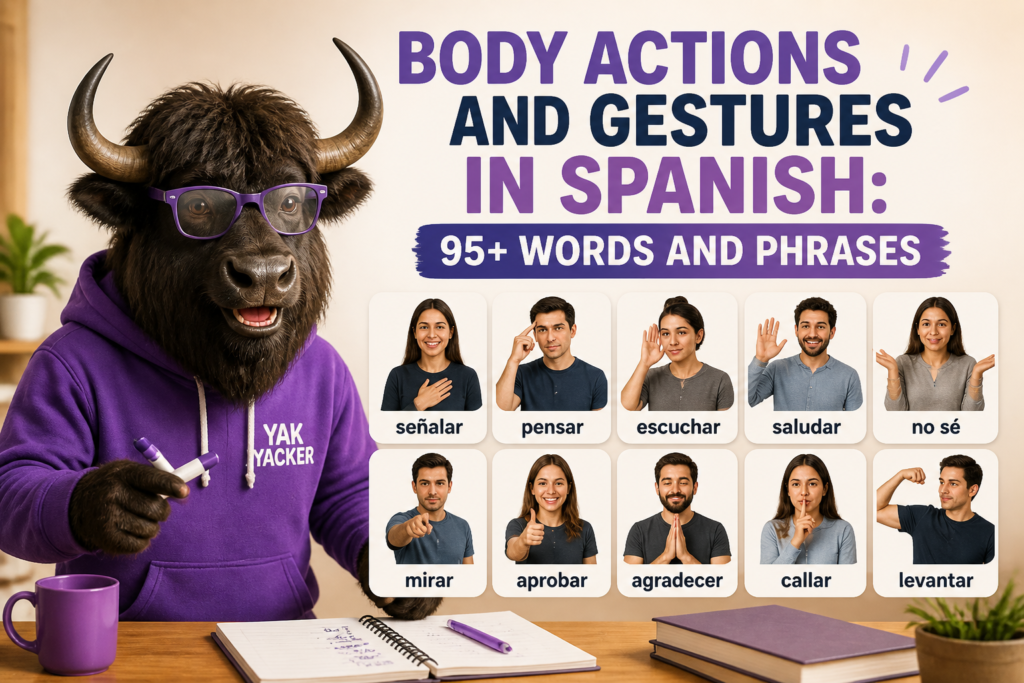
Some Spanish words are wonderfully literal. Others are the opposite, which is rude of them, honestly. If you want to talk about laughing, shrugging, pointing, waving, blushing, or giving someone the side-eye without resorting to dramatic mime, this guide has you covered.
By the end, you’ll know how to describe body actions and gestures in natural Spanish, with practical phrases you can actually use in real life. That means speaking more clearly, understanding native speakers faster, and looking a little less like you’re acting out a crime scene.
For a broader Spanish-learning path, you can also explore Yak Yacker’s Spanish hub.
Quick Note Before We Wave Our Arms Around
In Spanish, many body-action words are everyday verbs you’ll hear constantly: sonreír for “to smile,” señalar for “to point,” encogerse de hombros for “to shrug,” and cruzar los brazos for “to cross one’s arms.” Some are simple. Some are delightfully weird. Spanish does enjoy making one action into a whole little phrase.
Also, not every gesture means the same thing everywhere. A thumbs-up is usually fine across Latin America, but in some contexts it can still feel a bit casual. And yes, gestures can be regional, just like food, slang, and the eternal debate over where the best coffee lives.
Pronunciation tip: Spanish likes clean vowels. Say each one clearly: ah, eh, ee, oh, oo. Don’t mush them together like English often does.
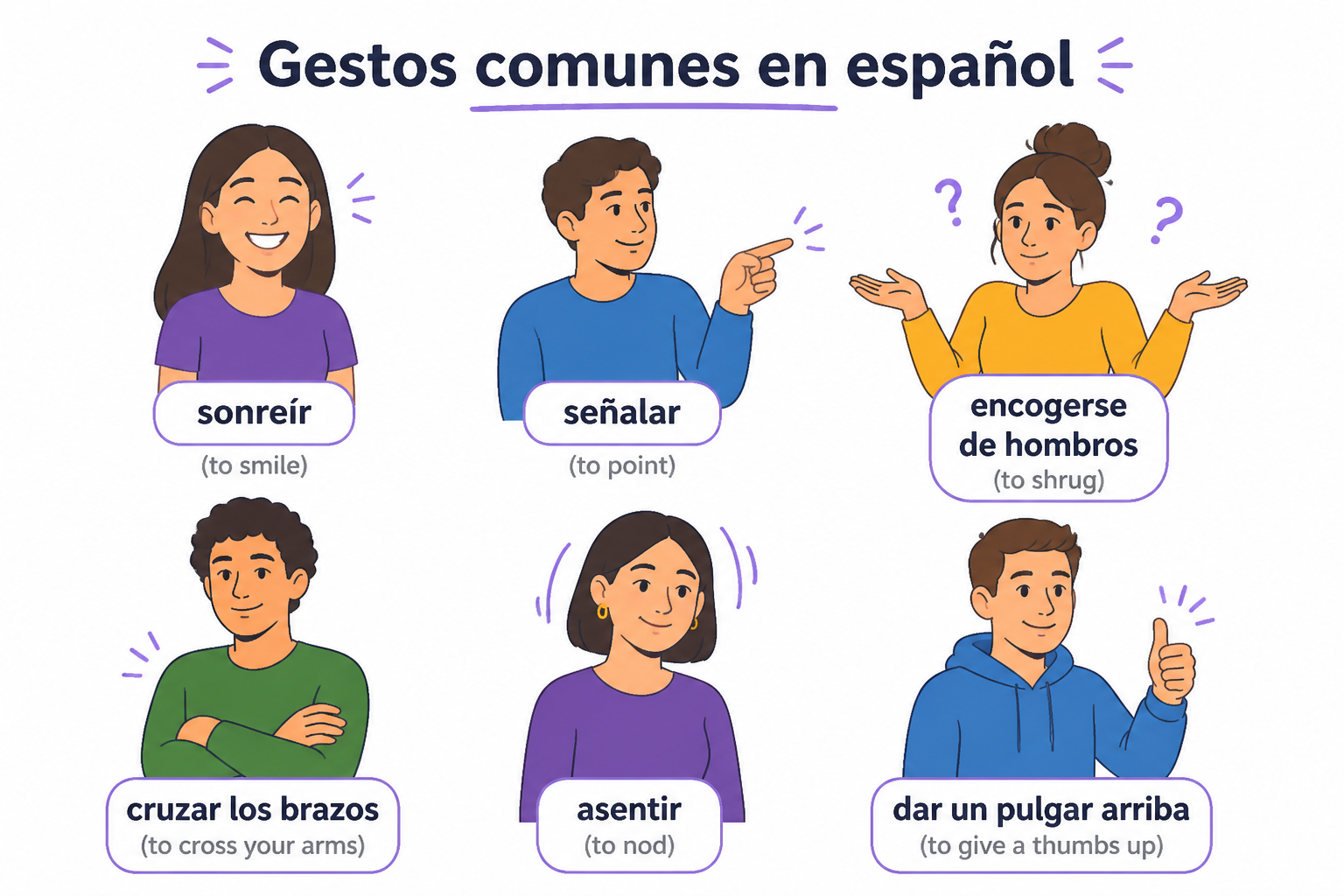
Core Body Actions In Spanish
Here are the most useful body-action verbs and phrases first. These are the ones you’ll actually see in conversation, instructions, storytelling, and everyday reactions.
| Spanish | Pronunciation | Meaning | Example Sentence | Translation | Learner Note |
|---|---|---|---|---|---|
| sonreír | sohn-reh-EER | to smile | Ella sonríe cuando oye buenas noticias. | She smiles when she hears good news. | The accent mark matters. It breaks the word into clear syllables. |
| reír | reh-EER | to laugh | Nos reímos mucho en la cena. | We laughed a lot at dinner. | Often used with reflexive forms: reírse. |
| llorar | yo-RAR | to cry | El bebé empezó a llorar. | The baby started to cry. | In most Latin American Spanish, ll sounds like a soft “y.” |
| parpadear | par-pah-deh-AR | to blink | Parpadea demasiado cuando está cansado. | He blinks too much when he is tired. | Good for describing eye behavior in stories or symptoms. |
| guiñar un ojo | gee-NYAR oon OH-ho | to wink | Me guiñó un ojo como si supiera un secreto. | He winked at me like he knew a secret. | Very common phrase. Literally “to wink an eye.” |
| mirar fijamente | mee-RAHR fee-hah-MEN-teh | to stare | No me mires fijamente, por favor. | Don’t stare at me, please. | Use carefully; it can sound intense or rude. |
| mirar de reojo | mee-RAHR deh reh-OH-ho | to glance sideways / side-eye | Me miró de reojo cuando hice la pregunta. | He gave me a side-eye when I asked the question. | Very handy for facial reactions and attitude. |
| señalar | seh-NYAH-lar | to point | Señaló la puerta con el dedo. | She pointed at the door with her finger. | The ñ sounds like the “ny” in “canyon.” |
| levantar la mano | leh-bahn-TAR lah MAH-no | to raise a hand | Levanté la mano para hacer una pregunta. | I raised my hand to ask a question. | Common in class, meetings, and group situations. |
| agitar la mano | ah-hee-TAR lah MAH-no | to wave one’s hand | Agitó la mano para despedirse. | He waved his hand to say goodbye. | Also used for quick signals or emphatic gestures. |
| saludar con la mano | sah-loo-DAR kohn lah MAH-no | to wave hello | Siempre saluda con la mano desde el coche. | He always waves hello from the car. | Neutral and very common. |
| aplaudir | ah-plow-DEER | to clap | Todos aplaudieron al final. | Everyone clapped at the end. | Watch the ll in related forms like aplauso (applause). |
| Spanish | Pronunciation | Meaning | Example Sentence | Translation | Learner Note |
|---|---|---|---|---|---|
| encogerse de hombros | en-koh-HER-seh deh OHM-bros | to shrug | Se encogió de hombros y no respondió. | He shrugged and didn’t answer. | Very common; literally “to shrink oneself of shoulders.” Spanish loves drama. |
| cruzarse de brazos | kroo-SAR-seh deh BRAH-sos | to cross one’s arms | Se cruzó de brazos mientras esperaba. | She crossed her arms while she waited. | Useful for describing attitude or impatience. |
| asentir con la cabeza | ah-sen-TEER kohn lah kah-BEH-sah | to nod | Asintió con la cabeza para decir que sí. | He nodded to say yes. | Often used in formal writing too. |
| negar con la cabeza | neh-GAR kohn lah kah-BEH-sah | to shake one’s head no | Negó con la cabeza antes de hablar. | She shook her head before speaking. | Clear and practical in stories and instructions. |
| inclinarse | een-klee-NAR-seh | to lean / bow | Se inclinó para recoger la llave. | He bent down to pick up the key. | Can mean a physical lean or a respectful bow. |
| agacharse | ah-gah-CHAR-seh | to bend down / crouch | Tuve que agacharme para entrar. | I had to bend down to get in. | Reflexive form is very common. |
| estirarse | eh-stee-RAR-seh | to stretch oneself | Se estiró después de dormir. | He stretched after sleeping. | Useful for body movement and comfort. |
| bostezar | bos-teh-ZAR | to yawn | Bostezó durante toda la clase. | He yawned during the whole class. | Very standard and easy to use. |
| estornudar | ehs-tohr-noo-DAR | to sneeze | Estornudó tres veces seguidas. | She sneezed three times in a row. | Handy in health or everyday conversation. |
| toser | toh-SER | to cough | Tose mucho cuando hace frío. | He coughs a lot when it’s cold. | Common in body, illness, and weather contexts. |
| respirar hondo | rehs-pee-RAR OHN-doh | to take a deep breath | Respiró hondo antes de entrar. | He took a deep breath before going in. | Useful for calming down, nerves, or tension. |
| volver a respirar | bohl-BEHR ah rehs-pee-RAR | to breathe again / recover breath | Necesitó unos segundos para volver a respirar. | He needed a few seconds to catch his breath. | Great for physical effort or stress. |
That’s already enough to describe a very expressive human being. But people rarely just “smile” or “nod” in isolation. They smile because of something, shrug instead of answering, or point while talking. So let’s build the useful phrases next.
Useful Gestures And Reaction Phrases
| Spanish | Pronunciation | Meaning | Example Sentence | Translation | Learner Note |
|---|---|---|---|---|---|
| hacer un gesto | ah-SEHR oon HES-toh | to make a gesture | Hizo un gesto con la mano. | He made a gesture with his hand. | Very general. You can specify the gesture after it. |
| hacer una mueca | ah-SEHR OO-nah MWEH-kah | to make a face / grimace | Hizo una mueca al probar la sopa. | She made a face when she tried the soup. | Common for disgust, pain, or annoyance. |
| poner cara de… | POH-ner KAH-rah deh | to look like / make a face like | Puso cara de sorpresa. | He looked surprised. | Great formula: cara de sueño, cara de enojo, etc. |
| abrir los ojos | ah-BREER los OH-hos | to open one’s eyes wide | Abrió los ojos al escuchar la noticia. | She opened her eyes wide when she heard the news. | Used for shock, surprise, or realization. |
| cerrar los ojos | seh-RAR los OH-hos | to close one’s eyes | Cerró los ojos para descansar un momento. | He closed his eyes to rest for a moment. | Very common and easy. |
| fruncir el ceño | froon-SEER el SEH-nyoh | to frown | Frunció el ceño cuando oyó la respuesta. | She frowned when she heard the answer. | Useful for confusion, displeasure, or suspicion. |
| guiñar | gee-NYAR | to wink | Le guiñó para bromear. | He winked at her to joke around. | Often appears as guiñar el ojo. |
| se tapó la boca | seh tah-POH lah BOH-kah | she/he covered the mouth | Se tapó la boca al reírse. | She covered her mouth while laughing. | Common with laughter, surprise, or politeness. |
| llevarse la mano a la boca | yeh-BAR-seh lah MAH-no ah lah BOH-kah | to bring a hand to one’s mouth | Se llevó la mano a la boca por vergüenza. | He brought his hand to his mouth out of embarrassment. | Often used in narratives. |
| tocar madera | toh-KAR mah-DEH-rah | to knock on wood | Lo he dicho, pero toco madera. | I’ve said it, but knock on wood. | Very useful cultural phrase; common in many Spanish-speaking places. |
| cruzar los dedos | kroo-SAR los DEH-dos | to cross one’s fingers | Cruzo los dedos para que todo salga bien. | I’m keeping my fingers crossed that everything goes well. | Works just like English, which is a rare treat. |
| encogerse de miedo | en-koh-HER-seh deh MYEH-doh | to shrink with fear | El niño se encogió de miedo. | The boy shrank with fear. | More descriptive than literal. |
Hands, Arms, And Upper-Body Actions
| Spanish | Pronunciation | Meaning | Example Sentence | Translation | Learner Note |
|---|---|---|---|---|---|
| dar la mano | dar lah MAH-no | to shake hands | Nos dimos la mano al presentarnos. | We shook hands when we introduced ourselves. | Very common in greetings and formal situations. |
| apretar la mano | ah-preh-TAR lah MAH-no | to squeeze / shake hands firmly | Me apretó la mano con fuerza. | He shook my hand firmly. | Good for describing intensity or pressure. |
| cruzar los brazos | kroo-SAR los BRAH-sos | to cross one’s arms | Se quedó cruzado de brazos todo el tiempo. | He kept standing there with his arms crossed the whole time. | Can suggest impatience or attitude. |
| levantar el pulgar | leh-bahn-TAR el pool-GAR | to give a thumbs-up | Levantó el pulgar para decir que estaba bien. | He gave a thumbs-up to say it was fine. | Usually clear in Latin America. |
| hacer señas | ah-SEHR SEH-nyas | to gesture / signal | Me hizo señas desde lejos. | She signaled to me from far away. | Very flexible and common. |
| mover la mano | moh-BEHR lah MAH-no | to move/wave the hand | Movió la mano para que me acercara. | He waved his hand for me to come closer. | Useful in directions and informal situations. |
| dar un abrazo | dar oon ah-BRAH-so | to give a hug | Me dio un abrazo al llegar. | He gave me a hug when I arrived. | Very common and warm; good for family and friends. |
| abrazar | ah-brah-SAR | to hug | La abuela la abrazó con cariño. | Grandma hugged her affectionately. | Related to abrazo (hug). |
| acariciar | ah-kah-ree-SYAR | to caress / stroke gently | Acarició al perro detrás de las orejas. | She stroked the dog behind the ears. | Gentle, affectionate, and very common with pets or children. |
| golpear | gohl-peh-AR | to hit / knock | Golpeó la mesa con la mano. | He hit the table with his hand. | Can be physical or just a tap/knock depending on context. |
| dar golpecitos | dar gohl-peh-SEE-tohs | to tap lightly | Le dio golpecitos en el hombro. | He tapped her on the shoulder. | Very useful for gentle actions. |
| apuntar con el dedo | ah-poon-TAR kohn el DEH-doh | to point with the finger | No apuntes con el dedo, que es de mala educación. | Don’t point with your finger; it’s rude. | Good cultural note: direct pointing can feel impolite in some settings. |
If you want more everyday Spanish around personal routines and visible body language, you may also like body care and hygiene in Spanish and clothing and accessories in Spanish.
Face And Eye Actions
| Spanish | Pronunciation | Meaning | Example Sentence | Translation | Learner Note |
|---|---|---|---|---|---|
| sonrojarse | sohn-roh-HAR-seh | to blush | Se sonrojó cuando recibió el cumplido. | She blushed when she received the compliment. | Great for embarrassment or shy moments. |
| ruborizarse | roo-boh-ree-ZAR-seh | to blush / become flushed | Se ruborizó un poco al hablar en público. | He blushed a little while speaking in public. | More formal than sonrojarse. |
| parpadear | par-pah-deh-AR | to blink | No parpadeó durante el chiste. | She didn’t blink during the joke. | Can be literal or dramatic in storytelling. |
| abrir los ojos como platos | ah-BREER los OH-hos koh-mo PLAH-tohs | to open eyes wide in surprise | Abrió los ojos como platos al ver el precio. | He opened his eyes wide when he saw the price. | Very natural idiom. Literally “like plates.” |
| guiñar el ojo | gee-NYAR el OH-ho | to wink | Me guiñó el ojo antes de entrar. | He winked at me before going in. | Can signal humor, flirting, or shared understanding. |
fruncir los labiosMore Spanish to explore Best graded readers for Spanish The Boy and the Sheep: A1 Beginner Spanish Story with Audio Martina the Little Cockroach: A1 Beginner Spanish Story with Audio Marianela: A B1 Intermediate Spanish Story with Audio |