


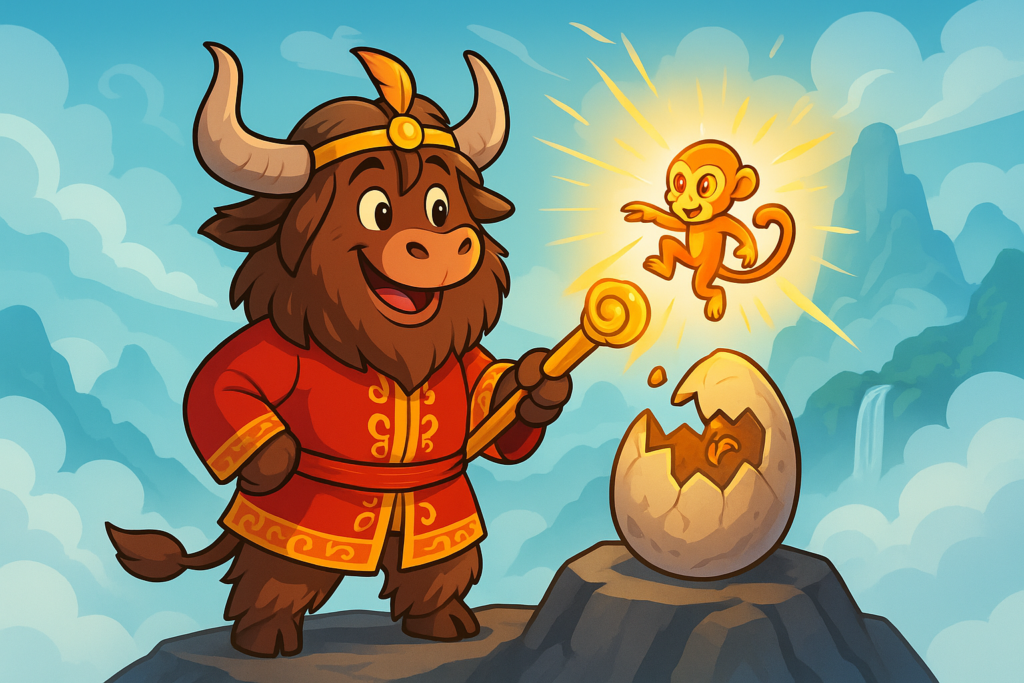
Meet the Monkey King, Sun Wukong, the legendary trickster hero of the classic Chinese tale <em>Journey to the West</em>. In this retelling, discover how he bursts forth from a magical stone egg, acquires his famous staff, and causes chaos in the Heavenly Palace.
With our free interactive reader, you can read the story at A2 Elementary level, tap any word for an instant translation, and listen along with the story audio. Lesson notes highlight key grammar and vocabulary, making it easy to learn Chinese while enjoying a timeless adventure.
从前,在花果山上,有一块大石头。有一天,石头突然裂开了,从里面跳出来一只小猴子。
一只老猴子说:"
大家都怕,不敢跳。石猴说:"我不怕!我去!" 他闭上眼睛,使劲跳进了瀑布。
石猴跳出来,高兴地说:"快来!里面很棒!" 猴子们跟着他跳进去,再也不打架了,开心地住下了。
Once upon a time, on Flower Fruit Mountain, there was a big rock. One day, the rock suddenly split open, and a little monkey jumped out.
This little monkey was special; he could jump very high and had great strength. He loved playing with other monkeys the most.
The monkeys liked to wrestle and play hide-and-seek. The stone monkey often hid where others couldn't find him.
One day, the weather was very hot, and the monkeys went to the river to play in the water. They saw a huge waterfall, water flowing down from high above.
An old monkey said, "What's behind the waterfall? Whoever dares to jump in and look, and comes back safely, we'll make him king."
Everyone was scared and didn't dare jump. The stone monkey said, "I'm not afraid! I'll go!" He closed his eyes and leaped into the waterfall with all his might.
Behind the waterfall was a big cave, beautiful like a palace! There were stone tables, stone chairs, and lots of delicious fruit.
The stone monkey jumped out and happily said, "Come quickly! It's wonderful inside!" The monkeys followed him inside, never fought again, and lived happily.
Everyone bowed to the stone monkey as king and called him "Handsome Monkey King." Later, the Handsome Monkey King got a magic staff that could grow big or small, called the Golden Cudgel.
Let's meet the words that give our tale its magic. These terms will help you talk about origins, bravery, and rulership in Chinese.
Pay attention to the characters, pinyin, and what they mean-try saying each aloud as you picture the Monkey King in action.
- 石头 (shítou) - stone
- 裂开 (liè kāi) - to split open
- 瀑布 (pùbù) - waterfall
- 王 (wáng) - king (as in 美猴王 Měihóu Wáng, the Handsome Monkey King)
Chinese verbs don't change for tense or subject, but they often team up with direction or result endings to paint a vivid picture.
- 跳 (tiào) - to jump. In the story, we see 跳进 (tiào jìn) - jump into. The 进 (jìn) tells us the direction: into the waterfall.
- 藏 (cáng) - to hide. The stone monkey loved to hide 在别人找不到的地方 (in places others couldn't find).
- 说 (shuō) - to say. Notice how the old monkey 说 '谁敢跳进去?' (said 'Who dares to jump in?').
- 拜 (bài) - to pay respect or worship. The monkeys 拜石猴为王 (bowed to the stone monkey, making him king).
Classical Chinese stories often open with 从前 (cóngqián), meaning 'once upon a time,' and use short, rhythmic sentences to build drama.
Adjectives become adverbs by adding 地 (de). For example, 高兴地说 (happily said) and 使劲地跳 (forcefully jumped) add flavor to the action.
- 从前 (cóngqián) - once upon a time (literally 'in the past').
- 突然 (tūrán) - suddenly, a go-to word for surprising turns.
- 再也不 (zài yě bù) - never again (as in 再也不打架了 - never fought again).
- 金箍棒 (jīngū bàng) - the legendary golden cudgel that can grow or shrink on command.
Now that you've seen how the Monkey King's story unfolds, try retelling it simply-or invent a tiny legend of your own. Even a few sentences build confidence.
You could start with: 从前,有一只特别的... 他能... 他喜欢... 有一天... 大家都... 后来... (Once upon a time, there was a special… He could… He liked… One day… Everyone… Afterwards…). Mix in the words from today's lesson and don't worry about perfection. The Monkey King himself started with one brave leap!
The Monkey King Is Born comes from the Chinese / Journey to the West tradition and is best known as a classic novel episode. This Yak Yacker article is an original learner retelling based on Journey to the West, 16th century; public domain, so the wording here is simplified for modern learners rather than copied from one old edition.
Older printings, translations, and retellings of this story can vary quite a bit. The original audience was usually kids/general, but this version is adapted for A2 Elementary learners studying Simplified Chinese. Use original novel/folk tradition, not modern animation details.
If you want to look into the source tradition, start with Project Gutenberg.
If you want to keep going, browse more in our Simplified Chinese section and review the HSK Level 1 Chinese Vocabulary. After that, try How to Ask Questions in Chinese for another useful next step.