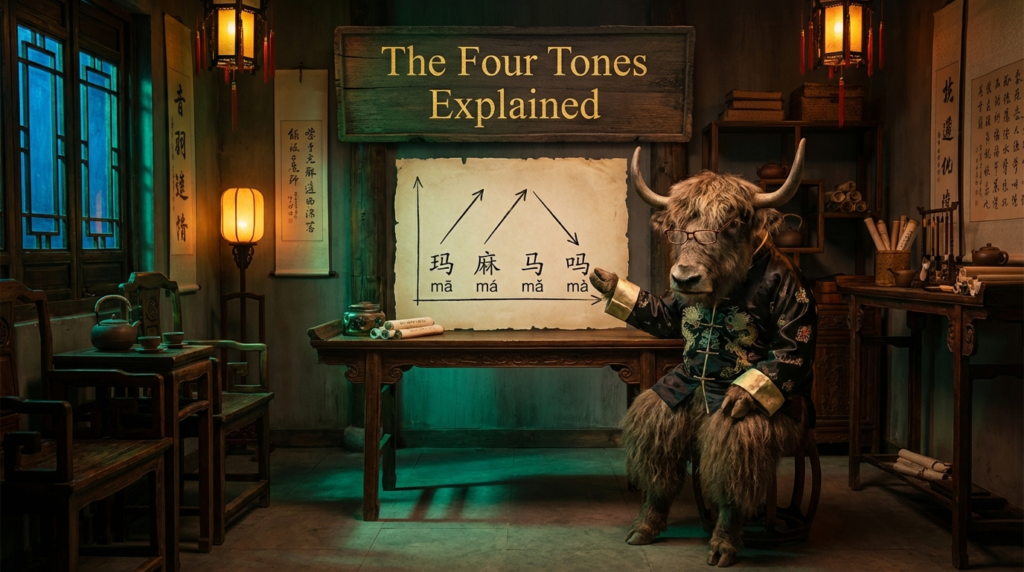
Mastering Chinese tones can feel like learning to sing a language before you speak it. This list of around 160 pronunciation essentials breaks down the four tones, the neutral tone, and common tone-change rules so you stop guessing and start sounding clear.
Each entry pairs a straightforward meaning with a practical example sentence, showing you exactly how the tone or sound pattern works in a real Chinese sentence. No dusty theory – just the patterns that show up when you order food, ask directions, or chat with friends.
Ready to make those tones less mysterious and a lot more friendly? Scroll to the bottom of this article for the free printable Chinese Pronunciation and Tones vocabulary list PDF and the free downloadable printable Chinese Pronunciation and Tones flashcards.
Use this list as a starting point, then keep going in the Yak Yacker Chinese section for more words, phrases, and study-friendly reference pages.
Quick Quiz
Think you can tell your má (hemp) from your mǎ (horse)? Take the quick quiz below to see how many tone patterns you’ve really locked in.
Keep building your Simplified Chinese
Choose a practical next step when you are ready.
Browse the Full List
| Word | Pinyin | Type | Meaning | Example |
|---|---|---|---|---|
| 卖 | mài | verb | to sell | 他卖电脑。 |
| 厨房 | chú fáng | noun | kitchen | 妈妈在厨房做饭。 |
| 去 | qù | verb | to go | 我去中国。 |
| 可以 | kě yǐ | modal verb | can / may | 我可以进来吗?,你不可以去。 |
| 司机 | sījī | noun | driver | 我爸爸是司机。 |
| 吃 | chī | verb | to eat | 我想吃苹果。 |
| 吃饭 | chī fàn | verb-object | to eat (a meal) | 你吃饭了吗? (Have you eaten?) |
| 名字 | míngzi | noun | name | 你叫什么名字? (What's your name?) 我的名字是大卫。 (My name is David.) |
| 吗 | ma | particle | question particle for yes/no questions | 你好吗? |
| 听 | tīng | verb | to listen | 请你听我说。 (Qǐng nǐ tīng wǒ shuō. Please listen to me.) |
| 咖啡 | kāfēi | noun | coffee | 我想喝咖啡。 |
| 哪儿 | nǎr | question word | where | 你在哪儿?,我们去哪儿? |
| 哪里 | nǎlǐ (pronounced nálǐ) | question word | where | 你去哪里? (Nǐ qù nǎlǐ?) |
| 唱歌 | chànggē | verb | sing | 他唱歌很好听。 |
| 商店 | shāngdiàn | noun | shop | 商店在哪儿? |
| 喜欢 | xǐ huan | verb | to like | 我喜欢中国菜。,你喜欢他吗? |
| 喝 | hē | verb | to drink | 他不喝茶。 |
| 喝水 | hē shuǐ | verb-object | to drink water | 我每天都喝水。 (I drink water every day.) |
| 四 | sì | number/word | four | 四月 (sì yuè) — April |
| 在 | zài | verb/preposition/adverb | at, in, on; to be at; indicates ongoing action | 我在家。 |
| 坐 | zuò | verb | to sit | 请坐。 |
| 多少 | duōshǎo | question word | how many; how much | 这个多少钱? (Zhège duōshǎo qián?) |
| 大 | dà | adjective | big | 这个苹果很大。 (Zhège píngguǒ hěn dà. This apple is big.) |
| 天气 | tiānqì | noun | weather | 今天天气很好。 |
| 太阳 | tàiyáng | noun | sun | 今天太阳很大。 |