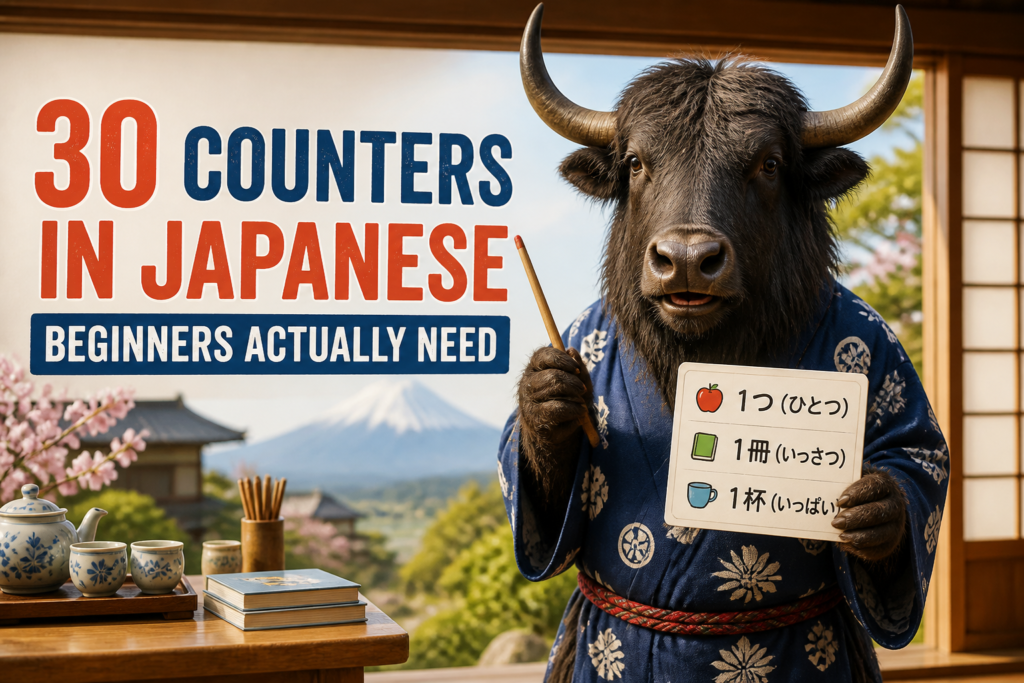
30 Common Counters in Japanese can feel a little dramatic at first. Japanese has a habit of making a simple thing like “three apples” look like a tiny grammar puzzle. Fun! But also mildly rude, because English just says “three apples” and moves on.
The good news: you do not need every counter on day one. You need the ones that show up constantly in real life. This guide gives you the everyday counters that help with people, things, books, flat objects, machines, and more. If you can count things naturally, your Japanese starts sounding much more real and less like a textbook trying too hard.
If you want a bigger study path after this, you can also check the main learn Japanese hub, plus the Japanese Placement Test and the Japanese Vocabulary Test. For extra practice, there are also pages for common Japanese counters and how to use Japanese counters. And yes, there is even another helpful lesson tucked away over there like a polite little grammar goblin.
Why Japanese Uses Counters
In Japanese, numbers usually need a counter after them. The counter changes depending on what you are counting. People use one counter, long thin objects use another, books use another, and so on. It is less “extra” than it sounds. Japanese is simply being specific. Annoying? Sometimes. Useful? Absolutely.
For example, “three books” is not just 三本, because books do not use the same counter as people or tiny round objects. Once you learn the pattern, though, it becomes very predictable:
- Number + Counter + noun
- Or just Number + Counter when the noun is already obvious
- Some counters are common in daily conversation, so they are worth memorizing first
For a quick official-style overview of the idea, the general concept is often called Japanese counter word. Boring link, useful idea. A surprisingly healthy combo.
The 30 Counters You Will Actually See
| Kanji | Rōmaji | Meaning | Example (Kanji) | Example (Rōmaji) | Translation (EN) |
|---|---|---|---|---|---|
| 一人 | hitori | one person | 一人です。 | Hitori desu. | It is one person. |
| 二人 | futari | two people | 二人で行きます。 | Futari de ikimasu. | We go as two people. |
| ~人 | ~nin | people | 三人います。 | San-nin imasu. | There are three people. |
| ~匹 | ~hiki | small animals | 猫が二匹います。 | Neko ga ni-hiki imasu. | There are two cats. |
| ~頭 | ~tō | large animals | 牛が一頭います。 | Ushi ga ittō imasu. | There is one cow. |
| ~羽 | ~wa | birds / rabbits | 鳥が三羽います。 | Tori ga san-wa imasu. | There are three birds. |
| ~本 | ~hon | long objects | ペンを一本買います。 | Pen o ippon kaimasu. | I will buy one pen. |
| ~冊 | ~satsu | books, notebooks | 本を二冊読みました。 | Hon o ni-satsu yomimashita. | I read two books. |
| ~枚 | ~mai | flat things | 紙が五枚あります。 | Kami ga go-mai arimasu. | There are five sheets of paper. |
| ~個 | ~ko | small round objects | りんごを三個ください。 | Ringo o san-ko kudasai. | Three apples, please. |
| ~つ | ~tsu | general counter, native Japanese | みかんを一つ食べます。 | Mikan o hitotsu tabemasu. | I will eat one mandarin orange. |
| ~台 | ~dai | machines, vehicles, equipment | 車が一台あります。 | Kuruma ga ichidai arimasu. | There is one car. |
| ~台 | ~dai | also for electronics | パソコンを二台使います。 | Pasokon o ni-dai tsukaimasu. | I use two computers. |
| ~階 | ~kai | floors of a building | 三階に行きます。 | San-kai ni ikimasu. | I am going to the third floor. |
| ~回 | ~kai | times, occurrences | 二回見ました。 | Ni-kai mimashita. | I watched it twice. |
| ~度 | ~do | degrees / times / frequency | もう一度言ってください。 | Mou ichido itte kudasai. | Please say it one more time. |
| ~時 | ~ji | o’clock / hour | 七時です。 | Shichi-ji desu. | It is seven o’clock. |
| ~分 | ~fun / ~pun | minutes | 十分快待ちます。 | Juppun machimasu. | I will wait ten minutes. |
| ~秒 | ~byō | seconds | 五秒で終わります。 | Go-byō de owarimasu. | It ends in five seconds. |
| ~日 | ~nichi | days of the month / duration | 十日休みます。 | Tōka yasumimasu. | I will rest for ten days / on the tenth day. |
| ~週間 | ~shūkan | weeks | 二週間勉強します。 | Ni-shūkan benkyō shimasu. | I will study for two weeks. |
| ~ヶ月 | ~kagetsu | months | 三ヶ月住みます。 | San-kagetsu sumimasu. | I will live there for three months. |
| ~年 | ~nen | years | 二年日本語を勉強しました。 | Ni-nen Nihongo o benkyō shimashita. | I studied Japanese for two years. |
| ~杯 | ~hai | cups, glasses, drinks | 水を一杯ください。 | Mizu o ippai kudasai. | One glass of water, please. |
| ~皿 | ~sara | plates, dishes | お皿が二皿あります。 | Osara ga ni-sara arimasu. | There are two plates. |
| ~足 | ~soku | pairs of footwear | 靴を一足買いました。 | Kutsu o issoku kaimashita. | I bought one pair of shoes. |
| ~着 | ~chaku | clothing items | シャツを三着持っています。 | Shatsu o san-chaku motte imasu. | I have three shirts. |
| ~室 | ~shitsu | rooms | 部屋が四室あります。 | Heya ga yon-shitsu arimasu. | There are four rooms. |
| ~ページ | ~pēji | pages | 十ページ読みました。 | Juppēji yomimashita. | I read ten pages. |
| ~本 | ~hon | bottles, sticks, tubes, some long items | 水を二本買います。 | Mizu o ni-hon kaimasu. | I will buy two bottles of water. |
Useful Counters In Real Life
Here are the counters you will meet most often in daily conversation. These are the ones that actually earn their keep.
| Kanji | Rōmaji | Meaning | Example (Kanji) | Example (Rōmaji) | Translation (EN) |
|---|---|---|---|---|---|
| ~人 | ~nin | people | 友達が四人います。 | Tomodachi ga yo-nin imasu. | I have four friends. |
| ~匹 | ~hiki | small animals | 犬が一匹います。 | Inu ga ippiki imasu. | There is one dog. |
| ~本 | ~hon | long items | 傘を一本持っています。 | Kasa o ippon motte imasu. | I am carrying one umbrella. |
| ~枚 | ~mai | flat things | 切符を二枚ください。 | Kippu o ni-mai kudasai. | Two tickets, please. |
| ~個 | ~ko | small objects | 卵を六個買いました。 | Tamago o roku-ko kaimashita. | I bought six eggs. |
| ~冊 | ~satsu | books | 雑誌を一冊読みます。 | Zasshi o issatsu yomimasu. | I will read one magazine. |
| ~台 | ~dai | machines / vehicles | 自転車が二台あります。 | Jitensha ga ni-dai arimasu. | There are two bicycles. |
| ~回 | ~kai | times | 三回練習します。 | San-kai renshū shimasu. | I will practice three times. |
| ~時 | ~ji | o’clock | 八時に会いましょう。 | Hachi-ji ni aimashou. | Let’s meet at eight. |
| ~分 | ~fun / ~pun | minutes | 十五分待ちます。 | Jūgo-fun machimasu. | I will wait fifteen minutes. |
How The Common Counter Patterns Work
The structure is usually simple:
- Number + Counter = the counting form
- Noun + が / を + Number + Counter = a full sentence
- Polite request form often uses ください
For example, if you want three apples, you say:
りんごを三個ください。
Ringo o san-ko kudasai.
Three apples, please.
That little counter 個 (ko) works for many small round-ish things. Not perfect science, more like useful language common sense. Japanese is polite, but it still likes shortcuts where possible.
Counter Groups That Help You Remember Faster
It is easier to remember counters by category than by random list. Your brain likes patterns. It is annoyingly efficient like that.
- People: 一人, 二人, ~人
- Animals: ~匹, ~頭, ~羽
- Long objects: ~本
- Flat things: ~枚
- Books and bound items: ~冊
- Small objects: ~個, ~つ
- Machines and vehicles: ~台
- Time: ~時, ~分, ~秒, ~日, ~週間, ~ヶ月, ~年
Special Counters With Common Everyday Use
| Kanji | Rōmaji | Meaning | Example (Kanji) | Example (Rōmaji) | Translation (EN) |
|---|---|---|---|---|---|
| ~階 | ~kai | floors | 二階です。 | Ni-kai desu. | It is the second floor. |
| ~回 | ~kai | times | 一回お願いします。 | Ik-kai onegaishimasu. | One time, please. |
| ~杯 | ~hai | cups / drinks | コーヒーを一杯飲みます。 | Kōhī o ippai nomimasu. | I will drink one cup of coffee. |
| ~足 | ~soku | pairs of shoes | 靴が三足あります。 | Kutsu ga san-zoku arimasu. | There are three pairs of shoes. |
| ~着 | ~chaku | clothes | コートを一着買いました。 | Kōto o itchaku kaimashita. | I bought one coat. |
| ~室 | ~shitsu | rooms | 会議室が二室あります。 | Kaigishitsu ga ni-shitsu arimasu. | There are two meeting rooms. |
| ~度 | ~do | degree / once more | もう一度見ます。 | Mou ichido mimasu. | I will look once more. |
| ~ページ | ~pēji | pages | 五ページ開いてください。 | Go-pēji hiraite kudasai. | Please open to page five. |
Mini Practice
Try swapping in the right counter. No cheating. Well, very little cheating.
- 1) 三___の本 → 三冊
- 2) 二___の犬 → 二匹
- 3) 四___の紙 → 四枚
- 4) 五___のペン → 五本
- 5) 六___の人 → 六人
- 6) 一___の車 → 一台
- 7) 七___の映画を見ました → 七回
- 8) 八___に行きます → 八階
Answers are easy if you remember the categories. People, books, flat things, long things, machines, times, floors. That is the whole trick pretending to be difficult.
Common Mistakes And Fixes
| Mistake | Why It Happens | Better Version |
|---|---|---|
| Using 個 for people | It feels like a general counter, but people need their own form | 一人, 二人, 三人 |
| Using 本 for every object | It is common in English-style thinking | Use 本 mainly for long things |
| Forgetting the counter completely | Very normal for beginners | Practice full patterns: number + counter |
| Mixing up 枚 and 冊 | Both can involve countable objects | 枚 = flat; 冊 = books / bound items |
| Using the wrong sound | Some counters change pronunciation | Memorize common combos like ippun, issatsu, ippon |
That pronunciation shift is the part that surprises people. For example, 一本 becomes ippon, not ichi-hon. Japanese likes sound changes. Tiny plot twist. Very efficient, very irritating.
Quick Reference Summary
- People: 人
- Animals: 匹, 頭, 羽
- Long objects: 本
- Books: 冊
- Flat things: 枚
- Small objects: 個, つ
- Machines / vehicles: 台
- Time and dates: 時, 分, 秒, 日, 週間, ヶ月, 年
- Other useful ones: 階, 回, 度, 杯, 足, 着, 室, ページ
If you want a simple study order, start with 人, 匹, 本, 枚, 個, 冊, and 台. Then add time counters. Then add the special ones when you meet them in real life. That is the sane way. A rare and beautiful thing.
Mastering counters is one of those Japanese milestones that suddenly makes everything sound more natural. It is not about memorizing 300 rules on a heroic weekend. It is about learning the common patterns first, using them often, and letting your brain stop treating numbers like suspicious furniture.