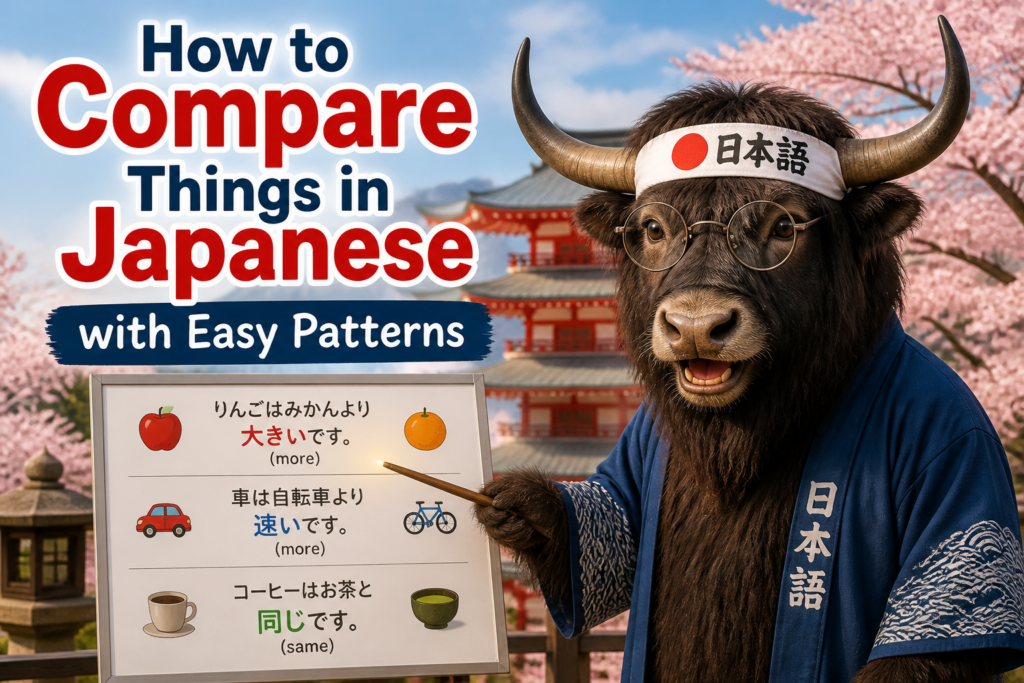
Japanese comparison is actually pretty friendly once you stop trying to wrestle it into English shape. The language likes neat patterns, and once you learn the core ones, you can compare almost anything: food, people, prices, sizes, speed, feelings, and the occasional mountain of laundry. A classic Japanese learning moment: you think “this will be complicated,” and then the grammar politely shows up with a simple pattern instead. Rude of it, honestly.
This guide shows you how to compare things in Japanese with more, less, and the same patterns. You will learn the key words, the sentence shapes, and the small grammar tricks that keep your comparisons natural. If you want a broad study path after this, the main learning hub is here: Japanese Learning Hub.
We will keep the English simple, the Japanese clear, and the examples useful. Because grammar is much less annoying when it behaves like a tool instead of a mystery box.
Core Comparison Patterns
Japanese often compares things with a basic structure using より (yori, “than”), ほうが (hō ga, “is more / is better”), ほど (hodo, “as … as / to the degree of”), and a few words like もっと (motto, “more”), 少し (sukoshi, “a little”), and 同じ (onaji, “same”).
The good news: the pattern is usually more important than the exact English wording. The not-so-dramatic news: Japanese does not always compare things in the same order English does. Tiny shift, big payoff.
More Than
〜より (yori) marks the thing you are comparing against, like “than.”
〜のほうが (~ no hō ga) means “… is more …” or “… is better …” and is often the most natural way to compare two things.
Pattern: A は B より adjective です。
Romanization: A wa B yori adjective desu.
Meaning: A is more adjective than B.
Pattern: A のほうが adjective です。
Romanization: A no hō ga adjective desu.
Meaning: A is more adjective.
Example: この本はあの本よりおもしろいです。
Romanization: Kono hon wa ano hon yori omoshiroi desu.
English: This book is more interesting than that book.
Example: この本のほうがおもしろいです。
Romanization: Kono hon no hō ga omoshiroi desu.
English: This book is more interesting.
Less Than
For “less than,” Japanese often uses より with a negative adjective or a smaller amount.
Pattern: A は B より adjective ではありません。
Romanization: A wa B yori adjective de wa arimasen.
Meaning: A is not as adjective as B.
Pattern: A は B より 少ないです。
Romanization: A wa B yori sukunai desu.
Meaning: A is less / fewer than B.
Example: 今日は昨日より寒くありません。
Romanization: Kyō wa kinō yori samuku arimasen.
English: Today is not as cold as yesterday.
Example: この町は東京より静かです。
Romanization: Kono machi wa Tōkyō yori shizuka desu.
English: This town is quieter than Tokyo.
Same As
同じ (onaji) means “same,” and と同じ (to onaji) means “the same as.”
Pattern: A は B と同じです。
Romanization: A wa B to onaji desu.
Meaning: A is the same as B.
Example: 私のかばんはあなたのと同じです。
Romanization: Watashi no kaban wa anata no to onaji desu.
English: My bag is the same as yours.
Example: このサイズはあのサイズと同じです。
Romanization: Kono saizu wa ano saizu to onaji desu.
English: This size is the same as that size.
How Much More or Less
Japanese can also compare amounts with もっと (motto, more), 少し (sukoshi, a little), and ずっと (zutto, much / by far).
Example: もっとゆっくり話してください。
Romanization: Motto yukkuri hanashite kudasai.
English: Please speak more slowly.
Example: 少し安いです。
Romanization: Sukoshi yasui desu.
English: It is a little cheaper.
Example: 彼は私よりずっと背が高いです。
Romanization: Kare wa watashi yori zutto se ga takai desu.
English: He is much taller than me.
Useful Comparison Phrases
| Kanji | Rōmaji | English Meaning | Example Sentence |
|---|---|---|---|
| より | yori | than | この店はあの店より安いです。 Kono mise wa ano mise yori yasui desu. This shop is cheaper than that shop. |
| ほうが | hō ga | is more / is better | コーヒーのほうが好きです。 Kōhī no hō ga suki desu. I like coffee more. |
| 同じ | onaji | same | 二人は同じクラスです。 Futari wa onaji kurasu desu. The two are in the same class. |
| もっと | motto | more | もっと静かにしてください。 Motto shizuka ni shite kudasai. Please be quieter. |
| 少し | sukoshi | a little | 少し寒いです。 Sukoshi samui desu. It is a little cold. |
| ずっと | zutto | much / far more | 駅は思ったよりずっと近いです。 Eki wa omotta yori zutto chikai desu. The station is much closer than I thought. |
| あまり | amari | not very / not much | 今日はあまり暑くないです。 Kyō wa amari atsuku nai desu. It is not very hot today. |
| 同じくらい | onaji kurai | about the same amount | このかばんはあのかばんと同じくらい重いです。 Kono kaban wa ano kaban to onaji kurai omoi desu. This bag is about as heavy as that one. |
| 以上 | ijō | more than / at least | 三人以上います。 San-nin ijō imasu. There are at least three people. |
| 以下 | ika | less than / at most | 五人以下です。 Go-nin ika desu. It is five people or fewer. |
| 前より | mae yori | than before | 前より元気です。 Mae yori genki desu. I am more energetic than before. |
| 思ったより | omotta yori | than I thought | この問題は思ったより簡単です。 Kono mondai wa omotta yori kantan desu. This problem is easier than I thought. |
More Example Patterns You Will Actually Use
| Kanji | Rōmaji | English Meaning | Example Sentence |
|---|---|---|---|
| この車はあの車より大きいです。 | Kono kuruma wa ano kuruma yori ōkii desu. | This car is bigger than that car. | Size comparison with adjective + より |
| この映画のほうが長いです。 | Kono eiga no hō ga nagai desu. | This movie is longer. | Natural “A is more…” pattern |
| 彼女は私より背が高いです。 | Kanojo wa watashi yori se ga takai desu. | She is taller than me. | Person comparison with body feature |
| このケーキはあのケーキほど甘くないです。 | Kono kēki wa ano kēki hodo amaku nai desu. | This cake is not as sweet as that cake. | “Not as … as” pattern |
| この部屋は前より明るいです。 | Kono heya wa mae yori akarui desu. | This room is brighter than before. | Change over time |
| 日本語は英語より難しいです。 | Nihongo wa Eigo yori muzukashii desu. | Japanese is harder than English. | Classic language comparison |
| このほうがいいです。 | Kono hō ga ii desu. | This one is better. | Common choice expression |
| どちらも同じくらい好きです。 | Dochira mo onaji kurai suki desu. | I like both about equally. | Equal preference |
| 今日は昨日より暖かいです。 | Kyō wa kinō yori atatakai desu. | Today is warmer than yesterday. | Weather comparison |
| この問題はあの問題より簡単です。 | Kono mondai wa ano mondai yori kantan desu. | This problem is easier than that problem. | Difficulty comparison |
Important Comparison Words
| Kanji | Rōmaji | English Meaning | Example |
|---|---|---|---|
| 大きい | ōkii | big | この箱は大きいです。 Kono hako wa ōkii desu. This box is big. |
| 小さい | chiisai | small | この家は小さいです。 Kono ie wa chiisai desu. This house is small. |
| 高い | takai | tall / high / expensive | この本は高いです。 Kono hon wa takai desu. This book is expensive. |
| 安い | yasui | cheap | この店は安いです。 Kono mise wa yasui desu. This store is cheap. |
| 速い | hayai | fast | この電車は速いです。 Kono densha wa hayai desu. This train is fast. |
| 遅い | osoi | slow | 彼は遅いです。 Kare wa osoi desu. He is slow. |
| 長い | nagai | long | この道は長いです。 Kono michi wa nagai desu. This road is long. |
| 短い | mijikai | short | この映画は短いです。 Kono eiga wa mijikai desu. This movie is short. |
| 重い | omoi | heavy | このかばんは重いです。 Kono kaban wa omoi desu. This bag is heavy. |
| 軽い | karui | light | この箱は軽いです。 Kono hako wa karui desu. This box is light. |
| 多い | ōi | many / a lot | 人が多いです。 Hito ga ōi desu. There are many people. |
| 少ない | sukunai | few / little | 時間が少ないです。 Jikan ga sukunai desu. There is little time. |
How To Use より And のほうが
These two are the heart of comparison in Japanese. If you learn only one thing from this article, make it this: より points to the standard of comparison, and のほうが often marks the side you prefer or the side that has more of the quality.
Rule: The thing with のほうが is the one being emphasized as more/greater. The thing with より is the “than” side.
| Pattern | Meaning | Example Sentence | Rōmaji | English |
|---|---|---|---|---|
| A は B より adjective です。 | A is more adjective than B. | このりんごはそのりんごより大きいです。 | Kono ringo wa sono ringo yori ōkii desu. | This apple is bigger than that apple. |
| A のほうが adjective です。 | A is more adjective. | このりんごのほうが大きいです。 | Kono ringo no hō ga ōkii desu. | This apple is bigger. |
| A は B より adjective ではありません。 | A is not as adjective as B. | この部屋はあの部屋より広くありません。 | Kono heya wa ano heya yori hiroku arimasen. | This room is not as spacious as that room. |
| A のほうが adjective ですか。 | Is A more adjective? | こちらのほうが安いですか。 | Kochira no hō ga yasui desu ka. | Is this one cheaper? |
Yes, Japanese can be this tidy. It just likes to act mysterious first.
Same As With と同じ And 同じくらい
When two things are equal, Japanese usually uses と同じ (to onaji) or 同じくらい (onaji kurai).
と同じ is very direct: “the same as.”
同じくらい means “about the same” or “roughly equal.” It is softer and more natural when exact equality is not important.
| Pattern | Meaning | Example Sentence | Rōmaji | English |
|---|---|---|---|---|
| A は B と同じです。 | A is the same as B. | この傘はあの傘と同じです。 | Kono kasa wa ano kasa to onaji desu. | This umbrella is the same as that umbrella. |
| A は B と同じくらい adjective です。 | A is about as adjective as B. | この道はあの道と同じくらい長いです。 | Kono michi wa ano michi to onaji kurai nagai desu. | This road is about as long as that road. |
| A も B も同じです。 | Both A and B are the same. | どちらも同じです。 | Dochira mo onaji desu. | Both are the same. |
More, Less, And “Not Very”
Japanese often uses degree words instead of very exact comparison. That is convenient when you want to sound natural and not like a robot doing algebra in a kimono.
| Kanji | Rōmaji | English Meaning | Example Sentence |
|---|---|---|---|
| もっと | motto | more | もっと安いのはありますか。 Motto yasui no wa arimasu ka. Do you have something cheaper? |
| 少し | sukoshi | a little | 少し疲れています。 Sukoshi tsukarete imasu. I am a little tired. |
| ずっと | zutto | much / a lot | このほうがずっといいです。 Kono hō ga zutto ii desu. This one is much better. |
| あまり | amari | not very | 今日はあまり忙しくないです。 Kyō wa amari isogashiku nai desu. Today is not very busy. |
| かなり | kanari | quite / considerably | この映画はかなり長いです。 Kono eiga wa kanari nagai desu. This movie is quite long. |
| とても | totemo | very | この問題はとても難しいです。 Kono mondai wa totemo muzukashii desu. This problem is very difficult. |
Useful Real-Life Comparison Sentences
Here are practical examples you can steal for everyday life. Linguistically speaking, “steal” is acceptable because grammar wants to be used, not admired from a distance.
- この店はあの店より安いです。
Kono mise wa ano mise yori yasui desu.
This store is cheaper than that store. - この宿題のほうが難しいです。
Kono shukudai no hō ga muzukashii desu.
This homework is harder. - 昨日より今日は寒いです。
Kinō yori kyō wa samui desu.
Today is colder than yesterday. - 彼のほうが早く着きます。
Kare no hō ga hayaku tsukimasu.
He arrives earlier. - このコーヒーはあのコーヒーよりおいしいです。
Kono kōhī wa ano kōhī yori oishii desu.
This coffee is tastier than that coffee. - この映画はあの映画ほど長くありません。
Kono eiga wa ano eiga hodo nagaku arimasen.
This movie is not as long as that movie. - 私の日本語は前より少し上手です。
Watashi no Nihongo wa mae yori sukoshi jōzu desu.
My Japanese is a little better than before. - この部屋はとても広いです。
Kono heya wa totemo hiroi desu.
This room is very spacious. - この机はあの机と同じです。
Kono tsukue wa ano tsukue to onaji desu.
This desk is the same as that desk. - 日本語は思ったより簡単です。
Nihongo wa omotta yori kantan desu.
Japanese is easier than I thought. - 彼女は私よりずっと忙しいです。
Kanojo wa watashi yori zutto isogashii desu.
She is much busier than me. - この問題はあまり難しくないです。
Kono mondai wa amari muzukashiku nai desu.
This problem is not very difficult.
Common Mistakes And Easy Fixes
Comparison grammar is not hard, but it does love tiny traps. Here are the usual ones.
Mistake: Using より alone and expecting it to work like English “than.”
Fix: Pair it with a full comparison sentence.
Mistake: Saying このほうが大きいです without clear context.
Fix: Use このりんごのほうが大きいです or add the comparison partner.
Mistake: Mixing up “same” and “similar.”
Fix: 同じ means the same, not just similar. For “similar,” try 似ています (nite imasu). Example: この二つは似ています。 Kono futatsu wa nite imasu. These two are similar.
Mistake: Forgetting that some adjectives change form before より or ほど.
Fix: Use the adverb form when needed: 高い → 高く, 安い → 安く.
Mistake: Trying to translate every English comparison word literally.
Fix: Focus on the Japanese pattern. Japanese likes structure more than drama.
Mini Practice
Try filling in the blank with the right comparison word or pattern.
- この本はあの本( )おもしろいです。
Kono hon wa ano hon ( ) omoshiroi desu.
This book is more interesting than that book. - このバッグの( )が好きです。
Kono baggu no ( ) ga suki desu.
I like this bag more. - この部屋はあの部屋と( )です。
Kono heya wa ano heya to ( ) desu.
This room is the same as that room. - 今日は昨日より( )寒いです。
Kyō wa kinō yori ( ) samui desu.
Today is a little colder than yesterday. - この映画はあの映画( )長くありません。
Kono eiga wa ano eiga ( ) nagaku arimasen.
This movie is not as long as that movie.
Answers: より / ほう / 同じ / ずっと or 少し / ほど
Quick Reference Summary
- より = than
- のほうが = is more / is better
- 同じ = same
- と同じ = the same as
- 同じくらい = about the same
- ほど = as … as / to the degree of
- もっと = more
- 少し = a little
- ずっと = much / far more
- あまり〜ない = not very …
If you want a quick way to remember this, think: より for “than,” のほうが for “this side is more,” and 同じ for “same.” That trio does a shocking amount of work.
For more practice after this lesson, a good next step is checking your level with the Japanese Placement Test JLPT or the Japanese Vocabulary Test. You can also continue with related grammar topics like questions in Japanese and want in Japanese. If you enjoy digging into sentence patterns, this related lesson may also help: another Japanese lesson.
Comparison in Japanese is not about memorizing a giant pile of rules. It is about seeing the shape: what you compare, what you compare it to, and whether it is more, less, or the same. Once that clicks, the language gets a lot friendlier. Not perfect. Just friendlier.