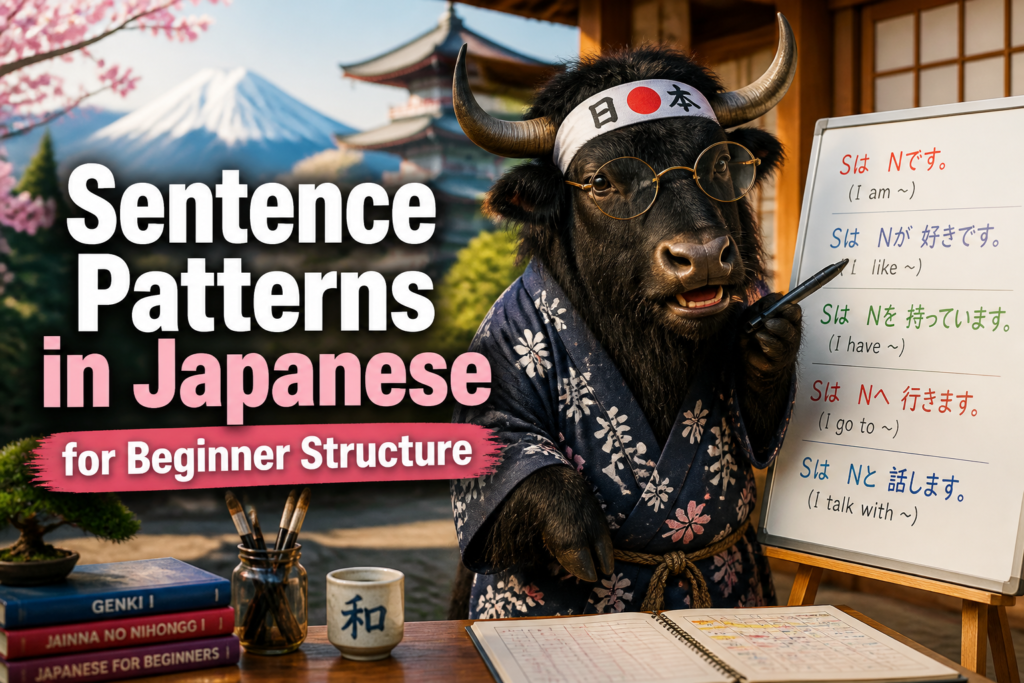
Japanese Sentence Pattern Chart for Basic Beginner Sentence Structures is the kind of guide that saves learners from staring at a sentence like it owes them money. Japanese is not hard because it is random. It just likes a different order. Once the basic patterns click, everything starts to feel a lot less mysterious and a lot more manageable.
If you have ever heard Japanese and thought, “Wait, where is the verb?” the answer is: usually at the end, because Japanese enjoys suspense. This article gives you the most useful beginner sentence patterns with Kanji, Rōmaji, English meaning, and real examples so you can start building your own sentences without guessing wildly.
For a useful companion lesson, see Questions in Japanese. And if you want a broader study path, the main guide lives here: Learn Japanese.
The Big Idea
Japanese beginner sentences often follow a simple shape:
Topic / Subject + Object + Time / Place + Verb
That is not a strict “one true rule,” but it is a very helpful starting point. The verb usually comes last, and particles like は (wa) and を (o) do the heavy lifting. English likes word order. Japanese likes particles. Everyone has their quirks.
Japanese does not need to show off with word order. The particles are doing the paperwork.
Core Beginner Sentence Patterns
Below are the most useful sentence patterns for beginners. Each one includes the Japanese pattern, Rōmaji, and the English meaning. After that, you will see real example sentences you can copy and reuse.
| Pattern | Rōmaji | English Meaning |
|---|---|---|
| A は B です | A wa B desu | A is B |
| A は B ではありません | A wa B dewa arimasen | A is not B |
| A は B ですか | A wa B desu ka | Is A B? |
| A が あります | A ga arimasu | There is / there are A |
| A が います | A ga imasu | There is / there are (living) A |
| A を B ます | A o B masu | Do B to A |
| A で B ます | A de B masu | Do B at / with / in A |
| A に 行きます | A ni ikimasu | Go to A |
| A に 来ます | A ni kimasu | Come to A |
| A が 好きです | A ga suki desu | Like A |
| A が ありますか | A ga arimasu ka | Do you have A? / Is there A? |
| A は どこですか | A wa doko desu ka | Where is A? |
1. Noun + です
This is the easiest beginner pattern. It works like “A is B.” You can use it for identity, description, nationality, jobs, and simple self-introductions.
私 は 学生 です。
Watashi wa gakusei desu.
I am a student.
田中 さん は 先生 です。
Tanaka-san wa sensei desu.
Mr. Tanaka is a teacher.
これは 本 です。
Kore wa hon desu.
This is a book.
Useful words in this pattern:
- 私 — watashi — I / me
- 学生 — gakusei — student
- 先生 — sensei — teacher
- 本 — hon — book
- これ — kore — this
2. Negative Form: ではありません
To make a polite negative sentence, use ではありません (dewa arimasen). In casual speech, you may also hear じゃないです (ja nai desu), but beginners should learn the polite form first.
私 は 学生 ではありません。
Watashi wa gakusei dewa arimasen.
I am not a student.
これは 日本語 ではありません。
Kore wa Nihongo dewa arimasen.
This is not Japanese.
あの 人 は 先生 ではありません。
Ano hito wa sensei dewa arimasen.
That person is not a teacher.
3. Question Pattern: ですか
Add か (ka) to make a question. That is the clean beginner version of “Is it?” or “Are you?” No dramatic hand gestures required.
あなた は 学生 ですか。
Anata wa gakusei desu ka.
Are you a student?
これは 本 ですか。
Kore wa hon desu ka.
Is this a book?
東京 は 日本 の 首都 ですか。
Tōkyō wa Nihon no shuto desu ka.
Is Tokyo the capital of Japan?
For more question practice, the related guide Questions in Japanese is a very solid next stop.
4. Existence: あります And います
These two patterns mean “there is” or “there are,” but they are not interchangeable.
あります (arimasu) is for things, plants, and non-living things.
います (imasu) is for people and animals.
机 の 上 に 本 が あります。
Tukue no ue ni hon ga arimasu.
There is a book on the desk.
部屋 に 猫 が います。
Heya ni neko ga imasu.
There is a cat in the room.
公園 に 木 が あります。
Kōen ni ki ga arimasu.
There are trees in the park.
公園 に 子ども が います。
Kōen ni kodomo ga imasu.
There are children in the park.
5. Action Sentence: を + Verb
This is one of the most important beginner patterns. The particle を marks the object of the action.
ご飯 を 食べます。
Gohan o tabemasu.
I eat rice / a meal.
本 を 読みます。
Hon o yomimasu.
I read a book.
映画 を 見ます。
Eiga o mimasu.
I watch a movie.
水 を 飲みます。
Mizu o nomimasu.
I drink water.
6. Place And Action: で + Verb
Use で (de) to show the place where an action happens. This is a super common beginner pattern.
図書館 で 勉強します。
Toshokan de benkyō shimasu.
I study at the library.
家 で 休みます。
Ie de yasumimasu.
I rest at home.
駅 で 友だち に 会います。
Eki de tomodachi ni aimasu.
I meet my friend at the station.
学校 で 日本語 を 勉強します。
Gakkō de Nihongo o benkyō shimasu.
I study Japanese at school.
7. Direction And Destination: に + Verb
The particle に (ni) often marks destination, target, or time. For beginners, the easiest use is destination with verbs like 行きます (ikimasu) and 来ます (kimasu).
学校 に 行きます。
Gakkō ni ikimasu.
I go to school.
日本 に 行きたいです。
Nihon ni ikitai desu.
I want to go to Japan.
友だち が 家 に 来ます。
Tomodachi ga ie ni kimasu.
My friend comes to my house.
六 時 に 起きます。
Roku-ji ni okimasu.
I wake up at six o’clock.
8. Likes And Dislikes
Use が 好きです (ga suki desu) for likes. The particle here is が, not を. Yes, Japanese likes to keep learners awake.
猫 が 好きです。
Neko ga suki desu.
I like cats.
日本語 が 好きです。
Nihongo ga suki desu.
I like Japanese.
寿司 が 好きです。
Sushi ga suki desu.
I like sushi.
映画 が 好きではありません。
Eiga ga suki dewa arimasen.
I do not like movies.
9. Possession And Having Things
To say “I have…” or “There is…” in a possession sense, use あります. The pattern often looks like A が あります.
お金 が あります。
Okane ga arimasu.
I have money.
時間 が あります。
Jikan ga arimasu.
I have time.
質問 が あります。
Shitsumon ga arimasu.
I have a question.
兄 が います。
Ani ga imasu.
I have an older brother.
10. Useful Beginner Pattern Chart
| Kanji | Rōmaji | Meaning | Example | English |
|---|---|---|---|---|
| 私は学生です | Watashi wa gakusei desu | I am a student | 私 は 学生 です。 | I am a student. |
| 本を読みます | Hon o yomimasu | Read a book | 本 を 読みます。 | I read a book. |
| 学校に行きます | Gakkō ni ikimasu | Go to school | 学校 に 行きます。 | I go to school. |
| 図書館で勉強します | Toshokan de benkyō shimasu | Study at the library | 図書館 で 勉強します。 | I study at the library. |
| 猫が好きです | Neko ga suki desu | Like cats | 猫 が 好きです。 | I like cats. |
| 質問があります | Shitsumon ga arimasu | Have a question | 質問 が あります。 | I have a question. |
Common Mistakes And Fixes
Beginner sentence patterns are simple, but a few mistakes show up again and again. No shame. These are extremely normal.
- Mistake: using English word order too rigidly.
Fix: remember the verb usually goes at the end. - Mistake: using を after “go to.”
Fix: use に with destinations: 学校 に 行きます. - Mistake: using います for objects.
Fix: use あります for non-living things. - Mistake: mixing up は and が in every sentence.
Fix: start with pattern memory first, then learn nuance later. - Mistake: forgetting the polite ending です or verb form.
Fix: make sure the sentence feels complete and polite.
Quick Practice
Try to build these sentences using the patterns above. Say them out loud. Yes, out loud. Languages are annoying like that.
- “I am a teacher.” → 私は先生です。 / Watashi wa sensei desu.
- “I read a book.” → 本を読みます。 / Hon o yomimasu.
- “I go to the station.” → 駅に行きます。 / Eki ni ikimasu.
- “I study at home.” → 家で勉強します。 / Ie de benkyō shimasu.
- “I like tea.” → お茶が好きです。 / Ocha ga suki desu.
- “There is a cat.” → 猫がいます。 / Neko ga imasu.
- “Do you have time?” → 時間がありますか。 / Jikan ga arimasu ka.
- “This is not a pen.” → これはペンではありません。 / Kore wa pen dewa arimasen.
Easy Reference Summary
| Use | Pattern | Example |
|---|---|---|
| Identity | A は B です | 私は学生です。 |
| Negative | A は B ではありません | 私は学生ではありません。 |
| Question | A は B ですか | これは本ですか。 |
| Existence of things | A が あります | 本があります。 |
| Existence of people / animals | A が います | 猫がいます。 |
| Object + verb | A を B ます | 水を飲みます。 |
| Place + action | A で B ます | 図書館で勉強します。 |
| Destination | A に 行きます | 学校に行きます。 |
| Preference | A が 好きです | 日本語が好きです。 |
Once these sentence patterns feel familiar, Japanese stops looking like a puzzle with missing pieces and starts looking like a system. A very polite, very orderly system. The kind that quietly expects you to use particles correctly and then rewards you with clarity when you do.
Keep this chart close, practice with real nouns you already know, and start with simple sentences before trying to sound impressive. Impressive comes later. Clear comes first, which is much more useful anyway.