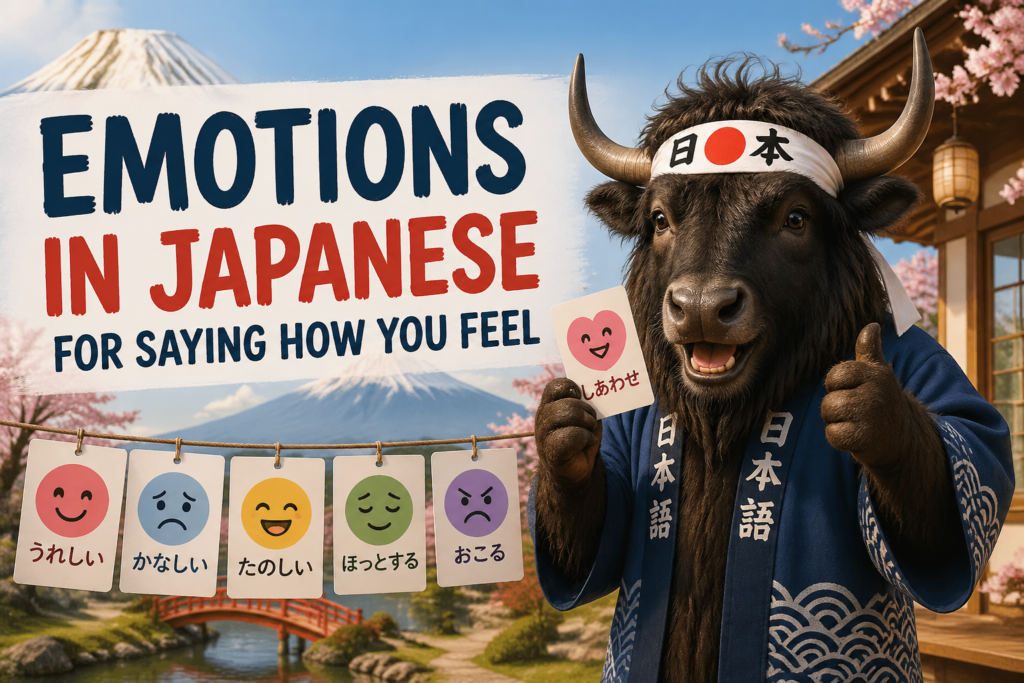
Emotions in Japanese can be surprisingly direct, or politely vague, depending on the situation. Japanese speakers do not always announce feelings with big dramatic fireworks. Sometimes the real message is tucked into a tiny word, a softer tone, or a humble “I’m fine” that definitely does not mean fine. Fun, right?
For the broader learning path, visit our parent guide.
If you already know basic greetings like how to ask “How are you?” in Japanese, this lesson helps you answer with real feeling. We will look at common emotion words, useful phrases, and natural example sentences so you can talk about happiness, sadness, anger, worry, and more without sounding like a robot with a dictionary.
Japanese emotion words often use different grammar depending on whether the feeling is yours, someone else’s, or just a temporary reaction. That is one of those tiny language things that seems innocent at first and then quietly turns into a whole lesson. Luckily, we can make it simple.
Common Emotion Words And Phrases
| Kanji | Rōmaji | English Meaning | Example Sentence |
|---|---|---|---|
| 嬉しい | ureshii | happy; glad | 嬉しいです。 / Ureshii desu. / I’m happy. |
| 楽しい | tanoshii | fun; enjoyable | この映画は楽しいです。 / Kono eiga wa tanoshii desu. / This movie is fun. |
| 悲しい | kanashii | sad | 悲しいです。 / Kanashii desu. / I’m sad. |
| 怒る | okoru | to get angry | 彼は怒りました。 / Kare wa okorimashita. / He got angry. |
| 腹が立つ | hara ga tatsu | to get angry; to be annoyed | その言い方に腹が立ちます。 / Sono iikata ni hara ga tachimasu. / That way of speaking annoys me. |
| 驚く | odoroku | to be surprised | とても驚きました。 / Totemo odorokimashita. / I was very surprised. |
| 怖い | kowai | scary; afraid | 暗い道は怖いです。 / Kurai michi wa kowai desu. / Dark roads are scary. |
| 緊張する | kinchō suru | to feel nervous | 面接で緊張します。 / Mensetsu de kinchō shimasu. / I get nervous in interviews. |
| 恥ずかしい | hazukashii | embarrassed; shy | 名前を忘れて恥ずかしかったです。 / Namae o wasurete hazukashikatta desu. / I was embarrassed because I forgot the name. |
| 安心する | anshin suru | to feel relieved | 無事だと聞いて安心しました。 / Buji da to kīte anshin shimashita. / I felt relieved to hear you were safe. |
| がっかりする | gakkari suru | to feel disappointed | 結果を見てがっかりしました。 / Kekka o mite gakkari shimashita. / I felt disappointed after seeing the result. |
| 寂しい | sabishii | lonely; lonely feeling | 一人だと寂しいです。 / Hitori da to sabishii desu. / I feel lonely when I am alone. |
Here is the first little twist: some emotion words are “adjectives” like 嬉しい (ureshii) and 悲しい (kanashii), while others are verbs like 安心する (anshin suru) and 緊張する (kinchō suru). In English, they all feel like “I am happy” or “I feel nervous.” In Japanese, the grammar does a bit more of the work.
Useful Emotion Phrases For Real Life
| Kanji | Rōmaji | English Meaning | Example Sentence |
|---|---|---|---|
| とても嬉しいです | totemo ureshii desu | I’m very happy | 合格してとても嬉しいです。 / Gōkaku shite totemo ureshii desu. / I’m very happy because I passed. |
| 本当に楽しいです | hontō ni tanoshii desu | It’s really fun | このパーティーは本当に楽しいです。 / Kono pātī wa hontō ni tanoshii desu. / This party is really fun. |
| 少し悲しいです | sukoshi kanashii desu | I’m a little sad | 友だちが帰って少し悲しいです。 / Tomodachi ga kaette sukoshi kanashii desu. / I’m a little sad that my friend left. |
| あまり嬉しくないです | amari ureshiku nai desu | I’m not very happy | 結果があまり嬉しくないです。 / Kekka ga amari ureshiku nai desu. / I’m not very happy about the result. |
| ちょっと怒っています | chotto okotte imasu | I’m a little angry | 待たされてちょっと怒っています。 / Matasarete chotto okotte imasu. / I’m a little angry because I was made to wait. |
| びっくりしました | bikkuri shimashita | I was surprised | プレゼントをもらってびっくりしました。 / Purezento o moratte bikkuri shimashita. / I was surprised to receive a present. |
| 怖くないです | kowaku nai desu | It is not scary; I’m not afraid | この映画は怖くないです。 / Kono eiga wa kowaku nai desu. / This movie is not scary. |
| 緊張しません | kinchō shimasen | I’m not nervous | もう面接で緊張しません。 / Mō mensetsu de kinchō shimasen. / I’m not nervous in interviews anymore. |
| 恥ずかしいです | hazukashii desu | I’m embarrassed; shy | みんなの前で話すのは恥ずかしいです。 / Minna no mae de hanasu no wa hazukashii desu. / Speaking in front of everyone is embarrassing. |
| 安心しました | anshin shimashita | I felt relieved | メールが来て安心しました。 / Mēru ga kite anshin shimashita. / I felt relieved when the email arrived. |
| がっかりしました | gakkari shimashita | I felt disappointed | 雨でイベントが中止になってがっかりしました。 / Ame de ibento ga chūshi ni natte gakkari shimashita. / I felt disappointed because the event was canceled due to rain. |
| さびしいです | sabishii desu | I feel lonely | 一人暮らしはさびしいです。 / Hitorigurashi wa sabishii desu. / Living alone feels lonely. |
How To Say Your Feelings Naturally
When you want to talk about your feelings in Japanese, the safest pattern is often: emotion word + です or emotion verb + ます. Simple, polite, and very usable. No dramatic poetry required, unless you want it.
For example:
- 嬉しいです — ureshii desu — I’m happy.
- 悲しいです — kanashii desu — I’m sad.
- 緊張します — kinchō shimasu — I feel nervous.
- 安心します — anshin shimasu — I feel relieved.
- 驚きました — odorokimashita — I was surprised.
A useful pattern for stronger feeling is とても (totemo, very) or 少し (sukoshi, a little). Japanese often prefers a softer style, so instead of declaring “I am furious” at full volume, people may say ちょっと怒っています (chotto okotte imasu) — “I’m a little angry.” That tiny ちょっと does a lot of social work.
Emotion Words You Will Hear All The Time
| Kanji | Rōmaji | Meaning | Example |
|---|---|---|---|
| 嬉しい | ureshii | happy, glad | 今日は嬉しい日です。 / Kyō wa ureshii hi desu. / Today is a happy day. |
| 楽しい | tanoshii | fun, enjoyable | 友だちと話すのは楽しいです。 / Tomodachi to hanasu no wa tanoshii desu. / Talking with friends is fun. |
| 悲しい | kanashii | sad | その話は悲しいです。 / Sono hanashi wa kanashii desu. / That story is sad. |
| 怒る | okoru | to get angry | 彼女はよく怒ります。 / Kanojo wa yoku okorimasu. / She gets angry often. |
| 怖い | kowai | scary, afraid | 私は高い所が怖いです。 / Watashi wa takai tokoro ga kowai desu. / I’m afraid of heights. |
| 恥ずかしい | hazukashii | embarrassed, shy | そんなことを言われて恥ずかしいです。 / Sonna koto o iwarete hazukashii desu. / I’m embarrassed to be told something like that. |
| 寂しい | sabishii | lonely | 夜は少し寂しいです。 / Yoru wa sukoshi sabishii desu. / Nights feel a little lonely. |
| 驚く | odoroku | to be surprised | そのニュースに驚きました。 / Sono nyūsu ni odorokimashita. / I was surprised by that news. |
| 安心する | anshin suru | to feel relieved | 家に着いて安心しました。 / Ie ni tsuite anshin shimashita. / I felt relieved after arriving home. |
| がっかりする | gakkari suru | to feel disappointed | 試合に負けてがっかりしました。 / Shiai ni makete gakkari shimashita. / I felt disappointed after losing the match. |
| 緊張する | kinchō suru | to feel nervous | 初日はいつも緊張します。 / Shonichi wa itsumo kinchō shimasu. / I’m always nervous on the first day. |
| ほっとする | hotto suru | to feel relieved; to feel at ease | テストが終わってほっとしました。 / Tesuto ga owatte hotto shimashita. / I felt relieved when the test ended. |
Curious Bit: Feelings And Context
One thing that surprises learners is that Japanese often describes the situation that causes the feeling, not only the feeling itself. So instead of just saying “I’m nervous,” you may hear 面接で緊張します (mensetsu de kinchō shimasu) — “I get nervous in interviews.” The context matters, because language enjoys being helpful in an annoyingly sensible way.
Another handy note: 嬉しい (ureshii) is usually used for your own feeling, while 嬉しそう (ureshisō) means “looks happy.” That small ending -そう is useful when talking about someone else’s emotion based on appearance.
| Pattern | Meaning | Example |
|---|---|---|
| 嬉しいです | I’m happy | プレゼントをもらって嬉しいです。 / Purezento o moratte ureshii desu. / I’m happy because I received a present. |
| 嬉しそうです | looks happy | 彼は嬉しそうです。 / Kare wa ureshisō desu. / He looks happy. |
| 悲しいです | I’m sad | 別れは悲しいです。 / Wakare wa kanashii desu. / Goodbyes are sad. |
| 悲しそうです | looks sad | 彼女は悲しそうです。 / Kanojo wa kanashisō desu. / She looks sad. |
Practice: Swap The Feeling Word
Try replacing the emotion word in each sentence with another one from this lesson. Keep the grammar the same. Yes, this is the part where your brain gets a tiny workout. It will survive.
- 今日は嬉しいです。 / Kyō wa ureshii desu. / I’m happy today.
- 今日は悲しいです。 / Kyō wa kanashii desu. / I’m sad today.
- 今日は楽しいです。 / Kyō wa tanoshii desu. / Today is fun.
- 今日はちょっと緊張します。 / Kyō wa chotto kinchō shimasu. / I’m a little nervous today.
- 今日は安心しました。 / Kyō wa anshin shimashita. / I felt relieved today.
Now try making your own sentence with one of these starters:
- 私は…が嬉しいです。 / Watashi wa … ga ureshii desu. / I’m happy about …
- 私は…で悲しいです。 / Watashi wa … de kanashii desu. / I’m sad because of …
- 私は…で緊張します。 / Watashi wa … de kinchō shimasu. / I get nervous because of …
- 私は…を見て驚きました。 / Watashi wa … o mite odorokimashita. / I was surprised when I saw …
Common Mistakes And Fixes
| Common Mistake | Better Version | Why |
|---|---|---|
| 私は嬉しい。 | 私は嬉しいです。 | Add です for polite, natural everyday speech. |
| 私は緊張です。 | 私は緊張します。 | 緊張する is the correct verb for “to feel nervous.” |
| 彼は悲しいです。 | 彼は悲しそうです。 or 彼は悲しいです。 | Use -そう when you are judging by appearance. |
| 私は怒るです。 | 私は怒っています。 | Use the correct form of the verb, often 怒っています for “I’m angry.” |
| 怖いです。 only for objects | この映画は怖いです。 / 私は犬が怖いです。 | 怖い can mean “scary” or “I’m afraid of.” Context does the heavy lifting. |
If you want a clean overview of related Japanese grammar and expression patterns, the learn Japanese hub is a useful place to keep wandering around.
Japanese emotion words are often softer than English ones. If you feel a lot, you can still say it. But in many situations, saying it calmly sounds more natural than shouting it from the rooftops like you just won a very small emotional lottery.
Quick Reference Summary
- 嬉しい (ureshii) = happy, glad
- 楽しい (tanoshii) = fun, enjoyable
- 悲しい (kanashii) = sad
- 怒る (okoru) / 腹が立つ (hara ga tatsu) = to get angry, to be annoyed
- 驚く (odoroku) = to be surprised
- 怖い (kowai) = scary, afraid
- 緊張する (kinchō suru) = to feel nervous
- 恥ずかしい (hazukashii) = embarrassed, shy
- 安心する (anshin suru) = to feel relieved
- がっかりする (gakkari suru) = to feel disappointed
- 寂しい (sabishii) = lonely
- ほっとする (hotto suru) = to feel relieved, at ease
When you speak about feelings in Japanese, keep it simple, clear, and natural. Use the basic emotion word, add a little context, and choose polite forms when needed. That is usually enough to sound thoughtful without trying too hard. And honestly, that is the sweet spot in language learning.
For one more related conversation practice, check the article linked here: this Japanese lesson. It pairs nicely with emotion words because feelings love showing up in real conversations, not just vocabulary charts.