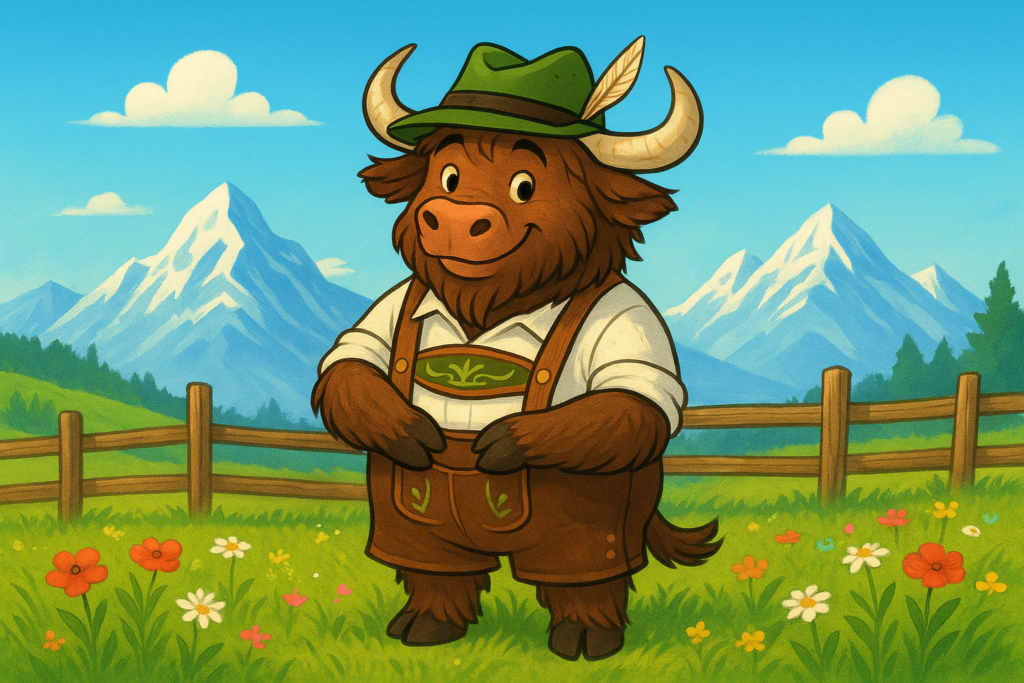
Meet Heidi, a cheerful orphan who goes to live with her grumpy grandfather high in the Swiss Alps. At first, he isn't sure about having a child around, but Heidi's sunny nature soon brightens his lonely life. She explores the flower-filled meadows with her goat-herding friend Peter, and the two have many simple adventures under the wide blue sky.
But then her aunt arrives to take Heidi to the city, where she must be a companion to a sickly girl named Clara. Heidi struggles with city life and misses her mountains terribly. This gentle, uplifting story is told in elementary German (A2 level) with audio narration, so you can listen as you read.
Every word is clickable for quick translations, and built-in lesson notes highlight useful phrases and grammar. It's a free, stress-free way to improve your German while enjoying a classic tale.
Heidi war ein mit , braunem Haar. Sie lebte bei ihrem Großvater in den . Die und die Wiesen waren voller bunter Blumen.
Der Großvater war ein alter Mann mit einem langen, weißen Bart. Viele Leute fanden ihn , aber er . Jeden Morgen tranken sie zusammen von den Ziegen.
Heidi verbrachte ihre Tage mit Peter, dem Ziegenhirten. Die Sonne und die Vögel in den Bäumen. Heidi lachte und rief: "Peter, die Welt ist so !"
"Pass auf, Heidi! Deine Lieblingsziege !" antwortete Peter. Heidi den grünen Hügel hinunter. "Komm zurück, kleine Ziege!", rief sie .
Eines Tages kam eine Tante und brachte Heidi in die große Stadt Frankfurt. Heidi war sehr . Die machten ihr . "Großvater, ich will nach Hause!", flüsterte sie, aber niemand hörte sie.
In Frankfurt wohnte Clara, ein krankes Mädchen im Rollstuhl. Clara war und zeigte Heidi die Stadt. Aber Heidi sah immer und von den grünen Bergen und dem blauen Himmel.
Heidi wurde krank vom . Sie aß kaum und wurde . Der Doktor sagte: "Das Mädchen muss zurück in die ." Endlich stieg Heidi in den Zug und fuhr nach Hause.
Als Heidi auf der ankam, sah sie den Großvater. Sie und weinte vor Freude. "Ach, Großvater, ich bin so glücklich!" rief sie. Der Großvater hatte und hielt sie fest.
Einige Wochen später besuchte Clara die Berge. Die und die warme Sonne taten ihr gut. Mit Peters Hilfe machte Clara ihre ersten . Heidi jubelte: "Clara, du kannst gehen! Es ist ein !" Alle waren .
Heidi was a little girl with curly brown hair. She lived with her grandfather in the high mountains. The air was fresh and the meadows were full of colorful flowers.
The grandfather was an old man with a long white beard. Many people found him strict, but he loved Heidi very much. Every morning they drank fresh milk from the goats together.
Heidi spent her days outside with Peter, the goatherd. The sun shone warmly and the birds sang in the trees. Heidi laughed and called out: "Peter, the world is so beautiful!"
"Look out, Heidi! Your favorite goat is running away!" answered Peter. Heidi ran quickly down the green hill. "Come back, little goat!" she called cheerfully.
One day an aunt came and brought Heidi to the big city of Frankfurt. Heidi was very sad. The tall gray houses frightened her. "Grandfather, I want to go home!" she whispered, but no one heard her.
In Frankfurt lived Clara, a sick girl in a wheelchair. Clara was friendly and showed Heidi the city. But Heidi always looked out the window and dreamed of the green mountains and the blue sky.
Heidi became sick from homesickness. She barely ate and became thin and pale. The doctor said: "The girl must go back to the fresh mountain air." Finally Heidi got on the train and traveled home.
When Heidi arrived at the alpine pasture, she saw the grandfather. She ran into his arms and wept for joy. "Oh, Grandfather, I am so happy!" she cried. The grandfather had tears in his eyes and held her tight.
A few weeks later Clara visited the mountains. The clear air and warm sun did her good. With Peter's help Clara took her first steps. Heidi cheered: "Clara, you can walk! It's a miracle!" Everyone was overjoyed.
This story is full of useful A2 vocabulary, especially words about nature, family, and feelings. Pay attention to how these words color the scenes.
Here are some key words and phrases that appear in the story. Try saying them aloud to practice pronunciation.
- der Großvater (grandfather), die Ziege (goat), der Ziegenhirte (goatherd)
- die Wiese (meadow), der Hügel (hill), die Berge (mountains), die Luft (air)
- frisch (fresh), bunt (colorful), grün (green), klar (clear), warm (warm), grau (grey)
- traurig (sad), glücklich (happy), fröhlich (cheerful), Heimweh (homesickness)
In written German stories, the simple past tense (Präteritum) is the natural choice. Unlike everyday speech, where the present perfect (Perfekt) is common, the Präteritum gives narratives a flowing, timeless feel.
Notice the most frequent verbs from the story: 'sein' (war), 'haben' (hatte), and regular verbs like 'leben' (lebte) or 'sagen' (sagte). These forms are the backbone of German storytelling.
- Heidi *war* ein kleines Mädchen. (Heidi was a little girl.)
- Der Großvater *hatte* einen langen, weißen Bart. (Grandfather had a long white beard.)
- Sie *lebte* bei ihrem Großvater. (She lived with her grandfather.)
- Peter *antwortete*: "Pass auf, Heidi!" (Peter answered: "Watch out, Heidi!")
This story shines because of its simple yet vivid descriptions. The adjectives bring the Alps to life and show us exactly how the characters feel.
Look at how 'voller' is used to mean 'full of', and how adjectives match the nouns in gender and case. These patterns will help you build your own colorful sentences.
- die hohen Berge – the high mountains
- die Wiesen voller bunter Blumen – the meadows full of colorful flowers
- die klare Luft und die warme Sonne – the clear air and the warm sun
- Sie war traurig / glücklich / krank. – She was sad / happy / sick.
Now that you've followed Heidi from mountain meadows to city streets and back again, try describing a place you love in German. Borrow words and phrases from the story – even a few simple sentences will build your confidence.
Next time you read a short German story, underline the Präteritum verbs and the adjectives. Little observations like these will make your German more fluent and natural without much effort.
- Describe your own 'Lieblingsort' (favorite place) using adjectives from the story.
- Re-read the story and circle all the past-tense verbs – notice the pattern.
- Write two sentences about yesterday's weather in Präteritum, e.g. 'Gestern *war* es warm.'
Heidi: An Alpine Adventure comes from an older public-domain story tradition and is best known as a public_domain_children_story_retelling. This Yak Yacker article is an original learner retelling based on public-domain source material, so the wording here is simplified for modern learners rather than copied from one old edition.
Older printings, translations, and retellings of this story can vary quite a bit. This version is adapted for A2 Elementary learners studying German.
If you want to keep going, browse more in our German section and review the Goethe A1 German Vocabulary. After that, try German Adjective Endings for another useful next step.