


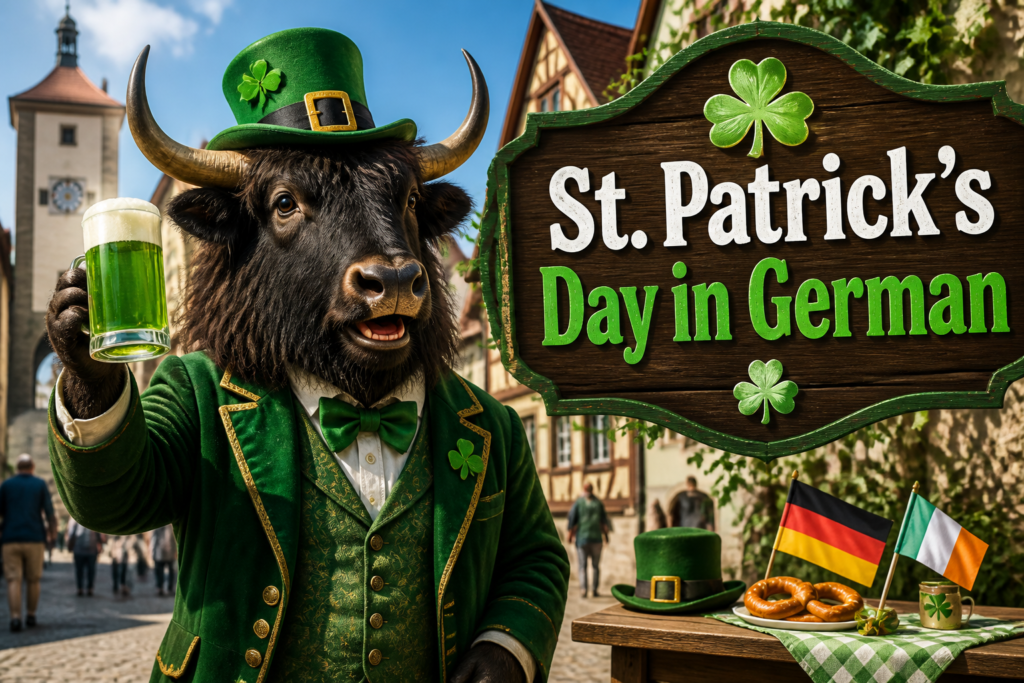
If you want to talk about St. Patrick’s Day in German, the good news is that the holiday name itself is usually just borrowed straight from English: St. Patrick’s Day. Germans will also say der St.-Patrick’s-Day or, more simply in a sentence, am St. Patrick’s Day. Yes, the apostrophe survives. German does enjoy borrowing English and then pretending it invented the thing.
This guide gives you practical German phrases for talking about the holiday, the colors, the parties, the food, and the little bit of culture that goes with it. By the end, you’ll be able to describe St. Patrick’s Day naturally, ask simple questions, and sound like a person who knows more than just Grün and Bier.
Quick Starter: The Most Useful Words
| German | Pronunciation | Meaning | Example Sentence | Translation | Learner Note |
|---|---|---|---|---|---|
| St. Patrick’s Day | shuhnt pahr-triks day | St. Patrick’s Day | Am St. Patrick’s Day tragen viele Leute Grün. | On St. Patrick’s Day, many people wear green. | Usually borrowed from English in German. |
| der Feiertag | FY-er-tahk | holiday, public holiday | Ist St. Patrick’s Day ein Feiertag in Deutschland? | Is St. Patrick’s Day a holiday in Germany? | Feiertag can mean a public holiday or a general holiday. |
| grün | groon | green | Die Stadt ist an dem Tag oft grün beleuchtet. | The city is often lit up green on that day. | Very important color for this holiday. |
| das Grün | groon | the green color | Das Grün ist überall: auf Kleidung, Deko und Plakaten. | The green is everywhere: on clothes, decorations, and posters. | Noun version of the color. Capitalized. |
| das Bier | beer | beer | Viele gehen am Abend etwas Bier trinken. | Many people go out to drink some beer in the evening. | Common party word. Gender: neuter. |
| feiern | FY-er-en | to celebrate, party | Wir feiern heute im Irish Pub. | We’re celebrating today in the Irish pub. | Very useful everyday verb. |
| das Fest | fest | festival, celebration, party | In vielen Städten gibt es ein kleines Fest. | In many cities there is a small festival. | Good general word for a celebration. |
| der Umzug | OOM-tsook | parade, procession | Der Umzug beginnt um 15 Uhr. | The parade starts at 3 p.m. | One of those useful German words that does not look like its meaning. |
| die Parade | pah-RAH-duh | parade | Die Parade ist klein, aber sehr bunt. | The parade is small, but very colorful. | Often used for a more festive, borrowed feel. |
| das Kostüm | kos-TOOM | costume | Einige tragen ein grünes Kostüm. | Some people wear a green costume. | Useful for parties and themed events. |
| der Leprechaun | LEP-reh-kown | leprechaun | Der Leprechaun ist ein typisches Symbol für Irland. | The leprechaun is a typical symbol of Ireland. | Often said the same way as in English. |
| Irland | EER-lant | Ireland | St. Patrick’s Day kommt aus Irland. | St. Patrick’s Day comes from Ireland. | Country name: no article in many contexts. |
How Germans Usually Talk About The Holiday
St. Patrick’s Day is not a big traditional holiday in German-speaking countries the way it is in Ireland or in some English-speaking places. In Germany, it is mostly a themed celebration, a pub event, or a city-lighting moment. That means the language you need is often simple and practical: talk about the date, the color green, the party, and the place.
If you want to check the date in German, this related guide helps: What Day Is It In German. For greetings that fit a holiday text or a pub chat, see Useful German Greetings.
And yes, if you want a boring but reliable background on the holiday itself, Wikipedia can fill in the obvious bits without drama. Sometimes the most useful source is the one that doesn’t try to be charming.
Useful Phrases For St. Patrick’s Day
Here are the phrases you’ll actually use when talking about St. Patrick’s Day in German, whether you’re going to a pub, texting a friend, or describing the whole thing to someone who has never worn a novelty shamrock in their life.
| German | Pronunciation | Meaning | Example Sentence | Translation | Learner Note |
|---|---|---|---|---|---|
| Frohen St. Patrick’s Day! | FROH-en shuhnt pahr-triks day | Happy St. Patrick’s Day! | Frohen St. Patrick’s Day! Viel Spaß heute Abend! | Happy St. Patrick’s Day! Have fun tonight! | This is understandable and friendly, even if borrowed from English. |
| Alles Gute zum St. Patrick’s Day! | AH-les GOO-tuh tsoom … | Best wishes for St. Patrick’s Day! | Alles Gute zum St. Patrick’s Day! Ich hoffe, ihr feiert schön. | Best wishes for St. Patrick’s Day! I hope you celebrate nicely. | Natural if you want a German-style greeting. |
| Wir feiern St. Patrick’s Day. | veer FY-er-n shuhnt pahr-triks day | We’re celebrating St. Patrick’s Day. | Wir feiern St. Patrick’s Day im Irish Pub. | We’re celebrating St. Patrick’s Day at the Irish pub. | Simple and very common. |
| Heute ist St. Patrick’s Day. | HOY-tuh ist … | Today is St. Patrick’s Day. | Heute ist St. Patrick’s Day. Die Stadt ist schon voll grün. | Today is St. Patrick’s Day. The city is already full of green. | Great for dates and announcements. |
| Es ist grün überall. | es ist groon oober-ALL | It’s green everywhere. | Am Abend ist es grün überall: Kleidung, Deko, Lichter. | In the evening, it’s green everywhere: clothes, decorations, lights. | Not perfect idiomatic German, but very clear. |
| grün beleuchtet | groon beh-LOYK-tet | lit up in green | Das Rathaus ist oft grün beleuchtet. | The town hall is often lit up green. | Useful for city landmarks and photos. |
| im Irish Pub | im EYE-rish pup | at the Irish pub | Viele Leute treffen sich im Irish Pub. | Many people meet at the Irish pub. | Loan phrase, very normal in German conversation. |
| grüne Kleidung | groo-nuh KLY-dung | green clothing | Viele tragen grüne Kleidung. | Many people wear green clothing. | Adjective ending changes because Kleidung is feminine. |
| ein grünes T-Shirt | ine GROO-ness tee-sher(t) | a green T-shirt | Ich habe heute ein grünes T-Shirt an. | I’m wearing a green T-shirt today. | Great adjective-ending practice. |
| ein Guinness | GWIN-iss | a Guinness | Er bestellt sich oft ein Guinness. | He often orders himself a Guinness. | Product names stay the same; article depends on the noun. |
| ein irisches Bier | INE EER-ish-es beer | an Irish beer | Sie trinkt gern ein irisches Bier. | She likes to drink an Irish beer. | irisch = Irish. Note the adjective ending. |
| eine Party machen | INE-uh PAR-tee MAH-khen | to throw a party | Wir machen heute Abend eine Party. | We’re having a party tonight. | Very common in spoken German. |
| bis spät in die Nacht | bis shpayt in dee nakht | until late into the night | Die Leute feiern oft bis spät in die Nacht. | People often celebrate until late into the night. | Handy phrase for party talk. |
| viel Spaß | feel shpass | have fun | Viel Spaß beim Feiern! | Have fun celebrating! | Very common and useful. |
| zum Wohl! | tsoom vohl | cheers! | Zum Wohl! Auf St. Patrick’s Day stoßen viele an. | Cheers! Many people toast on St. Patrick’s Day. | Standard toast in Germany. |
Mini Dialogues You Can Actually Use
These are short and natural. No theatrical nonsense. Just the kind of German you might actually say.
| German | Pronunciation | Meaning | Example Sentence | Translation | Learner Note |
|---|---|---|---|---|---|
| Feierst du heute St. Patrick’s Day? | FY-erst doo HOY-tuh … | Are you celebrating St. Patrick’s Day today? | Feierst du heute St. Patrick’s Day? | Are you celebrating St. Patrick’s Day today? | Casual du form. |
| Ja, wir gehen in einen Irish Pub. | yah, veer GAY-en in EYE-nen … | Yes, we’re going to an Irish pub. | Ja, wir gehen in einen Irish Pub. | Yes, we’re going to an Irish pub. | in einen because motion needs accusative. |
| Trägst du heute Grün? | traykst doo HOY-tuh groon | Are you wearing green today? | Trägst du heute Grün? | Are you wearing green today? | Useful and short. |
| Ich habe nur ein grünes Hemd. | ikh HAH-buh noor ine GROO-nes hempt | I only have a green shirt. | Ich habe nur ein grünes Hemd. | I only have a green shirt. | nur = only. Easy everyday word. |
| Treffen wir uns um acht? | TREF-en veer oons oom akht | Shall we meet at eight? | Treffen wir uns um acht? | Shall we meet at eight? | Word order in a question is neat and direct. |
| Die Stadt ist grün beleuchtet. | dee shtat ist groon beh-LOYK-tet | The city is lit up green. | Die Stadt ist grün beleuchtet. | The city is lit up green. | Good for photos and travel talk. |
| Es gibt heute eine Parade. | es gipt HOY-tuh EYE-nuh pah-RAH-duh | There is a parade today. | Es gibt heute eine Parade. | There is a parade today. | Es gibt is a super useful “there is/are” pattern. |
| Wir bleiben nicht lange. | veer BLY-ben nikht lang-uh | We won’t stay long. | Wir bleiben nicht lange. | We won’t stay long. | Simple negation with nicht. |
| Kann ich mitkommen? | kan ikh mit-KOM-en | Can I come along? | Kann ich mitkommen? | Can I come along? | Very natural in casual German. |
| Gern, komm einfach mit! | gehrn, kom EYN-fakh mit | Sure, just come along! | Gern, komm einfach mit! | Sure, just come along! | Friendly, informal response. |
Useful Vocabulary For Food, Drink, And Decorations
St. Patrick’s Day in German often means pub talk, snacks, decorations, and a lot of green things that should probably not be green. Here are words that help you describe the scene without sounding like you learned German from a sticker pack.
| German | Pronunciation | Meaning | Example Sentence | Translation | Learner Note |
|---|---|---|---|---|---|
| die Deko | DEE day-koh | decorations | Die Deko ist komplett grün. | The decorations are completely green. | Short, spoken form of Dekoration. |
| die Dekoration | dek-oh-rah-TSYOHN | decoration | Die Dekoration im Pub ist sehr bunt. | The decoration in the pub is very colorful. | More formal than Deko. |
| das Kleeblatt | KLAY-blat | cloverleaf, shamrock | Das Kleeblatt ist ein typisches Symbol. | The shamrock is a typical symbol. | Very relevant holiday word. |
| der Hut | hoot | hat | Viele tragen einen grünen Hut. | Many people wear a green hat. | Good to know for costume descriptions. |
| die Brille | BRIL-luh | glasses | Er hat eine verrückte grüne Brille. | He has crazy green glasses. | Brille is feminine. |
| das Getränk | guh-TRENK | drink, beverage | Welches Getränk willst du? | Which drink do you want? | Useful in bars and restaurants. |
| das irische Bier | das EER-ish-uh beer | Irish beer | Viele bestellen irisches Bier. | Many people order Irish beer. | Adjective ending changes after a noun phrase too. |
| der Schaum | showm | foam | Das Bier hat viel Schaum. | The beer has a lot of foam. | Handy in café or pub talk. |
| die Musik | moo-ZEEK | music | Die Musik ist heute sehr laut. | The music is very loud today. | Feminine noun, very common. |
| tanzen | TAN-tsen | to dance | Später wollen viele tanzen. | Later many people want to dance. | Common activity verb. |
| anstoßen | an-SHTOH-sen | to toast, clink glasses | Wir stoßen auf den Abend an. | We toast to the evening. | Separable verb. The prefix jumps to the end. |
| das Glas | glahs | glass | Sie hebt das Glas und lächelt. | She lifts the glass and smiles. | Neutral noun, useful in party scenes. |
Grammar Note: Talking About Events In German
When you talk about a holiday or event in German, you often use am for “on” with a date or special day. That’s because am is short for an dem. It shows time, not direction. Tiny preposition, big usefulness.
| Pattern | Meaning | German Example | English Translation | Learner Note |
|---|---|---|---|---|
| am + day/event | on a day | Am St. Patrick’s Day tragen viele Grün. | On St. Patrick’s Day, many people wear green. | Use am for dates and days. |
| an + time period | on/at with time | an diesem Tag gibt es viele Partys. | There are many parties on this day. | Good for “this day,” “that day,” and similar phrases. |
| um + clock time | at a specific time | Die Parade beginnt um 15 Uhr. | The parade starts at 3 p.m. | um = at for exact time. |
| bis + time | until | Wir feiern bis spät in die Nacht. | We celebrate until late into the night. | Very common in party talk. |
One useful little rule: if you want to say “at St. Patrick’s Day” in English, German usually prefers am St. Patrick’s Day. Not in St. Patrick’s Day. That would sound like you got lost inside the calendar.
Pronunciation Tips For A Few Tricky Words
German pronunciation is not the villain here, but a few sounds are worth a quick look because they show up in holiday talk, pub talk, and green-clothing talk all at once.
- grün — the ü sound is rounded lips, like saying “ee” while pretending to whistle. Very German, very useful.
- Feiertag — the ei sounds like “eye”: FY-er-tahk.
- St. in St. Patrick’s Day — usually said like “sint” in German speech? Not here. In this borrowed name, people usually keep the English-style holiday name or say the full borrowed form naturally.
- feiern — the ei again sounds like “eye”: FY-er-en.
- Grün vs grüne — the adjective changes when it comes before a noun: ein grünes T-Shirt, grüne Kleidung.
- anstoßen — separable verb. In a sentence, the an goes to the end: Wir stoßen auf euch an.
Yak note: If you can say Wir feiern heute and Es gibt eine Parade, you already sound surprisingly competent. German often rewards simple, solid sentences more than fancy ones.
Germany, Austria, And Switzerland: Any Difference?
For St. Patrick’s Day, the difference is mostly about how much people care, not about special national vocabulary. In all three countries, the holiday is usually a borrowed cultural event rather than a traditional public holiday.
| Region | Typical Usage | Learner Note |
|---|---|---|
| Germany | St. Patrick’s Day, pub events, city lighting, green outfits | Most likely place to hear the borrowed English name. |
| Austria | Similar borrowed usage, sometimes in bars or student events | Standard German still works fine. |
| Switzerland | Similar borrowed usage, often informal and event-based | Same basic phrases are safe. |
If you’re unsure, standard German is the safest choice: St. Patrick’s Day, feiern, grün, Parade, Irish Pub, Glück, and Viel Spaß.
Extra Words That Fit The Theme
These words are not all holiday-specific, but they are very useful if you want to describe the mood, the event, or the people around you.
| German | Pronunciation | Meaning | Example Sentence | Translation | Learner Note |
|---|---|---|---|---|---|
| die Leute | DEE loy-tuh | people | Die Leute sind heute gut gelaunt. | The people are in a good mood today. | Very common plural noun. |
| die Stimmung | SHTIM-oong | mood, atmosphere | Die Stimmung ist sehr fröhlich. | The atmosphere is very cheerful. | Great word for parties. |
| fröhlich | FRUH-likh | cheerful | Alle sind heute fröhlich. | Everyone is cheerful today. | Useful adjective for celebrations. |
| laut | lowt | loud | Die Musik ist sehr laut. | The music is very loud. | Handy for bars and parties. |
| gemütlich | guh-MOOT-likh | cozy, comfortable | Der Abend im Pub ist sehr gemütlich. | The evening in the pub is very cozy. | Important German culture word. |
| das Glück | glook | luck, happiness | Man wünscht sich am Tag oft Glück. | People often wish for luck on the day. | Very relevant with Irish themes. |
| der Glücksbringer | GLOOKS-bring-er | lucky charm | Ein Kleeblatt gilt als Glücksbringer. | A shamrock counts as a lucky charm. | Compound noun: luck + bringer. |
| das Symbol | zim-BOHL | symbol | Das Kleeblatt ist ein bekanntes Symbol. | The shamrock is a well-known symbol. | Easy academic-ish word. |
| der Brauch | browkh | custom, tradition | Das ist ein irischer Brauch. | That is an Irish custom. | Good for cultural talk. |
| traditionell | trah-dee-tsyoh-NEL | traditional | Das ist nicht sehr traditionell in Deutschland. | That is not very traditional in Germany. | Useful contrast word. |
Practice Time
Let’s turn the holiday vocabulary into usable German. Tiny drills, no suffering, no fluorescent grammar dungeon.
| Task | German | Answer / Hint |
|---|---|---|
| Translate | Happy St. Patrick’s Day! | Frohen St. Patrick’s Day! or Alles Gute zum St. Patrick’s Day! |
| Fill in the blank | Am St. Patrick’s Day tragen viele ____. | Grün |
| Correct the sentence | Wir gehen in Irish Pub. | Wir gehen in einen Irish Pub. |
| Make it polite | Feierst du heute? | Feiern Sie heute? or Feiern Sie St. Patrick’s Day? |
| Word order check | Heute viele Leute feiern. | Heute feiern viele Leute. |
| Separable verb | Wir stoßen auf den Abend __. | an |
| Choose the article | ___ Parade | die Parade |
| Choose the case | Ich gehe in ___ Irish Pub. | einen Irish Pub |
Now try turning these English ideas into German:
- We are celebrating today.
- The city is lit up green.
- Many people wear green clothes.
- There is a parade tonight.
- We’re meeting at eight in the Irish pub.
Possible answers:
- Wir feiern heute.
- Die Stadt ist grün beleuchtet.
- Viele Leute tragen grüne Kleidung.
- Heute Abend gibt es eine Parade.
- Wir treffen uns um acht im Irish Pub.
Common Mistakes And Easy Fixes
| Mistake | Better German | Why |
|---|---|---|
| in St. Patrick’s Day | am St. Patrick’s Day | German uses am for days and dates. |
| Ich feiere mit Grün. | Ich trage Grün. | You wear green; you don’t really “celebrate with green.” |
| Wir gehen in Irish Pub. | Wir gehen in einen Irish Pub. | Motion after in needs accusative, so use einen. |
| Die Stadt ist grün. when meaning “green-lit” | Die Stadt ist grün beleuchtet. | grün alone means the city is green, not lit up green. |
| ein grün T-Shirt | ein grünes T-Shirt | Adjectives before nouns need endings in German. |
| Die Leute ist fröhlich. | Die Leute sind fröhlich. | Leute is plural, so use sind. |
| Wir stoßen an auf den Abend. | Wir stoßen auf den Abend an. | In separable verbs, the prefix moves to the end. |
If you want a more general holiday vocabulary refresher, the parent guide at Learn German can keep the words from running away from you.
Quick Reference Summary
- St. Patrick’s Day is usually borrowed directly into German.
- am St. Patrick’s Day is the natural way to say “on St. Patrick’s Day.”
- grün, feiern, Parade, Irish Pub, and zum Wohl cover most real-life situations.
- in einen Irish Pub uses the accusative because you’re going into the place.
- grüne Kleidung and ein grünes T-Shirt are handy adjective-ending examples.
- anstoßen is separable: Wir stoßen auf den Abend an.
- Die Stadt ist grün beleuchtet. is perfect for landmarks and social media captions.
St. Patrick’s Day in German is not complicated, which is a relief. Borrow the holiday name, use am for the date, add a little green, maybe a parade, maybe a pub, and you’re set. Yak takeaway: if the sentence has Grün and feiern, you’re already speaking the right kind of festive German.