


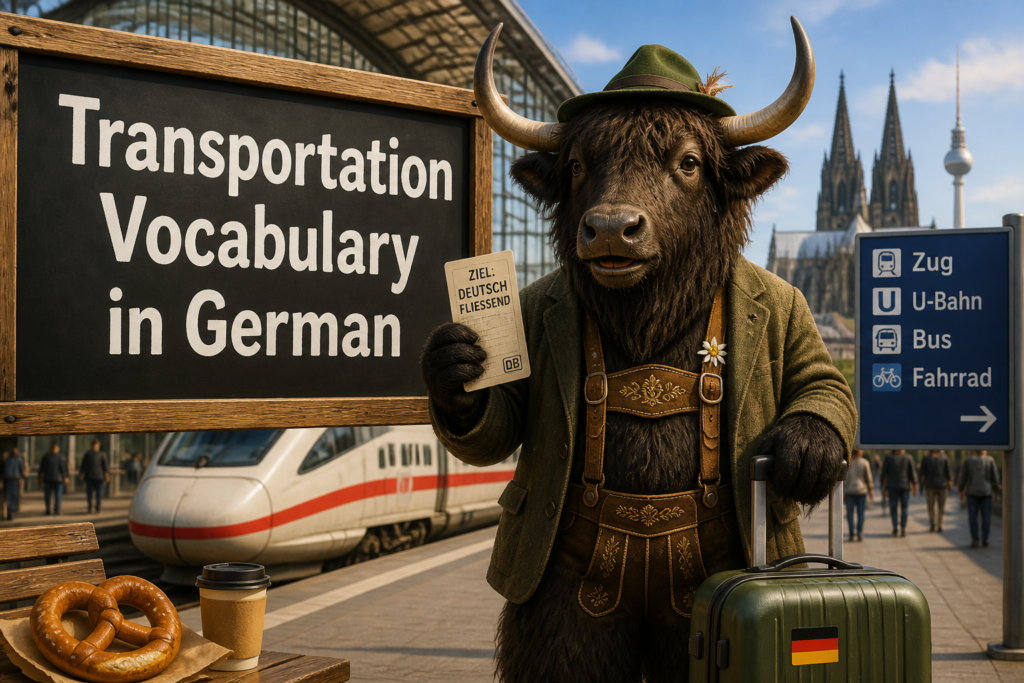
If you want to move around in German-speaking places without sounding like a confused tourist with a dead phone battery, transportation vocabulary is a very good place to start. Trains, buses, tickets, platforms, delays, taxis, bikes, and the eternal question of where the hell is the right track? — all of it turns up fast in real life.
This guide focuses on practical, everyday German for getting around in Germany-based standard German. You’ll learn useful words, common phrases, a few grammar notes, and the little bits of pronunciation that make transport talk much easier. By the end, you should be able to ask for directions, buy a ticket, understand basic travel info, and survive train-station chaos with dignity intact.
For a quick reference on the topic, you can also peek at the broader Learn German hub and the related guide at Yak Yacker article 5714.
German transport language is wonderfully literal. A train is often just a Zug, a station is a Bahnhof, and a platform is a Gleis. Efficient. Slightly severe. Very German.
Useful Transportation Words
Here are the core words you’ll see again and again. They are the “don’t panic at the station” vocabulary.
| German | Pronunciation | Meaning | Example Sentence | Translation | Learner Note |
|---|---|---|---|---|---|
| der Zug | tsoog | train | Der Zug hat zehn Minuten Verspätung. | The train is ten minutes late. | Very common. der is the article. |
| der Bahnhof | BAHN-hohf | train station | Der Bahnhof ist gleich hier. | The station is right here. | Capitalized noun, as always. |
| das Gleis | glice | platform / track | Der Zug fährt von Gleis 4 ab. | The train departs from platform 4. | In Germany, Gleis often means the track/platform number. |
| die Fahrkarte | FAHR-kahr-tuh | ticket | Ich brauche eine Fahrkarte nach Köln. | I need a ticket to Cologne. | Also das Ticket is common. |
| die Haltestelle | HAL-tuh-shtel-uh | stop | Die nächste Haltestelle ist am Rathaus. | The next stop is at the town hall. | Used for bus and tram stops. |
| der Bus | boos | bus | Der Bus kommt in fünf Minuten. | The bus comes in five minutes. | Easy one. Lucky you. |
| die Straßenbahn | SHTRAH-sen-bahn | tram | Die Straßenbahn ist heute sehr voll. | The tram is very crowded today. | Common in cities. Literally “street railway.” |
| die U-Bahn | OO-bahn | subway / underground | Wir nehmen die U-Bahn ins Zentrum. | We’re taking the subway to the center. | U means underground. |
| die S-Bahn | ESS-bahn | city train / suburban rail | Die S-Bahn fährt direkt zum Flughafen. | The S-Bahn goes directly to the airport. | Very useful in German cities. |
| das Taxi | TAHK-see | taxi | Ich nehme ein Taxi nach Hause. | I’m taking a taxi home. | Also common in plural: die Taxis. |
| das Fahrrad | FAH-rat | bicycle | Ich fahre oft mit dem Fahrrad zur Arbeit. | I often go to work by bike. | Very common everyday word. |
Common Phrases For Getting Around
These are the phrases that actually save your day when you’re standing in front of a ticket machine that clearly has a personal grudge against you.
| German | Pronunciation | Meaning | Example Sentence | Translation | Learner Note |
|---|---|---|---|---|---|
| Wie komme ich zum Bahnhof? | vee KOM-muh ikh tsoom BAHN-hohf | How do I get to the station? | Entschuldigung, wie komme ich zum Bahnhof? | Excuse me, how do I get to the station? | zum = zu dem. Very common. |
| Wo ist die Haltestelle? | voh ist dee HAL-tuh-shtel-uh | Where is the stop? | Entschuldigung, wo ist die Haltestelle für den Bus 12? | Excuse me, where is the stop for bus 12? | Good for buses and trams. |
| Welches Gleis? | VEL-khes glice | Which platform? | Welches Gleis ist für den Zug nach Berlin? | Which platform is for the train to Berlin? | Very short, very normal, very useful. |
| Ich habe eine Fahrkarte. | ikh HAH-buh EYE-nuh FAHR-kahr-tuh | I have a ticket. | Ich habe eine Fahrkarte, aber ich finde das Gleis nicht. | I have a ticket, but I can’t find the platform. | eine because Fahrkarte is feminine. |
| Ich möchte eine Fahrkarte kaufen. | ikh MÖKHT-uh EYE-nuh FAHR-kahr-tuh KOW-fen | I would like to buy a ticket. | Ich möchte eine Fahrkarte nach Hamburg kaufen. | I would like to buy a ticket to Hamburg. | Polite and very useful. |
| Wann fährt der Zug ab? | vahn fairt der tsoog ahp | When does the train depart? | Wann fährt der Zug ab? | When does the train leave? | abfahren is separable. The ab moves to the end in a normal sentence. |
| Der Zug hat Verspätung. | der tsoog hat fer-SHPAY-toong | The train is delayed. | Der Zug hat leider Verspätung. | The train is delayed, unfortunately. | Verspätung is one of the most useful travel nouns. |
| Ist das hier der richtige Zug? | ist dahs heer der RIH-ti-guh tsoog | Is this the right train? | Entschuldigung, ist das hier der richtige Zug nach München? | Excuse me, is this the right train to Munich? | Useful in platforms and stations. |
| Ich steige hier aus. | ikh SHTY-guh heer ows | I get off here. | Ich steige an der nächsten Haltestelle aus. | I get off at the next stop. | aussteigen = to get out / get off. |
| Ich steige um. | ikh SHTY-guh oom | I’m changing trains / transferring. | Ich steige in Frankfurt um. | I’m changing trains in Frankfurt. | umsteigen is very common in travel announcements. |
| Wie viel kostet das? | vee feel KOS-tet dahs | How much does that cost? | Wie viel kostet das Ticket? | How much does the ticket cost? | Works in lots of everyday situations. |
Pronunciation note: in Bahnhof, the h is not really pronounced separately. It just helps show the long vowel in Bahn. German loves doing small orthographic tricks and pretending it is not showing off.
More Travel Words You’ll See On Signs
Signs and announcements often use slightly more formal words than everyday conversation. If you know these, the station starts looking a lot less like abstract art.
| German | Pronunciation | Meaning | Example Sentence | Translation | Learner Note |
|---|---|---|---|---|---|
| die Ankunft | AHN-koomft | arrival | Die Ankunft ist um 18:20 Uhr. | Arrival is at 6:20 p.m. | Used in timetables and announcements. |
| die Abfahrt | AHB-fahrt | departure | Die Abfahrt erfolgt von Gleis 2. | Departure is from platform 2. | Formal but common in travel info. |
| die Verspätung | fer-SHPAY-toong | delay | Es gibt eine Verspätung von 15 Minuten. | There is a 15-minute delay. | Very common on station boards. |
| der Fahrplan | FAHR-plahn | timetable / schedule | Der Fahrplan wurde geändert. | The timetable was changed. | Useful for trains and buses. |
| der Anschluss | AHN-shloos | connection | Haben wir einen Anschluss in Köln? | Do we have a connection in Cologne? | Can mean a train connection. |
| die Richtung | RIHKH-toong | direction | Der Zug fährt in Richtung Zentrum. | The train goes in the direction of the center. | Also useful in road travel. |
| die Strecke | SHTREK-uh | route / line / stretch | Die Strecke ist heute gesperrt. | The route is closed today. | Used for rail lines and roads. |
| der Wagen | VAH-gen | carriage / carriage coach | Der Wagen ist fast leer. | The carriage is almost empty. | Common on trains. |
| der Wagenkasten | VAH-gen-kas-ten | carriage body | Der Wagenkasten ist modern gebaut. | The carriage body is built modernly. | Less common; more technical. |
| die Gepäckaufbewahrung | guh-PEK-owf-buh-VAH-roong | left luggage / baggage storage | Die Gepäckaufbewahrung ist am Bahnhof. | The luggage storage is at the station. | Long word, but very practical. |
Transport Types And Vehicles
These words help you understand what kind of transport you are dealing with. Helpful when the city has three different rail systems and one of them is somehow also a bus.
| German | Pronunciation | Meaning | Example Sentence | Translation | Learner Note |
|---|---|---|---|---|---|
| das Auto | OW-toh | car | Wir fahren mit dem Auto nach Stuttgart. | We’re driving to Stuttgart by car. | Very common. mit dem Auto = by car. |
| der Lkw | EL-kah-veh | truck | Der Lkw blockiert die Straße. | The truck is blocking the street. | Usually written LKW. |
| das Motorrad | MOH-toh-raht | motorcycle | Er fährt ein Motorrad. | He rides a motorcycle. | fahren is used for riding/driving vehicles. |
| das Flugzeug | FLOOK-tsoyk | airplane | Das Flugzeug startet um 9 Uhr. | The airplane takes off at 9 o’clock. | Compound noun: Flug + Zeug. |
| der Flughafen | FLOOK-hah-fen | airport | Der Flughafen ist weit vom Zentrum entfernt. | The airport is far from the center. | der article, despite ending in -en. |
| das Schiff | shif | ship / boat | Das Schiff legt um 8 Uhr ab. | The ship leaves at 8 o’clock. | Used for larger boats and ferries. |
| die Fähre | FAIR-uh | ferry | Wir fahren mit der Fähre über den Rhein. | We’re taking the ferry across the Rhine. | Useful in coastal and river regions. |
| das Fahrrad | FAH-rat | bicycle | Sie kommt mit dem Fahrrad zur Arbeit. | She comes to work by bike. | German cities often love bikes. Reasonably. |
| der Roller | ROH-ler | scooter | Er fährt mit dem Roller in die Stadt. | He rides into town on a scooter. | Can mean scooter or moped depending on context. |
| die Straßenbahn | SHTRAH-sen-bahn | tram | Die Straßenbahn hält direkt vor dem Hotel. | The tram stops right in front of the hotel. | Very city-friendly vocabulary. |
Useful Verbs For Travel Talk
Transport German gets much easier once you know the verbs people actually use. A lot of them are simple, but they do a lot of work.
| German | Pronunciation | Meaning | Example Sentence | Translation | Learner Note |
|---|---|---|---|---|---|
| fahren | FAH-ren | to go by vehicle / drive | Wir fahren mit dem Bus. | We’re going by bus. | Used with vehicles, not just cars. |
| umsteigen | OOM-shty-gen | to transfer / change trains | Wir müssen in Mannheim umsteigen. | We have to change trains in Mannheim. | Separable verb: steige um. |
| aussteigen | OWS-shty-gen | to get off | Ich steige an der nächsten Station aus. | I get off at the next station. | Separable verb again. |
| einsteigen | EYN-shty-gen | to get on / board | Wir steigen jetzt ein. | We’re getting on now. | Useful for trains, buses, and planes. |
| ankommen | AHN-kom-en | to arrive | Wann kommen wir an? | When do we arrive? | Separable: kommt an. |
| abfahren | AHB-fah-ren | to depart | Der Zug fährt pünktlich ab. | The train departs on time. | Separable verb. |
| umleiten | OOM-ly-tən | to reroute | Der Bus wird umgeleitet. | The bus is being rerouted. | More common in announcements. |
| parken | PAHR-ken | to park | Hier darf man nicht parken. | You are not allowed to park here. | Very useful for car travel. |
| laufen | LOW-fen | to run / walk / be running | Die Straßenbahn läuft heute nicht. | The tram is not running today. | In transport, it can mean a service is operating. |
| nehmen | NEH-men | to take | Wir nehmen den nächsten Zug. | We’ll take the next train. | One of the most useful travel verbs. |
Mini Grammar Notes That Matter
Transport vocabulary is also a sneaky way to learn common German grammar patterns. No, not the “enjoy your case system” kind of fun. The useful kind.
| Pattern | Meaning | German Example | English Translation | Learner Note |
|---|---|---|---|---|
| mit + dative | with / by | Ich fahre mit dem Bus. | I go by bus. | mit always takes dative: dem Bus, der Bahn. |
| nach + place | to a city / country / place | Wir fahren nach Berlin. | We’re going to Berlin. | Use nach with cities and many countries. |
| zu + place/person | to / toward | Ich gehe zum Bahnhof. | I’m going to the station. | zum = zu dem. Very common with places. |
| in + accusative | into / to inside | Wir steigen in den Bus ein. | We get on the bus. | in changes case depending on movement or location. |
| auf + dative | on / at | Der Zug wartet auf dem Gleis. | The train is waiting on the platform. | Location = dative. Movement often = accusative. |
| ab + noun | from / departing from | Der Zug fährt ab Gleis 2. | The train departs from platform 2. | Often seen in signs and announcements. |
Yak wisdom: In German travel talk, the words are often easy. The chaos comes from the schedule.
Real-Life Example Sentences
These are the kinds of sentences you might actually need in a station, on a bus, or while staring at a map like it has insulted your family.
- Entschuldigung, wo ist der Bahnhof? — Excuse me, where is the station?
- Wie komme ich zum Flughafen? — How do I get to the airport?
- Ich brauche ein Ticket nach Berlin. — I need a ticket to Berlin.
- Fährt dieser Bus zum Zentrum? — Does this bus go to the center?
- Wann ist die nächste Haltestelle? — When is the next stop?
- Der Zug ist leider verspätet. — The train is unfortunately delayed.
- Wir müssen einmal umsteigen. — We have to change trains once.
- Ich steige hier aus. — I’m getting off here.
- Gibt es eine direkte Verbindung? — Is there a direct connection?
- Kann ich mit Karte zahlen? — Can I pay by card?
Pronunciation note: Verbindung is pronounced something like fer-BIN-doong. The v sounds like f, and the ng is the soft German ng sound, not a hard n-g at the end.
Common Confusions And Easy Fixes
| Confusion | Wrong Or Risky | Better German | Why |
|---|---|---|---|
| Train platform | das Platform | das Gleis / der Bahnsteig | Platform in English does not map neatly onto German. Gleis is the track/platform number; Bahnsteig is the platform itself. |
| By bus / train | mit Bus | mit dem Bus / mit dem Zug | mit needs dative, so the article changes. |
| To Berlin | zu Berlin | nach Berlin | Use nach with city names. |
| Getting on a bus | ich gehe in den Bus | ich steige in den Bus ein | More natural and precise. |
| Taking the train | ich nehme den Zug | ich nehme den Zug | This one is actually good. German uses nehmen a lot here. |
| Delay | spät | Verspätung | spät means late, but Verspätung is the standard noun for a delay. |
Germany, Austria, And Switzerland: Small Transport Differences
Most of this vocabulary works across standard German in Germany, Austria, and Switzerland. Still, a few differences show up in real life.
In Switzerland, you may hear more Swiss German forms in daily speech, but standard German is still widely used in writing and announcements. In Austria, some words and habits differ a bit, especially with transport types and local expressions, but Zug, Bahnhof, Fahrkarte, and Verspätung are still very safe choices.
If you’re unsure, the standard forms in this article will not embarrass you. That’s usually a good policy in public transport, where confidence is already a fragile resource.
Quick Practice
Try these short drills. No stress. German transport vocabulary is a lot less scary after a few repetitions.
- Fill in the blank: Ich fahre mit ____ Bus. → dem
- Choose the right word: station / train station → Bahnhof
- Choose the right word: ticket → Fahrkarte or Ticket
- Translate: “The train is delayed.” → Der Zug hat Verspätung.
- Translate: “How do I get to the airport?” → Wie komme ich zum Flughafen?
- Change it: Wir fahren nach Berlin. → use a different city: Wir fahren nach Hamburg.
- Spot the pattern: zum Bahnhof = zu dem Bahnhof
- Say it aloud: Gleis, Fahrkarte, Verspätung, umsteigen
Pronunciation mini practice: say ei like “eye” in einsteigen, and say ie like a long “ee” in Ticket only if the word is actually spelled that way. German spelling is strict, but at least it usually tells the truth.
Quick Reference Summary
- Zug = train
- Bahnhof = train station
- Gleis = platform / track
- Fahrkarte = ticket
- Haltestelle = stop
- umsteigen = transfer
- aussteigen = get off
- einsteigen = get on
- Verspätung = delay
- mit dem Bus / Zug = by bus / train
- nach + city = to a city
- zum Bahnhof = to the station
If you remember only a few things, make them these: Zug, Bahnhof, Gleis, Fahrkarte, and umsteigen. Those five alone can rescue a messy travel day. And if you want a broader path forward, the Learn German hub is a solid place to keep moving.
Yak takeaway: German transportation vocabulary is practical, predictable, and wonderfully useful. Learn the core words first, then the station becomes a place to travel through instead of a place to suffer in.