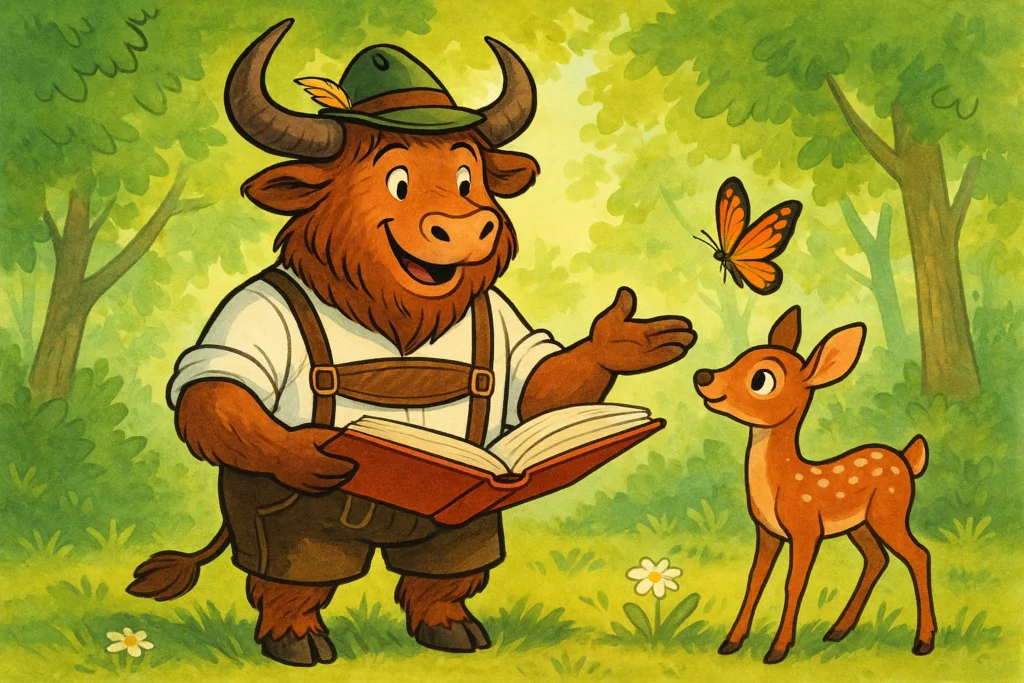
Step into the peaceful yet sometimes perilous forest world of Bambi, a young deer discovering the wonders and challenges of life. Follow his journey from a wobbly fawn to a wise stag, as he befriends Thumper the rabbit and Flower the skunk, learns from his mother, and faces the harsh reality of hunters in the woods.
This retelling of the classic story is specially written for A2 elementary German learners. You'll expand your vocabulary with everyday words about nature, animals, and emotions, while enjoying full story audio to perfect your pronunciation. Click any word for an instant translation, and explore our lesson notes for extra grammar and culture tips-all free and designed to make German reading feel natural and fun.
An einem warmen im tiefen Wald wurde ein kleines geboren. Es hieß Bambi. Seine Mutter leckte es sanft und sagte: „Schön, dass du da bist, mein Kleiner." Bambi öffnete die Augen und sah das durch die Blätter.
Bambi lernte schnell. Er sah die bunten Schmetterlinge und die kleinen Blumen. „Mutter, was ist das?", fragte er oft. Seine Mutter antwortete: „Das ist ein Schmetterling, mein Schatz. Und das hier sind Gänseblümchen."
Eines Tages sie zur großen . „Das ist die Wiese", sagte die Mutter. „Hier die Sonne so warm. Aber ! Die Wiese ist nicht immer sicher." Bambi und rief: „Oh, wie schön!"
Auf der Wiese traf Bambi andere Tiere. Ein Hase kam zu ihm. „Hallo, ich bin Hoppel! Wer bist du?", fragte der Hase. „Ich bin Bambi", antwortete das Rehkitz. Ein Eichhörnchen rief von einem Baum: „Willkommen, Bambi!"
Plötzlich die Mutter: „Bambi, sei still! Ich ." Bambi fragte: „Was für eine Gefahr?" Die Mutter antwortete leise: „Der Mensch. Er ist sehr . Wenn er kommt, hörst du einen ."
Ein paar Tage später spielte Bambi auf der Wiese. Er hörte einen – BANG! „, Bambi, lauf!", rief die Mutter. Beide in den dunklen Wald. Bambi hatte große .
Am nächsten Morgen suchte Bambi seine Mutter, aber sie war nicht da. Ein großer, alter Hirsch dem Nebel. „Deine Mutter ist nicht mehr hier", sagte er mit . „Du musst jetzt , Bambi. Ich bin der Prinz des Waldes."
Bambi und wurde stark und klug. Ein Jahr später, im Frühling, traf er ein Reh. „Hallo, ich bin Faline", sagte sie. Bambi lächelte. „Hallo, Faline. Ich bin Bambi." Sie auf der Wiese und waren glücklich.
Eines Tages hörte Bambi wieder den . Er dachte an die Worte des Prinzen. „, in den Wald!", rief er den anderen Tieren zu. Bambi war jetzt der Prinz des Waldes und alle auf. Und so lebte Bambi – stark, vorsichtig und voller Leben.
On a warm spring day in the deep forest, a small fawn was born. His name was Bambi. His mother licked him gently and said, "Nice that you are here, my little one." Bambi opened his eyes and saw the light through the leaves.
Bambi learned quickly. He saw the colorful butterflies and the little flowers. "Mother, what is that?" he often asked. His mother replied, "That is a butterfly, my darling. And these are daisies."
One day they went to the big meadow. "This is the meadow," said the mother. "Here the sun shines so warm. But be careful! The meadow is not always safe." Bambi hopped happily and exclaimed, "Oh, how beautiful!"
On the meadow, Bambi met other animals. A hare came to him. "Hello, I'm Thumper! Who are you?" asked the hare. "I'm Bambi," replied the fawn. A squirrel called from a tree, "Welcome, Bambi!"
Suddenly the mother whispered, "Bambi, be still! I smell danger." Bambi asked, "What kind of danger?" The mother answered quietly, "Man. He is very dangerous. When he comes, you hear a loud bang."
A few days later, Bambi played on the meadow. He heard a loud bang-BANG! "Run, Bambi, run!" cried the mother. Both ran quickly into the dark forest. Bambi was very afraid.
The next morning, Bambi looked for his mother, but she was not there. A large, old stag stepped out of the mist. "Your mother is no longer here," he said with a serious voice. "You must be strong now, Bambi. I am the Prince of the Forest."
Bambi grew and became strong and clever. A year later, in spring, he met a beautiful doe. "Hello, I'm Faline," she said. Bambi smiled. "Hello, Faline. I'm Bambi." They played together on the meadow and were happy.
One day, Bambi heard the loud bang again. He thought of the Prince's words. "Quick, into the forest!" he called to the other animals. Bambi was now the Prince of the Forest and looked after everyone. And so Bambi lived-strong, cautious, and full of life.
You encountered many lovely German words in Bambi's world. Let's look closer at some of them so you can use them yourself. We'll group them by theme to make them easier to remember.
Pay attention to how these words are combined in the story—seeing them in context helps them stick.
- Forest and nature: der Wald (forest), die Blume (flower), das Blatt (leaf), die Sonne (sun). You also saw der Schmetterling (butterfly) and die Gänseblümchen (daisies). Notice the diminutive -chen in Gänseblümchen: it makes things sound small and cute!
- Animals: das Rehkitz (fawn – literally 'deer kid'), der Hase (hare), das Eichhörnchen (squirrel – again with -chen). Der Hirsch is a stag – the old, wise one is der Prinz des Waldes (prince of the forest).
- Emotions and states: die Gefahr (danger), die Angst (fear) – you saw große Angst (great fear). Fröhlich means cheerful or happy. Still sein means to be quiet. Vorsichtig means careful – an important word for Bambi's world.
- Actions and imperatives: laufen (to run) – Lauf! (Run!), aufpassen (to watch out) – Pass auf! (Watch out!), and flüstern (to whisper).
The story is told mainly in the present tense, which is very common in spoken German and makes the narrative feel immediate. Even when talking about past events, we can use the present tense in storytelling.
You also saw many imperative forms. These are used when someone gives a direct command, like the mother deer's urgent calls to Bambi.
- Present tense verbs: Most verbs follow a regular pattern. For example, leben (to live): ich lebe, du lebst, er/sie/es lebt. In the story: Bambi lebt (Bambi lives). Sie spielen (they play) is a regular -en verb for plural or formal 'you'.
- Some strong (irregular) verbs: laufen (to run) → er läuft; sehen (to see) → er sieht; sprechen (to speak) → er spricht. You saw sieht das Licht (sees the light) and sprach (past tense, but used in storytelling).
- Imperatives: For du commands, drop the -st ending. Laufen → lauf! (run!), aufpassen → pass auf! (watch out! – separable verb, so the prefix moves to the end). Sei still! (be quiet!) uses the irregular sei for 'be'. For ihr commands, just use the ihr form without the pronoun: Lauft! (Run, you all!).
This story uses vivid language to pull you into the forest. Notice the onomatopoeia and emotional words that add depth. These touches make the German feel alive and memorable.
Expressions of childhood, wonder, and sudden danger are woven throughout. Learning these patterns helps you sound more natural in German.
- Sound words: BANG! – the loud noise of the hunter's gun. In German, Knall means a sudden loud noise, and here it's written as the sound itself. You might also recall leise (quietly) and lauter (louder).
- Diminutives with -chen: Rehkitz (fawn) already means a young deer, but Eichhörnchen and Gänseblümchen use -chen to make them small and endearing. It's like adding 'little' or '-let' in English.
- Emotional packs: große Angst (great fear), fröhlich (joyfully), and die Gefahr (danger). Questions express wonder: Was ist das? (What is that?). The mother's gentle tone: Schön, dass du da bist, mein Kleiner (Nice that you're here, my little one). These chunks are very reusable.
You've now experienced a classic story in German and noticed how simple language can create a big world. Why not try your own? Pick an animal you like, place it in a forest (or anywhere), and craft three or four sentences in German.
Use at least one new word from this lesson, one present-tense verb, and maybe a command if there's danger! The goal is not perfection—it's playing with the language in a way that feels fun.
- Start small: Heute ist ein schöner Tag im Wald. Ein kleiner Fuchs sieht einen Schmetterling. (Today is a beautiful day in the forest. A little fox sees a butterfly.)
- Add a twist: Plötzlich hört er einen Knall. 'Lauf, kleiner Fuchs!' ruft die Mutter. (Suddenly he hears a bang. 'Run, little fox!' calls the mother.)
- Share it with a friend or record yourself—the more senses you involve, the more naturally German comes.
Bambi: A Life in the Woods - German Retelling comes from an older public-domain story tradition and is best known as a public_domain_story_retelling. This Yak Yacker article is an original learner retelling based on public-domain source material, so the wording here is simplified for modern learners rather than copied from one old edition.
Older printings, translations, and retellings of this story can vary quite a bit. This version is adapted for A2 Elementary learners studying German.
If you want to keep going, browse more in our German section and review the Goethe A2 German Vocabulary. After that, try German Comparative and Superlative Forms for another useful next step.