Step into the eerie world of E.T.A. Hoffmann's 'The Sandman,' retold here in clear, intermediate German. Follow young Nathaniel as he grapples with childhood fears of the mythical Sandman-a creature said to steal the eyes of children who won't sleep. In this adaptation, the dark figure returns, blurring the line between nightmare and reality, and threatening Nathaniel's sanity and his love for the beautiful Clara.
Our B1-level version keeps the haunting atmosphere while making every sentence accessible for learners. You'll find clickable translations for tricky words, so you never lose the thread of the story. Plus, listen along with the included story audio to perfect your pronunciation and rhythm.
Whether you're revisiting a classic or meeting it for the first time, this free interactive reader gives you a full literary experience-complete with lesson notes that unpack the grammar and vocabulary naturally, right when you need them. Dive in and let the tale carry you deeper into German.
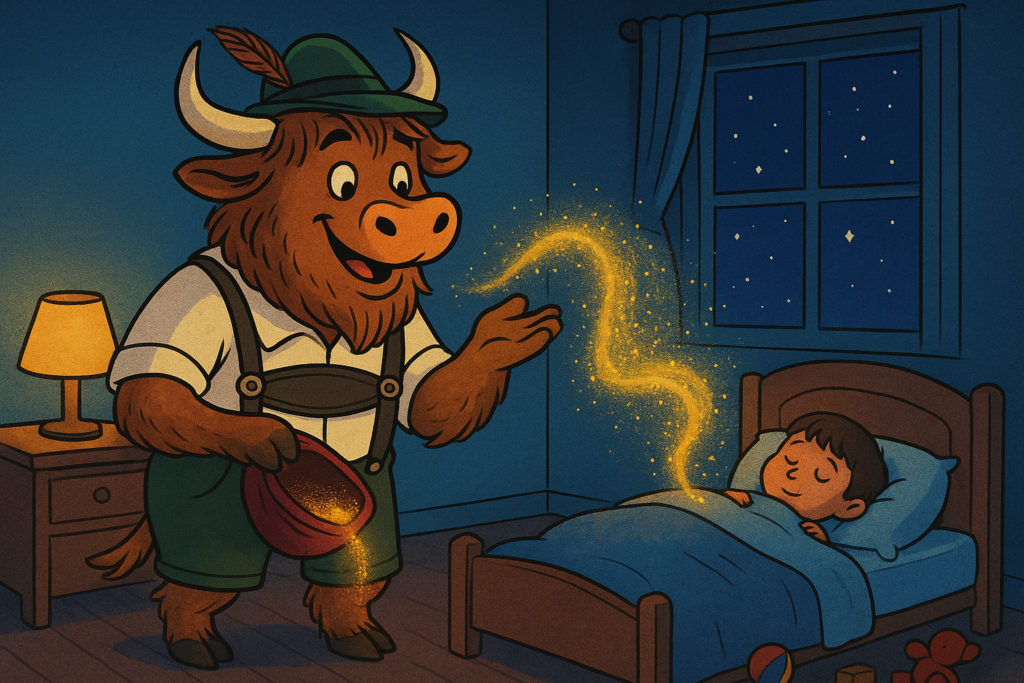
Leo lag in seinem Bett und konnte .
Er .
Das Zimmer war und .
„Wenn ich doch nur könnte!", er.
Plötzlich sah er ein , am Fenster.
Das Fenster .
Ein kleiner Mann mit einem kam herein.
Er eine kleine Tasche aus .
Leo .
„Wer bist du?", er .
Der kleine Mann warm.
„Ich bin der Sandmann", sagte er.
„Ich den Kindern den Schlaf und ."
Leo .
„Ich kann nicht schlafen. Ich bin einfach nicht ."
Der Sandmann verständnisvoll.
„Keine Sorge, ich kann dir ."
Er seine Tasche und nahm eine glitzernden Sand heraus.
Der Sand durch seine Finger.
„Schau her", sagte der Sandmann und den Sand in Leos Augen.
Leo .
Seine wurden , so schwer.
Er fühlte sich müde.
„Leg dich hin und ", flüsterte der Sandmann.
Leo .
Der Sandmann setzte sich auf die .
„Ich dir eine Geschichte, während du ."
Er begann mit einer , Stimme:
„Es war einmal ein kleiner Stern, der vom Himmel fiel …"
Leos wurde und gleichmäßig.
Bald schlief er .
In dieser Nacht träumte Leo, dass er konnte.
Er flog über und durch .
Alles war und voller Licht.
Am nächsten Morgen wachte Leo auf.
Er an den Sandmann und lächelte.
War es nur ein gewesen?
Aber da auf seinem lag ein goldenes Sandkörnchen.
Leo lay in his bed and couldn't fall asleep.
He tossed and turned.
The room was dark and quiet.
"If only I could fall asleep!" he whispered.
Suddenly he saw a soft, golden light at the window.
The window opened quietly.
A small man with a friendly face came in.
He carried a small velvet bag.
Leo sat up.
"Who are you?" he asked, surprised.
The little man smiled warmly.
"I am the Sandman," he said.
"I bring children sleep and beautiful dreams."
Leo sighed.
"I can't sleep. I'm just not tired."
The Sandman nodded understandingly.
"Don't worry, I can help you."
He opened his bag and took out a handful of glittering sand.
The sand trickled through his fingers.
"Look here," said the Sandman and gently blew the sand into Leo's eyes.
Leo blinked.
His eyelids became heavy, so heavy.
He felt wonderfully tired.
"Lie down and close your eyes," whispered the Sandman.
Leo obeyed.
The Sandman sat on the edge of the bed.
"I'll tell you a story while you fall asleep."
He began with a calm, melodious voice:
"Once upon a time, a little star fell from the sky..."
Leo's breathing became calm and steady.
Soon he was fast asleep.
That night, Leo dreamed that he could fly.
He flew over colorful meadows and through soft clouds.
Everything was peaceful and full of light.
The next morning, Leo woke up refreshed.
He remembered the Sandman and smiled.
Had it only been a dream?
But there on his pillow lay a tiny golden grain of sand.
Before we dive into the magic of the subjunctive, let's collect some dreamy words from the story. These will help you retell the tale and create your own bedtime fantasies in German.
Notice how many of these words are compounds: 'Sandmann' (sand + man), 'Augenlider' (eye + lids). This is a very German way to build precise, image-rich vocabulary.
- der Sandmann – the Sandman (a friendly bringer of sleep)
- einschlafen – to fall asleep (trennbar: 'Leo schlief endlich ein.')
- der Traum (die Träume) – dream ('In der Nacht träumte Leo einen schönen Traum.')
- das Sandkorn (die Sandkörner) – grain of sand ('Da lag ein winziges goldenes Sandkörnchen.')
- schwer – heavy ('Seine Augenlider wurden schwer.')
- flüstern – to whisper ('„Leg dich hin-, flüsterte der Sandmann.')
Right at the start, Leo can't sleep and wishes desperately: 'Wenn ich doch nur einschlafen könnte!' This is the Konjunktiv II (subjunctive II) – the go-to tool for wishes, hypotheticals, and polite requests.
While many verbs form the KII with 'würde' + infinitive, the most common verbs have their own special shapes. You probably already know 'könnte' (from können), 'wäre' (sein) and 'hätte' (haben). These are your magic keys to unlock countless wishes.
- können → könnte: 'Wenn ich doch nur fliegen könnte!' (If only I could fly!)
- sein → wäre: 'Ich wünschte, ich wäre schon zu Hause.' (I wish I were already home.)
- haben → hätte: 'Hätte ich nur mehr Zeit!' (If only I had more time!)
- Classic structure: 'Wenn ich doch nur ...' + KII verb at the end.
The sandman leaves Leo wondering: 'War es nur ein Traum gewesen?' Although this question is in the indicative, the subjunctive gives us a richer way to voice uncertainty and imagination. Try 'Es könnte ein Traum gewesen sein' (It could have been a dream) or 'Wenn ich der Sandmann wäre ...' (If I were the Sandman ...).
Using the KII allows you to soften statements, speculate politely, or paint 'what if' pictures. It’s the mood of possibility, exactly what you need for storytelling and daydreaming.
- Uncertainty: 'Das könnte stimmen, aber ich bin nicht sicher.' (That could be true, but I'm not sure.)
- Hypothetical: 'Wenn es hier ruhiger wäre, könnte ich besser schlafen.' (If it were quieter here, I could sleep better.)
- Imagination: 'Was würdest du tun, wenn du unsichtbar wärst?' (What would you do if you were invisible?)
Now it's your turn. Think of something you wish for – maybe a skill, a place, a moment. Wrap it in 'Wenn ich doch nur ...' and let your German drift into dreamland. The Sandman would approve.
As you drift off tonight, try forming little KII wishes in your head. Not only will you practise German, but you might just find the secret to falling asleep gently, like Leo.
- Pick a verb: können, sein, haben, or any that feels natural.
- Start: 'Wenn ich doch nur ...' + (rest of sentence) + KII verb.
- For extra magic, whisper it in the dark – or write a tiny 'Sandkorn' note to leave on your pillow.
Der Sandmann comes from an older public-domain story tradition and is best known as a public_domain_story_retelling. This Yak Yacker article is an original learner retelling based on public-domain source material, so the wording here is simplified for modern learners rather than copied from one old edition.
Older printings, translations, and retellings of this story can vary quite a bit. This version is adapted for B1 Intermediate learners studying German.
If you want to keep going, browse more in our German section and review the Goethe B1 German Vocabulary. After that, try Essential German Grammar Words for another useful next step.