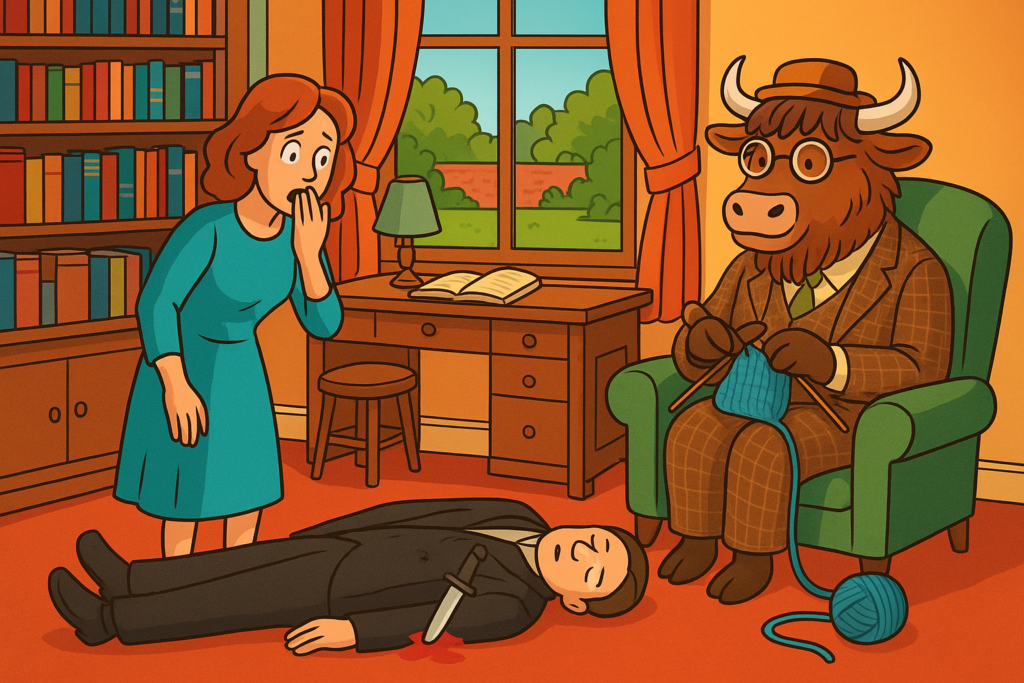
Welcome to our B1 intermediate English story, 'The Murder at the Vicarage'. In this classic whodunit, you'll follow the quiet village of St. Mary Mead as it is shaken by a shocking crime. When the unpopular Colonel Protheroe is found dead in the local vicar's study, everyone becomes a suspect. Join the clever elderly spinster, Miss Marple, as she uses her sharp observation skills to unravel the tangled web of secrets and lies.
This interactive graded reader is designed to help you improve your English naturally. Each paragraph comes with clickable word help, so you can check difficult vocabulary instantly. You can also listen to the story audio to practice your listening skills. At the end, you'll find free lesson notes that focus on key grammar and useful phrases. Enjoy this engaging mystery while building your English confidence-no sign-up required, just click and read!
It was a Sunday morning in St. Mary Mead. The sun was shining, but something was wrong at the . Mrs. Martha Clement found her husband, the vicar, lying dead on the floor of his study.
"Charles!" she cried. There was a . She , and the maid, Betty, came running. "Call the police!" Mrs. Clement shouted. "Someone has murdered my husband!"
Soon, Inspector Brown . He looked around the study. "We have three main ," he said. "Where were you all this morning? I need your ."
Mrs. Clement was . "I was in the garden, . I came inside and found him." Betty said she was in the kitchen. Jack, the gardener, said he was working by the gate.
The inspector wrote everything down. "These are your alibis," he said. But he was . Who had a to kill the kind old vicar? Then Miss Jane Marple walked in. "May I ask a few questions? Sometimes a notices little things."
Miss Marple looked at Mrs. Clement. "You said you were , but your hands are very clean. No dirt or . And your roses are full of . That's strange." Mrs. Clement said she washed her hands, but Miss Marple asked, "Why? You said you found him immediately."
Miss Marple turned to Betty. "You were vegetables, but the kitchen clock is broken. How did you know the time?" Betty started to cry. "I was reading a in my room. I didn't want to tell." But the letter was harmless-it was from her boyfriend.
Then Miss Marple noticed some . She walked to the study window and pointed to muddy on the floor. "These go out to the back garden. Jack, did you see anyone leave that way?" Jack shook his head. "No, but I saw Mrs. Clement's car driving away fast just before the scream."
Mrs. Clement jumped up. "That's a lie! I can't drive!" Miss Marple smiled. "Exactly. Someone who looks like you was driving away. Someone who wanted to ."
"Who would your arrest?" Miss Marple asked. The answer was a distant cousin who was the vicar's . He had a strong motive: he wanted the vicar's money.
The cousin had been in the village. He knew Mrs. Clement was about to his past crimes. So he murdered the vicar and tried to Mrs. Clement. But his plan failed because of Miss Marple's sharp questions.
The police the cousin later that day. "You were a great witness, Miss Marple," the inspector said. She just smiled. "Asking questions is the key to ."
On a quiet Sunday morning, the vicar's wife found him dead on the floor of his study.
She screamed when she saw a knife in his chest, and told the maid to call the police because someone had murdered him.
The inspector arrived, said there were three suspects, and asked for their alibis.
Mrs. Clement said she was cutting roses in the garden. Betty was in the kitchen. Jack was working by the gate.
The inspector was confused about the motive. Then Miss Marple arrived and offered to ask questions, noting that witnesses notice small things.
Miss Marple pointed out that Mrs. Clement's hands were clean despite cutting thorny roses, and questioned why she washed them if she found the body right away.
Miss Marple asked Betty how she knew the time since the kitchen clock was broken. Betty admitted she was reading a letter from her boyfriend, which was harmless.
Miss Marple found muddy footprints leading to the garden. Jack said he saw Mrs. Clement's car speeding away just before the scream.
Mrs. Clement said she can't drive. Miss Marple said someone who looks like her was driving to frame her.
Miss Marple asked who would benefit from her arrest. The answer was a distant cousin who would inherit the vicar's money.
The cousin hid in the village, killed the vicar, and tried to frame Mrs. Clement because she was going to expose his past crimes. Miss Marple's questions foiled his plan.
The police arrested the cousin. The inspector praised Miss Marple, and she said asking questions is key to solving crimes.
The story is full of useful crime-related words. These are common in detective stories, news reports, and everyday conversations about mysteries.
- alibi - proof that someone was somewhere else when a crime happened. (Example: "I need your alibis," the inspector said.)
- suspect - a person the police think may have committed a crime. (Example: "We have three main suspects.")
- motive - a reason to do something, often a crime. (Example: "Who had a motive to kill the kind old vicar?")
- witness - someone who sees an event and can tell about it. (Example: "Sometimes a witness notices little things.")
In this story, you'll notice how past continuous sets the background, while past simple moves the action forward. For example, "The sun was shining" describes the scene, but "She screamed" tells us what happened next.
Past continuous (was/were + -ing) is like a wide shot in a film, showing what was going on. Past simple is the close-up on specific actions.
- Background: "Mrs Clement was crying." (ongoing)
- Main event: "Inspector Brown arrived." (a completed action)
- Interrupted action: "She was cutting roses when she found the body." (an action in progress was interrupted by another action.)
- Try this: When telling a story, use past continuous for the atmosphere and past simple for the plot.
Miss Marple solves the crime by asking sharp questions. Notice how she forms them: sometimes directly, sometimes more politely and indirectly.
- Direct: "Where were you this morning?" (wh- word + was/were + subject)
- Indirect: "Mrs Clement, you said you were cutting roses, but your hands are very clean." (This sounds like a statement, but it's really a question - it invites an explanation.)
- Using indirect questions can be less aggressive and often works better for getting information in real life.
- Tip: Start with phrases like "I'd like to know..." or "Could you tell me...?" to sound more natural.
Now that you've seen how past tenses and crime vocabulary bring a mystery to life, why not find another short detective story? Notice how the author builds tension with grammar - and steal useful words for your own storytelling.
You could even write a few sentences about a suspicious event, using past continuous, past simple, and one or two new crime words. The best way to solve the mystery of English is to keep practising!
The Murder at the Vicarage comes from the English / Agatha Christie tradition and is best known as a mystery novel. This Yak Yacker article is an original learner retelling based on Agatha Christie, 1930; public domain in U.S. as of 2026, so the wording here is simplified for modern learners rather than copied from one old edition.
Older printings, translations, and retellings of this story can vary quite a bit. The original audience was usually adult/general, but this version is adapted for B1 Intermediate learners studying English. First Miss Marple novel; use original only.
If you want to look into the source tradition, start with Library of Congress.
If you want to keep going, browse more in our English section and review the B1 English Vocabulary List. After that, try English Question Words for another useful next step.