Read this story on Yak Yacker with clickable word help, full story audio, and lesson notes below the text.
This version is written for English-speaking learners who want a friendly reading experience in English.
Every afternoon, the children played in the . It was a garden with soft green grass, lovely flowers, and twelve peach trees.
One day the Giant . He had been away for seven years. He saw the children and , "What are you doing here?" The children .
The Giant a high wall around his garden. He put up a notice: NO CHILDREN ALLOWED. He was a very Giant.
Now the poor children had to play. They tried to play on the road, but it was and full of stones. They did not like it.
Spring came, but in the Giant's garden it was still winter. The birds did not sing. The trees did not . Snow and Frost stayed there. The Giant felt cold and sad. He said, "I cannot understand why spring is so late this year."
Then one morning, the Giant heard a . A little bird was singing. He looked out and saw a . A small hole in the wall, and the children had ! In every tree there was a child. The trees were so happy to have the children back that they covered themselves with blossoms.
But in one corner, it was still winter. A little boy was . He was so small he could not reach up to the tree. The Giant's heart . "How selfish I have been!" he said. He went out softly. He took the little boy and put him up into the tree.
The tree burst into bloom. The little boy kissed the Giant. The other children saw the Giant was not anymore. They came . The Giant took a big axe and the wall. "It is your garden now, children," he said.
All day the children played with the Giant. In the evening, they said goodbye to him. But the little boy-the one the Giant had put in the tree-was not there. The children did not know him. The Giant loved him best. "Where is the little boy?" he asked. But no one knew.
Every afternoon, the children played in the Giant's big, lovely garden. It had soft grass, pretty flowers, and twelve peach trees.
One day, the Giant returned after seven years. He saw the children and yelled, 'What are you doing here?' The children ran away.
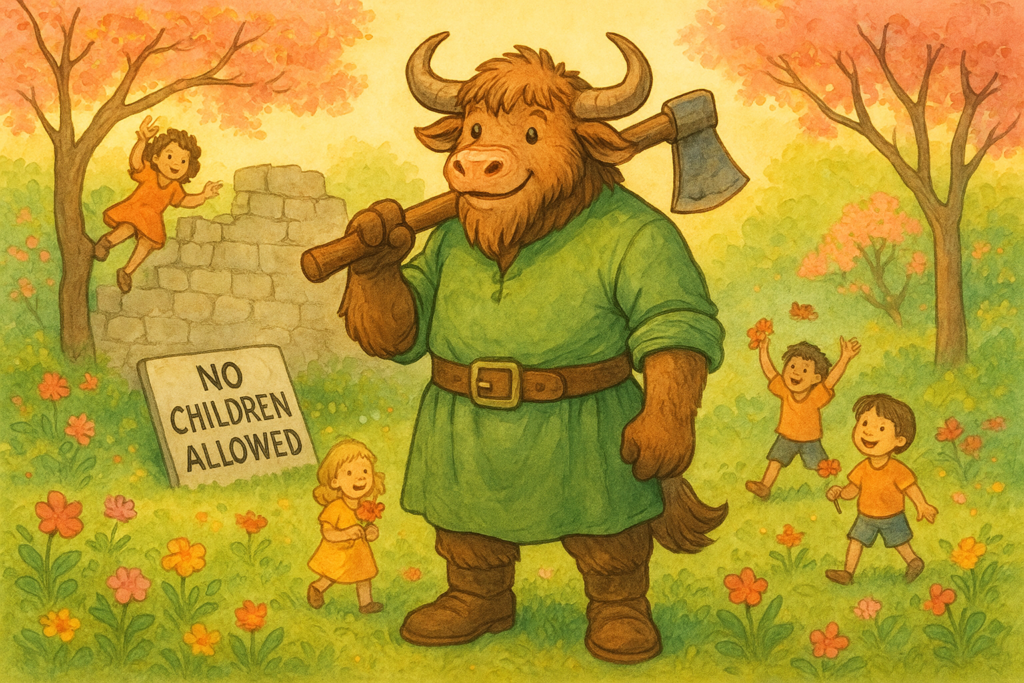
The Giant built a tall wall around his garden and put up a sign: 'NO CHILDREN ALLOWED.' He was very selfish.
Now the poor children had no place to play. They tried the road, but it was dusty and stony, and they didn't like it.
Spring arrived, but the Giant's garden stayed like winter. No birds sang, no trees bloomed. Snow and frost remained. The Giant, cold and sad, said, 'I don't understand why spring is so late.'
One morning, the Giant heard a lovely bird singing. He looked out and saw something wonderful: a small hole in the wall, and the children had sneaked in! There was a child in every tree. The trees were so happy they bloomed all over.
But in one corner, it was still like winter. A tiny boy stood there, too small to reach the tree. The Giant's heart softened. 'How selfish I've been!' he said. He gently went out, picked up the little boy, and placed him in the tree.
The tree suddenly bloomed. The boy kissed the Giant. The other children saw he was no longer bad and came running back. The Giant took an axe, knocked down the wall, and said, 'This is your garden now, children.'
All day, the children played with the Giant. In the evening, they said goodbye. But the little boy the Giant had lifted into the tree was missing. The other children didn't know him. The Giant loved him most. He asked, 'Where is the little boy?' But nobody knew.
Let's look at some words the story uses to paint its cold and warm moments. Understanding these will help you picture the Giant's change of heart.
The garden 'burst into bloom' - a lively phrase meaning flowers suddenly appeared. When the Giant's heart 'melted', it means his unkind feelings became soft and warm.
- selfish - thinking only of yourself. 'He was a very selfish Giant.'
- bloom / blossom - flowers opening. 'The trees covered themselves with blossoms.'
- creep, crept, crept - move quietly and slowly. 'The children had crept in.'
- wicked - (here) unkind or bad. 'The Giant was not wicked anymore.'
The story uses a useful pattern: so + adjective + that + result. It makes the connection between a strong quality and what happens because of it very clear.
For example: 'The trees were so happy to have the children back that they covered themselves with blossoms.' The happiness is so big that the trees react! Another one: 'He was so small that he could not reach up to the tree.'
- Structure: subject + be/verb + so + adjective + that + clause.
- You try: The Giant was so sad that he ______. (built a wall / asked for help / smiled)
- Note: In speaking, you can also just say 'It was so beautiful!' to mean 'very beautiful'.
In many stories, weather shows feelings. In this tale, winter stays while the Giant is selfish, and spring returns when he becomes kind. This is a powerful way to describe atmosphere.
When you tell a story, you can use the world around your characters to reflect their mood. Cold weather often means loneliness or sadness. Sudden warmth and flowers mean joy and friendship.
- The Giant 'felt cold and sad' - linking physical cold to emotions.
- 'The tree burst into bloom' after the Giant helped the little boy - showing sudden happiness.
- When you're happy, you might say: 'The sun came out for me.'
Now you have new vocabulary and grammar tools. Even a short story can change how we see the world - and how we use language to describe it. Maybe you can write or tell someone about a time you shared something and saw it 'burst into bloom'.
Remember: the best way to make words your own is to use them. Why not describe a favourite place with just the right adjectives from today?
The Selfish Giant comes from an older public-domain story tradition and is best known as a public_domain_fairy_tale_retelling. This Yak Yacker article is an original learner retelling based on public-domain source material, so the wording here is simplified for modern learners rather than copied from one old edition.
Older printings, translations, and retellings of this story can vary quite a bit. This version is adapted for A2 Elementary learners studying English.
If you want to keep going, browse more in our English section and review the A2 English Vocabulary List. After that, try 1,200 English Phrases and Expressions for another useful next step.