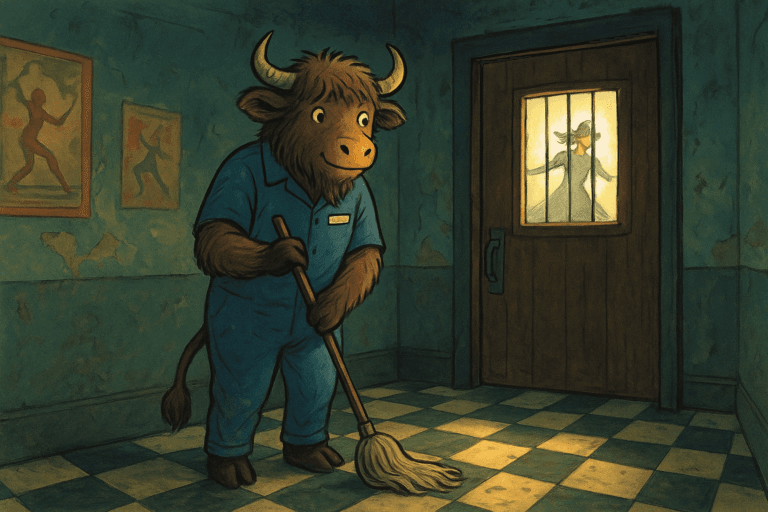
Step into medieval Paris with our retelling of Victor Hugo's classic, The Hunchback of Notre-Dame. This B1 intermediate English story follows Quasimodo, the kind-hearted bell-ringer with a twisted body, who lives hidden in the great cathedral. When he falls in love with the beautiful gypsy dancer Esmeralda, a tale of passion, jealousy, and sacrifice unfolds beneath the shadow of Notre-Dame.
Our graded reader brings this famous story to life with clear, accessible language for learners. You'll meet characters like the sinister Archdeacon Frollo and the brave Captain Phoebus, while improving your vocabulary and reading fluency. Every sentence is crafted for the B1 level, with clickable word help for tricky terms-so you can read without constantly reaching for a dictionary.
Listen to the full story with our engaging audio narration, practice with integrated lesson notes, and test your understanding with a short quiz at the end. It's a complete learning experience, free and ready to enjoy. Just click, listen, and let the bells of Notre-Dame carry you back in time.
High above the busy streets of Paris stood the great cathedral of .
Its rose into the , and its stone walls were covered with of saints and gargoyles.
Inside the cathedral, in the bell tower, lived a man named .
Quasimodo was kind, but he was very ugly. He had a large on his back, , and a face marked by sadness.
People in the city were afraid of him and called him the .
But Quasimodo loved the cathedral. He knew every and every .
His only friends were the stone that looked down on Paris with frozen smiles.
He talked to them when he felt . And Quasimodo was often lonely.
One day, a big celebration called the filled the streets with .
People laughed and danced, wearing . Quasimodo watched from high above, his heart full of .
Suddenly, a young woman began to in the square. Her name was Esmeralda.
She was full of . Her dark hair moved like in the wind.
Quasimodo was . He had never seen anyone so beautiful and free.
But not everyone was kind. The archdeacon, Frollo, watched her with . He was a man.
"Look at her," Frollo whispered to himself. "She is a . She must be stopped."
Later that day, Frollo tried to Esmeralda, but she .
He poor Quasimodo for helping her. "You foolish, ugly thing!" Frollo shouted.
"I did nothing wrong!" cried Quasimodo, his voice shaking with .
Frollo Quasimodo in the public square. He tied him to a and left him there in the hot sun.
The people laughed and threw stones. "Look at the !" they jeered.
Quasimodo's heart broke. Tears rolled down his . He felt more than ever.
Then, through the crowd, came Esmeralda. She saw the man.
Her eyes were full of . Slowly, she walked up to him.
"You are ," she said softly. She lifted a cup of water to his dry lips.
Quasimodo looked up in . No one had ever been kind to him before.
"Thank you," he whispered. "You have a ."
From that day, Quasimodo loved Esmeralda with a deep and .
But Frollo's anger grew . He wanted to Esmeralda because she did not obey him.
One night, when Frollo her again, Quasimodo heard her cries for help.
He from the bell tower on a long rope, her into his arms, and carried her into the cathedral.
"Sanctuary! Sanctuary!" he shouted from the top of the tower. The ancient law protected anyone inside the .
The crowd below gasped. "The Hunchback her!" they murmured in shock.
Inside the dark stone walls, Quasimodo hid Esmeralda and kept her .
"Do not be afraid," he told her gently. "I will you."
But even the cathedral could not protect her .
In the end, Frollo's evil plan still caused great .
After many terrible events, Esmeralda was taken away, and Quasimodo lost his only true .
He climbed to the highest tower and looked down at the city, his heart filled with .
Then he disappeared into the of the church he loved.
Years later, people found his bones beside those of a young woman in a .
Their story was a sad one, but it taught that a matters more than a beautiful face.
In the story, feelings are painted with careful words. Instead of just 'sad', you saw 'heart full of longing', 'voice shaking with fear and pain', and 'heart filled with sorrow'. These choices make emotions vivid.
Look at how Esmeralda's eyes were 'full of pity' and Quasimodo looked up 'in disbelief'. These phrases show emotions through physical reactions and specific nouns. You can use this trick too: instead of 'He was surprised', try 'He stared in disbelief'. Instead of 'She felt sorry for him', say 'Her eyes filled with pity'.
- longing - a deep wish or desire, especially for something you can't have (e.g., He watched the festival with longing.)
- pity - feeling of sadness and sympathy for someone's suffering (e.g., She saw his pain and felt pity.)
- disbelief - unable to believe something, often because it's too good or too shocking (e.g., His help left her in disbelief.)
- sorrow - a deep sadness caused by loss or disappointment (e.g., His heart was heavy with sorrow after she was gone.)
Let's study how the past simple and past continuous work together to build a narrative. The story uses: 'She was dancing in the square' (past continuous - a background action) and 'Quasimodo was amazed' (past simple - a completed state).
When two past actions happen at the same time, the longer one often takes the continuous form: 'People were laughing and dancing when suddenly a young woman began to dance.' Notice how 'began' (past simple) interrupts the background activity. You can create drama this way: 'I was walking home when I heard a strange sound.'
- Past continuous = was/were + verb-ing → describes a scene or an action in progress.
- Past simple = regular -ed or irregular forms → tells the main events or a finished action.
- Use when or while to connect them: 'She was crying when he arrived.' or 'While he was hiding, the crowd shouted.'
The story uses strong adjectives and adverbs to create mood. Quasimodo has 'a large hump', 'twisted limbs', and a 'face marked by sadness'. Esmeralda's hair moves 'like silk'. These details build a picture in your mind.
Adverbs shape how actions happen: 'she said softly', 'he shouted from the tower'. Notice how 'softly' changes the feeling of 'said'. Experiment by replacing ordinary verbs with more expressive ones: 'walked slowly' becomes 'crept', 'looked angrily' becomes 'glared'. Let the words carry the emotion.
- Use adjectives before nouns (a dark secret) or after verbs (she seemed kind).
- Adverbs often end in -ly and answer 'how?': gently, slowly, coldly.
- Stay simple but precise - 'a deep and silent love' is stronger than 'he loved her a lot'.
Now take what you've learned and tell the tale in your own words. Start with a short summary of a sad or dramatic event in your life-or imagine one. Use at least two emotion words from this lesson and a mix of past simple and past continuous.
Try this opener: 'It was a cold evening and the wind was blowing. I felt a sudden longing for home when…' Build the scene with descriptive details, and let the emotions guide the action. Storytelling is your voice-play with it.
- Write 6-8 sentences about a moment of kindness or loss.
- Challenge: Add one simile (e.g., her smile was like sunshine).
- Read your story aloud to hear the rhythm of your sentences.
The Hunchback of Notre-Dame comes from an older public-domain story tradition and is best known as a public_domain_story_retelling. This Yak Yacker article is an original learner retelling based on public-domain source material, so the wording here is simplified for modern learners rather than copied from one old edition.
Older printings, translations, and retellings of this story can vary quite a bit. This version is adapted for B1 Intermediate learners studying English.
If you want to keep going, browse more in our English section and review the B1 English Vocabulary List. After that, try 1,200 English Phrases and Expressions for another useful next step.