Join the brilliant detective Sherlock Holmes and his friend Dr. Watson as they unravel a curious Christmas mystery. In this B1 Intermediate English story, a precious blue jewel is found inside a goose, and Holmes must trace its journey from a luxury hotel to a humble market stall. You will meet suspicious characters, explore Victorian London, and watch Holmes use his famous powers of deduction to solve the case.
This interactive graded reader makes learning English enjoyable. Click on any word for an instant definition, listen to the full story audio narrated by a native speaker, and review clear lesson notes that explain key grammar and vocabulary. Whether you study alone or with support, this free Yak Yacker resource helps you improve your reading, listening, and word skills naturally.
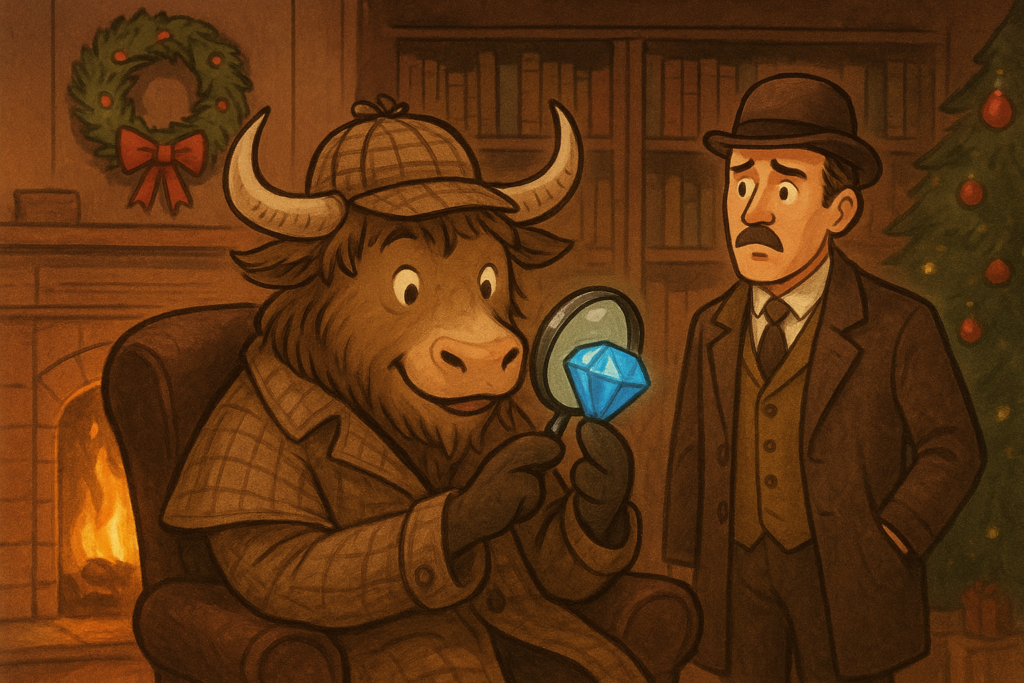
I called on Sherlock Holmes two days after Christmas. He was sitting in his armchair, looking at an old hat and a goose. "Ah, Watson!" he said. "I am glad you are here. These items present a most interesting problem."
"What is so interesting about a hat and a goose?" I asked. "Everything," Holmes replied, "if you know how to ."
He picked up the hat. "Look at this. What does it tell you about its owner?" I tried to guess. "He is… a man?" Holmes smiled. "Much more than that. He is an man, who has . He does not take much exercise. His wife has ceased to love him."
I was amazed. "How can you possibly know all that?" "By ," Holmes said. "The size of the hat shows a large brain. The dust and tell me he is now poor and inactive. And the hat has not been brushed for weeks – a sign that no loving wife is near."
Then Holmes told me the story. Early that morning, a named Peterson had seen a man the goose and hat. The man was attacked by some , but he ran away. Peterson brought the items to Holmes.
"And the goose?" I asked. "Peterson took it home to cook," Holmes said. "But he came an hour later with this."
Holmes held up a blue stone. It in the firelight. "What is it?" I gasped. "The Blue Carbuncle," he said. "Stolen from the Countess of Morcar's hotel room. The police have arrested a plumber, but the real thief is still free."
"How did the gem get inside a goose?" I wondered. "That is what we must find out," Holmes replied. "We must the goose back to its source."
We went to the poulterer's shop. The owner remembered selling the goose to a man from the Alpha Inn. At the inn, the landlord told us it was bought by a Mr. James Ryder.
"Ryder was very ," the landlord said. "He wanted the biggest goose we had." Holmes's eyes lit up. "The . Let us pay Mr. Ryder a visit."
That evening, a , pale young man came to our rooms. He was . "I am James Ryder," he said. "I heard you were asking about a goose?"
Holmes opened a case and showed the blue stone. Ryder cried out. "Don't arrest me! I will give it back!" "Sit down," Holmes said calmly. "Tell us everything. And remember – the truth is always best."
Ryder . He worked at the hotel. He stole the gem and hid it inside a goose he was taking to his sister. But he mixed up the geese, and the one with the gem was sold.
"I have been living in ," Ryder said, tears in his eyes. "I am not a bad man. Please don't ruin my life."
Holmes thought for a moment. "The police already have a . If we give the gem back, no one needs to know about you. Go, and make better choices." Ryder fled, full of gratitude.
"Why did you let him go?" I asked. Holmes smiled. "He is too frightened to ever again. Besides, it is Christmas. Even criminals deserve a second chance sometimes."
This story uses the past simple to move the investigation forward: Holmes sat, I asked, Peterson brought the items, and Ryder confessed. These are finished actions in a clear sequence, so the past simple is the natural choice.
The past continuous appears when the story gives background or shows an action already in progress: Holmes was sitting in his armchair, the stone was sparkling, and Ryder was trembling. Use it to set the scene or show what was happening when something else interrupted.
- Past simple = finished event: Holmes picked up the hat.
- Past continuous = action in progress: Holmes was looking at the hat.
- Use both together for story timing: He was reading when the door opened.
A few key words carry the mystery. A clue is a small piece of information that helps solve a problem. A deduction is a logical conclusion based on clues. If someone confesses, they admit they did something wrong. If a suspect is arrested, the police think that person may be guilty.
Holmes also uses words that sound a little formal but are very useful in stories: owner, commissionaire, landlord, and thief. You do not need to memorize every detail at once, but notice how the vocabulary helps the story feel precise and clever.
- clue = a helpful sign or piece of evidence
- deduction = a logical guess based on facts
- confess = admit the truth, especially a crime
- suspect = a person the police think may be involved
Holmes does not just describe what he sees; he explains what the evidence means. This is a great pattern for English learners: He saw the dust, so he concluded the man was poor. The hat was not brushed, so Holmes inferred that no loving wife was near. The structure often links a fact in the past to a conclusion in the past.
You can use phrases like must have, could have, and so to show reasoning. For example: The man must have been nervous. The gem could have fallen into the goose. The police arrested the wrong man, so the real thief remained free. These forms help you sound thoughtful, not just descriptive.
- Fact + conclusion: The hat was dusty, so the owner had fallen on hard times.
- must have + past participle = strong logical guess: He must have hidden the stone.
- could have + past participle = possible explanation: The geese could have been mixed up.
When you retell a mystery, try to separate what happened from what was inferred. First say the event, then the meaning: Ryder bought a goose. Holmes thought Ryder was nervous. That simple habit makes your English clearer and more dramatic.
Next time you read or watch a detective story, pause and ask: What did the character see? What did they conclude? That tiny question will help you notice past tenses, deduction language, and the logic that makes Sherlock Holmes so satisfying.
- Describe events first, then conclusions.
- Use past simple for the chain of events.
- Use past continuous for background and atmosphere.
- Look for clues in the text, not just the answer.
The Adventure of the Blue Carbuncle comes from an older public-domain story tradition and is best known as a public_domain_story_retelling. This Yak Yacker article is an original learner retelling based on public-domain source material, so the wording here is simplified for modern learners rather than copied from one old edition.
Older printings, translations, and retellings of this story can vary quite a bit. This version is adapted for B1 Intermediate learners studying English.
If you want to keep going, browse more in our English section and review the B1 English Vocabulary List. After that, try 1,200 English Phrases and Expressions for another useful next step.