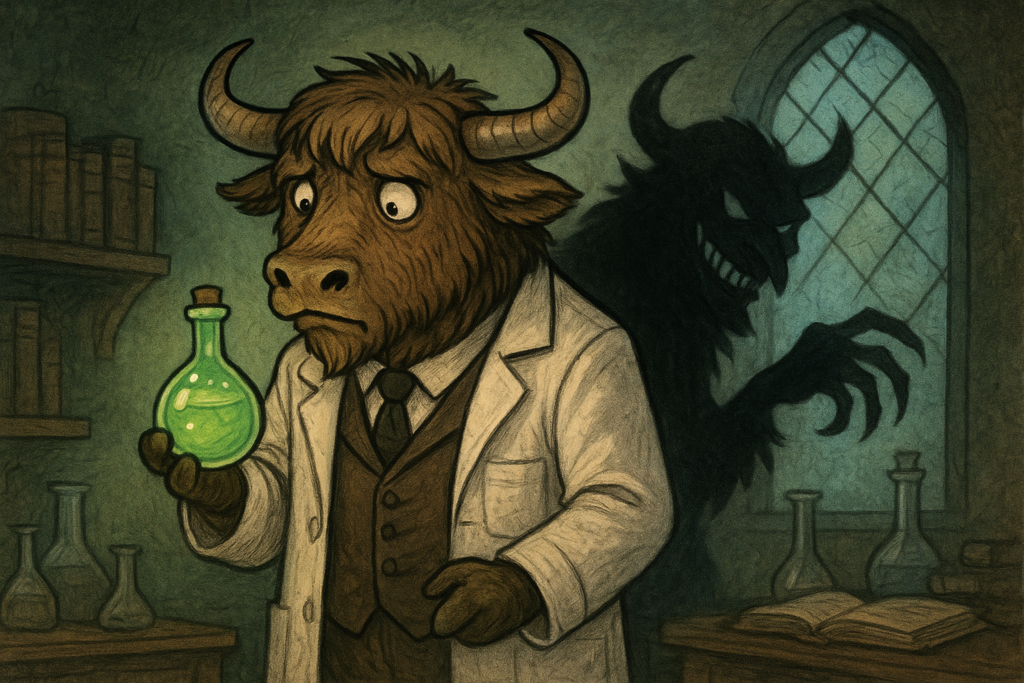
Read this story on Yak Yacker with clickable word help, full story audio, and lesson notes below the text.
This version is written for English-speaking learners who want a friendly reading experience in English.
Mr. Utterson and his cousin Enfield walked through . Enfield a door. "That door has a ," he said.
"Last winter, I saw a small, ugly man a little girl. He her! He didn't stop. I and made him pay. He went into that door to get the money. The door belongs to Dr. Jekyll's house."
Utterson knew Dr. Jekyll well. He also knew Jekyll's . It said that if Jekyll , all his money would go to a man named Edward Hyde.
Utterson wanted to . He the door. Soon, a man came. "Are you Mr. Hyde?" Utterson asked. "Yes. What do you want?" Hyde said in an ugly voice. Then he went inside. Utterson felt a .
A year later, a kind old man, Sir Danvers Carew, was on the street. A maid saw a small, man . It was Hyde. The police searched everywhere, but Hyde .
Utterson went to Jekyll. "I , I'm Hyde," Jekyll said. He gave Utterson a letter from Hyde. The letter said Hyde was leaving forever. But Utterson's clerk noticed that the looked just like Jekyll's.
For a while, Jekyll seemed happy. He , gave parties. Then he his room. He would not come out.
Utterson went to the house with Dr. Lanyon. They heard a strange, from Jekyll's . "Help! Get me the medicine! I need the salts!" it cried. It wasn't Jekyll's voice.
Dr. Lanyon later told Utterson he had seen something , but he wouldn't say what. Lanyon died soon after, full of .
One night, the servants called Utterson. Something was wrong. They the laboratory door. Inside, they found Mr. Hyde dead on the floor. He wore Jekyll's clothes, which were . Jekyll was gone.
On the desk was a letter. Utterson to read. It was from Jekyll.
Jekyll wrote about a . "I believed that every person has two sides: good and bad. I made a drink to them. When I drank it, I became Edward Hyde-pure evil. I Hyde. I did bad things without feeling guilty."
"But then, I started to change without drinking the potion. Hyde was getting stronger. I tried to stop, but I couldn't. The last bit of my good side is . As I write, I know I will soon become Hyde forever. I must end this before Hyde ."
Utterson put down the letter. He understood now. The good and bad inside his friend had , and the bad won. It was a story.
Utterson and Enfield walked at night. Enfield pointed to a door, saying it had a strange story.
Enfield saw a small ugly man run into a girl and walk over her. He caught him and forced payment. The man went in that door, which belongs to Jekyll's house.
Utterson knew Jekyll and his will: if Jekyll vanished, all money goes to Edward Hyde.
Utterson waited at the door and met pale, unpleasant Hyde. Hyde admitted identity rudely, went inside. Utterson felt deep fear.
A kind old man, Sir Carew, was murdered by a small violent man (Hyde). A maid saw it. Hyde disappeared.
Utterson visited Jekyll, who said he was done with Hyde and gave a letter from Hyde saying he's leaving. But the handwriting resembled Jekyll's.
Jekyll was happy for a while, helping and partying, then locked himself in his room.
Utterson and Lanyon heard a strange high voice from the lab crying for medicine. It wasn't Jekyll's voice.
Lanyon saw something horrible but wouldn't tell, then died frightened.
Servants called Utterson; they broke the lab door and found Hyde dead in Jekyll's clothes (too big). Jekyll was gone.
On the desk was a letter from Jekyll, which Utterson took home.
Jekyll wrote about a potion that separated good and evil. He became Hyde, pure evil, and enjoyed doing bad without guilt.
Then Hyde started appearing without the potion. Hyde grew stronger. Jekyll tried to stop but couldn't. His good side fades. He will become Hyde forever and must end it before Hyde kills more.
Utterson realized the good and bad fought inside his friend; the bad won. It was a sad, frightening story.
This story uses vivid language we can steal for our own conversations. Let's look at two key words.
First, a will. In the story, it's a legal document that says who gets your money after you die. Jekyll's will left everything to Hyde. Outside of legal talk, we use will to mean strong determination: "She has a will of iron." But be careful - in everyday English, will is also the future helper (I will go).
Another useful word is fade. Jekyll says his good side is fading - slowly disappearing. We can use fade for colours (the jeans faded), sounds (the music faded away), or feelings (my anger faded). It gives a soft, gradual feeling.
- will (n.) - a document saying who inherits your things; also, determination
- fade (v.) - to slowly become weaker or disappear
- potion (n.) - a magic or scientific liquid you drink
You saw several woulds in the story, and they aren't about the future. In past narratives, would has two common jobs.
First, it shows past refusal or insistence: "He would not come out." This means he refused to come out - it's stronger than 'didn't want to'. Compare: "I asked her to wait, but she wouldn't listen."
Second, we use would for future-in-the-past: "I knew I would soon become Hyde." Jekyll is speaking from a past moment about his future. It's like a backshifted 'will'.
- Past refusal: 'would not' (wouldn't) = refused to
- Future from a past viewpoint: 'I thought it would rain' (It didn't rain then, but I had the expectation)
- In stories, you'll also see would for repeated past actions: 'Every evening he would walk to the door.'
The horror of Jekyll and Hyde comes from descriptive adjectives. We don't just see a man - we see a pale, unpleasant man. Hyde's voice is ugly. The events are horrible.
Choosing the right adjective makes your listener feel the scene. Instead of 'bad', try 'unpleasant' or 'frightening'. Instead of 'small', use 'tiny' or 'little' (like the little girl). But be careful: little can also sound cute, so context matters.
Try building a short description: 'A tall, dark figure moved silently.' You've set a mood with just a few words.
- pale - light in colour, often suggesting sickness or fear
- unpleasant - not nice, causing a slightly bad feeling
- horrible - extremely bad, shocking
You've just read about a classic battle of good versus evil inside one person. It's a rich topic for conversation and writing.
Try retelling a part of the story in your own words, using some of today's vocabulary. Or imagine you are Utterson: write a diary entry about the moment you discovered the truth.
If horror isn't your taste, look for a different simplified classic. Every story has its own language treasure. Happy reading!
Dr. Jekyll and Mr. Hyde comes from an older public-domain story tradition and is best known as a public_domain_story_retelling. This Yak Yacker article is an original learner retelling based on public-domain source material, so the wording here is simplified for modern learners rather than copied from one old edition.
Older printings, translations, and retellings of this story can vary quite a bit. This version is adapted for B1 Intermediate learners studying English.
If you want to keep going, browse more in our English section and review the B1 English Vocabulary List. After that, try 1,200 English Phrases and Expressions for another useful next step.