


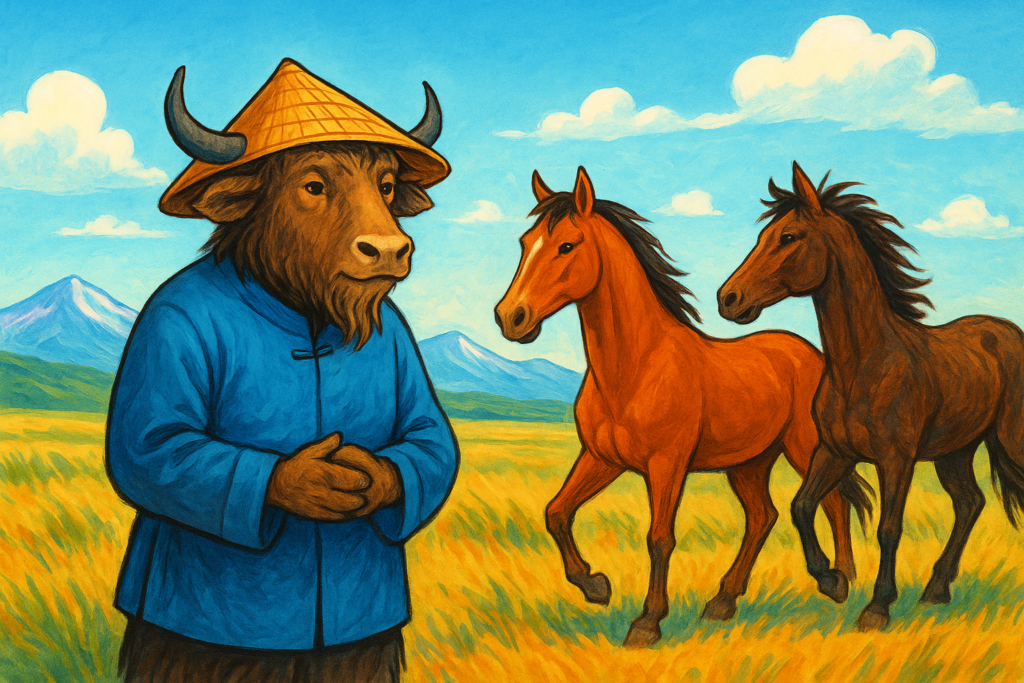
This A1 Beginner retelling of 塞翁失马 keeps the plot clear for learners while still giving the story some atmosphere and momentum.
This version teaches Simplified Chinese through English and includes clickable word help inside the story, full story audio, and lesson notes after the reading. It is free to use on Yak Yacker and is designed to feel natural, readable, and manageable for learners.
从前,在,有一个。
他有一匹。
有一天,马。
邻居们说:"!"
老人说:"?是好事。"
几个月后,马。
它还带回了。
邻居们说:"!"
老人说:"?是坏事。"
野马。
他,。
邻居们说:"!"
老人说:"?是好事。"
后来,。
年轻的男子都要。
腿断了,。
他。
人们说:"。"
Once upon a time, in the northern frontier, there was an old man.
He had a fine horse.
One day, the horse ran away.
The neighbors said, "How terrible!"
The old man said, "Who knows? Maybe it's a good thing."
A few months later, the horse came back.
It brought back a beautiful wild horse.
The neighbors said, "How wonderful!"
The old man said, "Who knows? Maybe it's a bad thing."
The old man's son rode the wild horse.
He fell off and broke his leg.
The neighbors said, "How terrible!"
The old man said, "Who knows? Maybe it's a good thing."
Later, war broke out.
All young men had to go to war.
The old man's son couldn't go because of his broken leg.
He stayed home safely.
People say, "A loss may turn out to be a gain."
Let's look at some useful words you met in the story. These will help you talk about luck, animals, and everyday life.
- 马 (mǎ) - horse
- 跑 (pǎo) - run
- 回来 (huílái) - come back
- 腿 (tuǐ) - leg
- 断 (duàn) - break
- 战争 (zhànzhēng) - war
The story ends with a famous Chinese idiom: 塞翁失马,焉知非福 (Sài wēng shī mǎ, yān zhī fēi fú). It means 'The old man lost his horse, how do you know it's not a blessing?' This saying reminds us that bad luck might turn into good luck, and the other way around.
- 塞翁 (Sài wēng) - old man from the border
- 失 (shī) - lose
- 马 (mǎ) - horse
- 焉知 (yān zhī) - how to know
- 非 (fēi) - not
- 福 (fú) - blessing
In the story, the old man often says: 谁知道呢? (Shéi zhīdào ne?) - 'Who knows?' This is a common way to say you're not sure what will happen. It's like saying 'We'll see' or 'Time will tell.'
- 谁知道呢?也许明天会下雨。 (Who knows? Maybe it will rain tomorrow.)
- Try using it when something unexpected happens. It's a handy phrase!
You're doing great! Stories like this are a fun way to learn Chinese. Try reading the story once more without looking at the English translation. Can you understand most of it now?
- Look for other Chinese idioms-they're like little treasures!
- Practice using 谁知道呢? in your daily life.
塞翁失马 comes from the Chinese / idiom story tradition and is best known as a idiom/fable. This Yak Yacker article is an original learner retelling based on Ancient Chinese tale; public domain, so the wording here is simplified for modern learners rather than copied from one old edition.
Older printings, translations, and retellings of this story can vary quite a bit. The original audience was usually kids/general, but this version is adapted for A1 Beginner learners studying Simplified Chinese. Good “bad luck/good luck” structure.
If you want to look into the source tradition, start with Wikisource.
If you want to keep going, browse more in our Simplified Chinese section and review the HSK Level 1 Chinese Vocabulary. After that, try Essential Chinese Grammar Words for another useful next step.